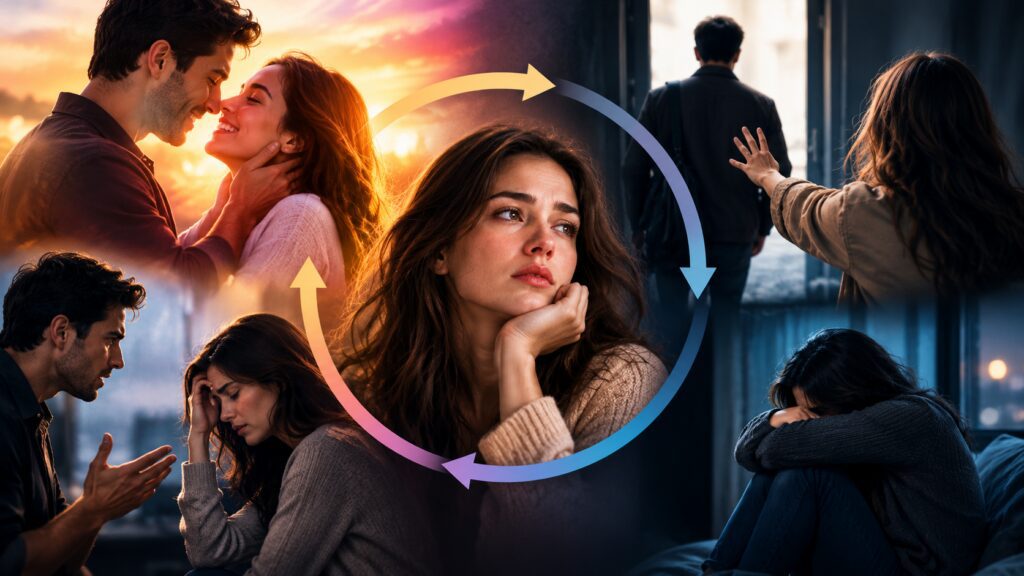
A hopeless romantic is someone who holds deeply idealistic, sentimental beliefs about love — often chasing soulmates, fairy-tale endings, and grand gestures, even when experience suggests love rarely works that way. The word “hopeless” doesn’t mean sad or doomed; it means the person is incorrigible about romance — they can’t help themselves and won’t stop believing in love, no matter how many times reality disappoints them.
What Does “Hopeless Romantic” Mean?
A hopeless romantic is a person who believes in love with almost stubborn optimism. They fall for the idea of soulmates, love at first sight, grand gestures, and “happily ever after” — and they keep believing in these things even after heartbreak, disappointment, or being told love doesn’t really work that way.
Psychologists who study relationships describe this in similar terms. Relationship experts interviewed by The Knot explained that a hopeless romantic is someone with an endless faith in the power of love, and that despite setbacks, they cling to the possibility of building a loving partnership.
In plain terms: it’s not about being naïve. It’s about choosing hope over cynicism, again and again, when it comes to love.
Core elements of the definition:
| Element | What It Means |
| Idealistic | Believes in “the one,” soulmates, or destiny in love |
| Sentimental | Gets emotionally moved by love stories, songs, and gestures |
| Persistent | Keeps believing in love even after past disappointment |
| Emotionally open | Falls in love quickly and fully, wearing feelings openly |
| Optimistic | Expects new relationships to work out, even after past failures |
Hopeless Romantic Meaning, Simple Explained
If someone asked you to explain it to a 10-year-old, here’s the simplest version:
A hopeless romantic is a person who loves the idea of love so much that they never stop hoping for a fairy-tale relationship — even if real life keeps proving that fairy tales aren’t real.
In one sentence: They love love itself, not just a specific person.
Simple breakdown of the phrase:
- Romantic = someone who idealizes love, beauty, and emotion
- Hopeless = so persistent and incurable about it that it’s almost a permanent trait — not something that can be “fixed” or talked out of them
Put together, the phrase describes someone who is charmingly, sometimes frustratingly, unable to stop hoping for perfect love.
Where Does the Phrase Come From? (Origin & History)
The word romantic has been used as a noun for someone with lofty, idealistic views on love and life since the early 1800s, tied to the Romantic literary movement’s focus on emotion, imagination, and passion over cold logic.
The specific pairing of “hopeless” and “romantic” is older than most people assume. According to etymology research from Dictionary.com, an 1855 novel used the phrase “hopeless, romantic attachment” to describe a mother’s worry that her son’s foolish, idealistic love would ruin his prospects, and a 1917 magazine article used similarly paired language to describe author Charlotte Brontë’s romantic nature.
The modern phrase — used as a personality label, “a hopeless romantic” — appeared as early as 1926 in a short story collection, describing a character who was very much in love despite others feeling the relationship wasn’t good for him.
By the 1920s and 1930s, the phrase had spread through literature and popular writing to describe people who fell in love easily, recklessly, or repeatedly, chasing love for its own sake even when it was impractical or unwise.
Timeline at a glance:
| Era | Development |
| Early 1800s | “Romantic” becomes a noun for idealistic, sentimental people |
| 1855 | Early paired use of “hopeless” + “romantic” in a novel |
| 1917 | Similar phrasing used in a magazine to describe a real author |
| 1926 | First known use of “a hopeless romantic” as a character label |
| 1920s–30s | Phrase spreads through literary culture |
| 2000s–today | Becomes everyday slang for a personality/relationship type |
Hopeless Romantic Meaning on Urban Dictionary
Slang dictionaries and crowd-sourced sites tend to define “hopeless romantic” more casually and emotionally than formal dictionaries. Common threads across these informal definitions include:
- Someone who falls in love “too easily” or “too hard”
- Someone who still believes in soulmates despite being hurt before
- Someone who loves love itself more than any one person
- Someone who gets emotionally attached to potential, not just reality
- Someone who is seen as “old-fashioned” about romance in a modern, casual-dating world
Urban-dictionary-style definitions tend to be more emotional and less clinical than academic sources, often written from personal experience rather than research — which is why tone varies a lot between entries, ranging from affectionate to self-deprecating.
“I’m a Hopeless Romantic” — What Are You Really Saying?
When someone says “I’m a hopeless romantic” (or “I am a hopeless romantic,” “I’m hopeless romantic,” “what’s hopeless romantic meaning” — all common ways people search or phrase this), they’re usually communicating a few things at once:
- A warning label: “I fall in love easily and get emotionally invested fast.”
- An identity claim: “I believe in true love, even if that sounds old-fashioned.”
- An invitation: “I want romance, gestures, and effort in a relationship — not just convenience.”
- A slightly self-aware joke: Often said with a laugh, acknowledging that this trait can set them up for disappointment.
“I Am Hopeless Romantic Meaning” vs. “I’m a Hopeless Romantic Meaning”
Grammatically, “I am a hopeless romantic” is the correct phrasing (using “romantic” as a noun). “I am hopeless romantic” (without “a”) is a common non-native-English variation, but it means the same thing — people search it interchangeably, and both point to the same personality description.
Signs You’re a Hopeless Romantic
Not sure if the label fits you? Here are common signs, drawn from how relationship writers and therapists typically describe the trait:
- You cry (happily) at weddings, proposal videos, or romantic movies
- You believe in “the one” or soulmates, even after breakups
- You fall in love quickly, sometimes within the first few dates
- You remember small romantic details — the song playing on a first date, the note left on a fridge
- You get more excited about grand romantic gestures than practical gifts
- You replay conversations and look for signs that someone “likes you back”
- You feel a little incomplete without a partner or a love story to look forward to
- You’ve been called “too much” or “too intense” about love by friends
- You still write, save, or reread old love letters/texts
- You root for the couple in every movie, even implausible ones
Note: Having a few of these traits doesn’t automatically make someone a hopeless romantic — it exists on a spectrum, and most people show at least some romantic idealism sometimes.
Hopeless Romantic vs. Hopeful Romantic
This is one of the most searched comparisons — “hopeless romantic meaning vs hopeful romantic.” While they sound similar, there’s a subtle but real difference in connotation.
| Aspect | Hopeless Romantic | Hopeful Romantic |
| Tone | Slightly self-deprecating, dramatic | More balanced, grounded |
| Belief in love | Idealistic, sometimes unrealistic | Optimistic but realistic |
| Response to heartbreak | Keeps believing anyway, “can’t help it” | Learns and adapts, stays open |
| Origin of term | Older, literary (1800s) | Newer, coined as a “healthier” alternative |
| Popular association | Old-fashioned, dreamy, all-in | Emotionally intelligent optimism |
| Risk | Can set unrealistic expectations | Lower risk of repeated disappointment |
In short: A hopeless romantic believes in love almost helplessly, sometimes against their own judgment. A hopeful romantic believes in love too — but tempers it with realistic expectations, making it a term some relationship writers now use as a more emotionally balanced alternative to “hopeless romantic.”
Opposite of Hopeless Romantic
People also frequently search “opposite of hopeless romantic.” There isn’t one single official antonym, but several terms are commonly used depending on the angle:
- Realist – someone who approaches love practically, without idealizing it
- Cynic – someone who doubts love will work out, often due to past hurt
- Pragmatist – someone who treats relationships more logically than emotionally
- Commitment-phobe – someone emotionally guarded against falling in love
- Emotionally detached / avoidant – someone who keeps romantic feelings at arm’s length
None of these are perfect opposites — “hopeless romantic” describes a mix of optimism and idealism, so its true opposite would be someone who is both unromantic and pessimistic about love, which isn’t one single common English word.
Hopeless Romantic in a Relationship
Being with (or being) a hopeless romantic changes the shape of a relationship. Here’s a balanced look:
What a Hopeless Romantic Brings to a Relationship
- Strong emotional investment and attentiveness
- Thoughtful gestures — remembering dates, planning surprises
- Deep verbal and physical affection
- A partner who believes in “us” even during hard patches
- Enthusiasm for milestones, anniversaries, and traditions
What Can Be Challenging
- Expecting grand gestures too often, or feeling let down by “ordinary” partners
- Idealizing a partner instead of seeing them realistically
- Taking mismatched effort personally
- Moving fast emotionally before the relationship has had time to develop trust
- Struggling to accept a relationship that’s “good enough” rather than “perfect”
Tips If You’re Dating a Hopeless Romantic
- Reassure them with words, not just actions — verbal affirmation matters to them
- Don’t dismiss their romantic gestures as “too much”; meet them partway
- Be direct about pacing if things feel too fast, rather than pulling away silently
- Appreciate the emotional depth they bring, even if it’s not your natural style
Is Being a Hopeless Romantic Good or Bad?
Neither, really — it’s a trait with real upsides and real risks, and most relationship writers frame it that way rather than as a flaw.
Mental health resources are clear that being a hopeless romantic isn’t a bad thing on its own, and balance is the key factor, since hopeless romantics fall in love quickly and can feel incomplete without a partner, tending to be optimistic about new relationships and believing in ideas like meeting “the one.” Importantly, being a hopeless romantic is described as a state of mind rather than a mental health condition, and like most personality traits, it exists on a spectrum.
Comparison: Benefits vs. Limitations
| Benefits | Limitations |
| Deep capacity for love and connection | Can set unrealistic expectations |
| Emotional openness and vulnerability | More prone to heartbreak or disappointment |
| Inspires romance and effort in relationships | May idealize partners instead of seeing them clearly |
| Resilient hope — doesn’t give up on love | Can rush emotional attachment before trust is built |
| Appreciates small, meaningful gestures | Risk of settling into a “fantasy” over reality |
The healthiest version of this trait isn’t about suppressing romantic hope — it’s about pairing that hope with realistic expectations and self-awareness.
Why Is It Called “Hopeless” Romantic? (The Paradox Explained)
This is a genuinely interesting linguistic question people search directly: “why is it called hopeless romantic?”
It sounds like a contradiction — “hopeless” usually means without hope, so why label an optimistic person “hopeless”?
The answer lies in an older meaning of “hopeless”: beyond hope of change, not “without hope.” Language references note that “hopeless” can describe something beyond hope of management or reform, used informally to emphasize how extreme a trait is — the same way “a hopeless jumble of papers” or “he is a hopeless romantic” both use “hopeless” to mean extreme and unchangeable, not sad or despairing.
So “hopeless romantic” really means:
Someone so completely, incurably devoted to romantic idealism that they can’t be talked out of it — not someone who has lost hope in love.
It’s the same structure as calling someone a “hopeless case” when they’re bad at something, or a “hopeless neat freak” when someone is extremely tidy. The word “hopeless” is intensifying the trait, not negating hope itself.
Hopeless Romantic Meaning in Different Languages
Because “hopeless romantic” is an English idiom, it doesn’t always translate word-for-word into other languages — most translations focus on capturing the concept (an idealistic, incurably sentimental lover) rather than a literal phrase.
| Language | Common Translation / Equivalent Phrase | Notes |
| Hindi | प्रेम में अत्यधिक आदर्शवादी व्यक्ति (prem mein atyadhik aadarshvaadi vyakti) | Describes someone extremely idealistic about love; no single fixed idiom exists |
| Urdu | محبت پر یقین رکھنے والا رومانوی شخص | Emphasizes unwavering belief in love |
| Marathi | प्रेमाबद्दल अतिशय आदर्शवादी व्यक्ती | Focuses on idealism about love |
| Telugu | ప్రేమపై అమితమైన నమ్మకం ఉన్న వ్యక్తి | “A person with immense faith in love” |
| Tamil | காதலில் மிகுந்த நம்பிக்கை கொண்ட நபர் | “A person with great belief in love” |
| Bengali | ভালোবাসায় অতিরিক্ত আদর্শবাদী মানুষ | Similar idealism-focused phrasing |
| Malay | seseorang yang terlalu percaya kepada kuasa cinta | “Someone who believes too much in the power of love” |
| Malayalam | സ്നേഹത്തിൽ അമിതമായ വിശ്വാസമുള്ള വ്യക്തി | Emphasizes excessive faith in love |
| Tagalog | taong sobrang naniniwala sa pag-ibig | “A person who believes strongly in love” |
Important note: These are descriptive/conceptual translations, not fixed dictionary idioms — most languages describe the behavior (excessive belief/idealism about love) rather than having a single exact matching phrase like English does.
Hopeless Romantic Meaning AI Tools & Chatbots Give
When people ask AI assistants like ChatGPT, Gemini, or Claude to define “hopeless romantic,” the answers are generally consistent with dictionary and psychology sources: a person who is idealistic and sentimental about love, believing in soulmates and fairy-tale romance despite real-world setbacks.
Where AI-generated answers add value compared to a plain dictionary entry:
- They often explain the word’s internal contradiction (“hopeless” meaning incorrigible, not sad)
- They tend to add practical, balanced advice (like tips on healthy romantic idealism)
- They can tailor tone — casual explanation vs. clinical/psychological explanation
- They often connect the term to related concepts like attachment styles or relationship expectations
The core definition, however, doesn’t change across sources: idealistic + sentimental + persistent belief in love, regardless of whether you’re reading a 1920s short story reference or asking a modern AI chatbot.
Hopeless Romantic in Pop Culture
“Hopeless romantic” has become a common self-description in music, movies, and social media captions — often used half-seriously to signal that someone is emotionally “all in” when it comes to love.
- It’s used as a personality label in countless song titles and lyrics across genres (including hip-hop and pop), typically describing an artist’s soft, sentimental side despite a tougher public image.
- It appears frequently in rom-com character archetypes — the person who believes in fate, keeps ticket stubs, or chases someone across an airport.
- On social media, it’s used as a bio tag or caption, often paired with heart emojis, signaling openness to love (sometimes self-mockingly).
Because song lyrics and film dialogue are copyrighted, this guide won’t quote specific lyrics or scripts — but the pattern across pop culture is consistent: “hopeless romantic” is shorthand for a soft, idealistic, all-in approach to love, used affectionately more often than critically.
How to Balance Being a Hopeless Romantic
If you recognize yourself in this description, here’s how to keep the trait as a strength rather than a vulnerability:
- Separate the person from the fantasy. Notice when you’re falling for someone’s potential rather than who they actually are right now.
- Give relationships time before fully investing emotionally. Trust and compatibility take longer to establish than instant attraction.
- Watch for one-sided effort. If gestures and emotional investment aren’t being reciprocated, that’s information — not a challenge to try harder.
- Keep your identity outside the relationship. Hobbies, friendships, and goals that don’t depend on romance protect against feeling “incomplete” without a partner.
- Let disappointment inform you, not discourage you. Learning from a bad relationship is different from becoming cynical about love altogether.
- Talk about pacing directly. If you tend to move fast emotionally, tell partners early so expectations are clear on both sides.
None of this means abandoning romantic idealism — it means pairing it with self-awareness, which most relationship experts agree is the real difference between a “hopeless romantic” and a “hopeful” one.
Key Takeaways
- A hopeless romantic is someone deeply idealistic and sentimental about love, believing in soulmates and fairy-tale endings despite past disappointment.
- “Hopeless” here means incorrigible or beyond changing — not sad or without hope.
- The phrase has roots going back to the 1850s, with the modern personality-label usage emerging around 1926.
- It’s considered a personality trait or state of mind, not a mental health condition, and exists on a spectrum.
- The trait has real strengths (emotional depth, optimism) and real risks (unrealistic expectations, idealizing partners).
- “Hopeful romantic” is a newer, more balanced alternative term some writers use.
- The phrase doesn’t translate literally into most other languages — translations focus on the concept of excessive romantic idealism.
- Self-awareness and pacing help keep this trait healthy in real relationships.
Frequently Asked Questions
What does “hopeless romantic” mean in simple words?
It means someone who believes strongly in love, soulmates, and fairy-tale relationships, and keeps believing in these things even after being disappointed before.
Is calling someone a hopeless romantic a compliment?
Usually, yes. It’s typically used affectionately to describe someone emotionally open, sentimental, and devoted to love, though it can occasionally carry a gently teasing tone about being “too much.”
What is the opposite of a hopeless romantic?
There’s no single official antonym, but common opposites used in everyday language include a realist, a cynic, a pragmatist, or someone emotionally guarded/avoidant about love.
Why is it called “hopeless” romantic if the person is hopeful about love?
Because “hopeless” is being used in its older sense of “incorrigible” or “beyond changing,” not “without hope.” It describes someone who can’t help being idealistic about love, not someone who has given up on it.
What’s the difference between a hopeless romantic and a hopeful romantic?
A hopeless romantic tends to believe in love almost helplessly, sometimes ignoring red flags in favor of the fantasy. A hopeful romantic believes in love too, but keeps that belief balanced with realistic expectations.
Is being a hopeless romantic a bad trait?
Not inherently. It’s considered a personality trait rather than a flaw or a mental health condition, and it exists on a spectrum — the key is balancing romantic idealism with realistic expectations.
What does it mean when a girl or guy says “I’m a hopeless romantic”?
It usually means they fall in love easily, value grand gestures and emotional connection, and are being upfront that romance and sentimentality matter a lot to them in relationships.
Can a hopeless romantic have a healthy relationship?
Yes. Many hopeless romantics have thriving, healthy relationships — the key is grounding romantic idealism in realistic expectations of their actual partner, rather than an imagined “perfect” version of love.
Where does the phrase “hopeless romantic” come from?
It traces back to 19th-century literature pairing the words “hopeless” and “romantic” to describe passionate but impractical love, with the modern personality-label usage appearing by the 1920s in short fiction.
Is “hopeless romantic” used the same way in other languages?
Not exactly — most other languages don’t have a single fixed idiom for it. Translations typically describe the underlying idea (excessive idealism or faith in love) rather than a literal phrase-for-phrase match.
Is a hopeless romantic the same as being clingy or needy?
No. Being a hopeless romantic is about idealizing love and romance; being clingy or needy relates more to attachment insecurity. The two can overlap, but they’re not the same trait, and one doesn’t automatically imply the other.
What are common signs someone is a hopeless romantic?
Common signs include falling in love quickly, believing strongly in soulmates, getting emotional over romantic movies or gestures, remembering small romantic details, and feeling a strong pull toward grand romantic gestures.
Conclusion
At its core, a hopeless romantic is simply someone who refuses to give up on love — even after heartbreak, even when the world tells them to be more “realistic.” The word “hopeless” isn’t about sadness; it’s about how deeply, stubbornly devoted that person is to believing in soulmates, grand gestures, and true love.
This trait isn’t good or bad on its own. Like most parts of personality, it comes down to balance: pairing that beautiful, idealistic belief in love with clear eyes about real people and real relationships. Whether you’re a hopeless romantic yourself, dating one, or just curious about the phrase, understanding the “hopeless” in “hopeless romantic” as incorrigible, not despairing, is the key to really getting what the phrase means.