Key Takeaways
- Warehouse location influences delivery speed, freight costs, labor access, and growth potential.
- The lowest lease rate is not always the lowest total operating cost.
- Order history and customer geography should guide site selection before real estate options are considered.
- One facility can simplify inventory management, while regional facilities can shorten delivery distances.
- Regular network reviews help businesses respond to changing demand, carrier performance, and service expectations.
Why Warehouse Location Matters
Choosing a warehouse is a supply chain decision, not simply a real estate decision. The right location can support faster deliveries, dependable carrier pickups, lower freight miles, and stronger customer service. The wrong location can create recurring costs that a favorable lease rate never fully offsets.
For companies serving the Mountain West, distribution centers in Colorado can be a useful model for evaluating regional coverage. Aspen Distribution operates a full-service warehousing and logistics facility in the Aurora and Denver area, supporting manufacturers, wholesalers, distributors, and national companies with Colorado operations. Its experience with pallet handling, inventory management, cross-docking, freight coordination, retail replenishment, and fulfillment across the Front Range illustrates why a capable regional 3PL can be an important part of a flexible distribution strategy.
Fast fulfillment remains a meaningful competitive advantage as e-commerce continues to account for a substantial share of U.S. retail activity. The U.S. Census Bureau’s quarterly retail e-commerce sales report shows that the online retail market remains large and active. Whether a business ships to consumers, retail stores, dealers, or industrial customers, dependable order turnaround can affect repeat purchases and customer retention.
Map Customer Demand Before Choosing a Site
Start with actual shipment data, not assumptions about customers’ locations. A demand map often reveals that a small number of metro areas, states, or delivery zones account for most orders. It can also show whether demand is stable year-round or concentrated around seasonal events.
- Collect at least 12 months of order, shipment, and return data.
- Group customers by ZIP code, city, state, or shipping zone.
- Identify the markets with the highest order volume and revenue.
- Separate consistent demand from short-term seasonal peaks.
- Compare customer locations with supplier locations and current freight lanes.
A single centrally located facility may well serve a business with concentrated demand. A company with customers spread across the country may need a regional network, a mix of owned and outsourced space, or inventory positioned near its largest markets.
Review Transportation Access and Freight Routes
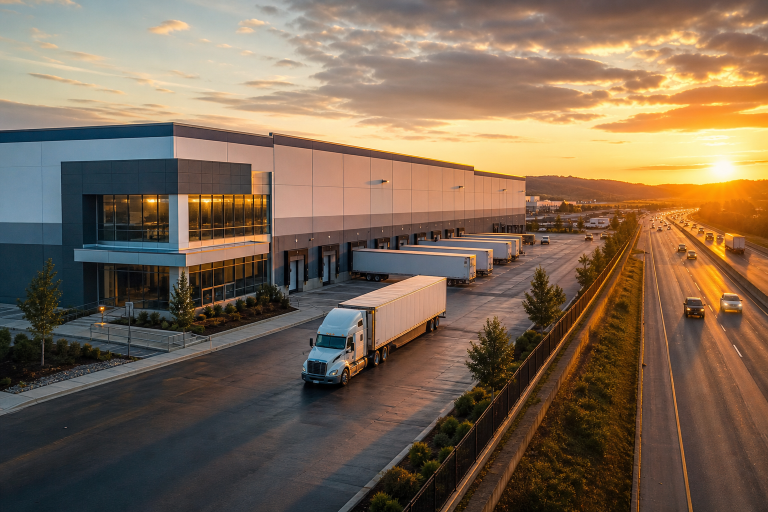
A site that appears close to customers on a map may still be difficult for trucks to reach. Congested interchanges, restricted truck routes, bridge limitations, poor dock design, and inconsistent pickup schedules can all affect service and cost. Review real travel times during the hours when inbound and outbound freight actually move.
- Distance and travel time to major highways.
- Availability of full truckload, less-than-truckload, parcel, and local carriers.
- Daily pickup and delivery options during required shipping windows.
- Access to suppliers, production plants, retailers, and end customers.
- Exposure to weather disruptions, road closures, or seasonal congestion.
- Dock capacity, trailer staging space, and safe vehicle circulation.
Compare the Full Cost of Each Location
Rent is only one line in the warehouse budget. A facility with a higher cost per square foot may be the better choice if it reduces outbound miles, avoids frequent inventory transfers, improves labor reliability, or provides stronger carrier access.
Build a total-cost worksheet for every candidate site. Include facility rent or ownership costs, inbound and outbound freight, wages and recruiting, utilities, insurance, taxes, material-handling equipment, packaging, technology integration, and expected expansion costs. Also consider business interruption risks, such as exposure to severe weather, labor shortages, or reliance on a single transportation corridor.
Choose Between One Facility and Multiple Facilities
One-Facility Model
- Reduces inventory duplication and simplifies stock control.
- Requires fewer operating teams, contracts, and systems.
- Can improve purchasing efficiency and replenishment visibility.
- May increase delivery distances and transit times for remote customers.
Multiple-Facility Model
- Places inventory closer to major customer markets.
- Can shorten transit time and support later order cut-off times.
- Provides more options during localized disruptions.
- Increases inventory complexity, replenishment needs, and management costs.
More facilities do not automatically improve service. Each location needs enough order volume, the right product mix, and dependable replenishment. Otherwise, a broader network can create stockouts in one market while excess inventory sits elsewhere.
Use Data to Improve Warehouse Decisions
Warehouse management systems, barcode scanning, transportation dashboards, and inventory reporting turn location planning into a measurable process. Teams should track performance before and after a network change rather than relying only on impressions from sales or operations.
Useful measurements include order cycle time, on-time shipment rate, inventory accuracy, dock-to-stock time, average miles per shipment, freight cost per order or pallet, fill rate, and return rate. These metrics help identify whether delivery problems stem from warehouse location, inventory placement, carrier performance, or internal fulfillment processes.
Use Regional Coverage Strategically
A regional facility can improve service when customer demand is concentrated within a practical delivery radius. For example, a manufacturer serving Colorado, Wyoming, Utah, and nearby markets may benefit from positioning inventory near a major Front Range population and transportation corridor. The value comes from matching inventory to customer density, carrier schedules, shipment volume, and service promises.
Before moving inventory, test the plan with real shipment data. Model freight costs, delivery times, replenishment frequency, safety-stock requirements, and the cost of transferring goods between facilities. A regional site should simplify and improve the network’s reliability, not merely add another storage point.
Build a Warehouse Location Scorecard
Use a weighted scorecard to consistently compare sites. Rate each category from one to five, multiply the rating by its weight, and review results with finance, operations, sales, and transportation stakeholders.
- Customer proximity, 25%: Is the site close to the highest-volume customer groups?
- Freight access, 20%: Can carriers reach the facility quickly and consistently?
- Total operating cost, 20%: What will the site cost beyond rent?
- Labor availability (15%): Can the business hire and retain the required workforce?
- Expansion potential, 10%: Can the facility absorb future volume or additional services?
- Risk and resilience, 10%: How vulnerable is the site to disruption?
Common Questions About Warehouse Location Planning
What is the most important factor in choosing a warehouse location?
Customer demand and transportation access are usually the most important factors. The right balance depends on the product type, shipment volume, delivery commitments, and service area.
How often should a business review its warehouse network?
Conduct a formal review at least once each year. Review sooner after an acquisition, major product launch, carrier change, sustained demand shift, or a significant change in service expectations.
How can a small business improve delivery speed without opening a new facility?
Improve inventory accuracy, re-slot fast-moving products, set clear carrier cut-off times, use zone-based shipping rules, reduce dimensional weight through better packaging, and consider working with a qualified third-party logistics provider.
Final Thoughts
A strong warehouse plan begins with where customers are and how products move, not with a building listing. By comparing delivery zones, total cost, freight access, labor, technology, resilience, and growth needs, businesses can make location decisions that support both current service levels and long-term expansion. The objective is not simply to store inventory. It is to position inventory where it can move reliably and create a better customer experience.
photo by depositphotos