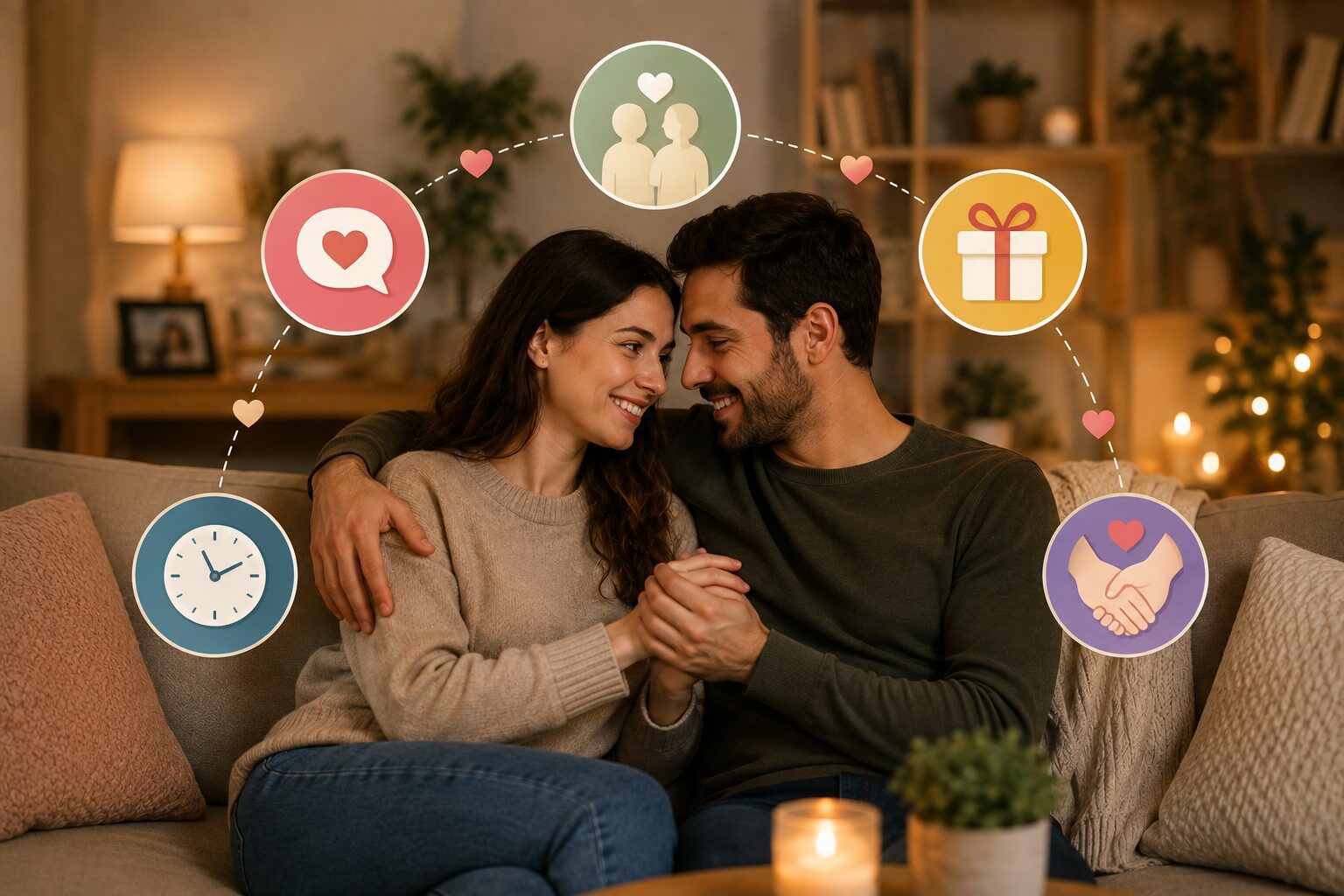
Love languages for couples refer to five distinct styles of expressing and receiving affection — words of affirmation, quality time, receiving gifts, acts of service, and physical touch — first identified by marriage counselor Dr. Gary Chapman in his 1992 book The Five Love Languages: How to Express Heartfelt Commitment to Your Mate. The idea is that each partner tends to feel most loved through one or two of these styles, and mismatches in how affection is expressed can create emotional distance even when both people genuinely care about each other.
What Are Love Languages for Couples? (Meaning & Origin)
The phrase “love languages for couples” describes a framework for understanding how partners naturally communicate affection — and, just as importantly, how they prefer to receive it. Dr. Gary Chapman, a Southern Baptist pastor and long-time marriage counselor, developed the concept after decades of counseling couples at Calvary Baptist Church in Winston-Salem, North Carolina. He noticed a recurring pattern in his sessions: one partner would say they felt unloved, while the other insisted they were showing love constantly.
That disconnect became the seed of his theory. Chapman concluded that people don’t all “hear” love the same way — much like people speak different verbal languages, they also have different emotional languages for love. If a husband expresses devotion by fixing the car and mowing the lawn (acts of service), but his wife feels loved through verbal compliments and conversation (words of affirmation), both partners can be trying hard and still feel disconnected.
Meaning in simple terms: A love language is the specific category of behavior that makes a person feel most valued, seen, and cared for by their partner.
Who Is Gary Chapman and Why His Theory Matters
Understanding the source of this framework matters for evaluating its credibility (an EEAT consideration).
| Detail | Information |
| Full name | Gary D. Chapman, Ph.D. |
| Profession | Pastor, author, marriage counselor, radio host |
| Original book title | The Five Love Languages: How to Express Heartfelt Commitment to Your Mate |
| First published | 1992 |
| Publisher | Northfield Publishing |
| Copies sold worldwide | Over 20 million copies |
| Bestseller list run | 297 weeks on the New York Times bestseller list |
| Basis of theory | Decades of marriage counseling experience rather than controlled scientific studies |
Chapman built the framework from clinical observation, not laboratory research — a distinction worth keeping in mind as you read further, especially in the science section below.
The Five Love Languages for Couples — Full Breakdown
Each of the five love languages represents a different emotional “dialect.” Below is a complete explanation of each, including what it looks like, why it matters, and its limitations.
Words of Affirmation
This language centers on verbal and written expressions of love, appreciation, and encouragement.
- What it looks like: Compliments, “I love you,” verbal appreciation, encouraging texts, praise for accomplishments, calling out specific qualities you admire.
- Why it matters: For people with this primary language, hearing affection spoken aloud carries more emotional weight than gestures alone.
- Limitation: Empty or insincere flattery can backfire; words must feel genuine, not performative.
Quality Time
This language is about undivided, focused attention — not simply being in the same room.
- What it looks like: Phone-free conversations, shared activities, eye contact during conversation, active listening, planned date nights.
- Why it matters: People with this language feel loved when a partner is fully present, not distracted by phones or multitasking.
- Limitation: Quantity isn’t the same as quality — an hour of half-attentive screen time doesn’t satisfy this need the way twenty focused minutes can.
Receiving Gifts
This is often the most misunderstood language — it isn’t about materialism, but about symbolism.
- What it looks like: Thoughtful, meaningful gifts (not necessarily expensive ones), remembering small preferences, surprise tokens that show you were thinking of your partner.
- Why it matters: A gift is a visual reminder that someone was thought of while apart. The emotional value lies in the thought, not the price tag.
- Limitation: Partners can conflate this with consumerism if the intent behind the gift isn’t communicated.
Acts of Service
This language treats helpful actions as expressions of love.
- What it looks like: Cooking a meal, doing chores without being asked, running errands, helping with a task the other partner finds tedious.
- Why it matters: For people with this language, actions genuinely do speak louder than words — practical help feels like devotion.
- Limitation: Can tip into resentment or a sense of obligation if one partner feels their “service” isn’t reciprocated or noticed.
Physical Touch
This language relates to affectionate physical contact, separate from sexual intimacy.
- What it looks like: Holding hands, hugging, a hand on the shoulder, cuddling on the couch, a reassuring touch during a hard conversation.
- Why it matters: Physical closeness can communicate safety, comfort, and connection in a way words sometimes cannot.
- Limitation: Requires clear boundaries and mutual comfort — touch should never be assumed or unwelcome.
List of Love Languages for Couples (Quick Reference Table)
| # | Love Language | Core Need | Example Action |
| 1 | Words of Affirmation | Verbal encouragement | “I’m proud of how you handled that.” |
| 2 | Quality Time | Undivided attention | A phone-free dinner conversation |
| 3 | Receiving Gifts | Thoughtful tokens | Bringing home their favorite snack |
| 4 | Acts of Service | Helpful actions | Doing the dishes without being asked |
| 5 | Physical Touch | Affectionate contact | Holding hands while walking |
How to Find Your Love Language: The Quiz & Test
The most reliable way to identify your primary love language is through Chapman’s official assessment, sometimes called the Couple’s Personal Profile, which is included in newer editions of the book and also available as a free online quiz on the official 5 Love Languages website.
How the quiz typically works:
- You’re presented with a series of paired statements (roughly 30 questions in most versions).
- Each pair forces a choice between two different expressions of love (for example, “I like it when my partner hugs me” vs. “I like it when my partner tells me they appreciate me”).
- Your answers are tallied by category, and the language with the highest score becomes your “primary” love language.
- Many quizzes also identify a secondary language, since most people don’t rely on just one exclusively.
Tips for taking a love languages for couples quiz effectively:
- Answer based on how you naturally feel, not how you think you should feel.
- Take the quiz separately from your partner first, then compare results together.
- Retake it periodically — needs can shift with major life changes such as parenthood, illness, or career stress.
- Treat the result as a conversation starter, not a rigid label.
Love Languages for Couples PDF and Book Resources
Many people search for a “5 love languages for couples PDF” or “love languages test PDF” to use offline or in couples counseling settings. Here’s what to know:
- Official quiz: The publisher and Chapman’s official website offer a free digital assessment; printable versions are also commonly distributed by licensed therapists.
- Caution with unofficial PDFs: Many PDFs circulating online are unofficial reproductions. For accuracy and to respect copyright, it’s best to use the official quiz through Chapman’s website or the published book itself, which contains the original, validated version of the assessment.
- The book itself: For couples wanting the complete framework — not just the quiz — the original book remains the most detailed primary source, including chapters on childhood influences on love language, expressing love during conflict, and love language in the context of long-term marriage.
Beyond Five: The “7 Love Languages” and “10 Love Languages” Discussion
Search interest around “what are the 7 love languages” and the “10 love languages book” reflects a broader, evolving conversation. Chapman’s original model has five categories, but later researchers and authors have proposed expanded frameworks.
Why the expansion happened:
Recent psychological research has directly tested whether five categories fully capture how people experience love. A multi-study analysis found that solutions ranging from seven to ten love languages provided a better statistical fit than the original five-factor model, suggesting Chapman’s framework may be narrower than the full range of ways people actually give and receive love.
Popular additions proposed by other authors and researchers include:
- Intellectual connection (deep conversation and shared ideas)
- Emotional security or reassurance
- Financial provision/security
- Shared experiences beyond quality time (novelty, adventure)
- Humor and playfulness
- Sensuality/intimacy as distinct from general physical touch
- Advocacy or being defended/supported publicly
This doesn’t invalidate Chapman’s original five — it simply suggests they may be a useful starting point rather than an exhaustive map of human affection.
Comparison Table: Love Languages Side by Side
| Love Language | Best For Couples Who… | Common Pitfall | Simple Daily Habit |
| Words of Affirmation | Value verbal connection and encouragement | Forgetting to say things out loud | Send one genuine compliment daily |
| Quality Time | Feel closest during shared, focused activities | Being “present” but distracted | 15 phone-free minutes together |
| Receiving Gifts | Appreciate symbolic gestures | Confusing this with expensive spending | Bring home a small, thoughtful item |
| Acts of Service | Feel loved through practical help | Doing tasks resentfully or unnoticed | Handle one chore before being asked |
| Physical Touch | Need physical closeness to feel secure | Assuming touch is always welcome | A hug or hand-hold during transitions |
Examples of Love Languages for Couples in Daily Life
Concrete, everyday examples make the framework easier to apply. Below are realistic scenarios for each language.
Words of Affirmation in action:
- Leaving a sticky note that says something specific you admire about them
- Publicly acknowledging their effort in front of family or friends
- Sending a mid-day text just to say you’re thinking of them
Quality Time in action:
- A weekly “no-phones” dinner
- Taking a walk together and actually talking, not just scrolling side-by-side
- Asking follow-up questions instead of half-listening
Receiving Gifts in action:
- Picking up their favorite coffee order unprompted
- Saving a ticket stub or small souvenir from a shared memory
- A handwritten card on an ordinary (non-holiday) day
Acts of Service in action:
- Filling their car with gas before a long drive
- Taking over a task they’ve been dreading
- Prepping their lunch or coffee before they wake up
Physical Touch in action:
- A hug when they walk through the door
- Holding hands during a difficult conversation
- Sitting close together while watching a show
Best Love Languages for Couples by Relationship Stage
Different relationship stages tend to surface different needs. This isn’t a rigid rule, but a helpful pattern many couples notice.
| Relationship Stage | Commonly Emphasized Languages | Why |
| New relationships / dating | Quality Time, Words of Affirmation | Building emotional trust and verbal openness |
| Engaged / newly married | Acts of Service, Physical Touch | Adjusting to shared responsibilities and daily intimacy |
| Parenting years | Acts of Service, Quality Time | Time and help become scarce and highly valued |
| Long-term/empty nest | Words of Affirmation, Quality Time | Reconnecting emotionally after years of logistics-focused living |
Different Love Languages for Couples: What Happens When Partners Don’t Match
It’s common — even typical — for partners to have different primary love languages. Recent research actually complicates the popular idea that “matching” languages is essential.
A large analytical study that tested combinations of partners’ preferences and expressions found that expressions of all five love languages were positively associated with relationship satisfaction regardless of a person’s stated preference, with very little evidence that matching specifically improved outcomes.
In practical terms, this means:
- You don’t need to share the same primary love language as your partner to have a strong relationship.
- What matters more is awareness — knowing what makes your partner feel loved, even if it’s not your own natural instinct.
- Miscommunication, not mismatch, is usually the real problem: partners often simply don’t know what the other one needs until they talk about it explicitly.
Common friction points when languages differ:
- A words-of-affirmation partner may feel a service-oriented partner is “cold,” even though they’re expressing care constantly through actions.
- A physical-touch partner may misread a quality-time partner’s need for deep conversation as distance.
- A gift-giving partner may feel underappreciated if their partner doesn’t associate value with tangible tokens.
Does Science Support Love Languages? A Balanced Look
Because EEAT and factual accuracy matter, it’s worth addressing directly: the scientific evidence for love languages theory is mixed, and in several respects, weak.
What research actually shows:
- A 2023 review examining the theory’s core assumptions concluded that decades of research do not support the basic tenets of love languages theory, and that people tend to like and value all five expressions of love, not just one.
- Research using rigorous statistical methods found very little evidence of “matching effects” — meaning having the same love language as your partner isn’t linked to better relationship outcomes the way pop culture often assumes.
- A comprehensive academic review noted that peer-reviewed studies through 2023 produced mixed results, with some research supporting the framework’s usefulness for couple communication while other studies failed to replicate Chapman’s exact five-category structure.
- One consistent finding across the literature: couples who explicitly talk about how they prefer to give and receive affection report higher relationship satisfaction than couples who don’t discuss it at all — and this effect held regardless of which specific framework they used.
Why the theory remains useful despite weak scientific validation:
Even critics acknowledge its practical value as a communication tool. As one academic review put it, the book, its companion quiz, app, and related materials remain widely used despite scant empirical support for the underlying theory.
Bottom line for couples: Treat love languages as a helpful conversation starter and shared vocabulary — not a scientifically validated personality typing system. Its real value lies in prompting couples to talk openly about their needs, not in the precision of the five-category structure itself.
Practical Strategies for Speaking Your Partner’s Language
Knowing the theory is only half the equation — application is what actually improves relationships.
Step-by-step approach:
- Take the quiz separately, then compare. Avoid influencing each other’s answers.
- Identify your partner’s top two languages, not just one. Most people have a primary and secondary preference.
- Start small and consistent. A tiny daily gesture in your partner’s language often outperforms one grand, occasional gesture.
- Communicate explicitly when you feel unseen. Instead of assuming your partner should “just know,” name the specific action that would help.
- Revisit the conversation periodically. Life stages change what people need — a new parent’s love language priorities can shift significantly from their dating-era priorities.
- Don’t abandon your own natural language entirely. Speaking your partner’s language shouldn’t mean suppressing how you naturally express love — aim for addition, not substitution.
Common Mistakes Couples Make With Love Languages
- Treating it as a fixed, permanent label. Preferences can shift with stress, health, parenthood, or major transitions.
- Using it as a weapon in arguments. (“You never do acts of service” can become a scorekeeping tool rather than a genuine request.)
- Assuming one language covers everything. Most people appreciate elements of all five, even if one stands out.
- Skipping the conversation entirely. Simply reading about love languages without discussing results together limits the benefit.
- Expecting a quiz to fix deeper relationship issues. Love languages help with day-to-day expression, not with resolving trust, communication breakdowns, or unresolved conflict on their own.
Key Takeaways
- Love languages for couples describe five ways people express and receive affection: words of affirmation, quality time, receiving gifts, acts of service, and physical touch.
- The framework was created by marriage counselor Gary Chapman based on decades of counseling experience, first published in 1992.
- Scientific support for the theory is mixed and, in several respects, weak — matching languages with your partner doesn’t reliably predict a better relationship.
- Newer research suggests the real framework may include seven to ten distinct categories rather than just five.
- The lasting value of love languages lies less in scientific precision and more in giving couples a shared vocabulary for talking openly about affection.
- Taking an official quiz together, discussing results honestly, and applying small daily gestures tends to matter more than finding a “perfect match.”
Frequently Asked Questions
What are the five love languages for couples?
The five love languages are words of affirmation, quality time, receiving gifts, acts of service, and physical touch. Each represents a different way partners express and prefer to receive affection, according to the framework developed by Gary Chapman.
Who created the love languages concept?
Gary Chapman, a marriage counselor and pastor, developed the concept after years of counseling couples who felt disconnected despite genuinely loving each other. He introduced the framework in his 1992 book on the subject.
How do I find out my love language?
The most common way is to take an official love languages quiz, which presents a series of paired statements about how you like to give and receive affection. Your answers are tallied to reveal a primary and often a secondary love language.
Is there a free love languages quiz available?
Yes, a free quiz is available through the official 5 Love Languages platform and is also included in many editions of the book as a printed assessment called the Couple’s Personal Profile.
Are love languages scientifically proven?
Not strongly. Comprehensive academic reviews have found mixed and often weak support for the theory’s core claims, particularly the idea that matching languages between partners improves relationship satisfaction. Many researchers view it as a useful communication tool rather than a validated psychological model.
What are the 7 love languages?
Some researchers and authors have expanded Chapman’s original five to include additional categories such as intellectual connection, emotional security, and shared experiences. Statistical analysis in at least one academic study found that models with seven to ten categories fit the data better than the original five-factor structure.
Can couples have different love languages and still be happy?
Yes. Research suggests that having different primary love languages doesn’t inherently harm a relationship. What matters more is whether partners are aware of each other’s preferences and make an effort to express love in ways the other person values.
Do I need to only use my partner’s love language and ignore my own?
No. Speaking your partner’s language should be additive, not a replacement for how you naturally express love. Healthy couples tend to blend both partners’ preferences rather than one person suppressing their own style entirely.
How often should couples retake the love languages quiz?
There’s no fixed rule, but many counselors suggest revisiting it during major life transitions — such as after having children, a career change, illness, or a significant relocation — since needs can shift over time.
Where can I find an official 5 love languages for couples PDF?
The most reliable source is the official book or the publisher’s website, since many unofficial PDFs circulating online may not accurately reflect the validated assessment. Using the original source also respects the author’s copyright.
Is receiving gifts as a love language about materialism?
No. The gifts love language is about symbolism and thoughtfulness, not monetary value. A small, meaningful item that shows your partner was thinking of you typically matters more than an expensive but impersonal purchase.
What’s the difference between quality time and just spending time together?
Quality time specifically involves focused, undivided attention — active listening and engagement — rather than simply occupying the same physical space while distracted by phones, work, or other activities.
Conclusion
Love languages for couples offer a simple, memorable vocabulary for talking about something that’s often hard to put into words: how we each personally experience being loved. Gary Chapman’s five categories — words of affirmation, quality time, receiving gifts, acts of service, and physical touch — have resonated with millions of couples since 1992, not because the theory is scientifically airtight, but because it gives people permission to ask a deceptively simple question: “What actually makes you feel loved?”
The honest, balanced picture is this: rigorous research hasn’t strongly validated Chapman’s exact five-category model, and matching languages with your partner isn’t the magic fix pop culture sometimes suggests. What does seem to help, according to relationship researchers, is the conversation itself — couples who talk openly about their needs tend to fare better, regardless of which specific framework they use to have that conversation.
If you take one thing from this guide, let it be this: don’t just take the quiz — talk about the results, ask follow-up questions, and revisit the conversation as your relationship evolves.