Your Money Can Do More Than Grow — It Can Change the World
Social impact investing is the practice of putting capital to work in companies, funds, or projects that generate measurable social or environmental benefits alongside a financial return.
Here is a quick snapshot of what you need to know:
- What it is: Investing with the intention to create positive change — not just profit
- Who it’s for: Institutional investors, family offices, foundations, and increasingly, individual investors
- Financial returns: Most impact investors target market-rate returns; 94% report investments met or exceeded their financial expectations (GIIN, 2024)
- Market size: The global impact investing market has surpassed $1.571 trillion — growing at a 21% compound annual rate since 2019
- How it differs from charity: Unlike philanthropy, impact investing expects a financial return; unlike ESG, it actively seeks out positive outcomes rather than simply avoiding harm
The term was coined in 2007 by the Rockefeller Foundation. Since then, it has grown from a niche idea into a mainstream force reshaping how the world’s wealthiest individuals and institutions deploy capital.
The core appeal is straightforward: why choose between doing good and doing well?
More than 40% of Millennials have already engaged in impact investing — double the rate of Baby Boomers. And at the institutional level, foundations, pension funds, and family offices are allocating billions toward healthcare, clean energy, affordable housing, and education.
For ultra-high-net-worth investors and family offices, this is no longer a feel-good side strategy. It is a serious asset class with real structures, real metrics, and real returns.
The Mechanics of Social impact investing: Beyond ESG and SRI
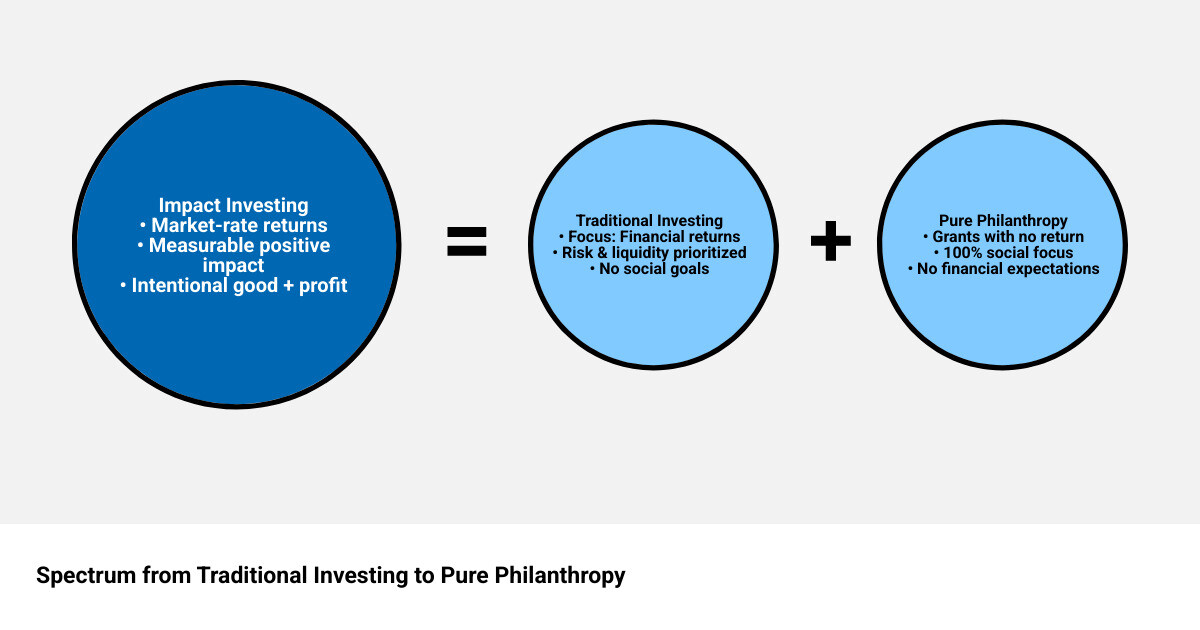
At its best, Social impact investing sits between traditional investing and pure philanthropy. We still care about risk, underwriting, liquidity, and returns. We also care about whether capital is solving a real problem.
That is the key distinction.
Traditional investing asks, “Will this make money?” Philanthropy asks, “Will this do good?” Impact investing asks, “Can this do both?”
Leading frameworks such as those used by the Global Impact Investing Network, or GIIN, generally center on four ideas:
- Intentionality: we invest on purpose to create positive social or environmental outcomes
- Financial return expectation: we still expect capital preservation, income, or growth
- Range of returns: returns can be concessionary, below-market, or market-rate depending on the strategy
- Impact measurement: outcomes should be tracked, reported, and managed
This is why impact investing is not just a rebrand of ESG or SRI.
- ESG typically incorporates environmental, social, and governance factors into investment analysis to improve risk management or identify better-run businesses.
- SRI, or socially responsible investing, often relies on screens, such as excluding tobacco, weapons, or other sectors that do not align with an investor’s values.
- Impact investing goes a step further by directing capital toward businesses, funds, or projects designed to produce measurable positive outcomes.
If ESG is “avoid the bad” and SRI is “screen for values,” impact investing is “fund the solution.”
For a broad primer, see Impact Investing: Definition, Types, and Examples.

| Approach | Primary Goal | Typical Method | Return Expectation | Impact Proof |
|---|---|---|---|---|
| Traditional investing | Maximize financial return | Financial analysis | Market-rate | Usually not required |
| SRI | Align with values | Negative and positive screening | Market-rate | Limited |
| ESG | Improve risk and opportunity analysis | ESG data in investment process | Market-rate | Often indirect |
| Impact investing | Generate measurable positive outcomes plus return | Thematic, direct, or fund investing | Below-market to market-rate | Required and tracked |
| Philanthropy | Maximize mission impact | Grants and donations | No financial return expected | Mission reporting |
The main participants in this market include:
- Institutional investors such as pension funds, insurers, and asset managers
- Foundations and donor-advised funds
- Family offices and ultra-high-net-worth individuals
- Banks and private credit providers
- Development finance and blended-capital vehicles
- Investees such as operating companies, social enterprises, nonprofits with revenue models, affordable housing projects, healthcare platforms, and climate infrastructure
In plain English: the “buyers” of impact are investors, and the “sellers” are organizations using capital to solve problems at scale.
Measuring Success in Social impact investing
If impact cannot be measured, it is dangerously close to a marketing slogan.
That is why serious impact investors rely on tools such as:
- IRIS+ metrics for standardized impact indicators
- Theory of Change frameworks to connect inputs, activities, outputs, and outcomes
- Impact management systems to monitor whether investments are delivering what was promised
- Standardized reporting to investors, boards, and beneficiaries
A Theory of Change is especially useful for family offices and foundations. It forces us to define:
- The problem we want to address
- The investment activity we believe will help
- The short-term outputs we expect
- The long-term outcomes we want to see
- The metrics that will tell us whether we are right
For example, in affordable housing, output metrics might include units financed or occupancy rates. Outcome metrics might track tenant stability, reduced housing cost burden, or access to transit and jobs.
This matters because investors increasingly worry about “impact washing” – funds making vague claims without hard evidence. Measurement is not glamorous, but neither is discovering your “planet-friendly” fund mostly owns clever branding and very little planet.
Legal Frameworks for Purposeful Capital
Legal structure helps turn good intentions into durable strategy.
Three commonly discussed tools are:
- Benefit corporations: for-profit companies that embed public benefit into their governance
- L3Cs: low-profit limited liability companies designed in some jurisdictions to support socially beneficial purposes
- Program-related investments, or PRIs: foundation investments made primarily to advance charitable goals
Benefit corporations can be useful when founders and investors want management to balance profit with mission. They help signal that purpose is not just a seasonal accessory.
PRIs are especially important for private foundations. These are investments, often below-market loans, guarantees, or equity stakes, that count toward a foundation’s annual payout requirement when structured properly. They allow foundations to support impact and potentially recycle capital instead of making one-time grants only.
Mission-related investments, or MRIs, are also widely used. Unlike PRIs, they are generally market-based investments from the endowment that align with the foundation’s mission.
For families building multi-generational portfolios, legal and governance planning matters as much as manager selection. Our guide to 5 Wealth Management Strategies Every High Net Worth Individual Should Know is a helpful starting point for fitting impact capital into broader wealth architecture.
Market Growth and Financial Performance in 2026
The impact market is no longer tiny, experimental, or confined to conference panels with excellent coffee.
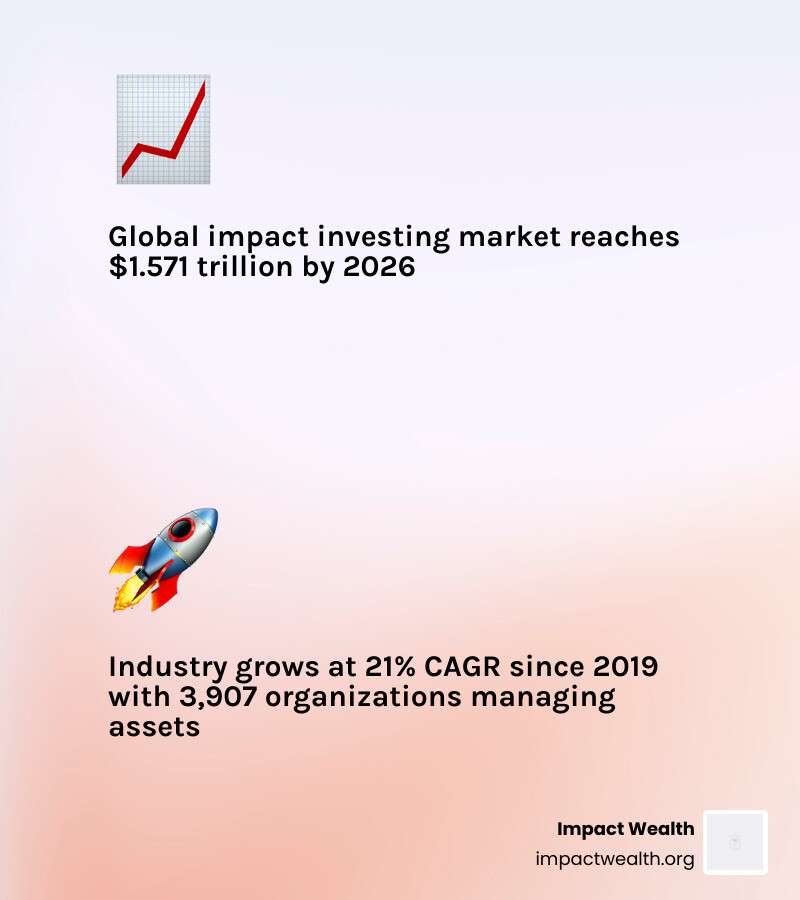
By 2026, the global impact investing market is estimated at $1.571 trillion, the first time GIIN’s estimate has moved past the $1.5 trillion mark. The industry has grown at a 21% compound annual growth rate since 2019, with 3,907 organizations managing impact assets.
That scale matters for two reasons:
- It gives investors more manager, fund, and sector options
- It makes benchmarking and professional due diligence easier
What about returns? This is the question everyone asks right after they nod approvingly about saving the world.
The answer: many impact investors are not sacrificing performance. Research cited in the market shows:
- 74% of impact investors seek risk-adjusted market-rate returns
- 94% reported their investments met or exceeded financial expectations
- One cited study found median impact fund IRR at 6.4% versus 7.4% for non-impact funds, which suggests some strategies may trail slightly while still remaining competitive
In other words, there is no single “impact return.” Outcomes depend on asset class, sector, manager skill, geography, and whether the investor is pursuing market-rate, concessionary, or impact-first capital.
This is exactly why high-net-worth investors should treat impact investing as portfolio construction, not wishful thinking.
For more on the broader conversation shaping the sector in 2026, see Impact Investing Forum 2026 April.
Emerging Trends in Global Markets
Several themes continue to gain momentum across the US, UK, Europe, China, and the Middle East.
- Gender lens investing: allocating capital to companies that improve outcomes for women, whether through leadership, employment, product design, or financial inclusion
- Environmental investing: climate solutions, renewable energy, energy efficiency, water, circular economy, and natural capital
- Blended finance: using catalytic or concessionary capital to bring in commercial investors
- Social infrastructure: housing, healthcare access, education, and community facilities
- Green and sustainability-linked bonds: part of the broader bond market expansion tied to environmental and social outcomes
The UK is a standout example of market development. Better Society Capital estimated the UK social impact investment market at GBP 7.9 billion at the end of 2021, up 20% from 2020. That growth supports the case that impact investing is becoming more institutional, more transparent, and more investable.
Blended finance is especially relevant where projects need patient capital before they can attract traditional investors. This is often how private wealth can help bridge gaps that public spending and philanthropy cannot fill alone.
Navigating Challenges and Impact Washing
For all the excitement, the sector still has real problems.
The biggest include:
- Inconsistent measurement standards
- Trade-off debates between impact and return
- Limited liquidity in some private vehicles
- Sparse track records in newer strategies
- Impact washing
Impact washing is not theoretical. In the 2020 GIIN survey, 66% of respondents said it was one of the greatest challenges facing the industry over the next five years.
That concern is justified. A manager saying “we care” is not enough. We should want clear evidence on:
- What outcomes are targeted
- Which metrics are used
- Whether results are independently reviewed
- How impact affects investment decisions
- What happens when an investment misses both financial and impact targets
Fiduciary duty also deserves attention. Investors, trustees, and family office CIOs need to document why an impact investment belongs in the portfolio and how it fits risk objectives. Done properly, impact investing can sit comfortably within prudent portfolio management.
If you are weighing private funds, direct deals, or thematic alternatives, Finding A Partner To Navigate The Complex World Of Alternative Investments offers useful context.
Strategic Implementation for High-Net-Worth Portfolios
There is no single correct way to build an impact portfolio. Most investors start in one of three ways:
- Carve-out strategy: dedicate a portion of the portfolio, such as 5% to 20%, to impact investments
- Integrated strategy: apply impact goals across public and private allocations while still maintaining conventional portfolio structure
- 100% impact portfolio: align the entire portfolio with mission, values, and measurable outcomes

A carve-out strategy is often the easiest entry point for family offices. It allows us to test managers, reporting, and sector exposure without overhauling the entire investment policy statement.
An integrated approach works well when impact is becoming part of the family’s identity, governance, and succession planning. This often includes public equities, fixed income, private equity, venture, real assets, and private credit.
A 100% impact approach is the most ambitious. It requires careful manager selection and a willingness to rethink old silos between investing and philanthropy.
Some investors also use an “impact-first” sleeve, where social outcomes take priority over maximizing return. For an example of how that approach is framed, see Impact-First Investments.
The Role of DAFs in Social impact investing
Donor-advised funds, or DAFs, are increasingly important gateways into impact investing.
They can support:
- Impact-oriented grants
- Recoverable grants
- Loans and other charitable investment structures
- Pooled strategies that recycle repaid capital into future impact
That last point is powerful. Capital recycling means the same dollar can potentially do more than one round of good. It is philanthropy with a boomerang effect.
Research shows donor behavior is moving in this direction. Fidelity Charitable donors recommended more than $344 million in grants to impact-investing nonprofits in 2025. More broadly, DAFs are often discussed as a major pipeline for impact-first capital.
For families already using charitable vehicles, DAFs can be a practical testing ground before moving into larger direct impact allocations. They also help bridge the gap between pure giving and investment discipline.
Individual Participation and Retail Access
Impact investing is no longer reserved for institutions or billion-dollar foundations.
Individual investors can participate through:
- Impact ETFs and mutual funds
- Green, social, or sustainability bonds
- Community investment notes
- Microfinance and small-business lending platforms
- Pooled private funds, where eligibility allows
- Public companies with strong, measurable impact business models
Retail investors should start with simple questions:
- What issue matters most to us – climate, housing, health, education, local jobs?
- Do we want public-market liquidity or private-market depth?
- Are we targeting market-rate return, concessionary return, or philanthropic leverage?
- How will we verify outcomes?
For those focused on place-based investing and local economic development, our piece on Investment Strategies To Propel Community Development offers practical ideas.
Real-World Success: From Global Climate to Local Communities
The strongest case for impact investing is not theoretical. It is visible in real assets, real communities, and real outcomes.
Common sectors include:
- Affordable housing
- Healthcare delivery and innovation
- Education access
- Clean energy and climate infrastructure
- Financial inclusion
- Community development
Examples of successful impact models include funds and projects that:
- Finance affordable housing near jobs and transit
- Expand access to healthcare facilities and preventive care
- Support schools, workforce training, and education technology
- Build or scale renewable power and energy-efficiency assets
- Provide lending to underserved entrepreneurs and small businesses
These sectors are attractive because they often combine strong demand with measurable outcomes. Housing can track units and affordability. Healthcare can track patients served or clinics opened. Climate investments can track emissions avoided or clean energy generated. Education can track enrollment, completion, and employment outcomes.
For a well-known example of sector-focused impact investing in real assets, see Turner Impact Capital.
Addressing Local Challenges in the UK and US
Impact investing becomes especially compelling when we apply it to local problems with local context.
In the UK, the social impact investment market reached GBP 7.9 billion by the end of 2021. That tells us place-based investing is not just a London boardroom concept. It has become a meaningful tool for housing, community finance, and social enterprise across the country.
In the US, local investing can support:
- Affordable housing in fast-growing metro areas
- Community health access
- Food systems and urban agriculture
- Education and youth development
- Neighborhood business revitalization
Community foundations can also play a useful role by pooling local knowledge, mission alignment, and patient capital. They often help investors identify where private capital can complement grants and public funding.
A good reminder of how local initiatives can create broader social value is Teens For Food Justice, which highlights the importance of investing in community-rooted solutions rather than only chasing scale from 30,000 feet.
High-Impact Philanthropic Partnerships
Impact investing works best when it complements philanthropy, not when it tries to replace it.
Some problems need grants. Others need investment capital. Many need both.
This is where philanthropic partnerships become powerful:
- Foundations can use PRIs and MRIs
- Family offices can pair grants with catalytic investment
- DAFs can support recoverable grants and impact-first vehicles
- Endowments can align more of their corpus with mission
The logic is simple: grants can absorb early risk, while investment capital helps scale what works.
That is one reason mission-aligned endowment strategies have gained traction. Rather than keeping philanthropy in one bucket and investing in another, more families and institutions are asking whether all capital should reflect their values.
For readers interested in the big-picture future of strategic giving, Bill Gates Pledges 200 Billion For Global Aid By 2045 shows how large pools of capital can influence the scale and urgency of social problem-solving.
Frequently Asked Questions about Social Impact Investing
Does social impact investing require lower financial returns?
Not necessarily.
Many impact investors seek market-rate, risk-adjusted returns, and most report that results meet or exceed expectations. That said, some strategies intentionally accept lower returns in exchange for deeper impact, especially in early-stage, catalytic, or underserved markets.
The better question is not “Are returns always lower?” but “What return profile fits this specific impact thesis?”
How do I distinguish between ESG and true impact investing?
Look for intentionality and measurement.
True impact investing should clearly state:
- The social or environmental outcome being targeted
- Why the investment is expected to create that outcome
- Which metrics will measure success
- How impact performance affects decision-making
If a strategy mostly talks about screening, governance quality, or sustainability preferences without showing direct outcomes, it may be ESG or SRI rather than impact.
Can I use a donor-advised fund for impact investments?
Yes, in many cases.
DAFs can be used for grants and, depending on the platform and structure, impact-oriented investments such as recoverable grants or mission-aligned pooled vehicles. They can be especially useful for families who want to test impact strategies, recycle charitable capital, and connect philanthropy with investing.
Conclusion
Social impact investing is no longer a niche corner of finance. It is a fast-growing global market, a practical portfolio tool, and for many families, a better expression of what wealth is actually for.
For us, the appeal is clear: values alignment, measurable outcomes, and the possibility of financial return without treating social good as an afterthought.
Whether we start with a small carve-out, a donor-advised fund, a local community strategy, or a fully integrated family office approach, the direction of travel is obvious. Capital is becoming more accountable. Investors are asking better questions. And the line between wealth creation and world improvement is getting thinner.
That is good news for portfolios, and even better news for the future.
To keep exploring the intersection of wealth, philanthropy, and purposeful investing, Read more in Impact Wealth Magazine.