
Most leaders treat software updates as an IT chore, something that happens quietly in the background or, too often, not at all. On a single office network, that habit was survivable. Across a fleet of remote laptops, phones, and home routers, it is a financial exposure hiding in plain sight.
The reasoning here is straightforward. Every device that connects to your systems from outside the office is a door. An unpatched door is an unlocked one, and attackers are very good at finding the ones left open.
This article looks at the question owners actually care about: not the technical mechanics, but what ignoring those open doors costs a business in real money, lost time, and lost trust.
Why Remote Endpoints Are the Weak Point
When work moved out of the office, the security perimeter dissolved with it. Company data now lives on devices that IT cannot see, touch, or reliably update on schedule.
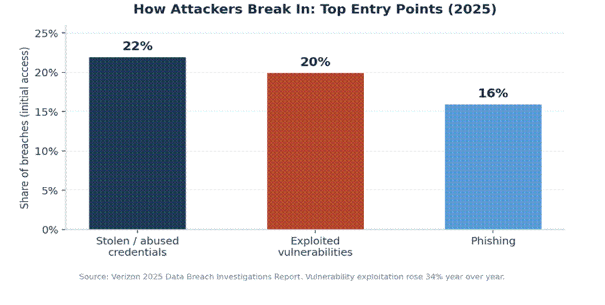
The numbers confirm the shift. Exploited software flaws were behind 20 percent of breaches in 2025, a 34 percent jump in a single year, putting them almost level with stolen passwords as the leading way attackers get in.
Remote and internet-facing systems are hit hardest. Industry analysis found that devices at the network edge, such as VPNs and gateways, often take around a month to patch, and barely half are fixed at all, leaving a wide and well-known window of risk.
Understanding the patch management risks for remote endpoints is the first step, because the gap between a fix being available and actually installed is exactly where the financial damage begins.
The Costs No One Puts in the Budget
The price of a breach is rarely a single number. It is a stack of costs that lands over months, and most of them never appear in an IT line item.
The table below breaks down where the money actually goes when an unpatched endpoint becomes an entry point.
| Cost category | What it means for the business |
| Direct breach response | Investigation, containment, legal counsel, and customer notification |
| Operational downtime | Halted systems, idle staff, and missed revenue during recovery |
| Regulatory and legal | Fines, penalties, and lawsuits, heaviest in regulated sectors |
| Reputation and trust | Lost clients, stalled deals, and a damaged brand that lingers |
| Insurance fallout | Higher premiums, and disputes when basic controls were missing |
Notice how few of these are technical. A missed patch is an IT event, but its consequences are felt in finance, sales, legal, and the corner office.
What a Breach Actually Costs
The headline figures are sobering, and they are trending in two directions at once.
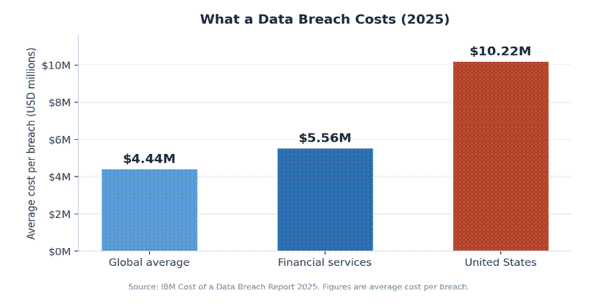
Globally, the average breach cost about 4.4 million dollars in 2025, a modest decline credited largely to faster detection. In the United States, though, the average climbed to a record 10.22 million, driven by stiffer regulatory penalties and slower containment.
For finance-adjacent businesses, the exposure is sharper still. Breaches in the financial sector averaged about 5.56 million dollars, reflecting the value of the data involved and the scrutiny that follows an incident.
Consider a simple, illustrative case. A mid-sized firm with a single unpatched laptop suffers a ransomware intrusion. Even if no ransom is paid, a week of downtime, an emergency forensics engagement, client notifications, and a regulator’s questions can stack into seven figures before the brand damage is even tallied.
The Damage That Outlasts the Breach
The invoice for incident response is only the beginning. The costs that hurt most are the ones that arrive slowly, long after the systems are back online.
Customers who lose confidence rarely announce it. They simply renew elsewhere, and the lost lifetime value never shows up as a breach expense even though it is one.
Deals can stall, too. Prospects and partners increasingly ask about security posture during due diligence, and a recent incident is a hard thing to explain across the table.
Leadership time is the quiet tax. Weeks that should go to growth instead go to lawyers, regulators, and reassuring anxious stakeholders, a cost that never appears on any ledger.
The Compliance and Trust Dimension
For owners with serious assets, the regulatory layer is often where an unpatched endpoint hurts most. Many frameworks expect timely patching as a basic duty of care.
When a breach traces back to a known, unfixed flaw, that omission can turn a security incident into a compliance failure, with fines and reporting obligations attached. This is increasingly central to the intersection of finance and technology, where security posture and financial governance now overlap.
Distributed teams raise the stakes again. Keeping evidence of consistent patching is part of managing compliance across remote teams, and auditors increasingly ask for it. Public resources like the list of actively exploited flaws set a clear baseline for what should have been fixed first.
Who Carries the Most Exposure
The risk is universal, but it is not evenly distributed. A few profiles should treat patch discipline as non-negotiable.
Regulated and finance-adjacent firms top the list, because they pair valuable data with strict oversight, so a single lapse can trigger both a breach and a penalty.
Businesses built on intellectual property are close behind. Their most valuable asset is also the most expensive to lose, and a quiet theft can go undetected for months.
Finally, any organization with a heavily remote workforce carries elevated exposure, simply because it has more unmanaged doors than a traditional office ever did.
Why Patching Slips Through the Cracks
If the math is this clear, why do so many businesses fall behind? The honest answer is that patching is easy to defer and hard to see.
Updates interrupt work, occasionally break an application, and rarely feel urgent until something goes wrong. In a distributed workforce, no one has a clear view of which devices are current and which are months behind.
That blind spot is the core problem. Without visibility into how known flaws get tracked and fixed across every remote device, a business is essentially guessing about its own exposure, and guessing is expensive.
Turning Patch Management Into a Business Safeguard
The good news is that closing this gap does not require a large security team. It requires treating updates as a managed process rather than an afterthought.
- Automate updates so remote devices stay current without manual chasing.
- Keep a live inventory of every endpoint that touches company systems.
- Prioritize fixes for flaws that are actively being exploited in the wild.
- Track and report patch status, so compliance and coverage are provable.
Framed this way, patching stops being a cost center and becomes cheap insurance. Set against a seven-figure breach, the effort of keeping software current is trivial, and the return is measured in disasters that never happen.
Frequently Asked Questions
Is one unpatched device really a serious risk?
Yes. Attackers only need one open door. A single outdated laptop or router can be the entry point for a breach that reaches the entire business.
Does patching alone prevent breaches?
No, and it is important to be honest about that. Patching closes one major path, but it works best alongside multi-factor authentication, backups, and staff awareness.
How fast should remote devices be patched?
Critical, actively exploited flaws should be fixed within days. Attackers often begin exploiting a known weakness almost immediately after it is disclosed.
Why are United States breach costs so high?
Stricter regulatory penalties, higher litigation exposure, and costly notification rules all push the average up, which is why prevention pays off most there.
We are a small business. Are we a target?
Very much so. Most attacks are automated and scan everyone, and smaller firms often have weaker defenses, which makes them attractive rather than overlooked.
The Bottom Line
Ignoring updates on remote devices is not a technical oversight. It is a business decision with a price tag, even if that price stays invisible until the day it suddenly is not.
The cost of staying current is small, predictable, and entirely within your control. The cost of a breach is large, chaotic, and often public.
For any owner with valuable data, clients, or a reputation worth protecting, keeping remote endpoints patched is one of the soundest, lowest-cost investments available.
References
- Verizon. “2025 Data Breach Investigations Report (DBIR),” 2025. https://www.verizon.com/business/resources/reports/dbir/
- IBM. “Cost of a Data Breach Report 2025” (global average 4.44 million dollars; United States 10.22 million; financial sector 5.56 million), 2025. https://www.ibm.com/reports/data-breach
- Cybersecurity and Infrastructure Security Agency (CISA). “Known Exploited Vulnerabilities (KEV) Catalog” and Binding Operational Directive 22-01. https://www.cisa.gov/known-exploited-vulnerabilities-catalog
- National Institute of Standards and Technology. “National Vulnerability Database” (new CVE volume). https://nvd.nist.gov/
- “What Is Vulnerability Management? A Complete Guide,” CyberGlossary reference. https://www.fortinet.com/resources/cyberglossary/vulnerability-management