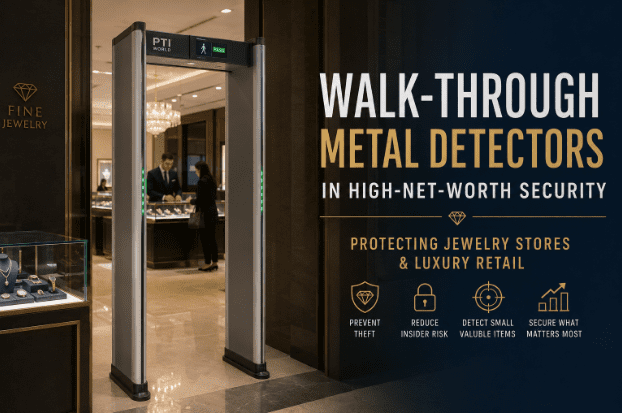
When Luxury Becomes a Target
High-net-worth retail environments occupy a unique position in the security landscape. A single display case in a fine jewelry boutique can hold more monetary value than an entire aisle of consumer electronics elsewhere. That concentration of portable, untraceable wealth creates a threat profile that standard retail security measures simply cannot address on their own. Walk-through metal detectors have quietly become one of the most effective tools luxury retailers deploy – not just for stopping external theft, but for managing the far more costly problem of insider loss.
The jewelry and luxury goods sector loses billions annually to theft, with a significant portion traced back to employees rather than external actors. Unlike shoplifting, which surveillance cameras can partially deter, employee theft tends to be methodical and planned. A walk-through metal detector at an employee entrance or loading dock creates a deterrent that is difficult to circumvent, requires no active human enforcement, and operates consistently across every shift.
For retailers serious about protecting inventory, investing in purpose-built detection equipment is essential. PTI World’s walk-through metal detectors are engineered specifically for high-sensitivity applications like precious metal detection – capable of identifying jewelry, findings, and small components that standard security-grade portals would miss entirely.
What Sets Luxury Retail Security Apart
Most commercial walk-through metal detectors are designed with airports or government buildings in mind – environments where the priority is detecting weapons. Luxury retail demands a different calibration. A boutique selling fine watches or high-karat gold chains needs detection sensitivity tuned to very small metallic objects, sometimes just a few grams.
This distinction matters enormously. Standard security portals can be set to ignore small metallic items to reduce false alarms from belt buckles, coins, and keys. In a jewelry environment, that threshold is counterproductive. The most valuable items – earrings, rings, loose diamonds set in gold – are precisely the objects that need to trigger an alert. Advanced walk-through systems built for the precious metals industry can be calibrated to detect items that weigh far less than a typical security threat, making them genuinely useful in a retail context where the assets at risk are small and dense.
External Threats vs. Internal Risk
Luxury retailers face two distinct threat vectors, and a walk-through detector addresses both differently. For external threats – shoplifters, grab-and-run incidents, or coordinated smash-and-grab attacks – visible metal detection infrastructure at entry and exit points serves primarily as a deterrent. Most opportunistic thieves will choose a softer target when they see professional detection equipment in place.
Internal risk requires a more systematic approach. Employees with access to stockrooms, display case keys, and inventory systems have opportunities that no customer-facing camera can monitor. Positioning walk-through detectors at staff entry and exit points – particularly at end-of-shift exits and loading dock doors – creates a checkpoint that applies equally to every staff member, removing the awkwardness of manual searches while maintaining a consistent standard.
Some luxury retailers also deploy detection at fitting room corridors or in transition zones between public and restricted areas. These installations rarely inconvenience customers but can flag movement of metallic items into areas where inventory shouldn’t be traveling.
Discretion and Brand Experience
One of the more underappreciated challenges in luxury retail security is maintaining an environment that feels exclusive and welcoming even as it operates rigorous security protocols. A jewelry store is selling an experience as much as a product. If a walk-through portal feels like an airport scanner, it undermines the atmosphere.
Modern high-sensitivity detectors have addressed this by offering sleeker profiles and quieter alert systems. Some models can be configured to alert only the operator – a discreet auditory cue or a light signal visible only to staff – rather than a loud alarm that would embarrass a customer. This allows floor associates to manage situations gracefully without creating scenes that damage the brand experience.
Integration With Broader Security Architecture
A walk-through detector is most effective when it sits within a layered security system rather than functioning as a standalone solution. In practice, this means pairing it with access control systems, CCTV coverage, and inventory management software that tracks stock levels in real time.
Many retailers also benefit from reading resources that clarify when and how to deploy different screening tools. A detailed look at the comparison between walk-through vs. handheld metal detectors can help security managers decide which technology fits each location within a larger store or complex.
Access control data, combined with detector logs, can identify patterns that no single system would catch. If inventory discrepancies cluster around specific shifts or specific staff members, and detector alerts correlate with those same windows, investigators have a much stronger starting point than camera footage alone could provide.
Practical Deployment Considerations
Before a luxury retailer installs a walk-through system, several operational factors deserve careful thought. Throughput is one: a high-volume boutique during a holiday sale may process dozens of employees and dozens of customer visits within minutes. A detector that creates a bottleneck can cause more friction than it solves. Models with wider portals and faster reset times handle high-traffic scenarios without turning entry into a choke point.
Power requirements, mounting surfaces, and proximity to other electronic systems (including alarm sensors and POS hardware) all affect installation planning. Most modern walk-through units operate with low electromagnetic interference profiles, but confirming compatibility with existing systems before installation avoids expensive troubleshooting later.
The Return on Investment Conversation
Security hardware is rarely framed in terms of financial return, but in high-net-worth retail it should be. A single prevented theft of a high-value piece can offset the cost of an entire detection system. When factored against ongoing shrinkage reduction over a multi-year installation lifespan, the economics often favor investment in quality detection equipment decisively.
Beyond the direct theft prevention benefit, walk-through detectors contribute to insurance compliance in some jurisdictions and may influence premiums for specialty jewelry coverage. Insurers increasingly ask about physical security infrastructure as part of underwriting assessments for high-value retail policies.
Conclusion
The luxury retail environment is not simply a harder version of standard retail security – it operates under a different logic entirely. The assets are highly portable, highly valuable, and often impossible to recover once removed from the premises. Walk-through metal detectors, calibrated correctly and integrated thoughtfully, represent one of the most cost-effective layers of protection available to jewelry stores and luxury goods retailers. For businesses ready to evaluate options, PTI World offers detection systems specifically engineered for the sensitivity demands of precious metal environments.