Why Global Economic Trends Matter
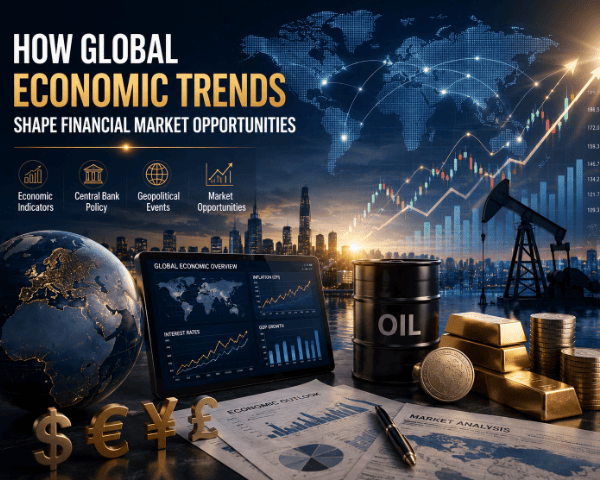
Financial markets do not move independently from the broader economy. Changes in inflation, interest rates, trade policies, and geopolitical developments can quickly influence investor behavior and create new opportunities across multiple asset classes.
Understanding global economic trends has become increasingly important for traders seeking to identify potential market movements before they become fully reflected in prices. Economic reports, central bank decisions, labor market data, and political events all contribute to shifts in market sentiment.
For example, stronger economic growth in a major economy can support equity markets, increase demand for commodities, and strengthen the local currency. On the other hand, concerns about slowing growth may encourage investors to reduce risk exposure and seek assets perceived as relatively safer.
Many market participants monitor economic calendars, central bank speeches, and analytical tools available through the ScoreCM trading platform to stay informed about developments affecting currencies, commodities, and stock indices.
Inflation and Central Bank Policy
Inflation remains one of the most influential drivers of financial markets.
When consumer prices rise faster than expected, central banks often respond by tightening monetary policy. This usually means increasing interest rates or maintaining restrictive conditions for a longer period.
Higher interest rates can slow borrowing, reduce spending, and lower demand in certain sectors of the economy. As a result, stock markets may face pressure, while government bond yields often move higher.
Inflation trading has become particularly relevant in recent years because inflation surprises frequently trigger sharp market reactions. Traders closely follow indicators such as consumer price indices, producer prices, and wage growth data to anticipate future policy decisions.
Commodity markets also play an important role in inflation expectations. Rising energy prices tend to increase transportation and manufacturing costs, which can eventually pass through to consumers. This relationship explains why commodity trading is often closely linked to inflation forecasts.
Interest Rates and Forex Markets
Interest rates are among the primary factors influencing forex markets.
Currencies generally become more attractive when investors expect higher returns from assets denominated in that currency. This is one reason why monetary policy announcements from major central banks receive significant attention.
Differences in interest rate expectations between countries can lead to substantial movements in exchange rates. Traders monitor these divergences to identify potential opportunities in currency pairs.
However, interest rates rarely act in isolation. Economic growth prospects, inflation trends, and global risk sentiment all contribute to how markets interpret policy decisions.
A central bank signaling future rate cuts may weaken its currency, while expectations of prolonged tightening can support demand. Understanding these broader relationships is an essential part of macroeconomic analysis.
Traders seeking exposure to currencies, commodities, and precious metals often prefer access to multi-asset environments offered by providers such as ScoreCM brokerage, allowing them to monitor how macroeconomic developments influence different markets simultaneously.
Geopolitical Risk and Financial Markets
Geopolitical developments often introduce uncertainty into financial markets.
Military conflicts, diplomatic disputes, sanctions, and trade disruptions can affect supply chains, alter investment flows, and increase volatility.
Markets typically dislike uncertainty. During periods of elevated geopolitical risk, investors frequently reduce exposure to riskier assets and move toward defensive positions.
Gold prices tend to benefit from these shifts because gold has historically been viewed as a store of value during uncertain periods. Government bonds and certain currencies may also attract inflows when investor confidence deteriorates.
At the same time, geopolitical events can generate short-term trading opportunities for participants who closely monitor global developments and understand how markets tend to react.
Recent US-Iran Tensions and Oil Prices
Recent tensions between the United States and Iran once again demonstrated how quickly geopolitical developments can influence market sentiment.
Concerns surrounding a possible escalation in the Middle East initially supported higher oil prices as traders assessed the risk of supply disruptions.
Energy markets are particularly sensitive to uncertainty in the region because several major oil-producing countries are located there. Even when physical production remains stable, fears about future disruptions may encourage traders to build risk premiums into prices.
These movements can eventually affect inflation expectations, transportation costs, and industrial production, creating ripple effects throughout the global economy.
However, markets do not remain focused on worst-case scenarios indefinitely.
As diplomatic efforts intensify or signs of de-escalation emerge, investors often reassess previous assumptions. Improved confidence may encourage participants to rotate back into equities and other growth-oriented assets.
Gold prices may also retreat during these periods as demand for safe-haven assets declines.
Why the Strait of Hormuz Matters
The Strait of Hormuz remains one of the most closely watched locations in global energy markets.
A significant portion of internationally traded crude oil passes through this narrow waterway connecting the Persian Gulf to global shipping routes.
Any disruption affecting tanker movements can influence supply expectations almost immediately.
Because oil prices have a direct impact on inflation expectations, traders monitor developments in the Strait of Hormuz very carefully. Rising oil costs can increase production expenses across multiple industries and complicate efforts by central banks to bring inflation back toward target levels.
As a result, developments in the region are not only important for energy traders but also for participants active in forex markets, equities, and precious metals.
The Trump Effect on Global Markets
Donald Trump’s return to the political spotlight has introduced another layer of uncertainty for investors.
Market participants continue to evaluate how future tariff discussions, trade negotiations, and shifts in US foreign policy may affect global economic conditions.
Trade restrictions and higher import duties can increase costs for businesses and consumers, potentially contributing to inflationary pressures.
Currencies linked to international trade may become more volatile when negotiations between major economies become uncertain. Commodity markets may also react as changing trade relationships alter global demand patterns.
Foreign policy expectations are another important consideration. Potential changes in diplomatic priorities, sanctions, or international agreements can influence geopolitical risk assessments and market sentiment.
Political uncertainty does not always produce negative outcomes. Increased volatility often creates opportunities for traders who are prepared to adapt to changing narratives while maintaining disciplined risk management practices.
Combining Macroeconomic and Technical Analysis
Macroeconomic analysis helps traders understand why markets move, while technical analysis can assist in determining potential entry and exit levels.
Combining both approaches allows traders to develop a more comprehensive view of market conditions.
For example, expectations of persistent inflation may support higher oil prices over the medium term, while chart patterns and momentum indicators can help identify favorable trading setups.
Similarly, geopolitical uncertainty may strengthen demand for gold, but technical analysis can provide additional insights regarding support zones, resistance levels, and trend strength.
Many traders also supplement their own research by following educational materials, economic calendars, and market updates available through platforms such as ScoreCM, helping them stay informed about evolving global economic trends.
Financial markets constantly evolve as economic conditions change. Traders who remain flexible, monitor global economic trends, and combine macroeconomic analysis with technical tools are often better positioned to adapt to new environments and identify emerging financial market opportunities.