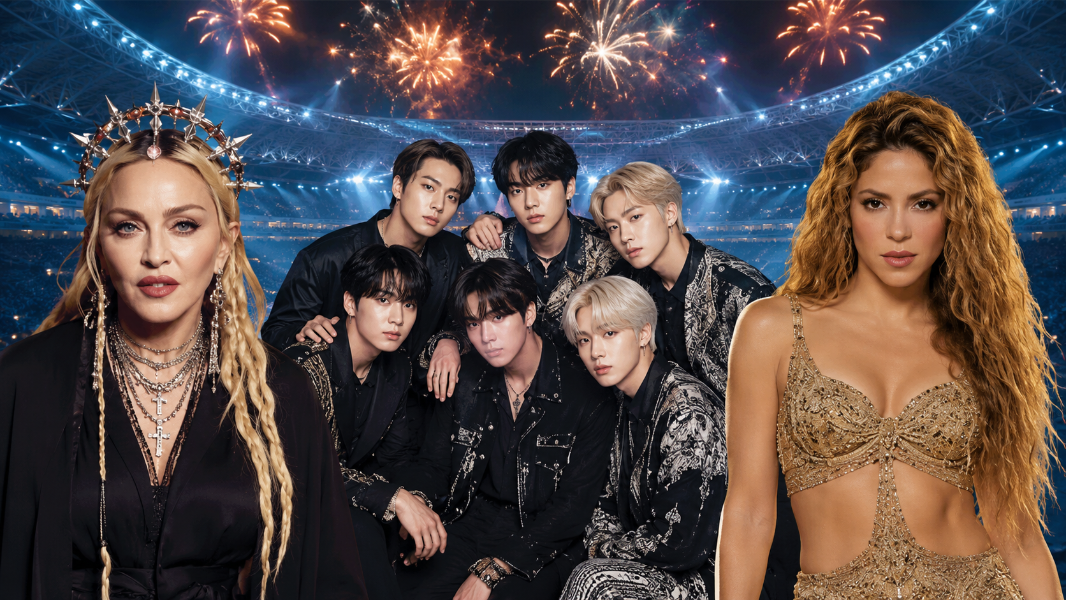
The announcement of the FIFA World Cup 2026 Halftime Show has introduced a major shift in how global football events are being presented to worldwide audiences. FIFA confirmed that Madonna, BTS, and Shakira will headline the first-ever halftime entertainment spectacle during the 2026 World Cup final at MetLife Stadium. Consequently, the tournament is now positioned not only as the world’s biggest football competition but also as one of the largest entertainment broadcasts in modern media history.
For decades, the FIFA World Cup focused almost entirely on sporting competition, national identity, and tournament drama. However, the 2026 edition reflects changing audience expectations in the digital era. Fans increasingly consume sporting events as cultural experiences that combine music, celebrity influence, live performances, and viral social media moments. Therefore, FIFA’s decision to launch a halftime show signals a broader transformation in sports broadcasting strategy.
The final will take place at MetLife Stadium in New Jersey during the expanded 48-team World Cup format, which itself represents one of FIFA’s most ambitious commercial projects. Meanwhile, reports indicate that Chris Martin will help curate the halftime production in partnership with FIFA and entertainment collaborators. This approach mirrors the highly successful Super Bowl halftime format that has become a centerpiece of American sports culture.
Moreover, the inclusion of Madonna, BTS, and Shakira demonstrates FIFA’s effort to appeal across multiple demographics, regions, and music markets simultaneously. The lineup combines Western pop influence, Latin music dominance, and K-pop’s enormous international reach. As a result, the FIFA World Cup 2026 Halftime Show is already being discussed as one of the defining crossover moments between global sports and entertainment industries.
Why FIFA Is Introducing a Halftime Show in 2026?
FIFA’s decision to introduce a halftime performance reflects broader changes in the economics of sports broadcasting. Traditionally, football tournaments relied primarily on the match itself to retain audience attention. However, global media consumption habits have evolved rapidly over the last decade. Viewers now expect entertainment-driven programming that extends beyond the sporting contest.
The Super Bowl provided a clear model for this transformation. Its halftime performances routinely generate enormous television ratings, streaming traffic, advertising engagement, and social media discussion. Therefore, FIFA recognized an opportunity to adapt a similar entertainment structure for football’s largest event. The organization appears focused on increasing global viewer retention while also expanding commercial sponsorship opportunities.
Moreover, sports organizations increasingly compete for audience attention in a crowded entertainment ecosystem. Streaming platforms, short-form video content, and social media trends have altered how younger audiences engage with live broadcasts. Consequently, FIFA is adapting its presentation strategy to remain culturally relevant among digitally connected global audiences.
The halftime show also strengthens FIFA’s broader branding ambitions:
- Expands non-football audience engagement
- Creates new sponsorship and advertising inventory
- Encourages viral social media amplification
- Increases entertainment media coverage
- Enhances broadcast value for global networks
Nevertheless, FIFA must balance spectacle with sporting integrity. Football fans traditionally value uninterrupted match flow and competitive focus. Therefore, the organization faces pressure to ensure that entertainment integration does not overshadow the match itself.
Madonna, BTS, and Shakira: A Global Cultural Lineup
The selection of Madonna, BTS, and Shakira reflects a deliberate global audience strategy rather than a celebrity-focused publicity campaign. Each artist represents a distinct cultural and geographic influence within the international music market. Together, they create a lineup designed to maximize worldwide engagement across multiple generations.
Madonna brings decades of mainstream pop recognition and cross-generational familiarity. Her involvement connects the halftime show to the long tradition of large-scale global pop performances. Meanwhile, Shakira already holds strong associations with football culture through previous FIFA performances, including the globally recognized World Cup anthem “Waka Waka.”
In contrast, BTS represents the rise of K-pop as a dominant force in international entertainment. BTS has cultivated one of the world’s most digitally active fan communities, making the group particularly valuable in terms of online engagement and global streaming visibility.
This combination offers several strategic advantages:
- Multi-generational audience appeal
- Representation across major music regions
- Strong social media amplification potential
- Cross-market sponsorship opportunities
- Expanded cultural accessibility
Moreover, the lineup reflects how football and music industries increasingly overlap in global branding campaigns. International tournaments now rely heavily on entertainment partnerships to expand relevance beyond traditional sports audiences. Consequently, FIFA appears focused on positioning the World Cup as a broader cultural event rather than solely a sporting competition.
Key Elements of the FIFA World Cup 2026 Halftime Show
| Element | Detail | Impact | Audience Value | Industry Significance |
|---|---|---|---|---|
| Headline Performers | Madonna, BTS, Shakira | Global media attention | Multi-generational appeal | Cross-market entertainment reach |
| Venue | MetLife Stadium, New Jersey | Large-scale production environment | Premium live spectacle | North American market expansion |
| Format | First-ever FIFA halftime show | New viewing experience | Entertainment integration | Structural change in football broadcasting |
| Creative Direction | Curated by Chris Martin | Unified artistic presentation | Stronger storytelling | Music industry collaboration |
| Broadcast Reach | Worldwide FIFA audience | Massive global exposure | Shared cultural experience | Advertising and sponsorship growth |
| Digital Amplification | Social media integration | Viral engagement potential | Real-time fan participation | Hybrid media strategy |
How the World Cup Became an Entertainment Platform?
The FIFA World Cup has always carried cultural significance beyond football. However, modern tournaments increasingly function as entertainment ecosystems shaped by media partnerships, sponsorship integration, and digital broadcasting strategies. Consequently, the competition now operates within a broader global entertainment framework.
Earlier World Cups primarily emphasized national competition and sporting prestige. In contrast, modern tournaments include celebrity appearances, opening ceremonies, music collaborations, and social media campaigns designed to maintain global attention throughout the event cycle. Moreover, streaming platforms and mobile viewing habits have encouraged broadcasters to prioritize visually dynamic content that can circulate rapidly online.
Short-form digital clips now influence audience engagement almost as much as live broadcasts themselves. Therefore, performances during major sporting events often achieve enormous visibility across platforms such as TikTok, Instagram, YouTube, and X. FIFA clearly recognizes that entertainment moments can extend tournament relevance far beyond match highlights.
Several trends accelerated this transformation:
- Growth of streaming-based sports consumption
- Expansion of global sponsorship deals
- Influence of celebrity-driven marketing
- Demand for shareable digital content
- Integration of music and sports branding
As a result, the FIFA World Cup 2026 Halftime Show represents the next stage in football’s evolution as a hybrid entertainment product.
The Role of Chris Martin and Global Production Teams
Reports surrounding the halftime show indicate that Chris Martin will play a major role in curating the performance structure and artistic direction. His involvement reflects FIFA’s desire to create a globally recognizable entertainment experience with broad cultural appeal.
Large-scale halftime productions require extraordinary coordination between sports organizers, production companies, artists, broadcasters, and stadium operations teams. Moreover, FIFA must ensure that the performance fits within strict timing limitations associated with a live football final. Consequently, production logistics may become one of the most challenging aspects of the event.
The halftime show will likely involve:
- Large-scale stage installation systems
- Rapid setup and removal coordination
- International broadcast synchronization
- Advanced lighting and sound production
- Security and crowd management planning
Meanwhile, organizers must also address cultural representation carefully. Because the World Cup attracts audiences from nearly every region globally, FIFA faces pressure to deliver entertainment that feels internationally inclusive rather than regionally focused.
However, live production risks remain significant. Technical delays, broadcast interruptions, or scheduling complications could generate criticism if the event affects match preparation or viewing flow. Therefore, FIFA’s production teams will likely prioritize operational precision as heavily as artistic presentation.
Sports vs Entertainment Integration Trends
| Category | Traditional Sports Event | Modern Hybrid Event | Audience Expectation | Industry Shift |
|---|---|---|---|---|
| Broadcast Focus | Match-centered | Match + entertainment | Continuous engagement | Experience-driven viewing |
| Fan Interaction | Passive viewing | Real-time digital participation | Social sharing | Interactive media culture |
| Sponsorship Model | Stadium branding | Cross-platform campaigns | Integrated storytelling | Expanded commercial value |
| Celebrity Involvement | Limited appearances | Central entertainment role | Cultural crossover | Sports-pop culture fusion |
| Content Distribution | Television dominant | Multi-platform ecosystem | Instant clips and highlights | Digital-first strategy |
Why the Super Bowl Model Influenced FIFA?
The Super Bowl halftime show has become one of the most influential entertainment formats in modern broadcasting. Its performances frequently dominate global online discussion and generate enormous advertising value for broadcasters and sponsors alike. Consequently, FIFA’s adoption of a similar model reflects clear commercial logic.
Unlike traditional sports broadcasts, the Super Bowl combines athletic competition with entertainment spectacle to retain wider audience attention during breaks in gameplay. Moreover, halftime performances often attract viewers who may not otherwise watch the sporting event itself. FIFA likely sees similar potential in expanding World Cup reach beyond football-focused audiences.
Additionally, halftime shows provide powerful marketing benefits:
- Increased advertising demand
- Greater sponsor visibility
- Higher digital engagement rates
- Broader mainstream media coverage
- Stronger global cultural relevance
Nevertheless, football differs significantly from American football in pacing and structure. Match rhythm remains central to fan experience, and extended interruptions could face criticism from traditional supporters. Therefore, FIFA must carefully adapt the Super Bowl model rather than replicate it entirely.
Risks and Challenges of a World Cup Halftime Show
Although the FIFA World Cup 2026 Halftime Show offers substantial commercial and entertainment opportunities, it also introduces operational and cultural challenges. Football supporters often value continuity, tactical intensity, and uninterrupted momentum during major finals. Consequently, any perceived disruption could become controversial.
Scheduling remains one of the biggest concerns. Football halftime periods are traditionally short, allowing players limited recovery and tactical adjustment time. A significantly extended entertainment segment may affect player preparation and match rhythm. Moreover, coaching staff could express concerns about competitive balance.
Other challenges include:
- Technical production failures
- Broadcast timing complications
- Weather-related disruptions
- Audience division over commercialization
- Security coordination complexity
In contrast, supporters of the new format argue that global sports events must evolve to remain commercially competitive. Entertainment integration can expand audience accessibility while generating additional revenue that supports tournament development initiatives.
Therefore, FIFA faces the difficult task of balancing innovation with football tradition.
How Global Fans Are Reacting to the Announcement?
Social media reaction to the halftime show announcement has been immediate and highly polarized. Many fans praised the international nature of the lineup, particularly the inclusion of artists representing different regions and music cultures. Meanwhile, others questioned whether football should adopt entertainment structures traditionally associated with American sports.
Digital platforms amplified discussion rapidly across multiple fan communities. BTS supporters celebrated the group’s involvement as another milestone in K-pop’s global expansion. Shakira’s inclusion generated nostalgia among football audiences familiar with her previous FIFA performances. Additionally, Madonna’s participation added broader mainstream visibility to the event announcement.
Several themes emerged online:
- Excitement over cultural diversity
- Debate regarding football tradition
- Anticipation for production scale
- Comparisons with Super Bowl performances
- Questions about future FIFA events
Moreover, the announcement demonstrated how sports news increasingly functions as entertainment media content. Viral reactions, fan edits, reaction videos, and discussion threads now shape public perception almost instantly after major announcements occur.
Why This Moment Changes Football Entertainment Forever?
The FIFA World Cup 2026 Halftime Show represents more than a musical performance. It signals a structural transformation in how global sports events are designed, marketed, and consumed. FIFA is no longer presenting the World Cup solely as a football championship. Instead, the organization is positioning the tournament as a hybrid entertainment festival with worldwide cultural influence.
This shift reflects broader industry realities. Sports organizations increasingly compete within the same attention economy as streaming platforms, music festivals, gaming events, and digital creators. Therefore, entertainment integration has become part of long-term audience growth strategy.
Moreover, global audiences now expect experiences that combine competition, storytelling, celebrity culture, and digital interaction. Live sporting moments gain additional value when they generate viral online conversation and cross-platform engagement. Consequently, FIFA’s entertainment-first approach aligns with evolving consumption behavior among younger audiences.
The halftime show also illustrates growing interdependence between sports and music industries. Artists gain access to enormous international audiences, while sports organizations benefit from expanded cultural relevance and commercial partnerships. As a result, future tournaments may incorporate even more structured entertainment experiences beyond opening ceremonies and musical collaborations.
Importantly, FIFA appears determined to function not only as a governing sports body but also as a global entertainment brand. The World Cup’s immense broadcast scale makes it uniquely positioned to merge football, music, advertising, and digital culture into a single worldwide event experience.
Therefore, the FIFA World Cup 2026 Halftime Show may ultimately become a defining turning point in the evolution of sports entertainment.
FAQs
What is the FIFA World Cup 2026 Halftime Show?
The FIFA World Cup 2026 Halftime Show is FIFA’s first-ever halftime entertainment performance during the World Cup final, combining football with large-scale live music production.
Who is performing at the World Cup 2026 halftime show?
Madonna, BTS, and Shakira are expected to headline the halftime performance during the 2026 FIFA World Cup final.
Why is FIFA introducing a halftime show?
FIFA aims to increase global audience engagement, expand commercial opportunities, and align football broadcasting with modern entertainment trends.
Where will the 2026 World Cup final be held?
The final will take place at MetLife Stadium in New Jersey, United States.
Is this inspired by the Super Bowl?
Yes. FIFA’s new halftime format appears heavily influenced by the entertainment-driven structure of the Super Bowl halftime show.
Who is curating the halftime performance?
Reports indicate that Chris Martin is helping curate the halftime production alongside FIFA and entertainment partners.
How will the halftime show affect the match schedule?
FIFA has not confirmed final scheduling details yet. However, organizers are expected to balance entertainment timing with player preparation and match flow.
What is the Global Citizen partnership?
The FIFA Global Citizen Education Fund initiative aims to support global education programs while connecting football audiences with broader social impact campaigns.
How are fans reacting to the announcement?
Fan reactions have been mixed, with excitement surrounding the global lineup alongside debate about commercialization and football tradition.
Will halftime shows become a regular part of FIFA events?
The success of the FIFA World Cup 2026 Halftime Show may influence whether FIFA adopts similar entertainment formats in future tournaments.