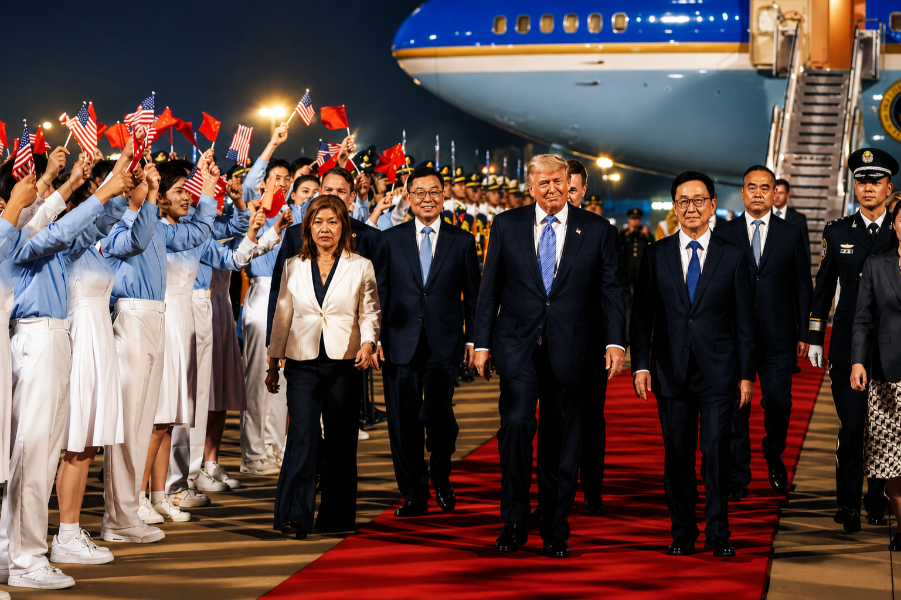
The debate around Nvidia China Market Reopening has quickly become one of the defining technology and geopolitical stories of 2026. As the United States and China continue competing for dominance in artificial intelligence, semiconductor policy now sits at the center of diplomatic negotiations. Against this backdrop, Nvidia CEO Jensen Huang joined former President Donald Trump during a high-level China delegation aimed at reopening commercial access for American technology firms.
The discussions focused heavily on semiconductor trade restrictions, AI chip exports, and broader economic cooperation between Washington and Beijing. The visit also highlighted how deeply intertwined corporate technology strategy and state-level diplomacy have become.
Nvidia occupies a uniquely influential position in the global AI economy. Its GPUs power data centers, AI research labs, cloud infrastructure platforms, and enterprise machine learning systems worldwide. However, ongoing US export restrictions have limited Nvidia’s ability to sell its most advanced processors to Chinese customers. Consequently, China remains both a massive commercial opportunity and a major political challenge for the company.
Meanwhile, the Trump-backed effort to reopen portions of the Chinese market reflects broader tensions inside US policy circles. Some officials prioritize national security and AI containment strategies. Others argue that excessive restrictions could weaken American companies while accelerating China’s domestic semiconductor independence. Therefore, Nvidia now finds itself balancing commercial expansion with mounting geopolitical scrutiny.
Why Nvidia China Market Reopening Is a Major Geopolitical Tech Issue?
China remains one of the world’s largest semiconductor demand centers. The country operates enormous cloud computing networks, rapidly expanding AI infrastructure, and advanced manufacturing ecosystems that require large-scale GPU deployment. As a result, Chinese technology firms have historically represented a significant market for Nvidia’s data center business.
However, Washington increasingly views advanced AI hardware as a strategic national security asset. Policymakers worry that high-performance GPUs could strengthen Chinese military systems, surveillance technologies, and state-backed AI programs. Therefore, export restrictions have become a central component of broader US China tech policy.
The issue goes beyond simple commercial competition. AI chips now influence military modernization, economic productivity, scientific research, and national technological leadership. Consequently, semiconductor trade policy has evolved into a core geopolitical battleground.
Several factors make the Nvidia China Market Reopening debate especially sensitive:
- China represents a major source of long-term AI infrastructure demand
- Advanced GPUs carry potential dual-use military applications
- US companies want access to international revenue streams
- Chinese firms continue investing heavily in local alternatives
- AI leadership increasingly shapes global political influence
Moreover, Nvidia’s position in global AI infrastructure magnifies the stakes. Few companies currently match Nvidia’s software ecosystem, developer tools, and GPU performance capabilities. Nevertheless, growing political pressure means every export decision now carries diplomatic consequences.
How Jensen Huang Became Central to US–China Tech Diplomacy?
The inclusion of Jensen Huang in Trump’s China delegation reflects a major shift in international trade negotiations. Corporate technology executives are no longer peripheral observers in diplomatic talks. Instead, they increasingly function as strategic participants in geopolitical decision-making.
Huang has repeatedly argued that restrictive export policies may unintentionally accelerate Chinese semiconductor self-sufficiency. In previous interviews and policy discussions, he emphasized that limiting American firms could create long-term opportunities for domestic Chinese competitors. Therefore, Nvidia has consistently lobbied for more flexible licensing frameworks rather than outright technology bans.
Meanwhile, Washington recognizes that semiconductor companies possess critical technical expertise that policymakers often lack. AI hardware capabilities, supply chain dependencies, and export compliance systems are highly specialized areas. Consequently, CEOs like Huang now play an influential advisory role during international negotiations.
The delegation also signals Trump’s broader push to reopen Chinese markets for American firms. While trade disputes continue, some US political leaders argue that limited commercial engagement remains necessary to protect domestic technology leadership and corporate competitiveness.
Key reasons Huang became central to these discussions include:
- Nvidia’s dominant position in AI accelerator markets
- Growing concern over lost Chinese revenue opportunities
- Rising competition from Chinese semiconductor firms
- Increasing complexity of export licensing systems
- The strategic importance of AI infrastructure worldwide
Additionally, Huang’s presence demonstrates how semiconductor diplomacy now extends beyond traditional government channels. Business leaders increasingly shape the direction of global technology policy.
Key Drivers Behind Nvidia China Market Reopening
| Factor | Impact on Nvidia | US Policy Role | China Response | Market Effect |
|---|---|---|---|---|
| AI chip demand growth | Expands revenue opportunities | Controls export permissions | Invests in domestic chips | Higher global competition |
| Export restrictions | Limits advanced GPU sales | National security enforcement | Accelerates self-reliance | Supply chain uncertainty |
| Semiconductor diplomacy | Increases political exposure | Integrates trade and tech policy | Uses negotiations strategically | Volatile investor sentiment |
| AI infrastructure expansion | Boosts global GPU demand | Regulates advanced hardware | Expands cloud AI systems | Intensifies chip race |
| Domestic Chinese competition | Threatens long-term dominance | Encourages strategic balancing | Funds local semiconductor firms | Reduced dependency on Nvidia |
AI Chip Export Controls and Their Impact on Nvidia’s Growth
US export restrictions have significantly reshaped Nvidia’s international strategy. Washington previously restricted exports of advanced AI accelerators to China, including high-performance data center GPUs. These measures targeted chips viewed as capable of supporting sophisticated AI training and military-related computing applications.
The debate intensified around products such as the H200 and Nvidia’s next-generation Blackwell architecture. Although some limited approvals and modified export-compliant variants emerged, regulators continued enforcing strict licensing requirements. Consequently, Nvidia faced growing uncertainty regarding long-term Chinese market access.
The company attempted to adapt by designing reduced-performance versions tailored to export regulations. However, these alternatives often failed to fully satisfy Chinese hyperscale customers seeking cutting-edge AI training capabilities. As a result, Chinese buyers increasingly explored local hardware options.
Meanwhile, semiconductor supply chains remain highly concentrated and globally interconnected. Manufacturing, packaging, design, and materials production occur across multiple countries. As a result, geopolitical conflict can disrupt entire technology ecosystems. Similar pressures are also reshaping global energy trade, as recent disruptions in Middle Eastern supply routes push China toward higher US ethane imports.
Several challenges continue shaping Nvidia’s export outlook:
- Licensing approvals remain politically sensitive
- Product modifications reduce competitive advantages
- Chinese buyers seek more stable suppliers
- Regulatory shifts can occur rapidly
- International customers monitor US policy closely
Nevertheless, Nvidia continues maintaining strong influence because of its CUDA software ecosystem, AI frameworks, and developer adoption. Even as China promotes domestic chips, Nvidia’s software compatibility remains deeply embedded across global AI development environments.
China’s Response: Domestic Chip Independence Push
China has accelerated efforts to reduce reliance on foreign semiconductor suppliers. Following years of export restrictions and technology sanctions, Beijing intensified investment in domestic chip manufacturing, AI accelerators, and semiconductor research programs.
Chinese firms increasingly position themselves as alternatives to Nvidia hardware. Meanwhile, state-backed industrial policy encourages local cloud providers, AI labs, and enterprises to adopt domestic solutions whenever possible. Consequently, China’s semiconductor ecosystem continues expanding despite technological challenges.
The push for self-sufficiency reflects broader concerns about supply chain vulnerability. Chinese policymakers understand that dependence on foreign AI hardware creates strategic risk during periods of geopolitical tension. Therefore, semiconductor independence has become a national priority.
Several developments illustrate China’s strategy:
- Increased funding for local semiconductor firms
- Expansion of domestic GPU research initiatives
- Stronger state support for AI infrastructure
- Encouragement of local hardware procurement
- Development of alternative AI software ecosystems
However, China still faces substantial technical obstacles. Nvidia maintains advantages in software integration, developer familiarity, and large-scale AI training performance. Consequently, many Chinese firms continue preferring Nvidia systems whenever access remains available.
On the other hand, prolonged restrictions may gradually weaken Nvidia’s long-term position inside China. As domestic alternatives improve, Chinese companies could become less dependent on American hardware providers.
US–China Semiconductor Trade Restrictions vs Market Access
| Policy Type | Business Impact | Nvidia Exposure | China Reaction | Industry Outcome |
|---|---|---|---|---|
| Advanced chip export bans | Reduces premium GPU sales | High | Accelerates domestic R&D | Market fragmentation |
| Licensing approval systems | Creates uncertainty | Moderate to high | Seeks alternative suppliers | Delayed deployments |
| Export-compliant chip variants | Preserves partial access | Moderate | Mixed commercial adoption | Reduced performance standards |
| Trade diplomacy initiatives | Potentially improves access | High strategic importance | Uses negotiations selectively | Temporary stabilization |
| Technology decoupling policies | Restructures supply chains | Long-term risk | Expands industrial policy | Regionalized semiconductor ecosystems |
Why AI Chips Have Become a Strategic Geopolitical Asset?
AI chips now function as critical national infrastructure. Unlike earlier generations of consumer electronics, advanced AI processors influence economic productivity, military modernization, cybersecurity, scientific research, and industrial competitiveness.
Therefore, governments increasingly treat semiconductors as strategic assets rather than ordinary commercial products. The United States and China both recognize that AI leadership could shape global power balances for decades.
Advanced GPUs enable large language models, autonomous systems, predictive analytics, and defense applications. Consequently, policymakers worry about the military and intelligence implications of unrestricted AI hardware transfers.
Meanwhile, semiconductor supply chains remain highly concentrated and globally interconnected. Manufacturing, packaging, design, and materials production occur across multiple countries. As a result, geopolitical conflict can disrupt entire technology ecosystems.
Several factors explain why AI chips became politically sensitive:
- AI influences economic and military competitiveness
- Semiconductor shortages expose supply chain vulnerabilities
- Governments seek technological sovereignty
- Advanced chips support both civilian and defense applications
- AI infrastructure increasingly drives national innovation capacity
In contrast to previous technology cycles, governments now intervene directly in hardware markets. Export policy, subsidies, investment controls, and diplomatic negotiations increasingly shape semiconductor industry outcomes.
Impact of China Market Reopening on Global Tech Industry
A partial reopening of the Chinese AI chip market could reshape the broader semiconductor landscape. Nvidia would likely benefit from renewed access to one of the world’s largest technology markets. Additionally, expanded Chinese demand could strengthen global GPU sales volumes.
However, the implications extend far beyond Nvidia alone. American competitors such as Advanced Micro Devices and Intel also monitor these negotiations closely. Any regulatory adjustments could influence competitive positioning across AI infrastructure markets.
Meanwhile, global cloud providers and enterprise AI developers would likely welcome more stable semiconductor trade conditions. Reduced uncertainty could improve supply chain planning and infrastructure investment timelines.
Potential industry impacts include:
- Increased global AI hardware demand
- More stable semiconductor supply chains
- Stronger competition among US chipmakers
- Lower pricing volatility in AI accelerators
- Expanded enterprise AI deployment capacity
Nevertheless, regulatory balancing remains difficult. US officials continue weighing commercial interests against national security priorities. Therefore, any reopening would likely include strict licensing conditions and monitoring requirements.
Risks and Limitations of Reopening the China Market
Despite growing commercial pressure, major obstacles remain. Political backlash inside the United States could intensify if policymakers believe advanced AI technology strengthens Chinese strategic capabilities.
Security agencies continue warning about dual-use risks associated with high-performance GPUs. Consequently, even limited export approvals may face congressional scrutiny and regulatory resistance.
Moreover, semiconductor policy remains highly unpredictable. Future administrations could tighten restrictions again depending on geopolitical developments, cybersecurity concerns, or military tensions.
Several risks complicate long-term market reopening:
- Domestic political opposition in Washington
- National security concerns over AI development
- Rapid changes in export compliance rules
- Continued Chinese self-sufficiency efforts
- Uncertain durability of trade agreements
Meanwhile, China continues pursuing semiconductor independence regardless of short-term negotiations. Therefore, even improved market access may not fully restore Nvidia’s previous dominance in the region.
Why Semiconductor Diplomacy Is Now Central to Global Trade?
The Nvidia China Market Reopening debate reveals a much broader transformation in international relations. Semiconductor companies are no longer operating solely as commercial enterprises. Instead, they increasingly function as strategic geopolitical actors shaping state-level policy discussions.
Governments now integrate technology executives directly into diplomatic negotiations because semiconductors influence economic resilience, military preparedness, and national competitiveness. Consequently, business strategy and foreign policy have become deeply interconnected.
AI hardware also serves as leverage during trade negotiations. Access to advanced chips can strengthen alliances, pressure rivals, or influence industrial development pathways. Therefore, semiconductor diplomacy now occupies a central position in global economic strategy.
Several trends define this structural shift:
- Technology firms increasingly influence foreign policy
- AI hardware access shapes global power dynamics
- Export controls guide innovation pathways
- Supply chains are becoming politically regionalized
- Trade negotiations increasingly revolve around technology access
Moreover, the world appears to be entering a long-term phase of partial technological decoupling combined with selective economic rebalancing. The United States seeks to maintain AI leadership while protecting national security interests. China, meanwhile, continues building domestic technological independence.
Nvidia sits directly at the center of this transition. The company represents both extraordinary commercial opportunity and intense geopolitical sensitivity. As a result, the Nvidia China Market Reopening discussion reflects far more than ordinary trade policy. It illustrates how semiconductors have become foundational instruments of global strategic power.
FAQs
Why is Nvidia trying to reopen the China market?
China represents one of the world’s largest AI infrastructure markets. Nvidia wants to restore access to Chinese customers while balancing US export regulations and national security concerns.
What role does Jensen Huang play in US–China talks?
Jensen Huang participates as both a technology executive and strategic industry advisor. His involvement reflects the growing importance of semiconductor companies in diplomatic negotiations.
Why are AI chip exports restricted to China?
The US government worries advanced AI chips could support Chinese military systems, surveillance technologies, and strategic AI development programs.
How important is China for Nvidia’s revenue?
China has historically been a major market for Nvidia’s data center and AI hardware business. Consequently, export restrictions significantly affect long-term commercial opportunities.
What are H200 chips used for?
The H200 is designed for advanced AI training, large-scale machine learning workloads, and high-performance data center computing applications.
How does China respond to Nvidia restrictions?
China continues investing heavily in domestic semiconductor development and AI chip independence while still maintaining demand for Nvidia’s software ecosystem.
Could US policy change again on chip exports?
Yes. Semiconductor export policy remains politically sensitive and may shift depending on geopolitical tensions, national security assessments, and trade negotiations.
Why are semiconductors politically sensitive?
Semiconductors power critical infrastructure, AI systems, defense technologies, and national economies. Therefore, governments increasingly view them as strategic assets.
What is semiconductor diplomacy?
Semiconductor diplomacy refers to the use of chip policy, technology access, and supply chain negotiations as tools of international political and economic strategy.
How could this affect the global AI industry?
Changes in US–China semiconductor policy could influence AI infrastructure investment, hardware pricing, supply chains, and international technology competition worldwide.