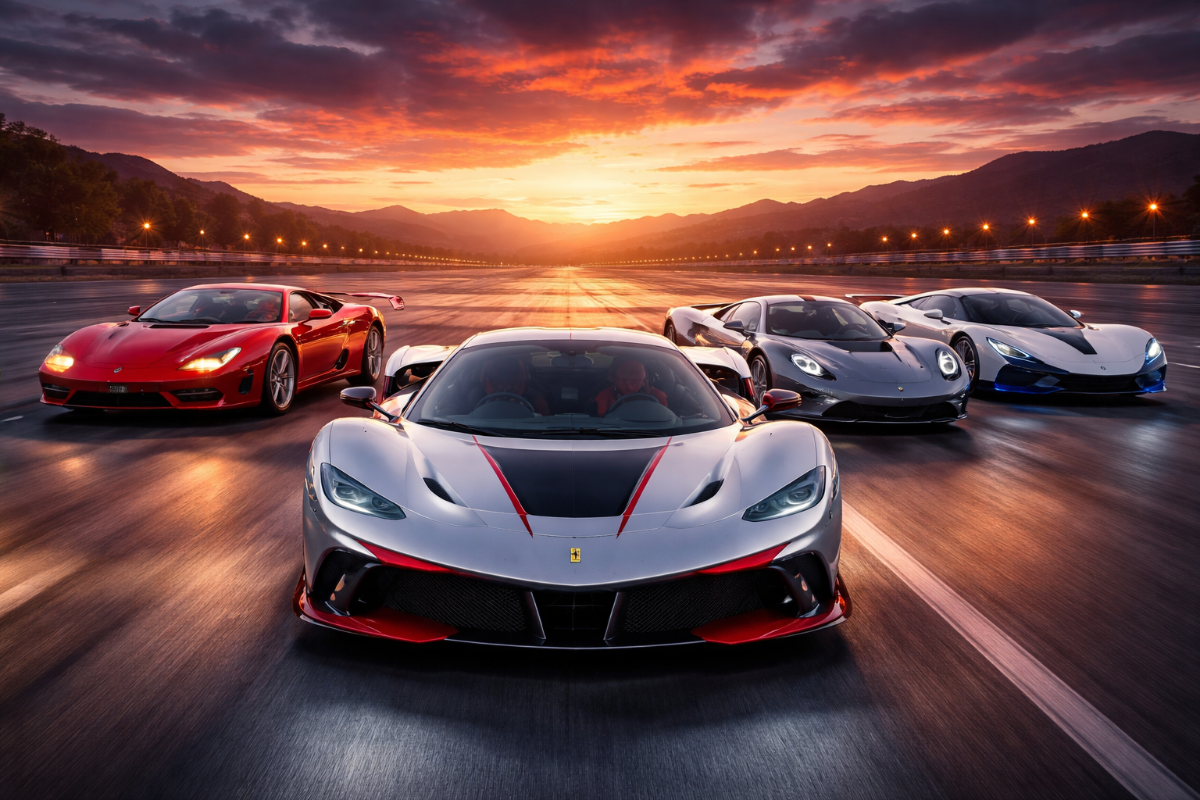
The Evolution of Supercars tells a fascinating story of speed, ambition, and technological innovation. For decades, supercars symbolized mechanical purity massive engines, minimal driver aids, and a relentless focus on raw performance. However, the modern era has transformed these machines dramatically.
Today’s supercars feature artificial intelligence, advanced aerodynamics, electrification, and digital driver assistance systems. Consequently, some enthusiasts question whether the essence of supercars has been diluted by technology.
Yet others argue that innovation has simply pushed performance into a new dimension.
So the real question becomes: has the Evolution of Supercars enhanced the driving experience, or has something been lost along the way?
The Birth of the Supercar: Mechanical Brilliance
The supercar era began in the 1960s and 1970s, when automotive manufacturers pursued extreme performance without compromise. At that time, speed relied purely on engineering skill rather than electronic intervention.
The defining characteristics of early supercars included:
-
Massive naturally aspirated engines
-
Lightweight chassis construction
-
Minimal driver aids
-
Aggressive styling
-
Limited production numbers
These machines demanded skill and courage from their drivers.
For example, vehicles such as the Lamborghini Miura and Ferrari Daytona redefined automotive performance standards. They delivered breathtaking speed while maintaining a raw and unpredictable driving character.
Moreover, early supercars focused on mechanical emotion rather than technological perfection. Drivers experienced every vibration, gear shift, and engine roar directly.
Consequently, these cars developed legendary reputations among collectors and enthusiasts.
Defining Eras in the Evolution of Supercars
The Evolution of Supercars can be divided into several major eras. Each period reflects technological shifts and changing consumer expectations.
1. The Analog Era (1960s–1980s)
This era emphasized raw mechanical engineering.
Key characteristics included:
-
Large naturally aspirated engines
-
Manual transmissions
-
Limited electronic assistance
-
High driver skill requirements
Cars like the Lamborghini Countach became cultural icons because of their extreme design and uncompromising performance.
However, these vehicles could be difficult to drive and often lacked reliability.
Nevertheless, they created the foundation of the modern supercar identity.
2. The Performance Refinement Era (1990s–2000s)
During this period, manufacturers began integrating advanced engineering techniques.
Improvements included:
-
Better aerodynamics
-
Carbon fiber construction
-
Early traction control systems
-
Improved braking technology
Cars such as the McLaren F1 pushed boundaries by combining lightweight engineering with record-breaking speed.
Moreover, supercars became more usable for everyday driving.
However, they still retained strong mechanical engagement.
3. The Digital Supercar Era (2010–Present)
Today’s supercars rely heavily on electronics, software, and advanced computing systems.
Key technologies include:
-
Active aerodynamics
-
Dual-clutch transmissions
-
Adaptive suspension systems
-
Torque vectoring
-
AI-assisted driving dynamics
Consequently, modern supercars deliver incredible performance while remaining surprisingly easy to control.
However, this technological sophistication has sparked debate among enthusiasts.
Some believe that digital control has replaced the raw driver involvement that once defined supercars.
Shift From Raw Power to Intelligent Performance
Historically, supercar performance depended mainly on engine size and horsepower.
Today, performance is increasingly driven by data, software, and electronic optimization.
Modern performance engineering focuses on:
-
Predictive traction management
-
Real-time torque distribution
-
Electronic stability systems
-
Advanced aerodynamic adjustments
Moreover, computers now control many aspects of vehicle behavior that drivers previously managed manually.
For instance, launch control systems optimize acceleration automatically. As a result, even inexperienced drivers can achieve near-perfect launches.
Consequently, lap times have improved dramatically.
However, this shift raises an important question: Does automation reduce driver involvement?
Some purists argue that the driver now plays a smaller role in achieving peak performance.
The Hybrid Revolution in Supercars
One of the biggest milestones in the Evolution of Supercars is the introduction of hybrid powertrains.
Initially, many enthusiasts resisted electrification because they feared reduced emotion and performance.
However, hybrid technology has actually enhanced performance in several ways.
Hybrid supercars combine:
-
High-revving combustion engines
-
Electric motors for instant torque
-
Regenerative braking systems
-
Battery-assisted acceleration
Consequently, hybrid supercars achieve extraordinary power levels.
For example, modern hypercars now produce over 1,000 horsepower while maintaining improved efficiency.
Moreover, electric motors eliminate turbo lag and deliver immediate acceleration.
Therefore, hybrids have become a powerful performance tool rather than merely an environmental solution.
The Rise of Electric Supercars
Electric technology represents the next major stage in the Evolution of Supercars.
Fully electric supercars offer unique advantages:
-
Instant torque delivery
-
Precise power distribution
-
Silent operation
-
Reduced mechanical complexity
However, electric powertrains also introduce new challenges.
These include:
-
Battery weight
-
Thermal management
-
Range limitations
-
Reduced engine sound experience
Nevertheless, electric supercars have achieved remarkable performance.
Some models accelerate from 0–100 km/h in under two seconds, outperforming many traditional hypercars.
Consequently, electric technology could reshape the future of high-performance vehicles.
Design Philosophy: From Aggression to Aerodynamic Science
Supercar design has also evolved dramatically.
Early supercars focused on dramatic visual impact. Sharp angles, low profiles, and exotic styling defined the category.
However, modern supercars integrate aerodynamic efficiency and airflow management.
Design now balances three priorities:
-
Downforce generation
-
Cooling optimization
-
Drag reduction
Moreover, designers collaborate closely with aerodynamic engineers.
Features such as active spoilers, air channels, and adaptive body panels enhance performance.
Consequently, modern supercars often look more futuristic and sculpted than their predecessors.
However, some enthusiasts miss the bold simplicity of earlier designs.
Driver Engagement vs Digital Control
One of the most controversial topics in the Evolution of Supercars is the debate between driver engagement and digital assistance.
Earlier supercars required intense driver focus. Steering feel, throttle modulation, and manual gear shifting defined the driving experience.
Modern supercars, however, rely heavily on electronics.
Advanced systems include:
-
Adaptive suspension
-
Electronic differential control
-
Stability management software
-
Autonomous safety features
These technologies significantly improve safety and performance.
However, some enthusiasts feel that they reduce emotional connection.
Nevertheless, many manufacturers attempt to balance both elements.
Some modern supercars offer analog driving modes that reduce electronic intervention.
Therefore, drivers can choose between pure mechanical engagement and optimized digital performance.
Collector Perspective: Rarity, Legacy, and Investment
The collector market has also influenced the Evolution of Supercars.
Classic supercars have become valuable assets due to their rarity and historical significance.
Collectors often value:
-
Limited production numbers
-
Unique design identity
-
Mechanical purity
-
Motorsport heritage
Consequently, vintage supercars often appreciate significantly in value.
However, modern supercars also attract collectors because of their advanced engineering and limited production runs.
Moreover, hypercars with hybrid technology have already become highly sought after.
Therefore, collectors now evaluate both technological innovation and historical importance when investing in supercars.
Classic vs Modern Supercars
| Feature | Classic Supercars | Modern Supercars |
|---|---|---|
| Engine Type | Naturally aspirated | Hybrid or turbocharged |
| Driver Aids | Minimal | Advanced electronic systems |
| Transmission | Manual | Dual-clutch automatic |
| Aerodynamics | Passive | Active aerodynamic systems |
| Driver Skill | Extremely high | Moderately assisted |
Market Expectations in the Modern Supercar Era
Consumer expectations have also changed significantly.
Modern supercar buyers now expect:
-
Extreme performance
-
Advanced technology
-
Luxury comfort
-
Everyday usability
Consequently, manufacturers must balance performance, innovation, and practicality.
However, this shift means supercars must appeal to a broader audience than before.
Earlier supercars often prioritized excitement over comfort.
Today’s buyers demand both.
The Future of the Evolution of Supercars
Looking ahead, the Evolution of Supercars will likely focus on several emerging technologies.
These include:
-
Advanced battery systems
-
Artificial intelligence driving assistance
-
Sustainable materials
-
Ultra-lightweight construction
Moreover, autonomous technology may eventually influence high-performance driving systems.
However, manufacturers must ensure that innovation does not eliminate the emotional appeal of supercars.
After all, passion remains the foundation of the supercar world.
Therefore, the challenge for the future is clear: combine cutting-edge technology with unforgettable driving experiences.
Frequently Asked Questions
What defines a supercar?
A supercar is a high-performance sports car characterized by extreme speed, advanced engineering, exotic design, and limited production.
How has the Evolution of Supercars changed performance?
Performance has shifted from purely mechanical power to technology-driven optimization using hybrid systems, aerodynamics, and electronic control.
Are electric supercars faster than traditional ones?
In many cases, yes. Electric motors deliver instant torque, allowing extremely fast acceleration compared to combustion engines.
Why do collectors value classic supercars?
Collectors value classic supercars for their rarity, mechanical purity, historical importance, and emotional driving experience.
Will hybrid and electric supercars replace gasoline engines?
Over time, electrification will likely dominate. However, combustion engines may remain popular among enthusiasts and collectors.