What You Need to Know About Private Jet Travel
Private jet travel gives you complete control over when you fly, where you land, and who’s on the plane with you. Here’s a quick breakdown of what it involves:
- What it is: Chartering or owning an aircraft for exclusive use, bypassing commercial airports and schedules
- Who it’s for: Ultra-high-net-worth individuals, executives, family offices, and groups who value time, privacy, and flexibility
- How much it costs: From around $2,800 for a short hop in a small aircraft to $34,500+ for a midsize jet on a 1.5-hour flight – and upward from there
- How to access it: On-demand charter, jet cards, fractional ownership, or full ownership
- Key providers: A global network of operators, brokers, and membership platforms serving domestic and international routes
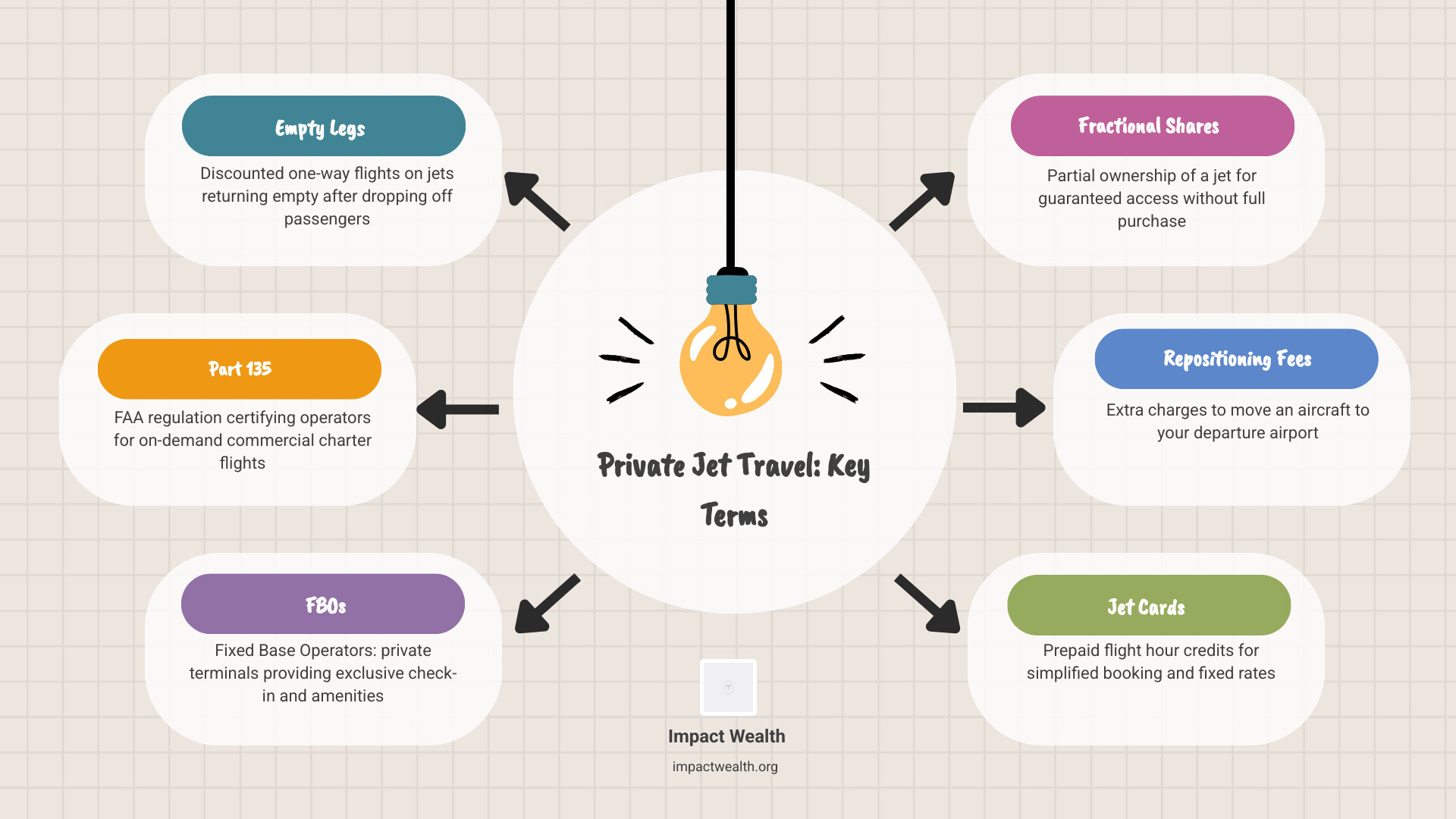
The world of private aviation has its own language. Empty legs. Part 135. FBOs. Fractional shares. Repositioning fees. If you’ve ever tried to book a private flight and felt lost in the terminology, you’re not alone.
This guide cuts through the jargon. Whether you’re evaluating your first charter or optimizing an existing aviation strategy, understanding these terms puts you in a stronger position – as a buyer, a negotiator, and a traveler.
The industry has also evolved significantly. Wellness programs, digital booking platforms, and sustainability initiatives are reshaping what flying private actually looks like in 2026. The experience now extends well beyond a leather seat and a bottle of champagne. For readers who want a baseline on the regulatory side of charter operations, the FAA explains on-demand charter rules under Part 135.
Why Private Jet Travel Appeals to High-End Flyers
In 2026, the primary currency for our readers isn’t just money—it’s time. Private jet travel is the ultimate tool for reclaiming those lost hours. Beyond the obvious prestige, the appeal lies in the total removal of friction. When we fly private, we aren’t just buying a seat; we are buying an environment tailored to our specific needs, whether that’s a mobile boardroom or a flying living room for the family.
The flexibility is unmatched. If a meeting in Miami runs late, the plane waits. If you decide on a whim to head from Los Angeles to a remote island in the Caribbean, you can often be in the air within a few hours. This convenience extends to our four-legged family members and oversized luggage—from sets of golf clubs for a weekend at Pebble Beach to skis for a trip to the Alps—all of which travel in the cabin with us, not in a dark cargo hold.
Private jet travel vs commercial flying
The difference between commercial first class and private jet travel is like the difference between a luxury bus and a chauffeured limousine. Even with a first-class ticket, you are still bound by the airline’s hub-and-spoke system, TSA security lines, and the inevitable “gate lice” at the terminal.
When flying private, we utilize Fixed Base Operators (FBOs). These are private terminals where the average time from car to takeoff is about 15 minutes. There are no liquid restrictions, no removing shoes, and no crowded waiting areas. Instead, we enjoy direct routes to smaller, more convenient airports that commercial jets simply cannot access, bringing us much closer to our final destination.
Who benefits most from private jet travel
While the “jet set” image often focuses on celebrities, the backbone of the industry consists of those who need to be in three cities in one day.
- Executives and Business Travelers: For those managing global interests, the ability to conduct confidential meetings mid-air is vital. Learn more about private jet charters for business travelers.
- Family Offices: Managing the travel of multiple generations becomes seamless when you can move ten people and their pets on a single manifest.
- Multi-stop Travelers: If you are visiting five factories in three countries over four days, commercial flight schedules make such a trip impossible.
What the airport experience is really like
The “airport experience” in private aviation is barely an airport experience at all. Upon arrival at the FBO, a concierge greets you. Your ID is checked discreetly, and your luggage is moved directly from your car to the aircraft. In many locations, such as Miami or Los Angeles, you can even be driven directly onto the tarmac to board the stairs of the jet. On the return leg, customs and immigration are often handled on the plane or in a private room within minutes, ensuring your discretion is maintained at all times.

Costs, Pricing Models, and What You’re Really Paying For
Understanding the bill is often the most complex part of private jet travel. The price tag isn’t just for the fuel; it covers the highly trained crew, maintenance, insurance, landing fees at exclusive airports, and the “positioning” of the aircraft to get it to you.
How much private jet travel typically costs in 2026
Pricing has stabilized in 2026, but it remains a significant investment. As a rule of thumb, charter flight prices start around $11,000 per hour for larger, more capable aircraft. However, smaller “hops” can be more accessible. A short 40-minute flight in a light jet might cost approximately $2,800. If you step up to a Midsize Jet for a 1.5-hour journey, such as New York to West Palm Beach, you should expect a quote closer to $34,500.
What changes the final charter quote
Several “invisible” factors can inflate a quote:
- Repositioning Fees: If the plane is in Miami and you are in Palm Beach, you pay for the flight to pick you up.
- De-icing: In winter months, de-icing a large jet can cost $5,000 to $10,000 per application.
- Peak Dates: Flying around major events or holiday periods will always command a premium.
- International Permits: Long-haul international flights can involve complex overflight permits and handling fees.
Charter, jet card, membership, or ownership?
How you pay depends on how much you fly.
- On-Demand Charter: Best for those flying less than 25 hours a year. You pay as you go with no long-term commitment.
- Jet Cards & Memberships: These programs often offer fixed hourly rates and guaranteed availability.
- Fractional Ownership: This allows you to buy a share of a specific plane, giving you many of the benefits of access and consistency without the full overhead of sole ownership. Explore more jet leasing options.
Empty leg flights and shared private options
For the savvy traveler, “empty legs” offer a way to experience private jet travel at a fraction of the cost, sometimes up to 75% off. These occur when a plane needs to fly empty to its next destination to pick up a full-paying client. Some platforms also offer shared private options, where you can book a single seat on a private aircraft between popular hubs like New York and South Florida. The tradeoff? You must be flexible with your timing, as these flights are often canceled if the primary charter changes.
Aircraft Types, Range, Speed, and Cabin Fit
Choosing the right “metal” for the mission is crucial. You wouldn’t take a Ferrari to haul lumber, and you shouldn’t take a Light Jet for a transatlantic crossing.
Choosing the right aircraft for your trip
When selecting an aircraft, we consider the “Mission Profile.” How many people? How much luggage? Is there a need for a flat floor or a full galley? For a quick trip to the Bahamas, a Turboprop or Light Jet is perfect. For a nonstop flight to Europe or China, you’ll need the cabin height and range of an Ultra-Long-Range jet.
Private jet travel by aircraft category
- Very Light Jets (VLJ): Perfect for 1-4 passengers on 1-2 hour flights.
- Light Jets: The workhorses for regional travel, seating 6-7.
- Midsize & Super Midsize: These offer “stand-up” cabins and can fly coast-to-coast.
- Heavy & Ultra-Long-Range: These are flying palaces that can fly 14+ hours nonstop with dedicated bedrooms and showers.

How far private jets can fly and how fast they go
Modern jets are pushing the boundaries of physics. Ultra-long-range jets can fly over 7,500 nautical miles, meaning you can fly from Los Angeles to Southeast Asia without a fuel stop. Speeds typically hover around Mach 0.85 to Mach 0.90, significantly faster than commercial airliners, which are often throttled back to save fuel.
Popular routes and destination patterns
Certain corridors are always buzzing. New York to South Florida is arguably one of the most traveled private routes in the world. We also see high demand for private jet charters to Europe during the summer and flights to China for global trade summits. Domestically, Los Angeles and Miami remain the primary hubs for luxury aviation. For those looking to skip the flight altogether for shorter distances, luxury helicopter transfers in Miami are the preferred way to beat the traffic.
How to Book a Charter Flight Step by Step
The booking process has moved from fax machines to sleek apps, but the underlying logistics remain complex.
Step-by-step private jet travel booking process
- The Request: You provide your dates, passenger count, and destination.
- The Sourcing: Your broker or provider scans the market for suitable aircraft.
- The Quote: You receive a selection of aircraft options with photos and prices.
- The Contract: Once you select a plane, you sign the charter agreement and wire the funds.
- The Trip Sheet: You receive a “Trip Sheet” with your tail number, crew names, and FBO addresses.
What documents and details you’ll need
For domestic flights, a valid government-issued ID is all you need. For international travel, passports are required, and the operator will handle the manifest for customs. If you are bringing a pet, ensure you have their vaccination records, especially for travel to Europe.
Safety and regulatory standards to verify
Safety is non-negotiable. Always ensure your operator is “Part 135” certified (the FAA standard for commercial charter). We also look for third-party audits from organizations like ARGUS or Wyvern. These ratings tell us that the operator goes above and beyond the minimum legal requirements for pilot training and aircraft maintenance.
What amenities and onboard services to expect
In 2026, the focus has shifted toward holistic wellness. Many providers now offer wellness-forward amenities such as cabin lighting designed to reduce jet lag and nutrition-focused menus. You can expect high-speed Wi-Fi, multi-course catering, and often a flight attendant on larger aircraft to ensure every detail is perfect. Explore more about air charter services.
Sustainability, Etiquette, and Real-World Use Cases
As we move through 2026, the industry is addressing its environmental footprint with more than just words.
Is private aviation becoming more sustainable?
The rise of Sustainable Aviation Fuel (SAF) is the biggest story in luxury aviation. Many providers now offer carbon offset programs as standard. While we aren’t at “zero emission” long-range flight yet, newer fleets are significantly more fuel-efficient than the jets of a decade ago.
Pets, luggage, and special requests
One of the greatest joys of private jet travel is the “yes” factor. Want a specific vintage of Bordeaux? Done. Need to bring four Great Danes? No problem. However, etiquette dictates that we inform the operator of these needs in advance so they can ensure the aircraft is properly prepared and weighted.
When owning a jet makes sense
If you find yourself flying more than 200-250 hours a year, full ownership starts to make financial sense. It allows for total control over the crew and the cabin’s interior design. However, for most of our readers, the “headache-free” nature of a Jet Card or Fractional share is the preferred route.
Private jet travel trends shaping 2026
We are seeing a move toward “Experiential Travel.” It’s no longer just about the flight; it’s about the destination access. Providers are now partnering with exclusive estates and vineyards to offer “door-to-vineyard” experiences. There is also a significant trend toward “Quiet Luxury” – where the service is impeccable but the branding is understated. Read more about the rise of quiet luxury in aviation.
Frequently Asked Questions About Private Jet Travel
Can you bring pets and extra luggage on a private jet?
Yes, and this is one of the primary reasons people choose private jet travel. Most jets are pet-friendly, allowing your dog or cat to sit right next to you. Luggage capacity depends on the aircraft; while a Heavy Jet can hold dozens of bags, a Very Light Jet may have limited space for bulky items like hard-shell suitcases.
How early should you arrive for a private flight?
For domestic flights, arriving 15 to 20 minutes before your scheduled departure is plenty. For international flights, 30 minutes is recommended to allow for passport processing. The plane leaves when you are ready.
Are private jets always safer than commercial flights?
When flying with reputable, audited operators, private aviation is exceptionally safe. Because the aircraft are often newer and the pilots have more personalized experience with the specific tail number, many argue the safety profile is superior to the high-volume environment of commercial airlines.
Conclusion
Private jet travel is the ultimate expression of autonomy. In a world that feels increasingly crowded and scheduled, the ability to move through the skies on your own terms is the truest luxury. By demystifying the terms – from understanding the cost of a West Palm Beach charter to choosing the right access model – you can ensure your time in the air is as productive or as peaceful as you desire.
At Impact Wealth, we believe that luxury is not just about the price tag, but about the quality of the experience. Whether you are flying for a global summit or a family retreat, the right aviation strategy is your passport to a more efficient and elegant life. Discover more about the luxury aviation lifestyle.