
Crypto taxation has entered a new phase. With the IRS now requiring exchanges to issue Form 1099-DA and enforcement activity continuing to increase, the question is no longer whether to report your crypto activity, it is whether your current approach is accurate enough to withstand scrutiny.
For investors managing meaningful portfolios, the stakes are higher than they were a few years ago. A missed DeFi transaction, a miscalculated cost basis, or a staking reward classified incorrectly can create problems that cost significantly more than the tax owed. The right software handles all of this automatically, and the options available in 2026 are considerably more capable than what existed even two years ago.
Top Picks at a Glance
| Tool | Best For | Free Plan | Starting Price |
| CoinLedger | Best overall | Yes | $49/year |
| Koinly | International investors | Yes (no download) | $49/year |
| ZenLedger | DeFi-heavy portfolios | Yes (25 tx) | $49/year |
Below is a full breakdown of the six strongest crypto tax platforms available this year, evaluated across accuracy, integration depth, DeFi and NFT coverage, and overall value for investors who take compliance seriously.
What Separates Good Crypto Tax Software from the Rest
Before getting into the tools, it is worth being clear about what actually matters when evaluating these platforms.
Cost basis accuracy. This is the core function. The software needs to correctly track the original purchase price of every asset across every exchange and wallet, apply the right accounting method (FIFO, HIFO, or LIFO), and flag gaps in the transaction history before they become reporting errors.
Integration breadth. Investors with assets spread across Coinbase, Kraken, multiple DeFi wallets, and a hardware wallet need a platform that connects to all of them — ideally without requiring manual CSV exports at every step.
DeFi and NFT classification. Yield farming income, liquidity pool withdrawals, staking rewards, and NFT sales are all taxable events, and they need to be classified correctly. Staking rewards are ordinary income at receipt, not capital gains at sale. Most platforms handle centralized exchange trades well; where they diverge is in handling on-chain complexity.
Form generation. At minimum: Form 8949, Schedule D, and increasingly Form 1099-DA. For investors with international holdings or more complex situations, FBAR and international reporting support matters too.
Audit trail documentation. If the IRS requests substantiation, you want a clean, organized record of every transaction, classification decision, and cost basis calculation. Not every platform makes this easy.
The 6 Top Crypto Tax Software Platforms in 2026
1. CoinLedger — Best Overall

CoinLedger consistently sits at the top of this category, and the reasons are straightforward. The platform combines the broadest integration coverage in the market — over 1,000 exchanges, wallets, and blockchains — with one of the most reliable error reconciliation systems available. For investors whose activity spans multiple chains and platforms, that last point matters considerably.
The missing cost basis problem is the most common source of tax filing errors in crypto. When an asset is bought on one exchange, transferred to a wallet, and sold on a DEX, the chain of custody needs to be preserved across all three steps. CoinLedger’s reconciliation tools surface these gaps proactively rather than letting them produce inflated gain calculations downstream.
The platform also generates a comprehensive audit trail report with all paid plans — useful documentation if questions arise later.
Key features:
- 1,000+ exchange, wallet, and blockchain integrations
- FIFO, HIFO, and LIFO cost basis calculation
- Full DeFi and NFT support, including correct income classification for staking rewards
- Tax-loss harvesting tool with unrealized loss identification
- Form 8949, Schedule D, and Form 1099-DA generation
- Direct export to TurboTax, TaxAct, H&R Block, and TaxSlayer
- Audit trail report on all paid plans
- 14-day money-back guarantee
Pricing:
- Free: Unlimited imports, portfolio tracking, capital gains preview
- Hobbyist: $49/year (up to 100 transactions)
- Investor: $99/year (up to 1,000 transactions)
- Pro: $199/year (up to 3,000 transactions)
- Unlimited: $299+/year
Best for: Investors who want the most thorough reconciliation and the widest integration coverage, particularly those with DeFi activity or multi-chain portfolios.
2. Koinly — Best for International Investors
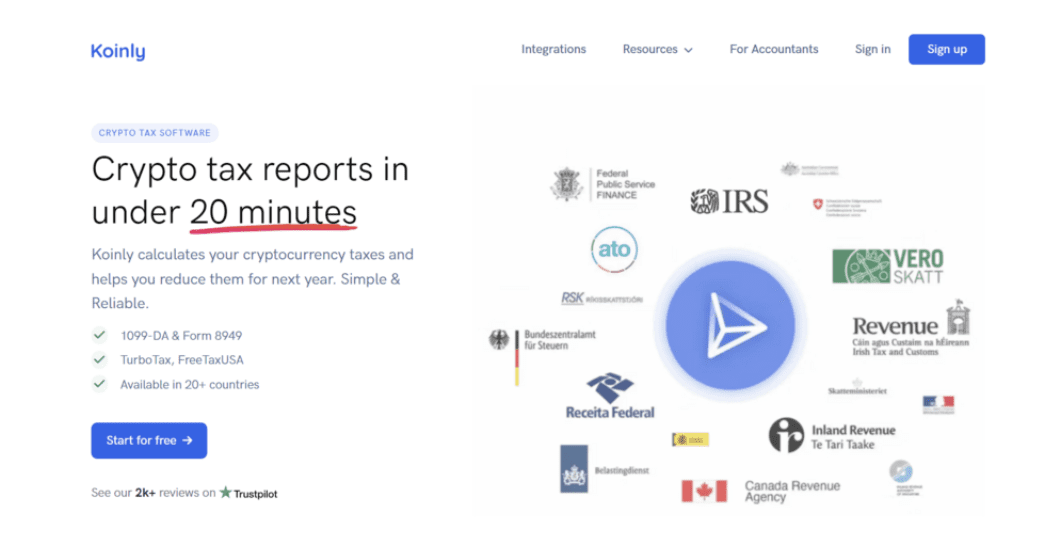
Koinly is the strongest option for investors managing crypto across multiple jurisdictions. It supports localized tax reporting for over 100 countries — including US Form 8949, UK HMRC reports, Canadian CRA filings, and Australian ATO documents — which makes it the practical choice for anyone with cross-border holdings or residency complexity.
The platform connects to over 850 exchanges, wallets, and blockchains, and its real-time portfolio dashboard shows capital gains and income positions before a paid report is purchased. For investors who want to monitor their tax exposure throughout the year rather than discover it in April, that visibility is genuinely useful.
Some users have noted that Koinly occasionally mislabels transaction types and that reclassification can require more manual effort than on competing platforms. For straightforward portfolios this is rarely an issue; for complex multi-chain activity it is worth factoring in.
Key features:
- 850+ exchange and wallet integrations
- Tax reports for 100+ countries
- Real-time capital gains and income tracking on free plan
- DeFi, NFT, staking, and margin trading support
- Tax-loss harvesting insights
- TurboTax and international tax software export
Pricing:
- Free: Unlimited imports and portfolio tracking (no report download)
- Newbie: $49/year (up to 100 transactions)
- Hodler: $99/year (up to 1,000 transactions)
- Trader: $179/year (up to 3,000 transactions)
- Pro: $279/year (10,000+ transactions)
Best for: International investors, or US-based investors with multi-jurisdiction complexity who need localized report generation beyond standard IRS forms.
3. TokenTax — Best for High-Net-Worth and Complex Situations

TokenTax operates at the intersection of software and professional services. At its entry tier it functions as a capable tax platform; at its upper tiers it provides access to a dedicated CPA who reviews and files your return from start to finish. For investors with significant unrealized gains, complex DeFi activity, or audit exposure, the professional review option is worth serious consideration.
The software itself has received mixed reviews for ease of use relative to CoinLedger or Koinly — the self-service interface is less polished. Where TokenTax genuinely earns its premium is in access to in-house tax professionals who understand crypto at a detailed level, which is a different offering than a general accountant with a crypto knowledge base.
The absence of a free plan and a no-refund policy mean you are committing before you can fully evaluate the experience — a meaningful downside compared to competitors.
Key features:
- Full-service CPA filing available at higher tiers
- DeFi and NFT support from Premium plan upward
- FBAR and international reporting for complex cross-border situations
- TurboTax integration
- Tax-loss harvesting
- Dedicated account management at top tiers
Pricing:
- Basic: $65/year (Coinbase only)
- Premium: $199/year (all exchanges, DeFi and NFT support)
- Pro: $799/year
- VIP: $3,499/year (includes dedicated CPA filing)
Best for: High-net-worth investors, active DeFi participants with significant positions, or anyone who wants a credentialed tax professional to own the filing process rather than doing it themselves.
4. ZenLedger — Best for DeFi and On-Chain Activity

ZenLedger has built its reputation specifically around DeFi tax reporting, and it shows in the depth of the platform’s protocol coverage. With support for over 400 exchanges and 100+ DeFi protocols — including Uniswap, Aave, PancakeSwap, and others — it handles the kind of on-chain complexity that causes other platforms to produce generic transfer classifications.
The platform correctly distinguishes DeFi income from capital gains, which matters for accurate filing. Yield farming income and liquidity pool rewards are not capital gains events; misclassifying them understates ordinary income and creates filing risk. ZenLedger’s classification engine handles this reliably.
Every plan includes access to a tax professional, which is unusual at entry-level pricing and adds a useful layer of verification for investors who want a second opinion on their return.
Key features:
- 400+ exchange integrations and 100+ DeFi protocol support
- Correct income vs. capital gains classification for DeFi events
- Staking, yield farming, liquidity pool, and mining tax support
- Tax professional access on all plans
- TurboTax integration and IRS form generation
- SOC 2 certified
Pricing:
- Free: Up to 25 transactions
- Starter: $49/year (up to 100 transactions)
- Premium: $149/year (up to 5,000 transactions)
- Executive: $399/year (unlimited transactions)
Best for: Active DeFi investors, yield farmers, and liquidity providers whose portfolios involve significant on-chain activity across multiple protocols.
5. TaxBit — Best for Compliance-First Investors

TaxBit was founded by CPAs and tax attorneys, and that origin shows in the platform’s approach. It prioritizes technical compliance accuracy over ease of use, making it less intuitive for casual users but well suited for investors who view their crypto activity through a compliance lens first.
The platform has shifted its primary focus toward enterprise and exchange-side tax solutions in recent years, but individual investor tools remain available. TaxBit’s strength is in handling exchange-reported transactions cleanly — particularly relevant now that Form 1099-DA has expanded the reporting obligations for major exchanges. For investors whose activity is concentrated on large centralized exchanges already integrated with TaxBit, the reconciliation workflow is smooth.
DeFi and niche wallet coverage is more limited than CoinLedger or ZenLedger, which is worth factoring in if your portfolio extends significantly beyond centralized exchange activity.
Key features:
- Founded by CPAs and tax attorneys with a compliance-first design philosophy
- Automated transaction syncing from supported exchanges
- Form 8949, Schedule D, and 1099-DA support
- Tax-loss harvesting and portfolio performance dashboard
- Real-time tax position tracking
Pricing:
- Plans from $65/year; higher tiers available for increased transaction volumes
Best for: Compliance-focused investors whose activity is primarily on major centralized exchanges, particularly those prioritizing accuracy and audit-readiness over breadth of DeFi integration.
6. H&R Block & CoinTracker — Best for Investors Who Self-File
H&R Block earns its place on this list for a specific use case: investors who file their own taxes through a consumer platform and want their crypto activity handled in the same workflow, without running a separate dedicated tool.
H&R Block integrates directly with CoinLedger, Koinly, and other crypto tax platforms, allowing you to import your crypto tax report and have it folded into your full federal and state return. For investors with relatively contained crypto activity — positions on one or two centralized exchanges, straightforward buy-and-hold history — this integration eliminates a step and keeps everything in one place.
It is not the right choice for complex portfolios. Significant DeFi activity, multiple wallet addresses, NFT positions, or staking income across multiple protocols all require dedicated crypto tax software upstream. But as a filing endpoint that handles the final step cleanly, it is a practical option.
Key features:
- Direct integration with major crypto tax platforms
- Import crypto gains into full federal and state return in one workflow
- Access to H&R Block tax professionals for review or assisted filing
- Form 8949 and Schedule D support
- In-person and online filing options
Pricing:
- Crypto support included in Deluxe tier and above (federal filing from approximately $35–$55)
Best for: Self-filing investors with straightforward crypto activity who want a single platform for their full tax return rather than a separate crypto-specific tool.
The Compliance Has Changed
Two developments in 2026 make accurate crypto tax reporting more important than it has been in previous years.
The first is Form 1099-DA. Starting with the 2025 tax year, centralized exchanges are required to issue 1099-DAs to customers and report to the IRS. This means the IRS now has direct visibility into exchange-level crypto activity for most investors, the era of unreported gains on major platforms is effectively over.
The second is the ongoing expansion of IRS enforcement capability. The agency has steadily increased its technical capacity for blockchain analysis, and the front-page crypto disclosure question on Form 1040 has been in place since 2019. Investors who have been inconsistent in reporting prior years face compounding risk as enforcement activity increases.
Choosing the Right Tool
For most investors, CoinLedger offers the best combination of integration depth, reconciliation accuracy, and value. The free tier lets you import your full transaction history and preview your tax position before committing to a paid plan, which removes most of the risk from the evaluation process.
For investors with international holdings or residency complexity, Koinly’s global reporting coverage is worth the trade-off in reconciliation depth. For those with significant DeFi positions, ZenLedger’s on-chain classification engine is the most specialized option available. And for investors who simply want a professional to own the process, TokenTax’s full-service tier provides that option at a defined cost.
The common thread across all of them: the time to connect your accounts and understand your tax position is not the week before filing. Most of these platforms offer free access to your transaction history and gain summary, there is no reason to wait.