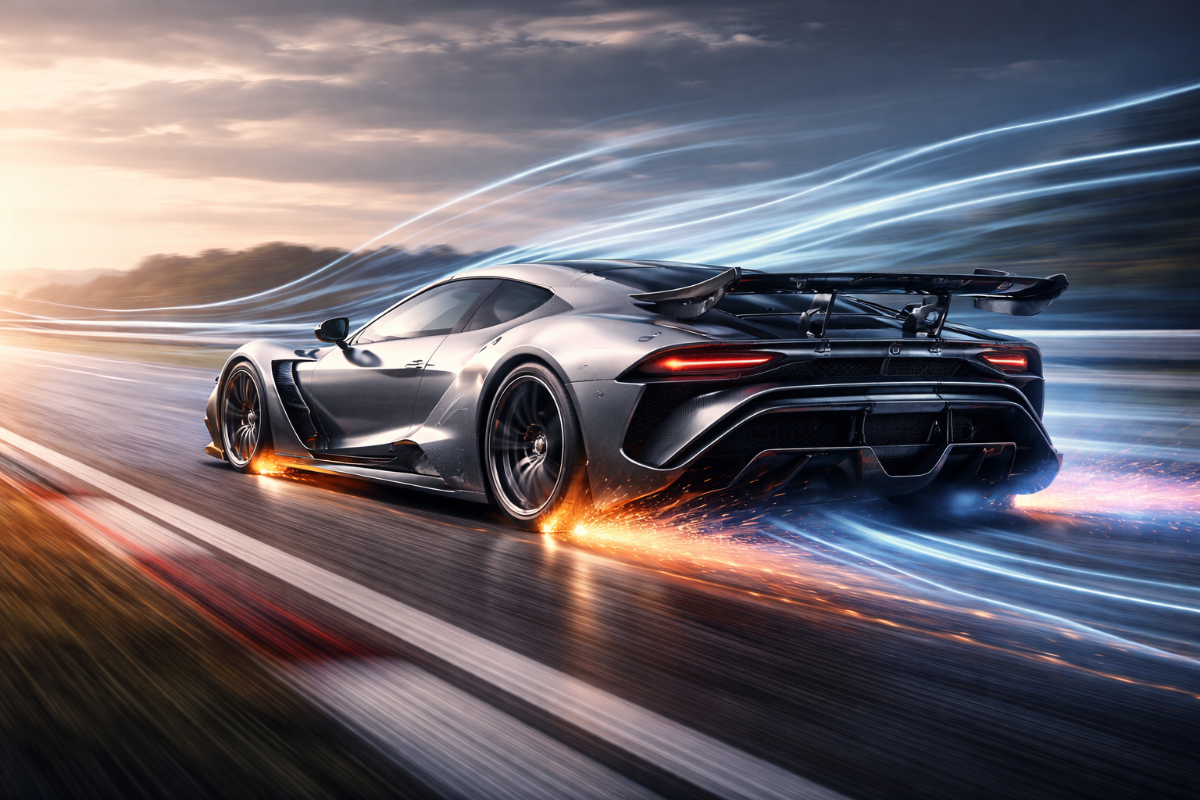
Modern hypercars represent the absolute frontier of engineering, where science and speed intersect with precision. The Physics Behind the Fastest Cars on Earth in 2026 is not simply about raw horsepower—it is about mastering aerodynamics, thermodynamics, friction control, and power-to-weight optimization. These vehicles operate at the outer limits of mechanical possibility, routinely exceeding 400 km/h through carefully balanced physical principles.
At extreme velocity, air becomes a wall of resistance, heat becomes a structural threat, and tire friction becomes a matter of survival. Consequently, engineers must harmonize airflow management, torque distribution, structural rigidity, and energy efficiency to unlock maximum speed safely. Hypercar performance is therefore less about brute force and more about intelligent design rooted in physics.
For automotive engineers, hypercar collectors, and high-net-worth automotive investors, understanding The Physics Behind the Fastest Cars on Earth in 2026 provides deeper insight into value, innovation cycles, and long-term technological leadership in extreme-speed engineering.
Extreme-Speed Engineering: The Scientific Foundation
Aerodynamics: Conquering Air Resistance
At speeds beyond 300 km/h, aerodynamic drag becomes the dominant opposing force. Drag force increases exponentially with velocity, governed by:
Fd = ½ ρ Cd A v²
Where:
-
ρ = air density
-
Cd = drag coefficient
-
A = frontal area
-
v = velocity
Consequently, reducing drag coefficient (Cd) by even 0.01 can significantly improve top speed.
Bugatti Chiron Super Sport 300+
With a drag coefficient around 0.28 in top-speed mode, the Chiron demonstrates how aerodynamic efficiency systems and elongated bodywork reduce turbulence and airflow separation.
However, minimizing drag alone is insufficient. Downforce must be carefully balanced to maintain tire contact at 400+ km/h. Too much downforce increases drag; too little reduces stability.
Active Aerodynamics and Downforce Optimization
Active rear wings, adaptive ride height, movable flaps, and air-bleed systems adjust in milliseconds. Moreover, computational fluid dynamics (CFD) modeling allows engineers to simulate airflow under countless conditions before physical testing.
Koenigsegg Jesko Absolut
The Jesko Absolut minimizes drag aggressively, removing large rear wings in favor of stabilizing fins and optimized airflow channels. As a result, it targets speeds exceeding 480 km/h under ideal conditions.
Key aerodynamic strategies include:
-
Drag coefficient optimization
-
Venturi tunnels and ground-effect management
-
Adaptive spoilers
-
Air curtain systems
-
Underbody diffusers
These systems represent high-performance automotive physics in action.
Power-to-Weight Ratio: The Speed Multiplier
Speed is proportional not only to power but to mass. Therefore:
Power-to-weight ratio = Horsepower ÷ Vehicle Mass
Carbon-fiber monocoque structures significantly reduce mass while maintaining torsional rigidity above 40,000 Nm/degree in some hypercars.
Lightweight materials include:
-
Carbon-fiber reinforced polymer (CFRP)
-
Titanium exhaust systems
-
Forged aluminum suspension components
Consequently, hypercars achieve ratios exceeding 1 hp per kg.
Thermodynamics and Heat Dissipation
Internal combustion hypercars generate immense heat—often over 2,000°C within turbochargers. Effective heat management ensures:
-
Engine durability
-
Brake efficiency
-
Tire structural integrity
-
Transmission stability
Radiators, intercoolers, oil coolers, and advanced ceramic thermal coatings prevent catastrophic failure at sustained high velocity.
Electric hypercars face similar thermodynamic challenges. Battery packs must maintain optimal temperature ranges; otherwise, performance drops sharply. Heat exchangers and liquid cooling systems are essential to ultra-high-velocity vehicle dynamics.
Torque Distribution and Traction Physics
At 400 km/h, traction is everything. Torque vectoring systems distribute power dynamically between wheels to maximize grip and stability.
SSC Tuatara
The SSC Tuatara employs advanced traction algorithms and rear-wheel-drive calibration for high-speed stability.
Frictional grip is governed by:
F = μN
Where:
-
μ = coefficient of friction
-
N = normal force (downforce + weight)
Consequently, tire compound design becomes a critical constraint in top-speed engineering.
Performance Physics Metrics Comparison
Below is a comparative overview of leading hypercars and their extreme-speed engineering metrics:
| Hypercar | Top Speed (km/h) | Horsepower | Torque (Nm) | Drag Coefficient (Cd) | Power-to-Weight Ratio |
|---|---|---|---|---|---|
| Bugatti Chiron Super Sport 300+ | 490+ | 1,600 hp | 1,600 Nm | ~0.28 | ~0.85 hp/kg |
| Koenigsegg Jesko Absolut | 480+ (target) | 1,600 hp | 1,500 Nm | ~0.278 | ~1.0 hp/kg |
| SSC Tuatara | 475+ | 1,750 hp | 1,735 Nm | ~0.279 | ~1.1 hp/kg |
| Rimac Nevera | 412 | 1,914 hp | 2,360 Nm | ~0.30 | ~0.9 hp/kg |
This comparison demonstrates how small aerodynamic differences significantly impact theoretical top speed.
Mechanical Stability and Control Systems
Speed without stability is useless. Therefore, mechanical systems are engineered to ensure predictable handling at extreme velocity.
| System Category | Example Implementation |
|---|---|
| Active Aero Components | Adaptive rear wings, dynamic ride height |
| Suspension Setup | Double wishbone with adaptive dampers |
| Tire Specifications | Michelin custom-rated hypercar tires |
| Braking Systems | Carbon-ceramic discs with multi-piston calipers |
| Chassis Materials | Carbon-fiber monocoque + aluminum subframes |
Hypercar braking systems can generate deceleration forces exceeding 2G. However, brake heat can exceed 1,000°C, requiring carbon-ceramic materials for resilience.
Energy Transfer Efficiency
Efficiency determines usable speed. Internal combustion engines convert only ~30–40% of fuel energy into motion. Electric drivetrains, however, exceed 85–90% efficiency.
Consequently, electric hypercars such as the Rimac Nevera demonstrate explosive acceleration due to instant torque delivery.
Energy management strategies include:
-
Regenerative braking
-
Advanced ECU tuning
-
Multi-clutch transmission systems
-
AI-driven torque optimization
The Limits of Physics at 400+ km/h
Even with advanced engineering, speed ceilings exist due to:
-
Tire rotational stress limits
-
Air density variations
-
Surface friction
-
Structural vibration frequencies
As a result, many hypercars are electronically limited below their theoretical maximum.
The Future of Ultra-High-Velocity Vehicle Dynamics
Beyond 2026, hypercar innovation will accelerate dramatically.
Electric Propulsion Evolution
Solid-state batteries may reduce mass while increasing energy density.
AI-Assisted Vehicle Dynamics
Real-time adaptive torque vectoring and predictive aerodynamics will optimize stability beyond human reflex capacity.
Advanced Composite Materials
Graphene-infused carbon fiber may enhance structural strength-to-weight ratios.
Next-Generation Aerodynamics
Active airflow morphing panels could dynamically reshape body contours at speed.
Moreover, electric propulsion combined with artificial intelligence will likely redefine The Physics Behind the Fastest Cars on Earth in 2026, pushing boundaries toward 500+ km/h production vehicles.
For collectors and investors, extreme-speed engineering is no longer just about prestige—it represents the cutting edge of applied physics and material science. Consequently, understanding high-performance automotive physics is essential for identifying the next generation of automotive innovation leaders.
FAQ: The Physics Behind the Fastest Cars on Earth in 2026
1. What ultimately limits top speed?
Aerodynamic drag and tire structural integrity are primary constraints.
2. Are these speeds safe?
Only under controlled conditions with specialized tires and long straight test tracks.
3. Do tires limit performance?
Yes. At 500 km/h, centrifugal forces can destroy standard tires.
4. Is fuel efficiency relevant at 400 km/h?
Fuel consumption increases exponentially due to drag. Efficiency becomes secondary to thermal management.
5. Will 500 km/h be achieved soon?
Technically feasible, however regulatory, safety, and tire constraints remain significant barriers.