Singapore commercial real estate has emerged as one of the world’s most sought-after asset classes for institutional investors, sovereign wealth funds, and ultra-high-net-worth individuals seeking durable returns and geopolitical stability. Within the first tier of global investment destinations, Singapore increasingly stands apart because it combines transparent regulation, limited land supply, and deep integration into global capital markets.
Over the last decade, the Singapore property market has evolved beyond traditional regional investment narratives. Instead, it now represents a strategic allocation for global wealth preservation and long-duration capital deployment. As billionaire real estate investment strategies become more defensive and selective, commercial property in Singapore has attracted unprecedented interest from family offices, pension capital, and multinational investors searching for resilient income streams.
This shift reflects broader global trends. Wealth migration toward Asia continues to accelerate, while investors seek jurisdictions capable of protecting capital during periods of inflation, geopolitical uncertainty, and monetary tightening. In that environment, commercial property plays a central role in high net worth property investment because it combines income generation with asset appreciation.
Singapore’s scarcity of developable land further strengthens this investment thesis. Unlike larger markets that can expand horizontally, Singapore’s finite geography creates structural constraints that support long-term value growth and reinforce its position as Asia’s leading destination for institutional real estate capital.
Why Singapore Is a Global Safe Haven for Capital?
Singapore’s reputation as a global safe haven rests on more than economic growth. It reflects decades of policy consistency, institutional credibility, legal predictability, and disciplined urban planning.
Investors allocating billions across multiple continents increasingly prioritize environments where governance reduces uncertainty. Singapore’s stable political framework, independent judiciary, and strong property rights provide conditions that institutional investors rarely find in equal measure elsewhere.
Moreover, Singapore occupies a strategic position between Western capital markets and emerging Asian growth economies. As global capital flows diversify away from concentrated exposure to North America and Europe, Singapore benefits from acting as both a destination and a regional operating base.
Several structural factors reinforce its appeal:
- Strong regulatory oversight and investor protection
- Transparent taxation and financial administration
- Global banking infrastructure
- Currency credibility and macroeconomic discipline
- Strategic access to Southeast Asian growth markets
These advantages support capital preservation while also enabling productive deployment into income-generating assets.
As volatility reshapes global allocation strategies, investors increasingly treat Singapore not merely as a market but as a jurisdictional hedge against uncertainty.
Inside Singapore Commercial Real Estate Market
The evolution of Singapore commercial real estate reflects broader transformations across institutional investing.
Historically, investors approached office and mixed-use assets primarily for yield. Today, allocations increasingly focus on long-term strategic positioning. Singapore’s commercial market benefits from demand generated by financial institutions, technology firms, legal services, asset managers, and multinational headquarters.
Commercial assets in Singapore generally cluster into several categories:
- Prime office towers
- Mixed-use integrated developments
- Business parks
- Logistics and industrial facilities
- Retail and hospitality-linked commercial assets
Prime office properties remain especially attractive because of limited supply and consistently high occupancy in premium districts.
Foreign capital inflows continue to influence valuation dynamics. Global investors increasingly perceive prime real estate Singapore opportunities as comparable to sovereign-quality assets that also generate recurring income.
Importantly, market liquidity supports institutional participation. Large transactions can occur efficiently relative to many regional markets, reinforcing Singapore’s role as an Asia commercial property hub.
Commercial demand therefore reflects not speculative momentum but durable economic activity anchored in financial and corporate expansion.
Grade A Office Demand in the CBD
The strongest expression of investor confidence appears in Singapore’s Grade A office market.
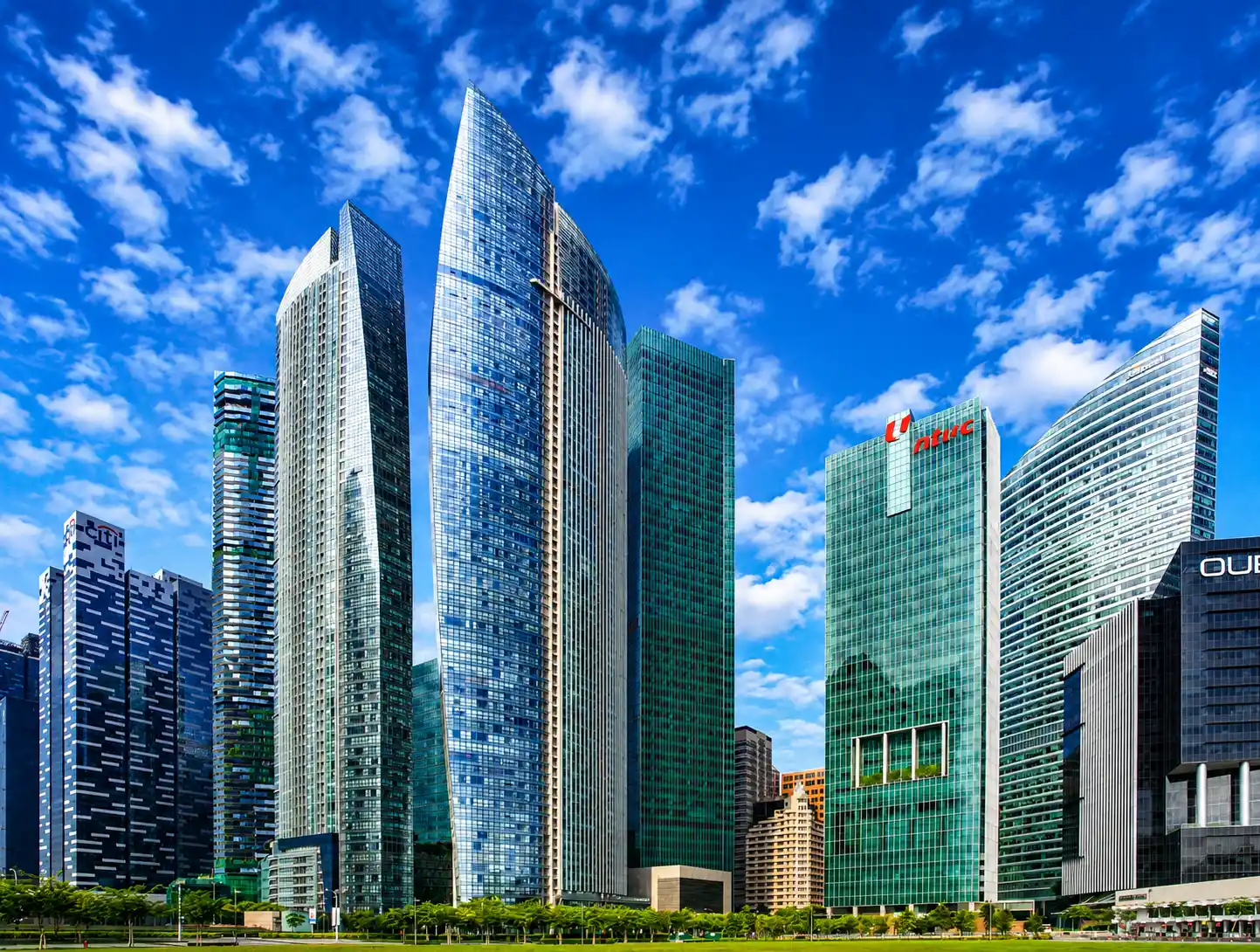
CBD Singapore office towers remain among the most competitive commercial assets in Asia. Premium office demand continues to attract capital because tenants increasingly prioritize quality, operational efficiency, and prestigious locations.
Multinational corporations, private banks, technology platforms, consulting firms, and asset managers maintain a strong preference for premium CBD space. Office presence in Singapore often serves both operational and signaling functions.
Several drivers continue supporting Grade A office absorption:
- Regional headquarters consolidation
- Growth in private wealth management
- Expansion of digital and financial services
- Increased demand for premium workplace experiences
- Limited new supply in core districts
This demand profile differs from many Western office markets where hybrid work has pressured occupancy.
Key Drivers of Singapore Grade A Office Demand
| Driver | Impact on Market |
|---|---|
| Multinational headquarters | Sustains premium leasing |
| Banking and financial expansion | Supports CBD concentration |
| Family office growth | Increases advisory ecosystem demand |
| Scarcity of central locations | Supports rental resilience |
| Regional business hub status | Drives long-term occupancy |
While cyclical fluctuations remain inevitable, the long-term trajectory suggests Singapore’s premium office market increasingly functions as infrastructure for capital formation rather than traditional commercial inventory.
Why Billionaires and Family Offices Are Investing in Singapore?
Global family offices increasingly view Singapore as a strategic wealth management platform rather than a secondary geographic allocation.
This transition accelerated as wealthy investors reassessed geopolitical exposure, tax efficiency, and intergenerational capital preservation.
Family office investment Singapore activity expanded because the jurisdiction offers more than favorable administration. Investors gain access to sophisticated banking services, legal expertise, and high-quality asset ecosystems.
Commercial property occupies a unique position within billionaire portfolios because it satisfies several objectives simultaneously:
- Stable cash flow
- Inflation protection
- Currency diversification
- Reduced volatility versus public markets
- Long-term capital appreciation
Ultra-wealthy investors increasingly favor concentrated ownership of institutional-quality assets over fragmented portfolios.
Additionally, commercial property provides optionality. Assets can support financing structures, succession planning, and cross-border wealth strategies.
This explains why billionaire real estate investment patterns increasingly prioritize commercial exposure in politically stable Asian markets.
Singapore vs Global Commercial Real Estate Hubs
Singapore competes directly with the world’s most established commercial property centers. Yet its appeal derives from balance rather than dominance in any single metric.
Comparison of Major Commercial Real Estate Hubs
| Market | Stability | Regulation | Yield Potential | Investor Sentiment |
| Singapore | Very High | Highly Transparent | Moderate–Strong | Strong |
| Hong Kong | Moderate | Strong but evolving | Moderate | Selective |
| London | High | Mature | Moderate | Stable |
| New York | Moderate–High | Mature | Variable | Cyclical |
| Dubai | Moderate | Improving | Higher | Growth-oriented |
Hong Kong continues to maintain global financial importance but faces changing perceptions around long-term certainty.
London retains institutional depth and legal credibility; however, economic transitions and taxation shifts influence investor behavior.
New York remains essential for global capital, although interest rates and office market adjustments create periodic uncertainty.
Dubai attracts entrepreneurial capital through yield opportunities and rapid development cycles.
Singapore occupies a distinctive position because it combines institutional stability with Asian growth exposure. As a result, investors often use Singapore allocations to anchor broader regional portfolios.
Role of REITs and Institutional Capital
Institutional ownership continues reshaping commercial property investment globally, and Singapore has become a leading example of this trend.
The REITs Singapore market provides investors with scalable access to income-producing assets while maintaining liquidity advantages.
Singapore’s REIT ecosystem supports multiple sectors including:
- Office
- Industrial
- Logistics
- Retail
- Data infrastructure
Institutional investors increasingly combine direct ownership with listed exposure.
This dual structure broadens participation and supports price discovery across asset classes.
Meanwhile, sovereign wealth funds and pension institutions reinforce market credibility. Their presence sends a powerful signal to private capital that valuations reflect disciplined underwriting rather than speculative expansion.
The rise of institutional ownership also aligns with global demand for inflation-hedged income-producing assets.
Supply Constraints and Long-Term Value Growth
Scarcity remains one of Singapore’s most underestimated investment drivers.
Unlike geographically expansive markets, Singapore’s development capacity is constrained by physical limitations and deliberate planning policy.
Limited land availability creates long-term pricing support across prime commercial districts.
Urban planning also contributes to sustained asset performance. Infrastructure investments consistently improve accessibility, productivity, and tenant quality.
Major strengths include:
- Integrated transport systems
- Planned business districts
- Smart-city implementation
- High infrastructure reliability
- Controlled development cycles
These structural characteristics reduce oversupply risk and encourage disciplined valuation growth.
As a result, investors increasingly interpret premium pricing not as excess but as a reflection of enduring scarcity.
The Future of Singapore’s Commercial Property Market
The next decade may strengthen Singapore’s role within global capital allocation.
Several forces are converging simultaneously.
Asian wealth creation continues expanding. Cross-border capital mobility remains active. Institutional investors increasingly seek resilient jurisdictions capable of absorbing large-scale allocations.
Commercial real estate therefore occupies a strategic position between infrastructure, finance, and wealth preservation.
Future demand is likely to remain concentrated in:
- Luxury office real estate Singapore
- Sustainable mixed-use developments
- Digitally enabled commercial assets
- Institutional-grade urban projects
At the same time, regulatory discipline may continue limiting speculative excess.
That balance supports a market designed for endurance rather than acceleration.
Unique Insight: Singapore Commercial Real Estate as a Wealth Anchor
Singapore commercial real estate is increasingly becoming more than an asset class.
For many institutional investors and ultra-wealthy families, it functions as a physical expression of capital preservation in Asia.
The premium valuations observed across Singapore’s office and commercial sectors often reflect trust rather than simple rental mathematics. Investors pay for regulatory certainty, geopolitical neutrality, and governance continuity.
This premium increasingly mirrors behavior traditionally associated with sovereign bonds or reserve currencies.
Institutional trust drives valuation resilience.
Scarcity strengthens confidence.
Commercial assets become repositories of strategic capital.
In that sense, Singapore acts not merely as an investment destination but as a global wealth anchor positioned at the center of Asia’s economic expansion.
Frequently Asked Questions
What is Singapore commercial real estate?
Singapore commercial real estate includes office buildings, mixed-use developments, business parks, logistics facilities, and other income-producing assets designed for business activity rather than residential use.
Why is Singapore attractive to billionaire investors?
Singapore combines political stability, transparent regulation, strong financial infrastructure, and strategic access to Asia, making it highly attractive for long-term capital preservation.
Is Singapore property a good investment?
Many investors consider Singapore attractive because of its disciplined regulation, scarcity-driven value support, and strong institutional participation.
How stable is the Singapore property market?
The Singapore property market is generally viewed as one of the most stable in Asia due to government oversight, liquidity, and diversified economic drivers.
What types of commercial properties are in demand?
Grade A offices, mixed-use developments, logistics assets, and institutional-quality commercial properties remain highly sought after.
How do REITs work in Singapore?
REITs allow investors to own shares in income-producing property portfolios while receiving distributions generated by rental income.
How does Singapore compare to Hong Kong and London?
Singapore typically attracts investors seeking greater policy predictability and stronger exposure to Asian economic growth.
Why are family offices moving to Singapore?
Family offices increasingly choose Singapore because of wealth infrastructure, regional access, governance standards, and capital protection frameworks.
What drives demand in Singapore CBD offices?
Demand is primarily supported by multinational corporations, private banks, financial services firms, and regional headquarters operations.
Why is Singapore commercial real estate considered a safe-haven asset?
Singapore commercial real estate is viewed as a safe-haven asset because investors associate it with regulatory consistency, limited supply, strong institutional participation, and long-term income resilience.