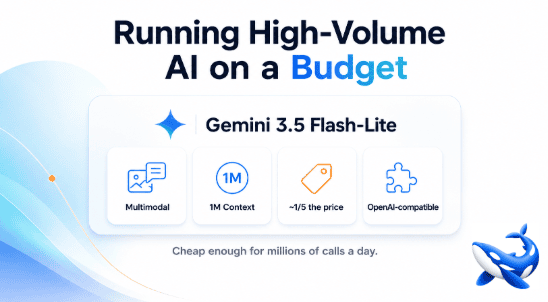
Most teams don’t fail at AI because the models aren’t smart enough. They fail because the economics don’t work at scale. A feature that costs a fraction of a cent per call in a demo can quietly turn into a five-figure monthly bill once it’s classifying every support ticket, tagging every image, or summarizing every document that flows through the business. The hard part of production AI isn’t the clever prompt — it’s making the clever prompt affordable a few million times a day.
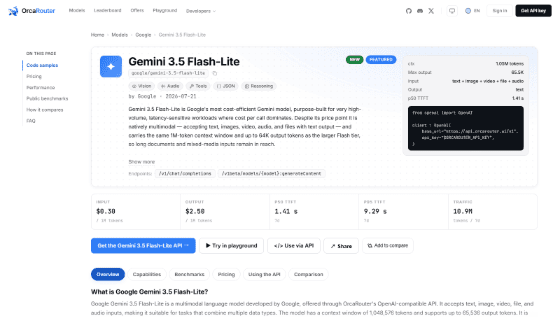
That is exactly the problem Google’s cheapest current model is built for. Released on July 21, 2026, Gemini 3.5 Flash-Lite is the most cost-efficient member of the Gemini family, aimed at very high-volume, latency-sensitive workloads where cost per call dominates everything else – at roughly a fifth of the price of the larger 3.6 Flash tier. If you want to try it against your own traffic, a router like OrcaRouter exposes it through one OpenAI-compatible endpoint alongside pricier tiers, so you can compare cost and quality on the same call.
What you get for the low price
The instinct with a “lite” model is to assume you’re trading away everything useful. That’s not the case here. Despite the budget positioning, Gemini 3.5 Flash-Lite is natively multimodal: it accepts text, images, video, audio, and files, and returns text. It carries the same 1-million-token context window and up to 64K output tokens as the full Flash tier, so long documents and mixed-media inputs are still on the table. And it keeps the production essentials — configurable reasoning effort, native tool calling, and structured JSON outputs.
The trade-off isn’t “cheap but crippled.” It’s “cheap and focused.” You give up some of the raw reasoning ceiling of a frontier model but keep multimodality, long context, and the plumbing you need to wire it into real systems. For a huge class of everyday tasks, that reasoning ceiling was never the bottleneck.
Where it earns its keep
The sweet spot is any task that is simple-to-moderate in difficulty but runs enormously often:
- Classification and routing — labeling tickets, tagging content, deciding which downstream workflow a request should go to.
- Extraction — pulling structured fields out of invoices, emails, PDFs, or forms into clean JSON.
- Summarization — condensing documents, transcripts, or threads at scale, where the 1M-token context helps.
- Lightweight agents — tool-calling loops that need to run reliably and cheaply rather than reason deeply.
- Synthetic data — generating training or test data in bulk, where per-call cost is multiplied by millions of rows.
The common thread is volume. Run a task ten times a day and price barely matters; run it ten million times a day and price becomes the product decision.
More capable than “lite” suggests
Cheap models used to mean fragile models. That gap has narrowed. On agentic and long-context evaluations, Gemini 3.5 Flash-Lite punches above its tier — a reported 74.0% on OSWorld-Verified and 72.2% on 128k multi-needle retrieval, both comfortably ahead of the previous 3.1 Flash-Lite. These are vendor-reported figures, so treat them as directional and benchmark on your own data. But the trend is clear: each generation of “lite” absorbs more of what used to need a mid-tier model, while the price stays low.
Route, don’t standardize
The most common mistake is picking one model for everything. Standardize on a frontier model and you overpay for the 90% of calls that are easy; standardize on a cheap one and you under-serve the 10% that are hard. The better pattern is a routing tier: send the bulk of easy, high-volume traffic to an inexpensive model like Gemini 3.5 Flash-Lite, and escalate only the hard requests to a frontier model. Because the model speaks the OpenAI chat-completions format, adding it to an existing integration is close to a one-line change.
How to try it without locking in
Because it’s OpenAI-compatible, you don’t need a vendor-specific SDK to evaluate it. Aggregators that expose many models behind one endpoint make A/B testing easy. OrcaRouter, for instance, exposes Gemini 3.5 Flash-Lite alongside frontier and budget models through one OpenAI-compatible API, so you can benchmark cost and quality side by side and route between them without maintaining a separate integration per vendor.
A sensible plan: take a representative sample of real traffic, run it through both your current model and the lite model, and compare output quality on your task, latency at your concurrency, and total cost at your real volume. If the lite model holds quality on 80–95% of that traffic, route those calls to it and escalate the rest.
What to watch out for
A lite model is not a frontier model. Don’t reach for it on tasks that hinge on deep multi-step reasoning or high-stakes correctness where a wrong answer is expensive. Watch quality on your hardest edge cases specifically, since averages hide tail failures. And always validate vendor benchmarks against your own data.
Frequently asked questions
How much cheaper is Gemini 3.5 Flash-Lite than the bigger Flash tier? Google positions it at roughly a fifth of the price of 3.6 Flash. At low volume that difference is noise; at millions of calls a day it’s the line item that decides whether a feature is profitable.
Does going cheaper mean going text-only? No. It stays natively multimodal — text, images, video, audio, and files in, text out — and keeps the 1M-token context window and up to 64K output tokens. That’s unusual at this price point and is a big part of its appeal.
Is it hard to integrate? Not usually. It speaks the OpenAI chat-completions format as well as Gemini’s native API, so if your code already targets an OpenAI-compatible client, adoption is typically a base-URL and model-name change.
Which tasks should stay on a frontier model? Anything that hinges on deep multi-step reasoning, subtle judgment, or high-stakes correctness. Keep those on the premium tier and route only the easy, high-volume majority to the lite model.
How should I decide if it’s good enough for my use case? Sample real production traffic, run it through the lite model, and grade the output against your own quality bar alongside latency and projected cost. If it clears the bar on most of that traffic, route those calls to it and escalate the rest.
The bottom line
The story of production AI in 2026 is less about the ceiling of what the smartest model can do and more about the floor of what the cheapest capable model makes affordable. Gemini 3.5 Flash-Lite sits at that floor: multimodal, long-context, OpenAI-compatible, and priced for millions of calls a day. Pair it with a simple routing strategy — cheap by default, frontier on escalation — and you keep most of the quality for a fraction of the cost.