A well-cut suit still says something in a boardroom that confidence alone cannot replace. For executives, entrepreneurs, and high-performing professionals, tailoring remains one of the most reliable signals of standards, discipline, and attention to detail. But the assumption that the most expensive option is automatically the right one is outdated. Off-the-rack suits, made-to-measure suits, and bespoke suits each serve a different purpose, and the smartest choice depends less on budget and more on how a man actually lives and works.
Understanding what separates these three approaches, and who each one is built for, makes it far easier to invest in men’s tailoring that actually earns its place in a wardrobe.
Off-the-Rack: Fast and Accessible
Off-the-rack suits are manufactured in standard sizes and stocked ready to wear, which makes them the fastest and most accessible entry point into professional menswear. A man can walk into a store, try on several options, and leave the same day with a suit ready for minor alterations.
The appeal is straightforward. Off-the-rack suits are widely available, generally the most affordable of the three options, and require no waiting period. For professionals who need a suit for an unexpected event, a last-minute interview, or simply want a reliable option in rotation, this accessibility is genuinely valuable.
The limitation lies in proportion. Off-the-rack suits are built around average body measurements, meaning shoulders, chest, waist, and sleeve length are approximations rather than a reflection of an individual’s actual build. A skilled tailor can improve the fit considerably through alterations such as adjusting the waist, hemming trousers, or shortening sleeves. Structural elements like shoulder width, however, are difficult or impossible to change, so the final result still works within the constraints of a standard pattern.
Off-the-rack tends to suit professionals who wear tailoring occasionally, are building a wardrobe on a budget, or need something functional rather than a signature piece.
Made-to-Measure: The Middle Ground
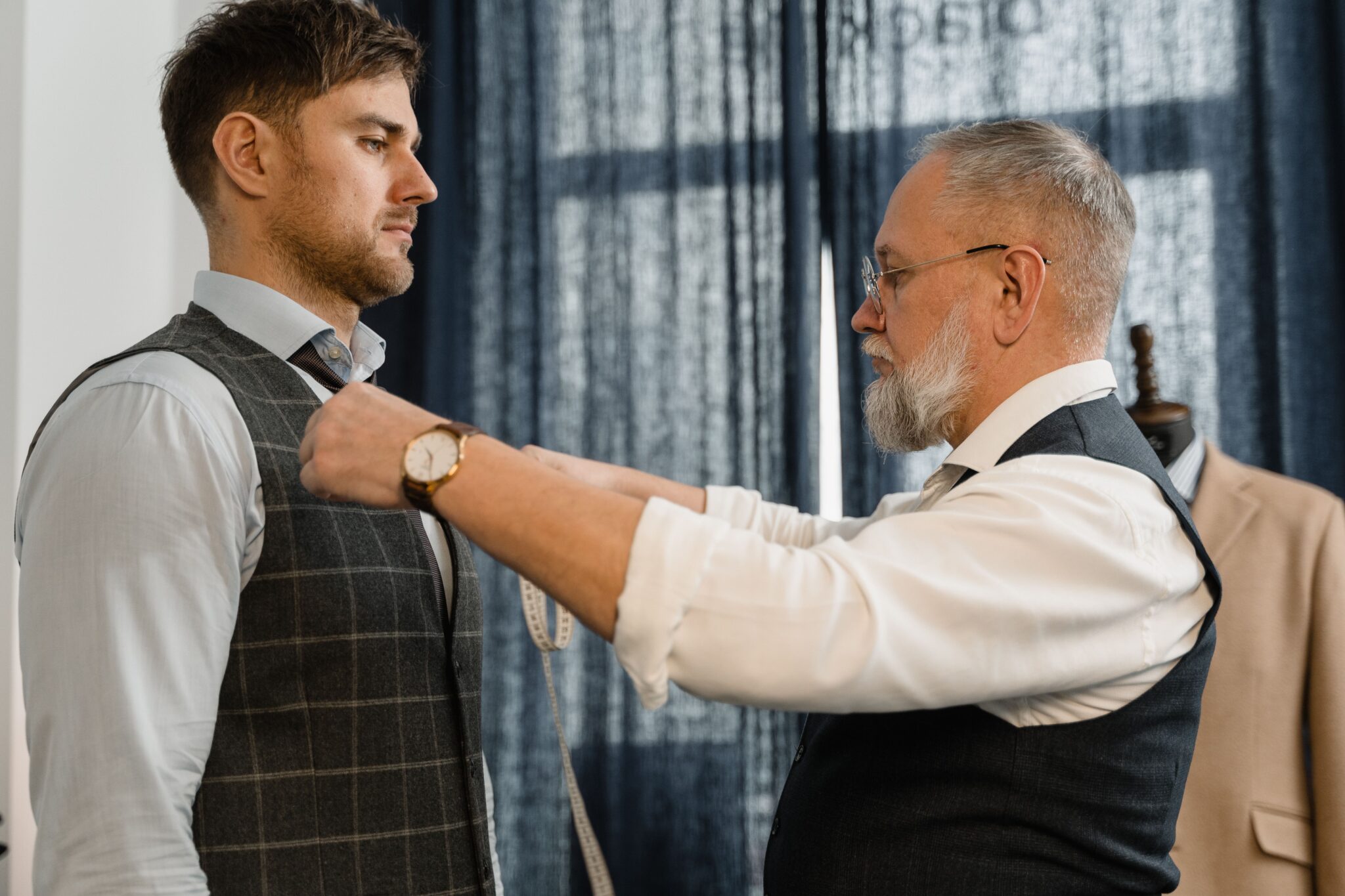
Made-to-measure suits start with an existing pattern, but that pattern is adjusted based on an individual’s actual measurements. A tailor measures the shoulders, chest, waist, arms, and posture, then modifies a base template to reflect them. Fabric selection, lining, buttons, and certain style details can typically be customized as well.
This process results in a noticeably better fit than off-the-rack, without the time investment of a fully bespoke garment. For busy professionals, made-to-measure suits represent a practical middle ground. They offer real personalization and improved comfort while still following a relatively efficient timeline, often requiring only one or two fittings.
Made-to-measure has become popular among executives who want custom suits that fit properly and reflect some personal style, without committing to the time a fully bespoke process demands.
Bespoke: Maximum Personalization
Bespoke suits are a different process entirely. Rather than adjusting an existing pattern, a bespoke garment is built from an individual pattern created specifically for the client. This typically involves multiple fittings over several weeks, allowing the tailor to refine the fit at each stage.
The result is the highest level of control over construction, silhouette, and detail. Nearly every element, from canvas construction to lapel shape, can be specified by the client. That level of customization comes with a longer timeline and a higher price point, reflecting the skilled labor and attention involved.
Bespoke tailoring is not automatically the better choice for every professional. It suits men who wear tailoring frequently, have specific fit requirements, or view their wardrobe as a long-term investment rather than a practical necessity. For someone who wears a suit twice a year, the added cost and time may not translate into meaningful value.
Which Option Makes Sense for a High-Performing Professional?
The right choice comes down to several practical factors rather than status alone.
Time. Off-the-rack requires the least, bespoke requires the most, and made-to-measure sits comfortably in between.
Fit. Bespoke offers the most precise fit, made-to-measure offers a significant improvement over standard sizing, and off-the-rack depends heavily on alterations.
Budget. Off-the-rack is the most accessible, made-to-measure sits at a moderate price point, and bespoke commands the highest investment.
Frequency of wear. Men who wear executive suits several times a week tend to benefit most from made-to-measure or bespoke, while occasional wearers often find off-the-rack sufficient.
Personalization. Bespoke offers full control, made-to-measure offers meaningful customization within a template, and off-the-rack offers the least flexibility.
Professional image. All three can look sharp when properly fitted, but bespoke and made-to-measure tend to hold their shape and move better on the body over a full workday.
For most executives and entrepreneurs, made-to-measure strikes the most practical balance between fit, cost, and time. Bespoke becomes worthwhile for those who treat tailoring as a daily uniform or who place a high value on complete personalization.
Convenience Is Changing the Tailoring Experience
One of the more significant shifts in professional menswear over the past several years has been the move toward convenience. Traditional custom suiting once required multiple visits to a showroom, often during business hours that conflict with a demanding schedule.
Modern tailoring services have adapted to this reality. Private appointments, workplace fittings, and mobile tailoring have made it possible for professionals to be measured, consult on fabric, and complete fittings without disrupting a full workday. Services such as Lupo Bianco bring the fitting experience directly to the client, offering mobile tailoring that fits into an executive’s calendar rather than the other way around. For professionals who value fit and personalization but cannot justify hours spent traveling to and from a showroom, this shift matters nearly as much as the tailoring itself.
Fit Still Matters More Than the Label
Regardless of which category a suit falls into, the final result comes down to fit. A well-fitted off-the-rack suit will always look better than a poorly fitted bespoke garment.
Key markers of proper fit include shoulders that sit flat without pulling or bunching, a jacket length that covers the seat without extending too far, sleeves that end near the wrist bone, and a trouser break that suits the wearer’s preferred style, whether clean or slightly stacked. Waist suppression should follow the body’s natural line without appearing overly tight, and the wearer should be able to move, sit, and reach comfortably throughout the day.
Posture and comfort matter as much as measurements on paper. A suit that looks correct on a hanger but restricts movement in a meeting or during travel has failed its purpose, no matter how it was constructed.
Final Word
There is no single correct answer to the off-the-rack, made-to-measure, or bespoke question. The right choice depends on how often a man wears tailoring, how much time he can dedicate to the process, and how much he values personalization. For some professionals, a properly altered off-the-rack suit covers every need. Others will find that made-to-measure or bespoke suits deliver a return on investment through better fit, comfort, and long-term durability. What matters most is choosing deliberately, rather than defaulting to whichever option seems most impressive on paper.