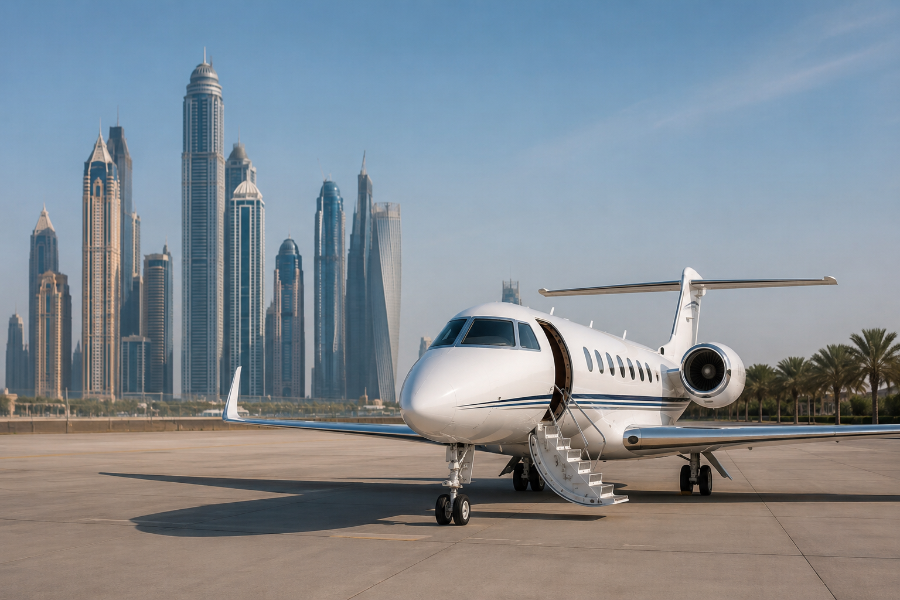
The Middle East Private Jet Trend is emerging as one of the most notable shifts in global aviation in 2026, reflecting deeper changes in wealth distribution, mobility preferences, and business dynamics across the region. Increasing demand for private aviation is no longer limited to ultra-billionaires or royal families; instead, it is being driven by a broader segment of high-net-worth individuals seeking efficiency, flexibility, and control over their travel schedules. Industry data and regional aviation patterns indicate that private jet usage has accelerated alongside economic diversification and cross-border business activity.
At the same time, the Middle East has seen a consistent rise in millionaires and ultra-high-net-worth individuals (UHNWIs), particularly across Gulf Cooperation Council (GCC) countries. This wealth expansion is directly influencing aviation behavior, with private flying becoming more integrated into business operations rather than being viewed solely as a luxury indulgence. Increasing demand observed in key markets such as the UAE and Saudi Arabia suggests that private aviation is now aligned with productivity and time optimization.
Moreover, private jets are increasingly being perceived as strategic tools that support global connectivity, especially in a region that acts as a bridge between Europe, Asia, and Africa. The Middle East Private Jet Trend reflects a broader transition where travel decisions are guided by efficiency, privacy, and reliability. Consequently, private aviation is evolving from a status symbol into an essential component of high-level business and personal mobility.
Middle East Private Jet Trend: What’s Driving the Surge in 2026
The Middle East Private Jet Trend is largely driven by the rapid expansion of wealth across GCC economies, particularly in sectors such as energy, finance, real estate, and technology. Regional growth patterns indicate that the number of millionaires continues to increase, supported by government-led diversification strategies and strong investment inflows. As wealth grows, so does the demand for premium mobility solutions that align with high-value time management.
In addition, business travel demand has intensified significantly, with executives and entrepreneurs frequently moving between global financial centers. Increasing demand observed in private aviation reflects the need for seamless international connectivity, especially when commercial airline schedules do not align with business priorities. Private jets allow direct routing, minimizing layovers and maximizing efficiency, which is increasingly critical for high-stakes decision-making environments.
Furthermore, geopolitical considerations and global mobility challenges have also influenced travel preferences. Industry reports suggest that individuals are prioritizing privacy and control over travel experiences, particularly in uncertain global conditions. Consequently, private aviation is not just about comfort but also about mitigating risks associated with commercial travel disruptions, making it a practical choice for many affluent travelers.
Who Is Flying Private in the Middle East?
The Middle East Private Jet Trend highlights a diverse group of users, ranging from millionaires to billionaires, each with distinct travel needs and usage patterns. While billionaires and royal families have historically dominated private aviation, the current shift shows increasing participation from entrepreneurs, corporate executives, and high-level professionals. This broader adoption reflects changing perceptions around the utility of private jets.
Entrepreneurs and business leaders are among the most active users, often leveraging private aviation for regional and international travel. Their travel frequency is typically high, driven by business expansion and investment opportunities across multiple markets. Increasing demand observed in this segment suggests that private jets are being integrated into operational workflows rather than occasional luxury experiences.
Corporate usage is also rising, with companies utilizing private aviation for executive travel, client meetings, and time-sensitive operations. Moreover, family offices and wealth managers are increasingly coordinating private flights for both business and leisure purposes. Consequently, the user base for private aviation in the Middle East is becoming more structured and strategically driven.
Private Jet Usage in the Middle East (2026)
| User Type | Travel Frequency | Aircraft Type | Purpose | Cost Range (USD) |
|---|---|---|---|---|
| Millionaires | Monthly | Light / Midsize Jets | Regional Business Travel | $3,000–$6,000/hr |
| Billionaires | Weekly | Long-Range Jets | Global Travel | $6,000–$12,000/hr |
| Corporations | Frequent | Midsize / Heavy Jets | Executive Mobility | $5,000–$10,000/hr |
| Royal Families | High | Ultra-Long-Range | Diplomatic & Leisure | $10,000–$20,000/hr |
Cost Breakdown: Private Jets vs Commercial Business Class
Cost remains one of the most critical considerations within the Middle East Private Jet Trend, particularly as more millionaires evaluate whether private aviation aligns with their financial priorities. Charter pricing typically ranges between $3,000 and $12,000 per flight hour depending on aircraft type, route, and availability. While these costs are significantly higher than commercial options, they must be evaluated within the context of time savings and operational efficiency.
Ownership presents an even higher financial commitment, with acquisition costs for private jets ranging from several million to over $70 million for ultra-long-range aircraft. In addition, operational expenses such as maintenance, crew salaries, insurance, and hangar fees add substantial ongoing costs. Consequently, full ownership is generally limited to ultra-high-net-worth individuals and large corporations.
However, when compared to commercial business class, private aviation offers advantages that extend beyond pricing. Time efficiency, flexibility, and productivity gains often offset the higher cost for frequent travelers. Industry patterns indicate that individuals who value time as a critical asset are more likely to justify private aviation expenses, especially when managing multiple business commitments across regions.
Read also: Dubai to Istanbul Now Costs $160K: Inside the Surge in Private Jet Prices
Why Private Aviation Is Becoming Essential (Not Just Luxury)?
The Middle East Private Jet Trend demonstrates a clear shift from luxury consumption to essential utility, particularly among high-net-worth individuals who prioritize time optimization. Private jets significantly reduce travel time by eliminating long airport procedures, enabling direct routes, and allowing flexible scheduling. This efficiency is especially valuable in a region where business opportunities often require rapid decision-making and mobility.
Privacy and security are also key factors contributing to the rise in private aviation demand. Increasing demand observed among executives and high-profile individuals reflects concerns about confidentiality, data protection, and personal safety. Private jets provide controlled environments where sensitive discussions can take place without external disruptions, making them ideal for high-level business interactions.
Moreover, flexibility remains a defining advantage of private aviation. Travelers can adjust schedules, access smaller airports, and avoid delays commonly associated with commercial flights. Consequently, private aviation is increasingly viewed as a strategic investment in productivity rather than an extravagant expense, aligning with the evolving priorities of the region’s wealthy population.
Private Jet vs Commercial Travel
| Factor | Private Jet | Commercial Business Class |
|---|---|---|
| Time | Minimal delays, direct routes | Fixed schedules, longer transit |
| Flexibility | High | Limited |
| Cost | Very high | Moderate |
| Privacy | Complete | Limited |
| Accessibility | Smaller airports available | Major airports only |
| Efficiency | Maximum | Moderate |
Key Hubs Driving the Middle East Private Jet Boom
The Middle East Private Jet Trend is strongly supported by the development of major aviation hubs across the region. Cities such as Dubai, Doha, and Riyadh have emerged as critical centers for private aviation, offering advanced infrastructure and strategic geographic positioning. These hubs facilitate seamless connectivity between continents, reinforcing the region’s role in global aviation networks.
Dubai continues to lead as a global aviation hub, with dedicated private terminals and a high concentration of business aviation services. Increasing demand observed in Dubai reflects its status as a financial and tourism center, attracting high-net-worth individuals from around the world. The city’s infrastructure supports both charter operations and private jet ownership, making it a central node in the private aviation ecosystem.
Doha and Riyadh are also experiencing rapid growth in private aviation activity. Doha’s focus on luxury aviation services and Riyadh’s expanding business landscape contribute to rising demand. Consequently, these cities are investing in airport infrastructure and private terminals to accommodate increasing traffic, further strengthening the Middle East Private Jet Trend.
Aircraft Types Dominating the Market
The Middle East Private Jet Trend is characterized by a diverse range of aircraft types, each serving specific travel needs. Light jets are commonly used for short regional routes, offering cost-effective solutions for quick trips within the GCC. These aircraft are popular among millionaires who prioritize efficiency for frequent short-distance travel.
Midsize and long-range jets dominate intercontinental travel, providing greater comfort and extended flight capabilities. Increasing demand observed in this segment reflects the need for direct flights between the Middle East and major global cities such as London, New York, and Singapore. These aircraft balance performance and luxury, making them ideal for business and leisure travel.
Ultra-long-range jets represent the highest tier of private aviation, offering global connectivity with minimal stops. These aircraft are typically used by billionaires and large corporations, enabling nonstop travel across continents. Consequently, the variety of aircraft available supports a wide range of user requirements, contributing to the sustained growth of private aviation in the region.
Challenges & Trade-Offs
Despite its growth, the Middle East Private Jet Trend faces several challenges that impact its long-term sustainability. High operational costs remain a significant barrier, limiting access to only the wealthiest individuals and organizations. Even for millionaires, the financial commitment required for frequent private travel can be substantial.
Airport slot constraints and infrastructure limitations also pose challenges, particularly during peak travel periods. Increasing demand observed in major hubs can lead to congestion, affecting scheduling flexibility. Consequently, ongoing investment in airport infrastructure is essential to support continued growth in private aviation.
Environmental concerns are another critical factor influencing the industry. Private jets have a higher carbon footprint compared to commercial flights, raising questions about sustainability. Industry reports suggest that efforts to adopt sustainable aviation fuel (SAF) and improve efficiency are underway, but these initiatives are still developing and may take time to scale effectively.
2026 Aviation Trends in the Middle East
The Middle East Private Jet Trend is evolving alongside broader changes in aviation and wealth management. Fractional ownership models are gaining popularity, allowing individuals to share the cost of private jets while maintaining access to premium travel experiences. This approach provides a more accessible entry point into private aviation for high-net-worth individuals.
Sustainability initiatives are also becoming more prominent, with increasing focus on reducing environmental impact. The adoption of sustainable aviation fuel and more efficient aircraft technologies reflects industry efforts to balance growth with environmental responsibility. Consequently, sustainability is expected to play a larger role in shaping the future of private aviation.
Expansion of private terminals and dedicated aviation facilities is another key trend. Increasing demand observed across the region is driving investments in infrastructure, enhancing the overall travel experience for private jet users. These developments reinforce the region’s position as a leading hub for business aviation.
Unique Insight: From Luxury to Time Optimization
A defining aspect of the Middle East Private Jet Trend is the shift from luxury consumption to time optimization. Wealthy individuals are increasingly valuing time as their most critical resource, prioritizing efficiency over traditional status symbols. Private aviation aligns with this mindset by enabling faster, more reliable travel.
This shift reflects broader changes in how wealth is utilized, with a focus on productivity and strategic decision-making. Rather than being viewed as an extravagant expense, private jets are becoming tools that support business growth and global connectivity. Consequently, the role of private aviation is evolving in line with the changing priorities of the region’s affluent population.
FAQs
What is the Middle East Private Jet Trend?
The Middle East Private Jet Trend refers to the increasing use of private aviation driven by rising wealth, business travel demand, and the need for efficiency.
Why are millionaires flying private more in 2026?
Millionaires are prioritizing time efficiency, flexibility, and privacy, making private aviation a practical travel solution.
How much does a private jet cost in the Middle East?
Charter costs range from $3,000 to $12,000 per hour, while ownership can exceed tens of millions of dollars.
Who uses private jets the most?
Billionaires, entrepreneurs, corporate executives, and royal families are the primary users.
Is private flying cheaper than business class?
No, private flying is significantly more expensive but offers greater efficiency and flexibility.
What are the main private jet hubs?
Dubai, Doha, and Riyadh are key hubs driving private aviation growth.
What types of jets are used?
Light, midsize, long-range, and ultra-long-range jets are commonly used.
Is private aviation growing in the Middle East?
Yes, industry patterns indicate consistent growth driven by wealth expansion and business needs.
What are the benefits of private jets?
Time savings, privacy, flexibility, and direct routing are key advantages.
Is it worth flying private?
It depends on travel frequency and priorities, particularly for those who value time and efficiency.