A sofa with the wrong upholstery looks like a mistake, whether it’s sitting in a beach house on the Gold Coast, a brownstone in Manhattan, or a high-rise apartment in Singapore. Doesn’t matter how good the frame is. And a beautiful fabric on the wrong silhouette doesn’t read as bold, it reads as fussy, regardless of which side of the Pacific it landed on. Two separate decisions, usually made on two separate days by two separate people, sometimes on two different continents entirely, somehow have to end up agreeing with each other by the time the piece lands in someone’s living room.
They often don’t. Across Australia, the US and APAC alike, that’s usually why a room that should feel effortless instead feels like it’s arguing with itself. In the homes that actually work, someone treated furniture and fabric as one decision, not two, no matter where in the world that home happens to be.
Shape decides more than colour does
Most people start with a palette. Wrong place to start. Silhouette sets the visual weight of a room, and it does that before a single swatch has entered the conversation. A low, curved sofa reads soft, almost slouchy in the right fabric. A sharp-edged armchair on exposed legs reads architectural, more like furniture with opinions. Neither is better. But they want different things sitting on top of them. A busy weave on a curved piece gets absorbed without feeling cluttered. The same weave on something rigid and linear, and now the piece is fighting itself.
Horgans has been bringing furniture into Australian homes since 1983, second generation now, and its Horgans trade program gives designers access to collections, design support, and fabric and finish swatches for exactly this kind of decision, made properly, before anything gets locked in.
Then fabric has to do the actual work
Once shape is settled, fabric is the part of the equation that changes how a room actually feels to live in, day to day, not just in a photograph. Woven and printed fabrics aren’t interchangeable, even when the pattern on paper looks similar. A print sits flat on the surface. A weave has real depth, it shifts depending on the light and the angle you’re standing at.
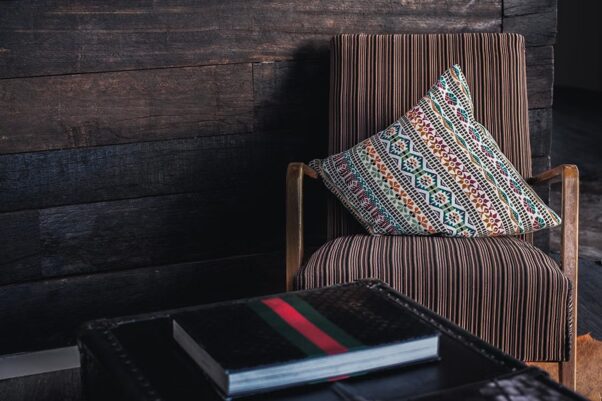
Colony fabrics‘ Marly design is a good example. That moquette weave has become one of the brand’s signature textiles for a reason. Its colour, scale and texture become much more apparent in person than they do in photography. That’s the case with Colony fabrics generally: Italian, best known for woven textiles, with designs drawing on French and Venetian references, combining pattern and texture through a range of weaving techniques. Boyac also offers the opportunity to view the fabrics in person, where colour, scale and texture reveal themselves properly, particularly with complex woven designs.
Where this goes wrong, in practice
It’s rarely a bad fabric choice on its own. It’s timing. A client falls for a fabric at a showroom in week two. Furniture gets specified in week six, from a completely different source, sometimes by a different person on the project entirely. Everything arrives. Scale’s off. The palette’s a half-shade wrong. Or the pattern is too busy for a piece that size, and nobody noticed until it was sitting in the room.
Sequencing fixes most of this, not perfectionism. Furniture silhouette first, roughly scaled. Fabric options tested against that actual shape, not chosen in isolation. And the physical swatch ordered before yardage gets committed, not a render, not a screenshot. Sounds obvious on paper. It’s the step that gets skipped when a project’s moving fast, which is most projects.
A rough test that actually works
Drape the swatch over the piece. Not next to it, held up like a paint chip, actually over it. Step back, look away for a second, then look back. If both the fabric and the shape register clearly on that second glance, it’s probably working. If one is drowning out the other, something needs to change, usually the scale of the pattern rather than the colour.
Size matters here too. A dining chair can carry something loud, since you only see a small amount at once. A sofa is a different problem entirely. The fabric’s on display across a much bigger surface, and there’s nowhere to hide a miscalculation once it’s delivered.
What holds a scheme together
Rooms that read as considered, rather than assembled, tend to have one thing in common: someone made the furniture and fabric decisions in conversation with each other. That doesn’t mean matching everything. Some of the best rooms pair a plain, structural sofa with one richly patterned chair, or a heavily textured wallcovering against furniture that stays deliberately quiet. Uniformity was never the goal. Intention was.
For anyone assembling more than one room, or more than one home, this gets a lot easier with the right resources close at hand: current swatches, honest lead times, a range wide enough to solve more than one brief without starting over each time. It gets harder, predictably, when sourcing happens piecemeal, one supplier here, another there, nothing talking to anything else.
None of this needs an unlimited budget, though it certainly helps to have one. It needs furniture and fabric treated as one decision made in two parts, not two decisions that happen to land in the same room by coincidence. Start with shape. Let it tell you what the fabric can carry. Test the actual swatch against the actual piece, in real light, before committing to yardage.
Effortless rooms rarely are. Someone just made