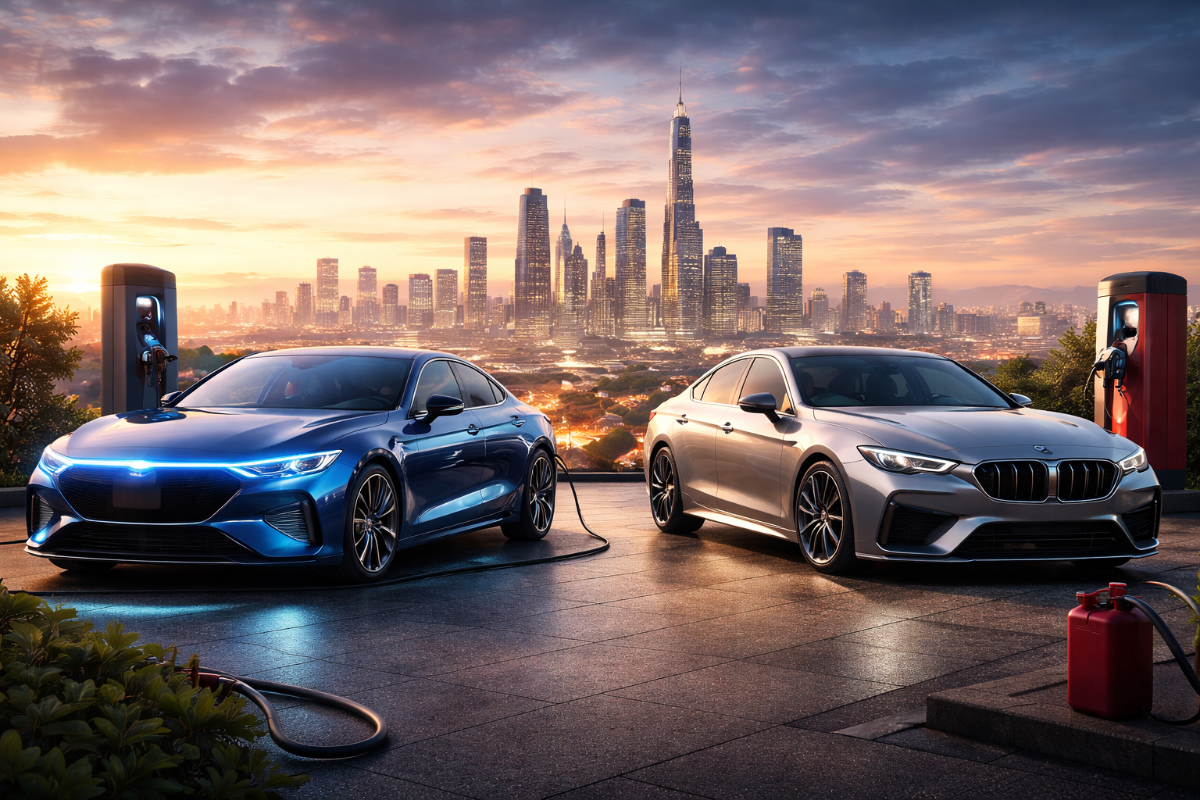
The debate around Electric vs Petrol Luxury Cars is no longer theoretical; instead, it is playing out in showrooms, corporate offices, and on highways worldwide. Brands that once built their reputation on handcrafted engines and distinctive exhaust notes are now investing heavily in battery systems and electric drivetrains. As a result, the shift feels structural rather than temporary.
For decades, petrol-powered luxury cars defined refinement through smooth V8 engines, grand touring comfort, and long-distance reliability. However, the rapid growth of electric mobility has disrupted that long-standing hierarchy. Today, electric drivetrains offer instant torque, silent acceleration, and software-based customization that reshapes the luxury driving experience.
Consequently, the discussion around Electric vs Petrol Luxury Cars has moved from asking “if” electrification will happen to “when” it will dominate. Therefore, the key question is clear: which technology will define prestige beyond 2026? To answer that, we must examine performance, ownership costs, environmental impact, and brand positioning.
The Luxury Market Shift
Luxury car strategy is now being redesigned around electrification. Established brands such as Mercedes-Benz, BMW, Porsche, and Audi have committed to clear electric roadmaps. Meanwhile, electric-focused companies like Tesla have reshaped luxury by centering it on software, over-the-air updates, and advanced driver assistance systems.
This transformation is driven by several forces. First, global emissions rules are becoming stricter. In addition, consumer demand for cleaner mobility continues to rise. Rapid improvements in battery technology also make electric vehicles more practical than before. Furthermore, many cities are introducing environmental policies that limit petrol vehicle access.
Performance Comparison: Power vs Precision
Performance remains central in the Electric vs Petrol Luxury Cars debate. However, the definition of performance itself is evolving.
Acceleration & Torque
Electric motors produce maximum torque instantly. This allows many electric luxury sedans and SUVs to achieve 0–100 km/h times under 4 seconds—often rivaling or surpassing petrol sports cars.
Petrol engines, however, deliver progressive power curves and emotional engagement through gear shifts and engine acoustics. Driving enthusiasts often prefer this mechanical interaction.
Driving Dynamics
Electric vehicles (EVs) benefit from a low center of gravity due to battery placement. Consequently, handling stability improves. However, heavier battery packs can influence agility.
Petrol luxury cars typically offer lighter chassis dynamics and refined engine tuning honed over decades.
Performance & Cost Breakdown Table
| Category | Electric Luxury Cars | Petrol Luxury Cars |
|---|---|---|
| Acceleration | Instant torque, rapid 0–100 km/h | Progressive power delivery |
| Torque | Immediate and high | Builds with RPM |
| Engine Sound | Silent | Distinct engine note |
| Fuel/Energy Cost | Lower per km | Higher fuel expense |
| Maintenance | Fewer moving parts | Higher servicing complexity |
| Depreciation | Improving stability | Traditionally predictable |
Ownership Costs & Long-Term Value
When evaluating Electric vs Petrol Luxury Cars, ownership economics are decisive.
Energy vs Fuel
Electricity generally costs significantly less per kilometer than premium petrol. Moreover, home charging adds convenience and savings.
However, battery replacement remains a long-term cost consideration—although warranties often cover 8–10 years.
Maintenance
Electric vehicles have fewer mechanical components: no oil changes, fewer moving parts, and reduced brake wear due to regenerative braking. Consequently, service intervals are often less expensive.
Petrol luxury cars, particularly high-performance models, incur regular maintenance for engines, transmissions, and exhaust systems.
Environmental Impact & Sustainability
Environmental positioning is central to the Electric vs Petrol Luxury Cars conversation.
Electric vehicles produce zero tailpipe emissions. Therefore, they significantly reduce urban air pollution. However, battery production and electricity sourcing influence overall carbon footprint.
Petrol vehicles emit CO₂ and nitrogen oxides during operation. However, improvements in hybridization and efficiency have reduced emissions compared to earlier generations.
Moreover, luxury manufacturers are investing in sustainable materials—recycled interiors, vegan leather alternatives, and carbon-neutral manufacturing facilities.
Technology Integration & Innovation
Electric platforms often serve as digital-first architectures.
EV luxury vehicles frequently include:
-
Over-the-air software updates
-
Advanced driver-assistance systems
-
AI-based personalization
-
Large digital displays
Tesla pioneered software-centric mobility, influencing legacy brands.
Petrol luxury cars, however, are increasingly hybridized with advanced infotainment systems and semi-autonomous capabilities. Yet, the inherent mechanical focus remains central to their appeal.
Charging Infrastructure vs Fuel Convenience
Convenience shapes buyer confidence.
Electric Charging
Charging infrastructure is expanding rapidly across Europe, North America, and parts of Asia. Fast-charging networks reduce downtime significantly. However, range anxiety remains a psychological barrier for some buyers.
Petrol Refueling
Petrol stations are globally established. Refueling takes minutes and supports long-distance travel seamlessly.
Consequently, infrastructure maturity still favors petrol in certain developing markets. However, this gap is narrowing annually.
Ownership Experience Comparison
| Aspect | Electric Luxury Cars | Petrol Luxury Cars |
|---|---|---|
| Driving Feel | Smooth, silent, instant | Mechanical, engaging |
| Refueling Time | 20–40 min (fast charge) | 3–5 minutes |
| Maintenance Frequency | Lower | Higher |
| Cabin Experience | Digital-first, minimalist | Traditional luxury craftsmanship |
| Urban Suitability | Excellent | Moderate |
| Long-Distance Travel | Improving rapidly | Highly convenient |
Brand Positioning & Consumer Perception
Luxury has historically meant craftsmanship and engine excellence. Today, innovation and sustainability redefine status.
Younger affluent buyers associate electric mobility with forward-thinking responsibility. Consequently, electric luxury vehicles increasingly symbolize technological leadership.
However, traditional luxury customers still value petrol engines for emotional connection and heritage—especially in brands with strong motorsport histories.
Therefore, many manufacturers offer hybrid transitions to balance both worlds.
Regulatory Pressures & Global EV Mandates
Governments worldwide are accelerating EV adoption:
-
European Union combustion engine phase-out targets
-
China’s aggressive EV production quotas
-
U.S. state-level emissions standards
Regulatory pressure directly influences luxury brand strategy. Consequently, automakers are reallocating R&D budgets toward battery platforms.
Petrol luxury cars may remain in niche performance segments, but regulatory frameworks increasingly favor electrification.
The Future of Luxury Automotive Excellence
The future of Electric vs Petrol Luxury Cars is not binary—it is transitional.
Short-term (2026–2035):
-
Hybrid and plug-in hybrid dominance
-
Rapid EV infrastructure growth
-
Continued petrol performance models in limited volumes
Long-term:
-
Full electrification in mainstream luxury
-
Software-defined vehicles
-
Autonomous integration
Moreover, battery energy density improvements and solid-state technology could eliminate current range concerns. Therefore, electric luxury mobility appears positioned for structural dominance.
However, petrol engines may evolve into collector-grade craftsmanship—valued for heritage rather than volume production.
Conclusion
The Electric vs Petrol Luxury Cars debate reflects a broader transformation in mobility philosophy. Luxury is no longer defined solely by engine refinement—it now encompasses sustainability, digital integration, and technological foresight.
Moreover, regulatory frameworks, infrastructure expansion, and consumer expectations increasingly favor electrification. Consequently, electric vehicles are positioned to dominate mainstream luxury markets beyond 2030.
However, petrol-powered luxury cars will likely persist as emotional and heritage-driven symbols of automotive artistry.
The future is electric but the legacy of petrol remains deeply woven into automotive culture.
Frequently Asked Questions
Are electric luxury cars faster than petrol models?
In acceleration metrics, yes. Instant torque gives EVs a measurable advantage in short sprints.
Are petrol luxury cars becoming obsolete?
Not immediately. They remain strong in performance and enthusiast markets, but regulatory trends favor electrification.
Is maintenance cheaper for electric luxury cars?
Generally, yes. Fewer moving parts reduce servicing requirements.
Do electric luxury cars hold resale value?
Resale stability is improving as battery durability and consumer confidence increase.
Which is better for long-distance travel?
Petrol cars currently offer faster refueling convenience, though charging networks are expanding rapidly.