
Source: image by magnific
The discipline you apply to any acquisition — verify, corroborate, inspect, negotiate from evidence — scales down perfectly to a used car. Skipping it is leaving money on the table.
Anyone who manages real assets understands that due diligence is not optional — it is the discipline that separates a sound acquisition from an expensive mistake. You verify the asset, corroborate the records, inspect the condition, and negotiate from evidence rather than emotion. That rigor is second nature for a property or a portfolio position. Curiously, it is often abandoned at the dealership, where otherwise careful people buy a depreciating asset worth tens of thousands of dollars on little more than a glossy listing and a short test drive.
A used vehicle deserves the same process, scaled down. It is frequently the second-largest discretionary purchase a household makes, and it sits in a market defined by information asymmetry — the seller knows the car’s history, and you, by default, do not. Closing that gap is straightforward, inexpensive, and very much in keeping with how a disciplined buyer approaches any acquisition. It begins with the vehicle’s seventeen-character identification number.
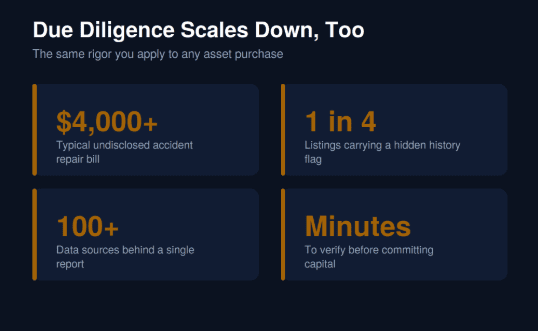
The figures above frame the stakes in plain terms. Undisclosed accident repairs routinely run into the thousands, a meaningful share of listings conceal a flag, and the report that surfaces all of it draws on a hundred or more data sources — returning its findings in minutes. Set the trivial cost of verification against the four-figure cost of a bad purchase and the calculation is not close. This is exactly the kind of asymmetric, low-cost risk reduction a sound asset manager looks for.
The instrument is a VIN history report. Enter the number into a service such as a comprehensive vehicle history report and you receive a consolidated record — accidents and their severity, the odometer timeline, title brands such as salvage or flood, ownership type, and open recalls — assembled from insurers, motor-vehicle agencies, auction houses, and federal databases. It is the equivalent of pulling the documents on any asset before you commit capital to it.
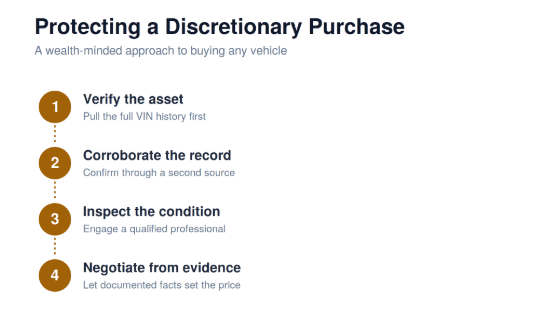
The approach above mirrors the discipline of any considered acquisition. Verify the asset by pulling the full history first. Corroborate the record through a second source. Inspect the physical condition with a professional. And negotiate from evidence, letting documented facts — not the seller’s narrative — set the price. Each step is familiar to anyone who has done diligence on anything that matters; the only novelty is how cheaply and quickly it now applies to a car.
Corroboration deserves particular emphasis, because it is where disciplined buyers separate themselves. On a meaningful purchase, confirm the vehicle through a second, independent source such as an independent verification service, and compare the two records directly. Agreement between providers is strong reassurance; a discrepancy points precisely to the record that warrants a closer look. Redundancy is not wasted effort — it is how prudent buyers engineer confidence into a decision.
There is a direct financial upside beyond risk avoidance, and it is the part disciplined buyers appreciate most. A documented defect is leverage. When a report surfaces an issue the seller failed to mention, that finding routinely moves the price — hundreds, sometimes more than a thousand dollars — and in a market where comparable vehicles are abundant, the credible ability to walk away is itself a pricing tool. Verification does not merely prevent losses; it actively improves the terms of the deal.
Intellectual honesty about the limits keeps the discipline sound. A clean report reflects what was reported to the sources a service can access — powerful reassurance, not an absolute guarantee — and coverage varies by region. The considered approach treats the report as one essential layer and pairs it with a pre-purchase inspection by a qualified professional. The report documents the recorded past; the inspection assesses the asset as it stands today. Two complementary lenses, each covering what the other cannot.
There is a behavioral point worth making here as well, because it is where discipline most often breaks down. A car is an emotional purchase in a way a portfolio position rarely is — the test drive, the new-car smell, the desire to be done with the search all push toward acting on feeling rather than evidence. Disciplined buyers know this about themselves and build a process precisely to counteract it. Pulling the report before the dealership visit, rather than after falling for a particular car, is a small structural safeguard against your own enthusiasm — the same reason sound investors write down their criteria before they go looking.
The broader principle is simply consistency. The habits that protect significant wealth — verify, corroborate, inspect, negotiate from evidence — are not reserved for large transactions; they are most valuable precisely because they apply at every scale. A used car is a modest acquisition, but the discipline that makes it a good one is the same discipline that compounds across a lifetime of sound decisions. Spend the few dollars and the few minutes. Treating every purchase as worthy of diligence is, in the end, what good asset management actually is.