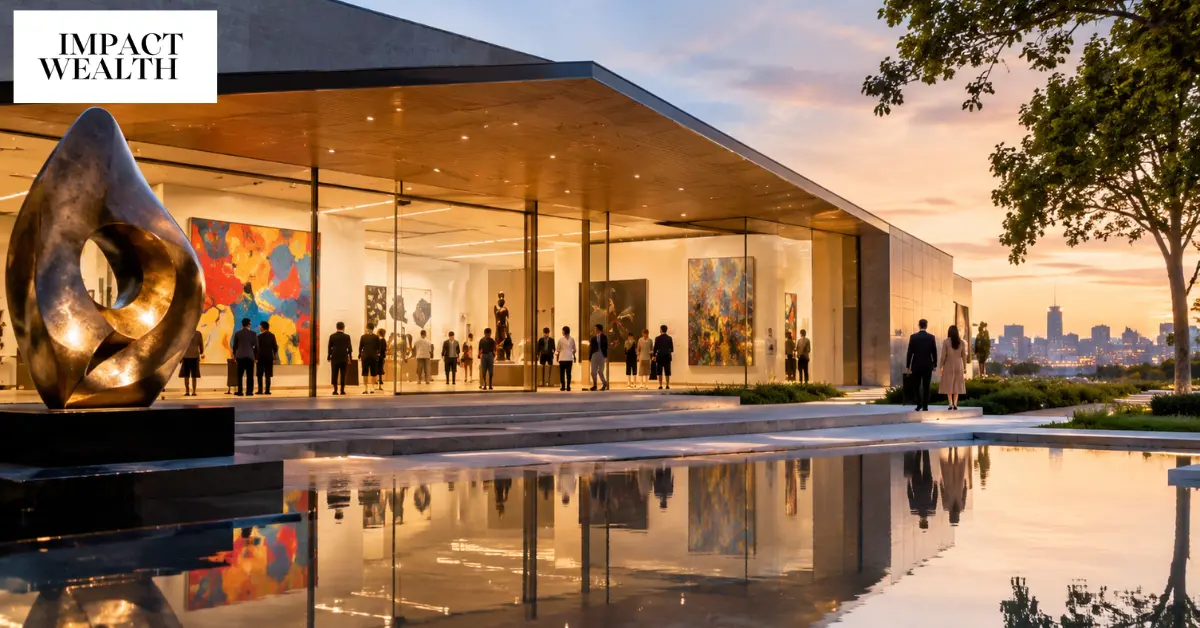
The rise of private museums marks a significant change in how extreme wealth interacts with art. The traditional image of the billionaire collector is a private residence filled with important paintings and sculptures. Increasingly, however, some collectors are moving beyond ownership and creating museums, foundations, exhibition spaces and cultural institutions designed for public engagement.
This shift is not simply about displaying expensive art. It brings together collecting, philanthropy, architecture, scholarship, education and cultural influence. A private collection can express personal taste; a museum introduces a wider set of responsibilities around preservation, interpretation and access.
Research into the global growth of private art museums found 446 such institutions worldwide, with the large majority established in the 21st century. The study also found that billionaire wealth is significantly represented among their founders.
The deeper question, therefore, is not why wealthy people buy art. It is why some are increasingly turning collections into cultural infrastructure.
From Private Collection to Public Institution
Owning an important collection and operating a museum are fundamentally different undertakings.
A private collection can remain largely personal, with access restricted to family, advisers, friends or invited guests. A museum requires a more formal structure. Foundations, nonprofit entities, professional staff and exhibition programs can transform a collection into an institution with an ongoing public role.
That transformation changes the responsibilities attached to the art.
Collectors who establish museums may need curators, conservators, researchers, educators, registrars and museum directors. Works require documentation, appropriate storage, conservation and scholarly interpretation. Exhibitions require planning, while public programs create another layer of institutional responsibility.
Glenstone in Maryland illustrates how far this model can extend. Founded by Emily Wei Rales and Mitchell Rales, the museum combines modern and contemporary art with architecture and landscape. It opened to the public in 2006 and later expanded substantially, with admission remaining free.
Glenstone, founded by collectors Emily and Mitchell Rales, demonstrates this model: a privately established institution that combines modern and contemporary art with architecture, landscape and
The result is no longer simply a collection housed on private property. It is a structured cultural experience.
Why Art Has Become a Form of Cultural Capital
The financial dimension of art remains important, but the significance of collecting extends beyond prices.
Art can create relationships with artists, galleries, museums, scholars and cultural organizations. For UHNW art collectors, participation in this ecosystem can also generate forms of cultural capital that are difficult to measure financially.
The current market provides evidence of how significant collecting remains among wealthy households. The Art Basel and UBS Survey of Global Collecting 2025 found that HNW collectors allocated an average of 20% of their wealth to art in 2025, up from 15% in 2024. Among collectors with more than $50 million in assets, the average was 28%.
However, ownership represents only one level of participation.
A collector can buy an artwork. A foundation can support an artist. An exhibition space can introduce that artist to a broader audience. A museum can preserve the work, commission research and create educational programming around it.
That progression helps explain why luxury art is increasingly connected to cultural participation rather than simply possession.
The Rise of the Billionaire Museum
The growth of collector-led museums has occurred alongside a broader expansion of the global art ecosystem.
Private capital can provide resources for buildings, acquisitions, conservation, research and experimental exhibitions that might otherwise face funding constraints. Yet capital alone does not create a museum. Institutional expertise determines how successfully a collection can be preserved, interpreted and presented.
The Pinault Collection provides another useful example. François Pinault’s contemporary art collection is presented through Palazzo Grassi and Punta della Dogana in Venice, which opened to the public in 2006 and 2009. The collection now comprises approximately 10,000 works, while its museums maintain an active program of temporary exhibitions and cultural events.
Its current program demonstrates the institutional approach: exhibitions involving artists such as Lorna Simpson, Michael Armitage, Amar Kanwar and Paulo Nazareth, alongside educational activities and cultural mediation.
This is an important distinction. The institution is not simply showing what one collector owns. It is creating an ongoing framework through which contemporary art can be encountered and interpreted.
From Private Collection to Cultural Institution
| Collector Model | Primary Purpose | Public Role |
|---|---|---|
| Private Collection | Personal collecting and ownership | Limited or invitation-based access |
| Private Museum | Exhibition and public engagement | Regular public access |
| Art Foundation | Cultural and philanthropic mission | Education, exhibitions and grants |
| Artist Foundation | Preservation and artist legacy | Research, exhibitions and archives |
| Collector-Funded Institution | Long-term cultural development | Broader community and cultural programming |
The important transition occurs when the collection develops a public mission. Once visitors, researchers, students and artists become part of the institution’s audience, decisions about access and interpretation become central.
That is why the emergence of private museums represents more than an increase in wealthy people displaying art. It represents the institutionalization of private collecting.
Architecture Becomes Part of the Collection
Collector-led museums have also changed the relationship between art and architecture.
In a conventional private collection, the building generally serves the artworks. In major private museums, architecture can become part of the cultural proposition itself.
Glenstone explicitly integrates art, architecture and landscape. Its founders describe the museum as a place where these elements work together, while the institution’s visitor experience deliberately incorporates the surrounding landscape.
The Pinault Collection similarly operates within significant historic buildings in Venice, while architectural tours at Palazzo Grassi and Punta della Dogana introduce visitors to both the buildings and their restoration.
This matters because architecture can transform a collection into a destination. Location, landscape, interiors and circulation through exhibition spaces all influence how visitors encounter the art.
For collectors, therefore, the museum building itself can become part of the long-term cultural legacy.
When Collecting Becomes Philanthropy
Private ownership should not automatically be described as philanthropy. The distinction matters.
A collector may create a museum primarily to preserve and exhibit a collection. Another institution may place greater emphasis on education, community engagement, artist support or research.
Where a public mission exists, however, collecting can become connected to cultural philanthropy.
That can include free or affordable admission, educational programs, conservation initiatives, artist residencies, scholarships, publications and research. Glenstone, for example, currently offers free admission and welcomes visitors through scheduled public visits.
The philanthropic value therefore depends less on the wealth of the founder than on what the institution actually does with its resources.
The Curator’s New Role in a Collector-Led Museum
As collections become institutions, professional expertise becomes increasingly important.
Curators help determine how works are interpreted and displayed. Conservators protect the physical integrity of collections. Researchers develop scholarship. Educators translate exhibitions for different audiences. Museum directors oversee the institutional framework connecting all these functions.
This creates an important balance between collector preference and institutional independence.
The collector may have established the collection and provided the capital, but a functioning museum has obligations to scholarship, conservation and its public. The strongest institutions therefore cannot depend entirely on personal taste. They require systems capable of continuing beyond individual collecting decisions.
That distinction also explains why the transition from private art collections to museums is not automatic. A valuable collection is an asset. A museum is an organization.
The Contemporary Art Market and the Museum Effect
Contemporary art has become particularly important within this model because it allows collectors to participate in an evolving cultural conversation rather than simply preserve historical objects.
The 2026 Art Basel and UBS Global Art Market Report estimates that contemporary art represented 14% of fine-art auction sales by value in 2025, while the overall global art market reached an estimated $59.6 billion, up 4% year on year.
Private museums can provide contemporary artists with exhibition platforms, scholarly attention and long-term visibility. They can also connect artists to audiences outside commercial galleries and auction houses.
However, opening a museum does not automatically increase an artwork’s financial value. Its more defensible effect is cultural: it can create new contexts in which artists and their work are studied, presented and remembered.
The Tension Between Private Wealth and Public Culture
The growth of collector museums also raises difficult questions.
Who determines what the public sees? How independent are curatorial decisions? What governance structures protect the institution’s mission? How transparent is its funding? What happens if the founding family loses interest or financial circumstances change?
Private Museum Research has highlighted precisely this tension, arguing that the expansion of private museums gives wealthy individuals greater influence over which art enters the public sphere.
That does not make collector-led institutions inherently beneficial or problematic. It means their cultural significance depends on governance, access, professional standards and sustainability.
The question is particularly relevant because the global art market itself remains highly concentrated. In 2025, the United States, United Kingdom and China accounted for 76% of global art sales by value, according to Art Basel and UBS.
As wealth and cultural power become increasingly interconnected, questions about who controls cultural visibility become harder to separate from questions about who owns the art.
Why the Private Museum May Be the Ultimate Legacy Project
Real estate can survive its owner. Luxury goods can pass between generations. Financial assets can be transferred.
A museum can potentially do something different: it can create an institutional framework that continues after the original collector.
That possibility explains part of the appeal of cultural legacy. A collection preserved inside a private residence may remain associated primarily with its owner. A museum can instead attach that collection to curatorial programs, scholarship, public access and education.
The legacy, in other words, becomes less about what was accumulated and more about what was built around the accumulation.
The Future of Collector-Led Cultural Institutions
The next stage may involve greater use of digital access, international exhibition partnerships, traveling collections, artist residencies and research programs.
Some institutions may also develop closer relationships with universities, public museums and cultural organizations. Others could become hybrid models combining private funding with broader public programming.
Yet longevity will remain the crucial test.
Buildings can be impressive and collections can be extraordinary, but institutions survive through governance, funding, professional expertise and a clear public purpose. The question for the next generation of collector museums will therefore be whether they can evolve beyond the identity of their founders.
Unique Insight: From Owning Art to Building Cultural Infrastructure
The deeper significance of private museums is the movement from owning cultural objects to building cultural infrastructure.
A valuable collection can remain an expression of private wealth. A museum introduces a different set of responsibilities: preservation, interpretation, access, education, scholarship and long-term governance.
That is why the private museum represents a different stage of collecting culture. The collector is no longer simply deciding what to own. The institution begins to influence how art is encountered by others.
Conclusion
Private museums are becoming an increasingly visible part of the global art ecosystem because extreme wealth is increasingly capable of supporting not only collections, but buildings, foundations, research, education and long-term cultural programs.
The trend reflects a changing relationship between wealth and cultural influence. Yet the significance of any individual institution depends on what happens beyond the artwork itself: how it is governed, who can access it, how independently it is curated, what educational purpose it serves and whether it can remain sustainable beyond its founder.
The defining shift is therefore not simply from buying art to displaying it. It is from private ownership toward institutional cultural participation.
Frequently Asked Questions
What is a private museum?
A private museum is a publicly accessible cultural institution established or funded by private individuals, families or organizations, often around a significant art collection.
Why are billionaire collectors opening private museums?
Documented reasons vary by institution. Private museums can provide a framework for preservation, public access, education, philanthropy and long-term cultural programs. Individual motivations should not be assumed.
What is the difference between a private collection and a private museum?
A private collection primarily concerns ownership, while a museum requires an institutional structure involving public access, preservation, interpretation and programming.
Are private museums open to the public?
Some are, while others operate with limited or appointment-based access. Policies vary considerably. Glenstone, for example, offers free scheduled public admission.
How do private museums support artists?
They can provide exhibition opportunities, commissions, research, publications and educational programming, although the extent varies by institution.
Why is contemporary art important to billionaire collectors?
Contemporary art allows collectors and institutions to participate in an evolving cultural conversation and support living artists and emerging practices.
Are private museums considered philanthropic institutions?
Not automatically. Their philanthropic character depends on their mission, governance, funding and public programs.
How do collectors build cultural legacies through museums?
Museums can preserve collections while creating educational, research and cultural programs capable of continuing beyond the original collector.
What role do curators play in private museums?
Curators provide scholarly expertise, develop exhibitions and help balance collection interests with institutional and public responsibilities.
How are private museums changing the global art world?
They are expanding the role of private collectors from owners of artworks to founders and funders of cultural institutions, increasing the visibility of private wealth within the public art ecosystem.