Text to speech has changed dramatically.
What once sounded unmistakably robotic can now produce speech with natural pacing, emotion, accents, conversational pauses and, in some systems, a recognisable vocal identity.
Text to speech (TTS) is technology that converts written text into spoken audio. Modern AI text-to-speech systems use neural or generative models to interpret language, predict how it should sound and synthesize the resulting speech.
In 2026, the technology is being used for far more than accessibility or automated announcements. Text to speech now powers AI assistants, video narration, audiobooks, customer-service agents, games, multilingual content and real-time conversational applications.
The important question is no longer simply, “Can AI read this text aloud?”
It is:
How naturally, quickly, accurately and responsibly can it speak?
Text to speech at a glance
| Question | Short answer |
|---|---|
| What is text to speech? | Technology that converts written words into spoken audio |
| Is modern TTS AI? | Most advanced systems now rely heavily on neural or generative AI |
| Can text to speech sound human? | Leading systems can produce highly natural speech, although quality varies by voice, language, model and script |
| Can AI copy someone’s voice? | Some platforms support authorised voice cloning or custom voices |
| Can TTS work in real time? | Yes. Low-latency models can now support interactive voice applications |
| Is text to speech the same as speech to text? | No. TTS creates audio from text; speech-to-text transcribes audio into text |
| Main 2026 use cases | Narration, accessibility, AI agents, localization, education, games and customer service |
What Is Text to Speech?
Text to speech, also known as speech synthesis, converts a written input into audible speech.
A simple example is an article reader that takes:
“Artificial intelligence is changing how people interact with software.”
and produces spoken audio containing the same sentence.
Older text-to-speech engines often relied heavily on prerecorded speech units or relatively rigid synthesis techniques. Amazon still documents a standard Polly engine based on concatenative synthesis, where recorded speech components are combined to produce an output. (Reference: AWS Documentation)
Modern neural systems take a more flexible approach.
Microsoft describes neural text to speech as a process in which text is analysed into linguistic or phonetic information, an acoustic model predicts characteristics such as timbre, speaking style, stress and intonation, and a neural vocoder converts those characteristics into audible speech. (Reference: Microsoft Learn)
Generative systems may work differently again. Amazon’s generative Polly engine, for example, uses a transformer to convert text into speech codes before a decoder turns those codes into streamable audio.
That distinction matters.
There is no single universal architecture behind every modern AI voice generator. Different providers use different combinations of language models, acoustic representations, codecs, decoders and vocoders.
How Does AI Text to Speech Work?
A useful simplified pipeline looks like this:
Written text → language analysis → pronunciation and prosody → voice model → acoustic representation → audio
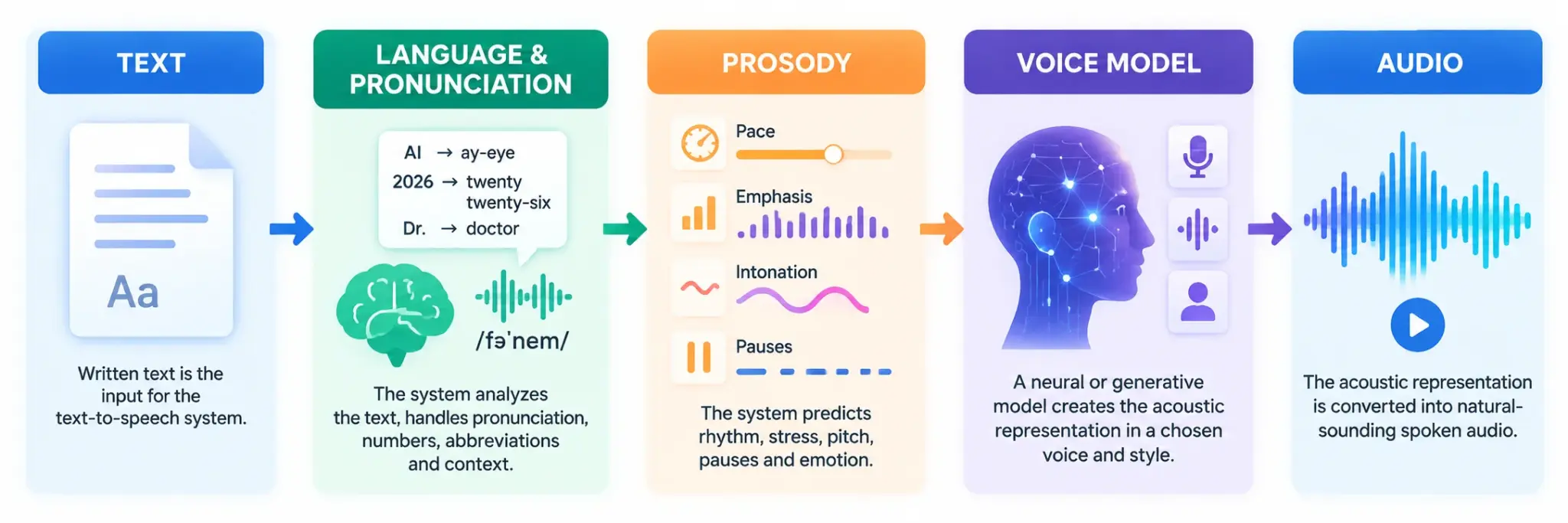
1. The system interprets the text
Before speaking, the model needs to understand what the text means and how it should be pronounced.
That includes handling things such as:
“2026”
“$12.50”
“Dr.”
“AI”
“1/4”
and names that may not follow common pronunciation rules.
Numbers and abbreviations are surprisingly difficult because the same characters can be spoken differently depending on context.
2. It determines pronunciation
The system maps written language to the sounds required to pronounce it.
In linguistic terms, these sounds can be represented using phonemes.
Modern systems also need to understand where words belong within the sentence so the delivery does not sound like an isolated sequence of correctly pronounced words.
3. It predicts prosody
Prosody includes characteristics such as:
pace, emphasis, pitch, pauses, stress and intonation.
This is one of the biggest differences between old robotic speech and modern AI voice generation.
A question should not necessarily sound like a statement.
A dramatic audiobook passage should not sound like a weather alert.
And an AI customer-service agent should not deliver every response with identical pacing.
4. The voice is synthesized
The model then predicts the acoustic representation needed to reproduce the intended voice and speaking style.
Depending on the technology, another model or decoder converts that representation into the final waveform that reaches the listener.
Why Text to Speech Sounds So Much Better in 2026
Several improvements are converging at once.
AI voices can now follow speaking instructions
Modern TTS systems increasingly accept instructions describing how something should be said rather than only what should be said.
OpenAI’s current text-to-speech model, for example, supports instructions affecting characteristics including accent, emotional range, intonation, speed, tone and whispering. It also supports streaming audio for realtime applications.
Google’s Gemini-TTS similarly allows developers to steer style, pace, tone, accent and emotional expression through natural-language instructions. (Source; Google Cloud)
This effectively turns the prompt into part of the directing process.
Emotion is becoming controllable
Some voice models now expose explicit controls for emotional performance.
ElevenLabs’ Eleven v3 supports speech directions such as emotional and delivery tags along with multi-speaker dialogue. Its documentation currently lists support for more than 70 languages.
That makes generated voice useful for more than functional narration.
It can increasingly be performed.
Latency has fallen dramatically
An excellent voice that takes several seconds to respond is acceptable for producing a video.
It is frustrating in a conversation.
That is why one of the most important improvements in text to speech is not audio quality at all.
It is latency.
ElevenLabs currently lists its Flash v2.5 model at roughly 75 milliseconds of model latency, excluding application and network latency, while its newer conversational model prioritizes expressive real-time speech at around 280 milliseconds.
Google’s Chirp 3 HD voices are similarly designed around low-latency streaming and conversational applications.
This shift is what makes modern voice agents practical.
Leading Text-to-Speech Platforms in 2026
There is no single text-to-speech platform that is best for every workflow.
Impact Wealth has not conducted a controlled acoustic benchmark of these services. The comparison below is based on current official product documentation reviewed on September 27, 2026.
| Platform | Particularly suited to | Current distinguishing features |
|---|---|---|
| ElevenLabs | Narration, expressive speech, localization | Eleven v3, real-time conversational model, low-latency Flash models, voice cloning |
| Google Cloud TTS | Developers, AI agents, multilingual applications | Gemini-TTS, Chirp 3 HD, streaming, prompt-controlled speech, custom voices |
| Microsoft Azure Speech | Enterprise deployments and brand voices | Neural TTS in 100+ languages/locales, custom voice options, SDK/API ecosystem |
| Amazon Polly | AWS applications and scalable cloud TTS | Standard, neural and generative engines; streamable generative speech |
| OpenAI Audio | AI applications and conversational systems | GPT-4o mini TTS, streaming, instruction-controlled speaking style |
ElevenLabs
ElevenLabs is particularly strong where expressive voice is part of the finished product.
Its model lineup currently includes Eleven v3 for high-expression speech, Eleven v3 Conversational for realtime interaction, Multilingual v2 for stable long-form output and Flash v2.5 for low-latency generation.
That makes it relevant to creators, audiobook production, dubbing and interactive applications.
Google Cloud Text-to-Speech
Google now offers several distinct speech-generation technologies rather than one generic TTS model.
Gemini-TTS emphasizes prompt-based control, while Chirp 3 HD focuses on conversational speech and low-latency streaming. Google’s current product documentation also describes instant custom-voice creation from short authorised audio samples in supported locales.
Microsoft Azure Speech
Microsoft’s Speech service currently offers standard neural voices across more than 100 languages and locales alongside custom-voice capabilities.
Its architecture and enterprise controls make it especially relevant for organisations integrating synthetic voice into established applications.
Amazon Polly
Amazon Polly now spans multiple generations of speech synthesis.
Its generative engine uses a billion-parameter transformer and streamable decoding architecture, and Amazon currently lists dozens of voices available through the generative engine.
That makes Polly a natural option for companies already building inside AWS.
OpenAI
OpenAI’s Audio API provides text-to-speech generation through its GPT-4o mini TTS model, with streaming and prompt-based control over delivery characteristics.
OpenAI also explicitly requires developers to disclose to end users that the voice they hear is AI-generated rather than a human recording.
Text to Speech vs Voice Cloning vs Speech to Text
These terms are frequently mixed together.
| Technology | Input | Output | Example |
|---|---|---|---|
| Text to speech | Written text | Spoken audio | Turn an article into narration |
| Speech to text | Spoken audio | Written text | Transcribe an interview |
| Voice cloning | Voice sample + new text | New speech resembling the reference voice | Create authorised narration using someone’s vocal identity |
| Speech to speech | Existing speech | Modified/generated speech | Change language or vocal characteristics while preserving performance |
| Voice agent | Conversation | Interactive spoken response | Customer-service assistant |
A voice agent may use several of these technologies at once.
One common architecture is:
Microphone → speech to text → language model → text to speech → speaker
More advanced systems can increasingly process and generate audio directly, but the modular architecture remains common because developers can select different providers for transcription, reasoning and synthesis.
What Is Text to Speech Used For?
Content creation
Creators can generate narration without rerecording an entire script every time the wording changes.
That becomes particularly valuable for:
video explainers, product demonstrations, educational content and multilingual publishing.
Text to speech also fits naturally beside AI-generated visual workflows. Impact Wealth’s guide to AI video generators for creators in 2026 explains how generative tools are increasingly being combined into complete production pipelines rather than used as isolated applications.
Audiobooks and long-form narration
Long-form narration places different demands on a model than a fifteen-second advertisement.
A voice needs to remain consistent over thousands of words while correctly handling:
names, numbers, dialogue, emotional changes and paragraph-level rhythm.
This is one reason short demonstration clips should not be the only criterion when choosing a TTS platform.
Accessibility
Text to speech has long played an important role for people who cannot conveniently read text on a screen.
It can convert websites, books, documents, educational material and interfaces into audio.
Voice cloning can also have assistive applications. The U.S. Federal Trade Commission has noted the potential for voice-cloning technologies to help people who have lost their natural speaking voice because of illness or injury. Federal Trade Commission
AI customer-service agents
Real-time TTS makes it possible for AI systems to respond conversationally instead of communicating only through text.
The complete system typically combines:
speech recognition + an AI reasoning layer + text-to-speech output.
As latency decreases, the interaction begins to feel much closer to a phone conversation than to waiting for a computer-generated audio file.
Localization
Traditionally, producing the same video in five languages might mean casting and recording several voice performers.
Multilingual TTS changes that workflow.
A company can create different language versions from the same source script, while some custom-voice systems can preserve aspects of an authorised speaker’s vocal identity across languages.
That does not eliminate the need for human review.
Names, cultural expressions, humour and specialised terminology can still sound wrong even when the underlying voice sounds convincing.
Games and interactive entertainment
Games create an unusual TTS challenge because dialogue may not always be known before the player acts.
Generative speech creates the possibility of characters that can respond dynamically rather than selecting only from prerecorded lines.
The trade-off is increased importance of moderation, consistency, latency and voice-rights management.
How to Choose a Text-to-Speech Platform
Instead of asking only “Which AI voice sounds best?”, Impact Wealth recommends evaluating five questions.
The Impact Wealth Five-Question TTS Test
| Question | Why it matters |
|---|---|
| 1. Does it sound natural for your actual content? | A voice that handles advertising well may struggle with a two-hour audiobook |
| 2. Is it fast enough? | Latency matters enormously for agents but much less for offline narration |
| 3. Does it handle your language and vocabulary? | Language availability does not guarantee equal pronunciation quality |
| 4. Do you have the necessary commercial and voice rights? | Licensing and consent matter as much as technical quality |
| 5. What does a finished minute actually cost? | Generation price alone ignores failed takes, editing and additional tools |
The last point is especially important.
A cheaper voice model can become expensive if every usable paragraph requires repeated generation and manual correction.
The economically useful metric is not simply:
cost per character
but something closer to:
total voice-production cost ÷ publishable audio produced
That includes generation, regeneration, human review and editing time.
Naturalness Is Not the Only TTS Quality Metric
When comparing AI voices, listen for more than whether the demo sounds human.
A useful evaluation includes:
| Metric | What to test |
|---|---|
| Naturalness | Does speech sound convincing for several minutes? |
| Pronunciation | Names, acronyms, currencies, dates and specialist terms |
| Stability | Does the same character maintain a consistent voice? |
| Prosody | Are pauses, stress and emotion appropriate? |
| Latency | How quickly does audible output begin? |
| Multilingual performance | Does quality remain strong outside English? |
| Control | Can pace, emotion or pronunciation be adjusted? |
| Integration | API, streaming and production workflow support |
| Rights | Commercial use, custom-voice consent and licensing |
This is also why impressive five-second demos can be misleading.
Production-quality TTS should be tested using the content you actually intend to publish.
What Is Voice Cloning?
Voice cloning creates a synthetic voice based on recordings of a particular speaker.
Some systems require substantial training material. Others can create a recognisable custom voice from a much shorter reference recording.
Google currently advertises Chirp 3 instant custom voice creation from as little as around ten seconds of audio for supported use cases and locales.
ElevenLabs offers both instant and higher-fidelity professional cloning workflows.
But the improving accessibility of cloning introduces a major distinction:
Technical capability does not equal permission.
A system being able to reproduce someone’s voice does not mean the user has a legitimate right to do so.
The Biggest Risk: A Voice Is No Longer Proof of Identity
This may be the most important consequence of advanced TTS.
People have traditionally treated a familiar voice as evidence that they know who is speaking.
That assumption is becoming unsafe.
The FTC has warned that scammers can use short voice samples obtained from publicly available content to impersonate relatives and other individuals.
In the United States, the FCC has also confirmed that AI-generated or cloned voices fall under restrictions governing artificial or prerecorded voice calls under the Telephone Consumer Protection Act.
For individuals, a sensible rule is:
Do not authenticate an urgent request solely because the caller sounds familiar.
Verify important requests using a separate known communication channel.
For businesses using synthetic speech, consent records, disclosure practices, access controls and restrictions on voice cloning should become part of normal risk management.
Impact Wealth has examined the broader relationship between rapid AI adoption and uncertainty in its analysis of the AI risk premium.
Is AI Text to Speech Replacing Human Voice Actors?
Not completely.
AI can significantly reduce the cost of producing:
routine narration, draft voiceovers, localisation, temporary dialogue and frequently updated material.
Human performers retain advantages where the voice itself is part of the creative product.
A skilled actor can understand subtext, reinterpret direction, collaborate with a director and intentionally deliver an unexpected performance.
The more useful way to look at AI voice generation is therefore not:
AI voice versus human voice
but:
Which parts of the production process require human performance, and which require scalable speech generation?
For some projects, the answer may be entirely synthetic.
For others, AI may handle drafts and localisation while the flagship version remains human-performed.
Where Text to Speech Is Heading Next
The next stage of TTS will probably be defined less by raw realism and more by interaction.
Five areas matter particularly:
Real-time responsiveness. Conversation becomes much more natural as latency falls.
Multilingual identity. One authorised voice may increasingly work across languages without needing a separate recording process for each market.
Promptable performance. Users can direct speech with ordinary language rather than manipulating dozens of audio controls.
Persistent characters and brand voices. Companies and entertainment studios can maintain recognisable synthetic voices across products.
Voice authentication. As generated speech improves, proving the origin of audio becomes more important.
The FTC has explored approaches including authentication, detection and watermarking as possible components of a broader response to harmful voice cloning.
Frequently Asked Questions
What is text to speech?
Text to speech is technology that converts written text into spoken audio. Modern TTS commonly uses neural or generative AI to produce more natural pronunciation, pacing and expression.
Is text to speech artificial intelligence?
Not every historical TTS system was based on modern AI, but today’s leading text-to-speech platforms predominantly use neural networks, generative models or related machine-learning technologies.
What is the best text-to-speech AI?
There is no universal best choice. ElevenLabs is particularly oriented toward expressive generated speech; Google, Microsoft and AWS offer extensive cloud and enterprise capabilities; OpenAI’s TTS fits naturally into AI application workflows. The right choice depends on naturalness, latency, language support, rights, integration and cost.
Can text to speech clone my voice?
Some services support custom or cloned voices, but capabilities and verification requirements vary. Only clone a person’s voice when you have the appropriate consent and rights.
Can text to speech work in real time?
Yes. Several current TTS platforms offer streaming or low-latency models designed for conversational applications and voice agents.
Is text to speech the same as an AI voice generator?
The terms overlap. “AI voice generator” can describe text-to-speech systems, but it can also cover voice cloning, speech-to-speech transformation and voice-design tools.
Is text to speech free?
Many providers offer demos, credits or limited free usage, but limits and commercial rights change frequently. For production use, compare the provider’s current pricing and licensing rather than assuming a free generation can be used commercially.
Can I use AI text to speech for YouTube?
Technically, yes, provided the service’s commercial-use terms allow it and you have rights to the content and any cloned voice involved. For channels relying heavily on generated material, the usefulness and originality of the overall content still matter more than simply whether narration is synthetic.
The Bottom Line
Text to speech has evolved from a utility that reads words aloud into a programmable layer of modern software.
The most advanced systems can now control pacing and emotion, work across many languages, stream speech quickly enough for conversation and, with proper authorization, reproduce aspects of a particular voice.
That makes TTS increasingly valuable for creators, publishers, developers, educators and businesses.
But realistic speech also changes the trust model around audio.
As it becomes harder to tell whether a voice was recorded or generated, consent, disclosure and verification will matter just as much as naturalness.
The question for 2026 is therefore no longer whether machines can speak convincingly.
They can.
The more important question is where synthetic speech genuinely improves the experience—and whether the system producing it can be trusted at scale.
Editorial methodology
Reviewed: September 27, 2026.
Impact Wealth reviewed current official product documentation from OpenAI, Google Cloud, Microsoft, Amazon Web Services and ElevenLabs, along with U.S. FTC and FCC materials concerning voice cloning and synthetic speech. Platform descriptions reflect publicly documented capabilities at the time of review. We did not conduct a controlled acoustic benchmark and therefore do not assign numerical quality scores or declare a universal “best” TTS provider.