The Ultimate Guide to Global Banking and Payment Solutions
Why Global Banking Services Are Essential for Cross-Border Wealth and Business Growth
Global banking services have become the backbone of international wealth management, cross-border trade, and business expansion in 2026.
Whether you’re a family office principal moving assets across jurisdictions, a multinational corporation managing payroll in a dozen currencies, or a private investor diversifying into foreign markets — the right global banking setup is the difference between frictionless growth and costly delays.
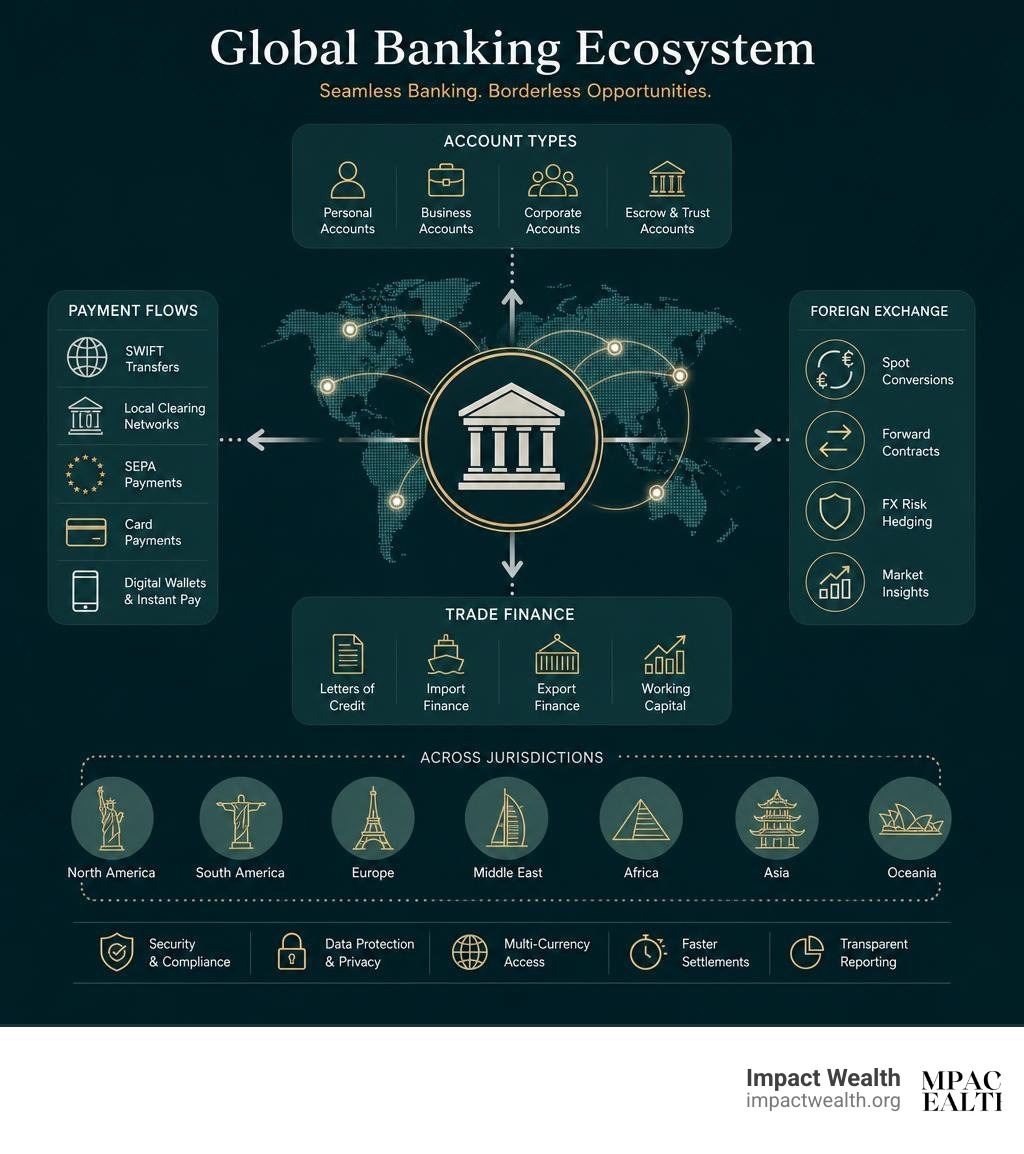
Here’s a quick-reference summary of what global banking services cover:
| Service Category | What It Does |
|---|---|
| Multi-currency accounts | Hold, send, and receive funds in multiple currencies |
| Cross-border payments | Wire transfers, SWIFT, SEPA, and local clearing networks |
| Trade finance | Letters of credit, import/export financing, working capital |
| Foreign exchange (FX) | Spot conversions, forward contracts, hedging strategies |
| Offshore/foreign accounts | Asset diversification, privacy, and political risk mitigation |
| Private & wealth banking | Bespoke investment, lending, and legacy planning for UHNWIs |
| Remote account opening | Online onboarding for foreign companies without physical presence |
The global banking landscape today spans two very different worlds. On one side sit legacy institutions — J.P. Morgan, HSBC, UBS — with centuries of history, deep capital markets access, and truly global reach. J.P. Morgan alone serves clients in over 100 countries and offers lending in more than 60 currencies. On the other side, a new wave of tech-enabled alternative platforms is moving faster, onboarding clients digitally, and filling the gaps that traditional banks leave open — especially for the growing number of ultra-high-net-worth (UHNW) individuals relocating internationally.
That number is significant. More than 120,000 high-net-worth individuals have relocated internationally over the past decade, driving urgent demand for banking solutions that work seamlessly across borders.
The challenge isn’t finding a global bank. It’s knowing which type of provider fits your specific situation — and what to look for when comparing them.
This guide breaks it all down: core services, traditional vs. alternative platforms, offshore account considerations, FX risk management, and the emerging trends reshaping global finance.
Core Capabilities of Global Banking Services
Core Offerings of Modern Global Banking Services
To navigate the complex waters of international trade and global wealth, one must understand the foundational pillars of modern international banking. At their core, global banking services are designed to eliminate the friction of geographic borders. The primary tools used to achieve this are multi-currency accounts (MCAs), real-time liquidity management, and integrated cross-border payment networks.
For international businesses and family offices, relying on single-currency accounts is a recipe for operational headaches and unnecessary conversion fees. Multi-currency accounts allow you to hold, receive, and disburse dozens of currencies under a single banking relationship. This capability is bolstered by advanced liquidity solutions that pool cash across different regions, ensuring that idle capital in Europe can offset credit needs in the US or the UK.
When moving money across these regions, utilizing Secure Payment Networks is vital. High-value international wires rely on robust infrastructures like SWIFT or FedWire, while day-to-day operations utilize localized, low-cost clearing systems. Understanding how these networks operate is essential for Streamlining Cross Border Transactions Why Secure Payment Systems Matter, as it directly impacts your transaction speed and bottom-line costs.
For those requiring comprehensive institutional capabilities, tier-1 institutions provide the gold standard. For example, International Banking: Global Banking Solutions offers businesses over 200 years of experience in international expansion, facilitating global lending in over 60 currencies. Whether you are managing cash flow from a regional base or coordinating international investments, consolidating your banking relationships under a single global network simplifies compliance and reporting.
In key financial hubs, physical proximity still carries immense value for tailored support. If you are operating out of South Florida, you can leverage localized expertise through institutions like Our Palm Beach, FL Office | J.P. Morgan Private Bank U.S., utilize personalized regional services at Grove Bank & Trust | South FL Personal & Business Banking | Loans, or coordinate transactional needs via Truist in Bal Harbour and the Hallandale Beach Financial Center & Drive-Thru ATM.
Trade Finance and Letters of Credit
International trade involves inherent trust gaps. How does an importer in Los Angeles know the exporter in Shanghai will ship the correct goods? Conversely, how does the exporter guarantee they will get paid? This is where trade finance solutions, particularly letters of credit (LCs), become indispensable.
A Letter of Credit acts as a bank-backed payment guarantee. Instead of requiring a risky cash prepayment, the buyer’s bank guarantees payment to the seller, contingent upon the presentation of strict shipping and compliance documentation. This preserves working capital for the buyer and provides ironclad security for the seller.
Beyond LCs, global banks offer specialized import and export financing, standby letters of credit, and supply chain finance solutions to optimize working capital. Leading global institutions like Global Banking | Standard Chartered provide financing and advisory solutions across major trade corridors in Asia, Africa, and the Middle East, helping businesses manage liquidity throughout the entire trade cycle. Similarly, institutions like BNP Paribas support these complex transactions with more than 300 trade finance experts operating across 100 dedicated trade centres in 60 locations worldwide.
Traditional Private Banks vs. Alternative Digital Platforms
Reshaping Private Wealth for UHNWIs and Family Offices
For decades, wealth preservation and private banking were synonymous with grand marble lobbies, wood-paneled boardrooms, and highly exclusive relationships in London, Zurich, or Palm Beach. However, the rapid pace of global wealth migration and technological advancement has forced a dramatic shift in how ultra-high-net-worth individuals (UHNWIs) and family offices manage their capital.
Traditional private banks excel at complex, bespoke lending (such as financing luxury real estate, yachts, or private jets) and structuring multi-generational succession plans. However, they are frequently bogged down by legacy software, rigid risk-appetite models, and slow onboarding processes. For a newly relocated entrepreneur trying to establish transactional accounts, waiting three to six months for traditional bank compliance can stall vital business operations.
This friction has fueled the rise of alternative digital banking platforms. These tech-enabled providers do not necessarily seek to replace traditional private banks; instead, they coexist by filling critical transactional niches. They leverage modern digital onboarding, offer rapid compliance processing, and provide instant multi-currency capabilities with in-country IBANs.
As global wealth continues its upward trajectory in 2026, family offices are increasingly adopting a multi-banked approach. They utilize legacy institutions for long-term asset management and custody, while leveraging agile digital platforms for daily transactions and rapid foreign exchange execution. This dual strategy is particularly relevant as Why Affluent Canadian Families Are Turning To Multi Family Offices to navigate complex cross-border tax environments and asset structures.
At the same time, major legacy institutions are fighting back by upgrading their digital infrastructure. To see how these global giants are balancing historical stability with modern digital capabilities, you can explore UBS financial services around the globe | UBS Global. However, major integrations and mergers among global banks have also introduced unique challenges, such as temporary cybersecurity vulnerabilities that bad actors attempt to exploit. This makes robust verification protocols a must for any modern wealth owner.
Correspondent Banking vs. Local In-Country Accounts
To move money globally, banks historically relied almost entirely on correspondent banking networks. In this system, a bank in Miami uses a partner bank in London to clear a transaction destined for Europe. While highly secure, this “chain” of intermediary banks often leads to delayed processing times, hidden fees, and a lack of transparency.
To bypass this friction, modern global corporate banking increasingly utilizes local in-country accounts (ICAs). By establishing virtual or physical accounts directly within local clearing networks—such as SEPA in the Eurozone or BACS/Faster Payments in the UK—businesses can collect and disburse funds as if they were a local entity.
| Feature | Correspondent Banking (SWIFT) | Local In-Country Accounts (ICA) |
|---|---|---|
| Transaction Speed | 1 to 5 business days | Near-instant to same-day |
| Fee Structure | Intermediary fees can be unpredictable | Low, flat local clearing fees |
| FX Conversion | Often forced at unfavorable bank rates | Controlled by the account holder |
| Best Used For | Large, complex, cross-border institutional transfers | High-frequency payroll, vendor payments, and local collections |
For multinational corporations, integrating these local accounts into a centralized dashboard is crucial. Platforms like Global Corporate Banking Solutions | J.P. Morgan allow corporate treasurers to manage global liquidity, optimize cash positioning, and execute transactions smoothly across borders, bridging the gap between legacy correspondent networks and local clearing efficiency.
Navigating Remote and Offshore Account Opening
Benefits and Challenges of Remote Onboarding
The ability to open a bank account remotely is a massive operational advantage for foreign companies expanding internationally. It eliminates the need for expensive, time-consuming travel just to sign physical paperwork in a distant branch.
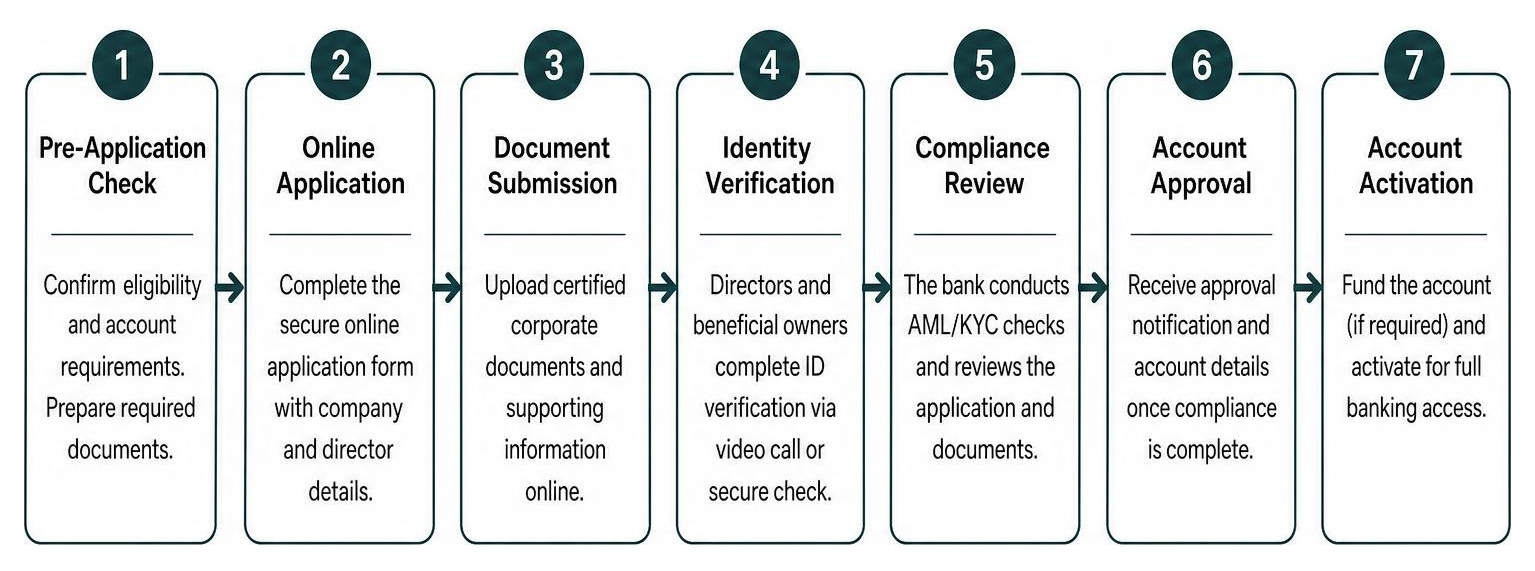
However, remote onboarding is far from a simple “click-and-sign” process. Because global banks must adhere to strict Anti-Money Laundering (AML) and Know Your Customer (KYC) regulations, they require exhaustive documentation. The compliance timeline can range from a single week for digital-first platforms to several weeks or months for traditional institutions.
Commonly required documentation includes:
- Certified corporate registry documents and articles of association.
- Detailed proof of business activities (contracts, invoices, or utility bills).
- Comprehensive ownership structures identifying all Ultimate Beneficial Owners (UBOs) holding more than 10% or 25% of the entity.
- Certified passport copies and proof of address for all directors and signers.
Navigating these regulatory landscapes requires a deep understanding of local compliance frameworks. For businesses managing global workforces and entities, Harnessing The Eor Advantage In Global Compliance can streamline operational setups. To explore specialized services that facilitate 100% remote international and offshore corporate setups, you can consult Home – Global Banking Services.
Offshore Accounts, Privacy, and Asset Diversification
For UHNWIs and international corporations, opening an offshore or foreign bank account is rarely about hiding assets; rather, it is a strategic move for political risk mitigation, asset protection, and financial diversification. By holding capital in stable, well-regulated jurisdictions outside their home country, investors protect their wealth from localized economic instability, currency devaluations, and geopolitical friction.
However, the offshore landscape has evolved. The era of absolute bank secrecy has been replaced by global compliance standards. Under the Common Reporting Standard (CRS) and the Foreign Account Tax Compliance Act (FATCA), financial institutions automatically share account information with tax authorities globally. Staying compliant requires a proactive understanding of Global Tax Transparency to ensure all international structures are fully disclosed and legally optimized.
When comparing jurisdictions for offshore or foreign banking, consider this comparison between traditional wealth havens and modern digital financial hubs:
| Jurisdiction Type | Key Strengths | Typical Minimum Balance Requirements | Compliance & Onboarding Speed |
|---|---|---|---|
| Traditional Havens (e.g., Switzerland, Liechtenstein, UK) | Unmatched asset protection, multi-generational trust services, deep private banking heritage. | High ($1M to $5M+ USD) | Slow and meticulous (4 to 12 weeks) |
| Modern Digital Hubs (e.g., Dubai, Singapore, Miami) | Pro-business environments, cutting-edge digital infrastructure, seamless integration with digital assets. | Moderate ($100k to $500k USD) | Moderate to fast (2 to 6 weeks) |
Strategic Treasury Management and Emerging Financial Trends
How Global Banking Services Mitigate Currency Risk
Operating across international borders means constant exposure to foreign exchange (FX) volatility. A sudden shift in the value of the Euro or Sterling can instantly erode the profit margins of a cross-border transaction. Global banks help businesses mitigate this risk through structured treasury management and hedging strategies.
The foundation of FX risk management is the establishment of a budget rate—a benchmark exchange rate set during the financial planning process. To protect this budget rate, corporate treasurers utilize several hedging instruments:
- Spot Conversions: Immediate currency exchanges at current market rates, best for immediate transactional needs.
- Forward Contracts: Agreements to lock in an exchange rate for a specific date in the future (e.g., 30, 60, or 90 days out). This ensures that the cost of future inventory or foreign payroll remains completely predictable, regardless of market fluctuations.
- FX Options: Financial contracts that give the buyer the right, but not the obligation, to exchange currency at a set rate, providing protection against downside risk while allowing participation in favorable market movements.
Implementing these strategies is a core component of navigating International Markets successfully, ensuring that geopolitical shifts do not disrupt your corporate liquidity.
AI Integration, Crypto Accounts, and Sustainable Finance
As we progress through 2026, the global banking sector is undergoing a massive technological and philosophical evolution, driven by three major forces: artificial intelligence, digital assets, and sustainability.

Artificial intelligence is rapidly shifting from a back-office automation tool to a core component of Ai In Financial Services. Global banks are deploying advanced “decision intelligence” systems that analyze vast amounts of transaction data in real time. For corporate treasurers, AI-driven assistants predict cash flow bottlenecks, optimize liquidity allocation, and instantly flag fraudulent activity during major banking transitions.
Simultaneously, the integration of cryptocurrency and digital assets into mainstream banking is accelerating. Progressive financial institutions now offer dedicated crypto custody, allowing family offices and institutional investors to hold digital assets alongside traditional fiat currencies. This trend is particularly evident in forward-thinking jurisdictions, prompting many wealth owners to explore From Europe To Dubai Redomiciliation And Wealth Structuring For Digital Asset Principals to optimize their digital portfolios.
Finally, sustainable finance is no longer a corporate social responsibility checkbox; it is a core commercial driver. Global banks are structuring multi-billion-dollar green loans and sustainability-linked credit facilities. These financial products offer preferential interest rates to corporate borrowers who meet strict Environmental, Social, and Governance (ESG) benchmarks, such as transitioning data centers to renewable energy or developing low-carbon infrastructure.
Frequently Asked Questions about International Accounts
Can a foreign company open a bank account remotely?
Yes. Many international banks and alternative digital platforms allow foreign companies to open accounts 100% remotely. The process involves submitting digital corporate registry documents, verifying the identities of all directors and ultimate beneficial owners (UBOs) via secure video portals, and detailing the company’s business activities. While digital platforms can complete this process in a week, traditional banks may take several weeks to conduct thorough compliance checks.
What are the minimum balance requirements for offshore accounts?
Minimum balance requirements vary drastically depending on the institution and the jurisdiction. Digital-first transactional platforms may require little to no minimum balance. However, traditional offshore private banks in jurisdictions like Switzerland or the UK typically require substantial minimums, often starting at $1,000,000 USD and reaching upwards of $5,000,000 USD in assets under management to maintain active, dedicated advisory services.
How do letters of credit protect international trade transactions?
Letters of credit (LCs) protect both parties by shifting the transaction risk to the participating financial institutions. The buyer’s bank guarantees that the seller will be paid, but only after the seller presents verifiable proof (such as bills of lading and customs documentation) that the correct goods have been shipped. This prevents the buyer from losing capital on unfulfilled orders and guarantees the seller will receive payment once their shipping obligations are met.
Conclusion
In 2026, navigating the global financial landscape requires a sophisticated blend of traditional stability and modern digital agility. Whether you are expanding a multinational enterprise, establishing a remote corporate entity, or safeguarding wealth across generations, selecting the right global banking services is a vital strategic decision.
By carefully balancing the deep capital access of legacy private banks with the transactional speed of alternative digital platforms, you can build a resilient, cross-border financial ecosystem.
To explore tailored approaches to protecting and growing your capital, discover our comprehensive insights on Wealth Management Strategies.