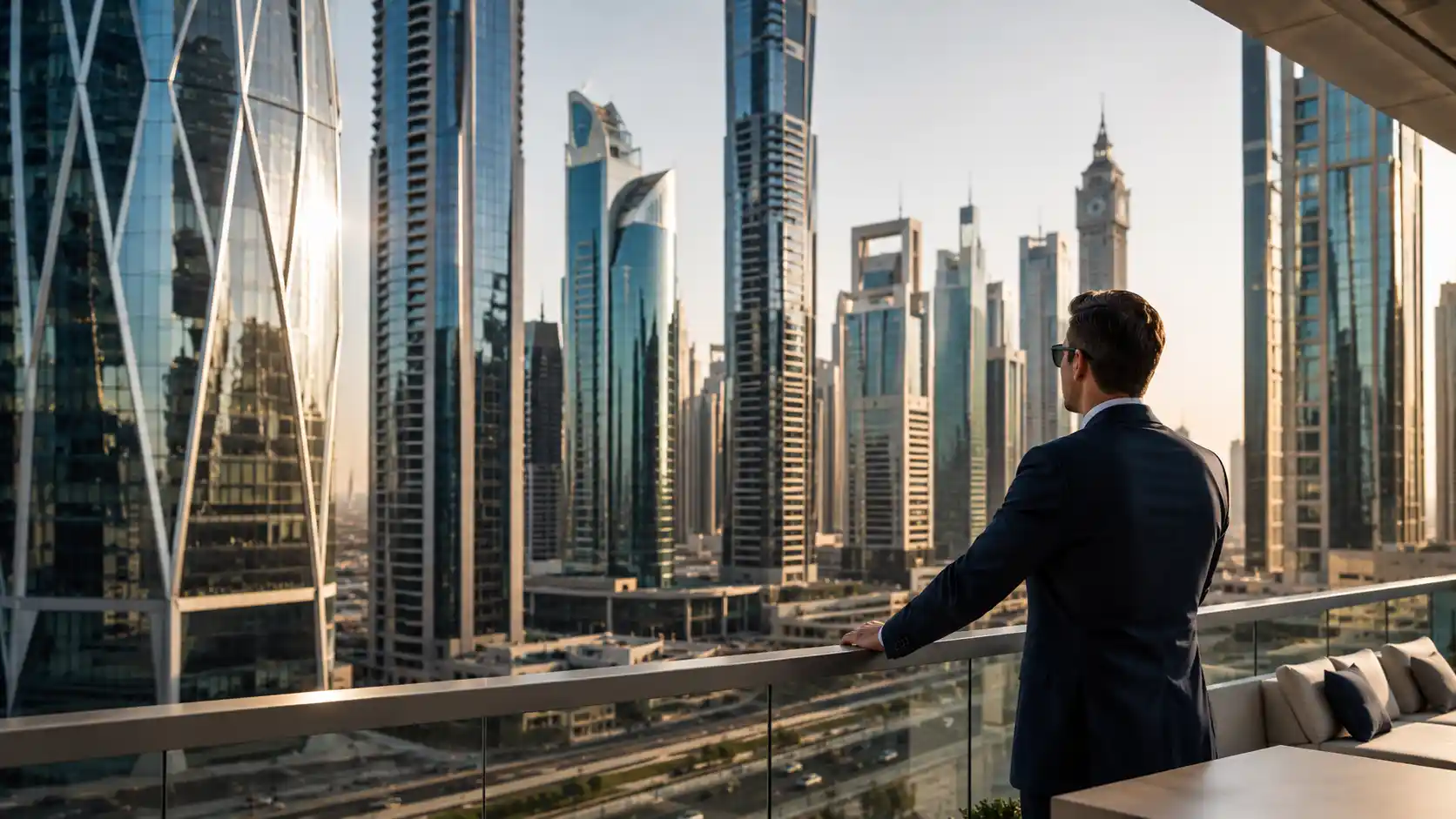
Dubai commercial real estate has evolved from a regional investment opportunity into one of the world’s most influential commercial property markets. Within just a few decades, the emirate has transformed into a strategic destination where multinational corporations, family offices, institutional investors, entrepreneurs, and ultra-high-net-worth individuals allocate capital with a long-term perspective. As the Dubai property market continues to mature, investors increasingly view commercial property Dubai as a gateway to sustainable income, portfolio diversification, and wealth preservation rather than simply another real estate opportunity.
Dubai’s unique position between Europe, Asia, and Africa gives it exceptional strategic value. Combined with world-class infrastructure, political stability, business-friendly regulation, and continuous economic diversification, the city has become a preferred location for global companies expanding across multiple regions. This transformation has strengthened Dubai real estate investment across office developments, logistics facilities, retail destinations, and mixed-use business districts while reinforcing Dubai’s reputation as a magnet for global wealth.
Unlike many mature markets that face slower growth or higher taxation, Dubai offers investors an environment where commercial assets benefit from strong demand, attractive rental yields, international connectivity, and ongoing government investment. These advantages continue attracting capital from both established institutions and private investors seeking long-term resilience in an increasingly uncertain global economy.
How Dubai Became One of the World’s Leading Commercial Property Markets?
Dubai’s rise as a global commercial property destination reflects decades of deliberate economic planning rather than rapid urban expansion alone. Successive government initiatives have diversified the economy beyond hydrocarbons into finance, logistics, tourism, technology, healthcare, manufacturing, aviation, and professional services. That diversification has steadily expanded demand for premium office developments, logistics facilities, retail destinations, and mixed-use commercial projects.
The city’s strategic geography further enhances its competitive position. Businesses operating from Dubai gain efficient access to markets across Europe, Africa, South Asia, and the Middle East while benefiting from internationally recognized transport infrastructure, advanced telecommunications, and modern financial services.
This combination has elevated Dubai into a true international business center where companies establish regional headquarters, investment funds deploy capital, and entrepreneurs launch globally focused enterprises. Consequently, office space Dubai remains highly sought after in premium districts, while demand for modern commercial developments continues expanding alongside population and business growth.
Beyond physical infrastructure, regulatory modernization has significantly improved investor confidence. Transparent property registration, stronger legal protections, digital government services, and evolving ownership regulations have strengthened trust among international investors seeking long-term exposure to UAE commercial real estate.
These structural advantages created the foundation for sustained commercial property growth, setting the stage for increasing international capital allocation.
Why Global Investors Continue to Choose Dubai Commercial Real Estate?
The appeal of Dubai commercial real estate extends well beyond attractive returns. Today’s investors increasingly prioritize political stability, capital preservation, tax efficiency, liquidity, and international diversification. Dubai performs strongly across each of these factors.
Several powerful drivers continue attracting international capital:
- Tax-efficient investment environment
- High-quality commercial developments
- Strong rental demand
- Transparent regulatory framework
- Strategic global connectivity
- Continuous infrastructure investment
Family offices increasingly allocate capital to Dubai because commercial assets complement broader wealth preservation strategies. Institutional investors similarly recognize Dubai as a market offering income generation alongside long-term appreciation potential.
Meanwhile, multinational corporations continue expanding operations throughout the emirate. Regional headquarters, innovation centers, financial institutions, consulting firms, and technology companies create consistent demand for premium offices and flexible workspaces.
The result is a commercial market supported by genuine business activity rather than speculative investment alone. This distinction has become increasingly important as investors seek resilient assets capable of performing throughout different economic cycles.
The Commercial Sectors Driving Long-Term Growth
Dubai’s commercial market benefits from diversification across multiple asset classes rather than dependence on a single sector.
Office developments continue attracting international firms seeking premium corporate environments equipped with smart technology and sustainability features. Grade A offices remain especially attractive as global businesses prioritize employee experience and operational efficiency.
Retail assets have evolved beyond traditional shopping centers into lifestyle destinations integrating entertainment, hospitality, wellness, and dining experiences.
Industrial and logistics facilities have become one of the fastest-growing segments due to expanding e-commerce, regional distribution networks, and global supply chain diversification.
Mixed-use developments combine commercial offices, hospitality, retail, residential, and leisure facilities within integrated urban districts that appeal to both investors and occupiers.
| Commercial Sector | Investment Appeal | Long-Term Opportunity |
|---|---|---|
| Office | Stable corporate demand | Premium rental growth |
| Retail | Tourism and consumer spending | Experience-driven destinations |
| Logistics | E-commerce expansion | Regional distribution leadership |
| Mixed-use | Diversified income streams | Sustainable urban development |
Each sector contributes differently to portfolio resilience. Together, they create a balanced commercial ecosystem capable of adapting to changing economic conditions while supporting long-term investment performance.
Infrastructure, Free Zones, and the Business-Friendly Investment Environment
Infrastructure investment remains one of Dubai’s greatest competitive advantages. Continuous upgrades to transport networks, ports, airports, digital connectivity, and smart city technologies enhance commercial property values while improving business productivity.
Equally important are Dubai’s internationally recognized free zones, which continue attracting multinational companies through flexible ownership structures, simplified business registration, sector-specific ecosystems, and attractive regulatory frameworks.
Key advantages include:
- Foreign ownership opportunities
- Efficient licensing procedures
- Modern logistics infrastructure
- Industry-focused business clusters
- Strong legal and regulatory support
Sustainability has also become central to commercial development. Developers increasingly integrate energy-efficient systems, smart building technologies, green certifications, and ESG principles into new projects. Institutional investors increasingly prioritize environmentally responsible assets, making sustainable commercial developments more competitive over the long term.
This ongoing evolution ensures that Dubai remains aligned with changing global investment expectations while reinforcing its appeal to international businesses.
Dubai vs. Other Global Commercial Property Markets
Every major commercial property market offers unique advantages. However, Dubai distinguishes itself through its combination of taxation, connectivity, infrastructure investment, and comparatively attractive yields.
| Dubai | London | Singapore | Key Difference |
| Attractive rental yields | Lower yields | Stable but competitive | Higher income potential |
| Tax-efficient environment | Higher tax burden | Competitive taxation | Greater investor efficiency |
| Global aviation hub | Financial leadership | Asian business gateway | Three-continent connectivity |
| Rapid infrastructure growth | Mature infrastructure | Highly developed | Faster expansion opportunities |
While London continues attracting financial institutions and Singapore real estate remains a dominant Asian commercial hub, Dubai increasingly serves businesses operating across multiple continents simultaneously.
Rather than replacing established financial centers, Dubai complements them by offering strategic diversification and broader regional access. That complementary role continues strengthening its position within global investment portfolios.
The Future of Dubai Commercial Real Estate
Future growth will likely be driven by demographic expansion, digital transformation, sustainability initiatives, and continued economic diversification.
Artificial intelligence, financial technology, advanced manufacturing, healthcare innovation, and professional services are expected to generate additional demand for modern commercial facilities designed around flexibility and technology integration.
Hybrid working patterns will reshape office design rather than eliminate office demand. Premium workplaces offering collaboration, wellness, smart technology, and sustainable construction are likely to outperform older assets.
Logistics properties should continue benefiting from expanding trade volumes, while mixed-use developments remain attractive due to diversified income sources and integrated urban planning.
As international capital increasingly prioritizes resilience over speculation, Dubai’s commercial market appears well positioned to capture further investment inflows.
Why Dubai Continues to Lead Global Commercial Investment?
Dubai’s success reflects more than impressive construction projects. It stems from a broader economic strategy combining business-friendly regulation, world-class infrastructure, international connectivity, and continuous innovation.
The city consistently attracts entrepreneurs launching new ventures, multinational corporations establishing headquarters, investment managers seeking diversified portfolios, and wealthy families protecting intergenerational wealth.
Unlike markets dependent upon a single economic sector, Dubai continues broadening its commercial base across finance, technology, tourism, healthcare, logistics, education, and advanced services. That diversification reduces long-term risk while creating sustained demand across multiple commercial property categories.
These strengths reinforce Dubai’s growing reputation as one of the world’s most resilient destinations for commercial real estate investment.
Unique Insight
The greatest strength of Dubai commercial real estate lies not simply in attractive rental yields or premium developments but in its strategic role within the global economy. Dubai has evolved into a bridge connecting Europe, Asia, and Africa, allowing investors to gain exposure to expanding trade, international business activity, and cross-border capital flows from a single location.
This convergence of infrastructure excellence, tax efficiency, investor-friendly regulation, and global connectivity explains why family offices, sovereign wealth funds, pension managers, and institutional investors increasingly treat Dubai as a permanent strategic allocation rather than a cyclical opportunity.
The growing emphasis on ESG-certified buildings, smart commercial infrastructure, flexible workplaces, and integrated mixed-use developments further enhances long-term competitiveness. Ultimately, the enduring value of Dubai commercial real estate comes from its ability to provide diversification, stability, international accessibility, and participation in one of the world’s fastest-evolving business ecosystems.
Conclusion
As international investors continue seeking resilient assets capable of generating income while preserving long-term wealth, Dubai commercial real estate remains exceptionally well positioned. Strong infrastructure, business-friendly policies, strategic geography, diversified economic growth, attractive investment conditions, and expanding global connectivity collectively support one of the world’s most dynamic commercial property markets.
Rather than representing a short-term investment trend, Dubai has established itself as a permanent center of international commerce. For institutional investors, entrepreneurs, multinational corporations, and family offices alike, the emirate offers an increasingly compelling combination of stability, opportunity, innovation, and long-term value that few global commercial property markets can match.
Frequently Asked Questions
What is driving demand for Dubai commercial real estate?
Business expansion, foreign investment, infrastructure development, and population growth continue increasing demand across office, logistics, retail, and mixed-use assets.
Is Dubai commercial real estate a good long-term investment?
Yes. Dubai commercial real estate combines attractive rental yields, capital appreciation potential, and diversification benefits that appeal to long-term investors.
Can foreign investors buy commercial property in Dubai?
Yes. Foreign investors can purchase commercial property in designated freehold areas under regulations designed to encourage international investment.
Which commercial sectors are growing the fastest in Dubai?
Logistics, Grade A offices, mixed-use developments, and premium retail continue experiencing strong growth.
Why do multinational companies choose Dubai?
Dubai offers strategic connectivity, modern infrastructure, business-friendly regulation, skilled talent, and access to regional markets.
How does Dubai compare with London and Singapore for commercial property?
Dubai generally offers stronger rental yields, tax advantages, and faster infrastructure expansion while complementing both financial centers.
What role do free zones play in Dubai’s business growth?
Free zones simplify business operations, encourage foreign investment, and create specialized commercial ecosystems supporting economic diversification.
How does Dubai commercial real estate support wealth preservation?
Commercial assets provide income generation, geographic diversification, inflation protection, and exposure to long-term economic growth.
What risks should investors consider?
Investors should evaluate market cycles, sector selection, tenant quality, financing conditions, and evolving regulations before investing.
What is the future outlook for Dubai commercial real estate?
The outlook remains positive, supported by economic diversification, global business expansion, sustainability initiatives, and continued international capital inflows.