For decades, the ultimate symbol of maritime wealth was simple: bigger decks, glamorous ports, and increasingly elaborate displays of floating luxury. Today, that equation is changing. Explorer yachts have emerged as one of the most dynamic categories in the global superyacht market, attracting billionaires, entrepreneurs, family offices, and ultra-high-net-worth individuals who want something more valuable than visibility—freedom.
Unlike traditional pleasure vessels designed primarily for coastal cruising and social calendars, luxury explorer yachts and expedition yachts promise access. Owners are trading predictable Mediterranean circuits for remote archipelagos, polar waters, and months-long journeys supported by long-range capability and self-sufficient design. The shift reflects a broader evolution in luxury consumption: experiences increasingly matter more than possessions.
This transformation also aligns with wider changes in luxury yacht travel. Privacy, autonomy, wellness, and meaningful exploration now define status in ways that conventional displays of wealth once did. Among today’s billionaire yachts, the most admired are often not those seen in crowded marinas but those capable of disappearing into the Arctic Circle, crossing oceans uninterrupted, and delivering five-star hospitality far from civilization.
What Defines an Explorer Yacht?
Explorer yachts occupy a unique position between expedition capability and ultra-luxury hospitality. At their core, they are engineered to travel farther, remain independent longer, and operate in environments that conventional superyachts often avoid.
Their defining characteristic is not simply appearance. While many feature rugged profiles, high bows, reinforced hulls, and commanding observation decks, their true advantage lies beneath the surface.
Typical characteristics include:
- Extended fuel and freshwater capacity
- Long-range navigation systems
- Enhanced storage and provisioning capability
- Stabilization technology for challenging seas
- Expedition-grade tenders and support equipment
- Reinforced construction for remote operations
Historically, expedition vessels prioritized utility over comfort. Modern explorer superyachts have transformed that formula. Owners no longer choose between adventure and refinement—they expect both.
Many new builds resemble boutique luxury resorts that happen to possess transoceanic capability. Interiors rival elite residences, while technical systems allow months of autonomous operation.
The evolution from functional expedition vessels into floating luxury sanctuaries has reshaped expectations across the entire superyacht industry.
Why Global Billionaires Are Choosing Explorer Yachts?
A quiet shift has taken place among global wealth holders.
The traditional model of ownership emphasized visibility: Mediterranean summers, glamorous arrivals, and social recognition. Yet many wealthy owners now seek something less public and more personal.
Explorer yachts answer that demand.
Privacy has become increasingly scarce at the highest levels of wealth. Commercial aviation, luxury resorts, and conventional tourism rarely deliver genuine isolation. Explorer vessels provide complete control over environment, schedule, and destination.
Several factors are accelerating demand:
- Greater interest in experiential luxury
- Multi-generational family travel
- Longer periods spent onboard
- Flexible remote work lifestyles
- Increased focus on security and privacy
Long-range yachts also align with changing family dynamics. Rather than purchasing multiple residences globally, some owners view yachts as mobile estates capable of relocating with seasons and interests.
This approach appeals particularly to entrepreneurs and family offices focused on asset flexibility and lifestyle diversification.
At the same time, explorer ownership reflects a more understated version of prestige. Reaching remote coastlines, spending weeks beyond traditional cruising routes, and accessing inaccessible destinations increasingly carry greater cachet than being seen in familiar luxury hubs.
Inside the Luxury Features of Modern Explorer Superyachts
If early expedition vessels emphasized endurance, today’s explorer superyachts elevate hospitality to unprecedented levels.
Guests stepping aboard often encounter interiors created by leading residential designers rather than naval architects alone. Spaces prioritize natural materials, expansive glazing, wellness integration, and residential comfort.
Modern onboard experiences commonly include:
- Beach clubs with fold-down sea terraces
- Full-service spas and treatment suites
- Cinema lounges and immersive entertainment spaces
- Wine cellars and private dining salons
- Fitness studios and recovery facilities
- Infinity pools and observation lounges
Expedition equipment has also become increasingly sophisticated.
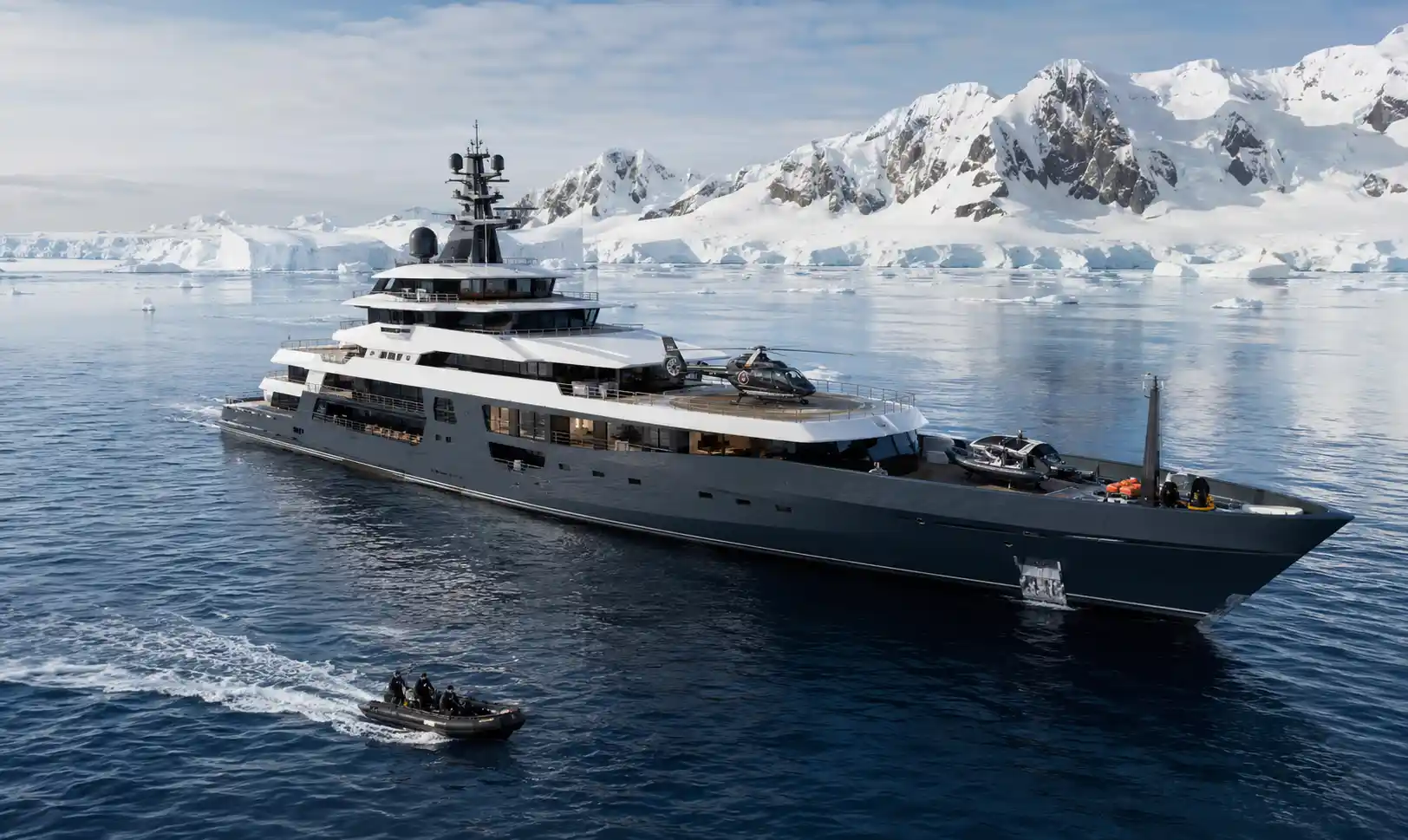
Helicopter decks are now standard on many larger vessels, enabling direct transfers and destination access. Some owners include submarines for underwater exploration, while others equip yachts with scientific laboratories, dive centers, snowmobiles, and support craft.
Rather than competing with luxury hotels, these vessels increasingly replace them.
The result is a new category of ultra luxury yachts capable of delivering private aviation, luxury hospitality, and expedition travel within a single experience.
| Explorer Yacht Feature | Purpose | Owner Benefit |
|---|---|---|
| Extended fuel capacity | Long-range cruising | Reduced reliance on ports |
| Ice-class hull | Polar and remote navigation | Expanded destination access |
| Helipad | Fast transport and exploration | Greater flexibility |
| Support tenders | Shore access and activities | Enhanced expedition capability |
| Hybrid systems | Improved efficiency | Lower environmental impact |
| Wellness facilities | Long-term comfort | Residential-style living |
As amenities continue to evolve, engineering has become just as important as aesthetics.
Technology, Sustainability, and Long-Range Capability
The rise of adventure yachts coincides with rapid advances in maritime innovation.
Owners increasingly expect vessels capable of remaining operational for weeks or months while minimizing environmental impact. This expectation has accelerated investment in hybrid propulsion, advanced energy systems, and intelligent vessel management.
Several developments now shape new construction:
- Hybrid-electric propulsion
- Dynamic positioning technology
- Energy recovery systems
- Advanced weather routing software
- Noise and vibration reduction
- Smart automation platforms
Ice-class engineering has emerged as another major differentiator.
Specialized hull reinforcement allows access to colder and more demanding environments including Antarctica and Greenland. Combined with enhanced stabilization and navigation tools, these technologies dramatically expand cruising possibilities.
Sustainability has also become part of the ownership conversation.
Although large yachts remain resource-intensive assets, owners increasingly request lower-emission systems, efficient hull forms, improved waste management, and reduced onboard energy consumption.
This movement mirrors broader shifts across luxury travel where environmental awareness increasingly influences purchasing decisions.
The result is a new generation of expedition yachts that combine exceptional capability with responsible innovation.
Explorer Yachts vs. Traditional Superyachts
The contrast between explorer vessels and traditional superyachts extends beyond engineering.
Conventional superyachts often prioritize social entertainment, short-distance cruising, and visual impact. Explorer platforms prioritize endurance, destination flexibility, and immersive experiences.
That difference increasingly shapes purchasing decisions.
| Yacht Type | Best For | Defining Characteristics |
| Explorer Yacht | Remote exploration and long voyages | Long range, expedition capability, autonomy |
| Traditional Superyacht | Coastal luxury cruising | Entertainment-focused design |
| Expedition Yacht | Adventure travel | Utility-oriented exploration |
| Performance Superyacht | Fast regional movement | Speed and sleek design |
The difference between explorer yachts and traditional superyachts extends well beyond engineering.
While conventional superyachts often focus on social entertainment, short coastal routes, and visual impact, explorer yachts are built for longer journeys, greater freedom, and deeper experiences. As a result, many owners now choose vessels that deliver both luxury and flexibility.
Design priorities also differ.
Explorer yachts usually include more storage, stronger backup systems, and layouts designed for extended time onboard. In contrast, traditional superyachts often dedicate more space to entertainment areas and marina-centered lifestyles.
Likewise, the owner experience changes.
Explorer owners generally value discovery, privacy, and continuity throughout longer voyages. Traditional superyacht owners, however, often prefer seasonal cruising and established luxury destinations.
From an investment point of view, demand for explorer categories continues to remain strong. In addition, growing order books suggest that this segment may continue outperforming broader superyacht markets over time.
Consequently, this rising interest is shaping a new map of luxury travel.
The World’s Most Extraordinary Destinations for Explorer Yachts
Explorer ownership becomes truly meaningful when paired with destinations that reward range and independence.
Today, owners increasingly seek places beyond traditional luxury routes. Instead of returning to familiar ports, they pursue journeys that combine adventure with refined hospitality.
Antarctica
For many owners, Antarctica represents the ultimate destination. Towering glaciers, open ice fields, and untouched landscapes create one of the world’s most exclusive travel experiences. At the same time, ice-class engineering allows access while maintaining comfort and safety.
Greenland
Likewise, Greenland continues to attract explorer owners looking for privacy and distance from crowded luxury circuits. Massive fjords, dramatic coastlines, and wildlife encounters create experiences that feel both remote and deeply personal.
Norwegian Fjords
Meanwhile, the Norwegian fjords offer a different style of exploration. Here, dramatic scenery meets world-class infrastructure, allowing owners to enjoy both comfort and discovery throughout the journey.
Alaska
Similarly, Alaska appeals to owners seeking longer seasonal adventures. Because of its vast landscapes and extended cruising opportunities, the region has become increasingly popular for multi-week itineraries.
Galápagos Islands
The Galápagos deliver a rare balance of controlled access and natural richness. As a result, owners enjoy highly curated experiences while remaining immersed in extraordinary surroundings.
South Pacific
Elsewhere, the South Pacific continues to define remote luxury. Scattered islands, flexible itineraries, and exceptional privacy make the region especially attractive for extended cruising.
Arctic Circle
Finally, the Arctic Circle offers experiences once limited to research missions and specialist expeditions. Today, modern explorer yachts allow owners to reach these regions without giving up luxury or personalized service.
Ultimately, what connects these destinations is not exclusivity alone—it is freedom of access. More importantly, owners increasingly define luxury by where they can travel rather than by what they can display.
The Future of Explorer Yachts and Luxury Adventure
The rise of explorer superyachts points to a lasting shift rather than a passing trend.
Owners continue to request greater cruising range, more residential interiors, and stronger expedition capability. At the same time, designers are combining advanced marine systems with the warmth and comfort of private homes.
Several developments are expected to shape the next generation:
- Greater use of hybrid propulsion
- Better energy storage systems
- Flexible expedition spaces
- Smarter autonomous support systems
- Expanded wellness and recovery areas
In addition, longer voyages are changing how owners think about time at sea.
As remote work and global mobility continue to expand, many owners now treat yachts as seasonal residences instead of occasional escapes. Consequently, vessels increasingly function as mobile luxury estates.
This change reflects a wider shift in modern luxury values.
Unique Insight
Perhaps the most important change created by explorer yachts is not technical—it is cultural.
For decades, luxury often depended on visibility. Being seen represented success. However, explorer yachts are changing that idea.
Today, many owners place greater value on privacy.
Experiences are replacing traditional status symbols. Likewise, self-sufficient travel increasingly represents freedom. At the same time, adventure is becoming a new expression of prestige.
Therefore, explorer yachts are becoming far more than luxury vessels.
They are evolving into floating private residences that reach places conventional superyachts cannot access while still delivering exceptional comfort, hospitality, wellness, and personalized service.
Above all, their greatest luxury is not size or appearance.
Instead, it is the freedom to travel farther, stay longer, and experience the world on entirely personal terms.
Conclusion
The rapid rise of explorer ownership reflects one of the most significant changes in global luxury travel.
Today’s billionaires increasingly choose experiences over visibility, flexibility over routine, and meaningful journeys over traditional displays of wealth.
By combining expedition-level capability with refined hospitality, advanced technology, wellness, and residential comfort, these vessels have created a new standard in maritime luxury.
Ultimately, Explorer yachts are redefining billionaire travel and shaping the future of ultra-luxury experiences—not through attention, but through the freedom to explore.
Frequently Asked Questions
What are explorer yachts?
Explorer yachts are luxury vessels designed for extended cruising, remote access, and expedition capability while maintaining premium onboard comfort.
How are explorer yachts different from traditional superyachts?
They prioritize range, autonomy, and exploration rather than short-range entertainment and marina-centered lifestyles.
Why are billionaires buying explorer yachts?
They offer privacy, long-duration travel, destination flexibility, and experiences that conventional luxury assets cannot replicate.
What luxury features do explorer yachts offer?
Typical features include spas, helipads, cinemas, wellness suites, submarines, beach clubs, and personalized hospitality.
Can explorer yachts travel to polar regions?
Many models include ice-class engineering that enables operation in Arctic and Antarctic environments.
What is the difference between an explorer yacht and an expedition yacht?
Explorer yachts generally emphasize luxury integration, while expedition yachts traditionally prioritize operational capability.
Are explorer yachts designed for long-distance cruising?
Yes. Long-range fuel capacity, provisioning systems, and advanced navigation support extended voyages.
Which destinations are most popular for explorer yacht owners?
Antarctica, Greenland, Norwegian fjords, Alaska, the South Pacific, and the Galápagos remain among the leading choices.
Are explorer yachts more sustainable than conventional superyachts?
Many newer designs incorporate hybrid propulsion, improved efficiency systems, and lower-impact technologies.
Why are explorer yachts becoming the future of luxury yachting?
Explorer yachts combine adventure, privacy, autonomy, and ultra-premium comfort in ways increasingly aligned with modern luxury expectations.