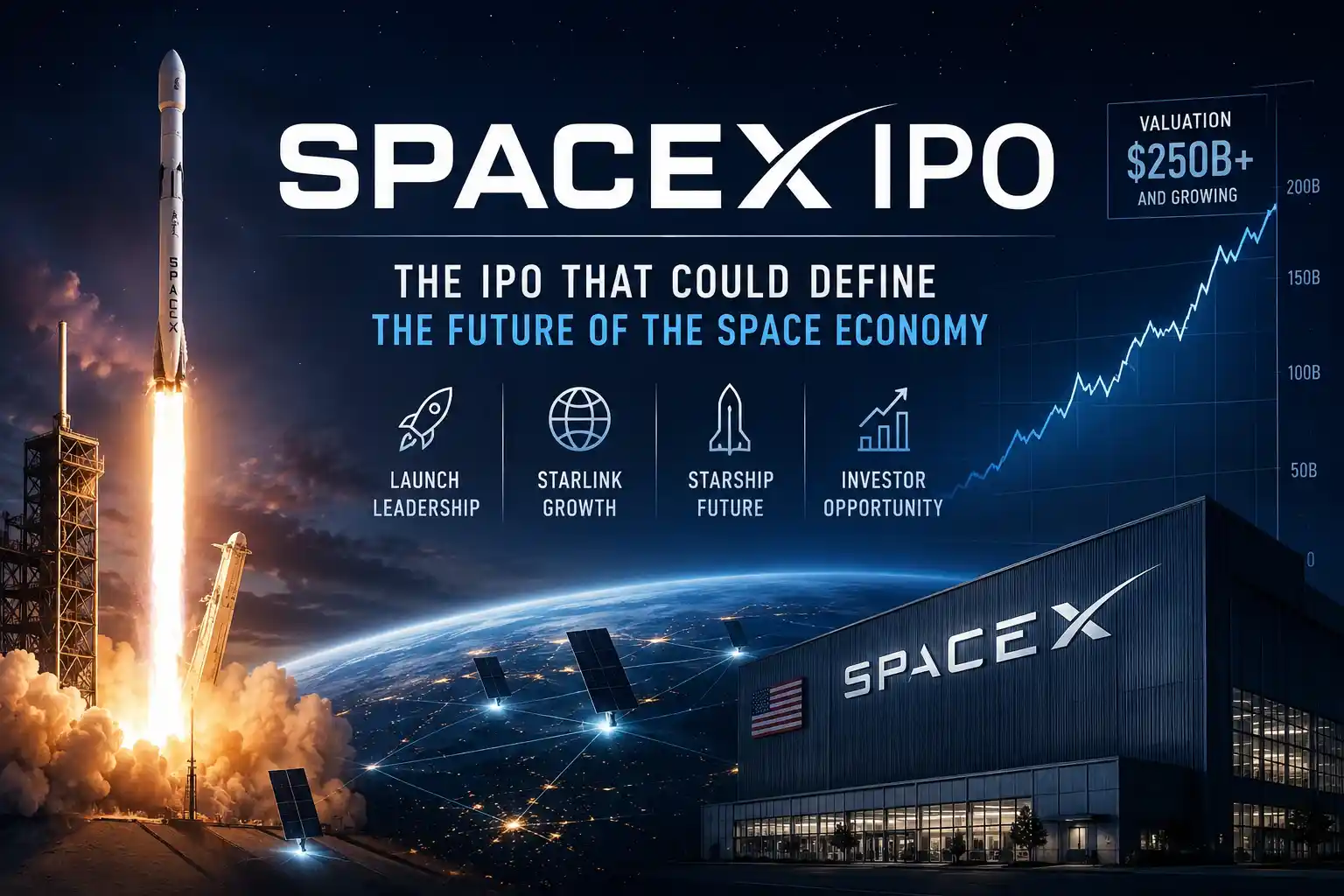
For years, financial markets have searched for the next defining public offering an event capable of reshaping valuation frameworks, attracting global capital, and setting the tone for an investment cycle. Increasingly, many investors believe that event could be the SpaceX IPO.
Even without an official filing or listing timeline, discussion around a possible SpaceX public debut has expanded far beyond traditional venture circles. Hedge funds monitor secondary markets. Sovereign wealth funds evaluate strategic access. Institutional allocators model future ownership scenarios. Retail investors search for indirect exposure.
The fascination is not simply about owning shares in a famous company.
Markets increasingly view SpaceX as something larger: a platform for orbital infrastructure, global communications, launch logistics, and potentially the backbone of a new industrial cycle.
The extraordinary attention surrounding the SpaceX IPO reflects more than investor enthusiasm it reflects how capital markets price scarcity, infrastructure dominance, and long-duration technological change.
Why the SpaceX IPO Has Become the Most Watched Private Market Event?
Private companies routinely achieve multi-billion-dollar valuations. Very few become global market narratives.
SpaceX occupies a different category.
Unlike many high-growth technology firms that rely primarily on software expansion, SpaceX combines physical infrastructure, recurring services, government relationships, and vertically integrated manufacturing.
That combination has made it one of the most closely observed private companies in modern financial history.
Several forces explain the attention:
- Limited access to private allocations
- Massive demand for frontier technology exposure
- Expanding space economy investment themes
- Expectations of future liquidity events
- Scarcity of infrastructure-scale growth assets
Institutional investors increasingly view private markets as crowded. Yet few private assets offer the scale, brand recognition, and potential economic influence associated with SpaceX.
This scarcity drives premium pricing and ongoing speculation.
SpaceX Valuation and the Psychology of Scarcity
Discussion surrounding SpaceX valuation rarely centers only on current earnings.
Instead, investors debate future infrastructure value.
Traditional valuation approaches struggle to capture businesses that combine launch services, satellite connectivity, defense contracts, and long-duration industrial expansion.
This dynamic creates persistent disagreement:
- Growth investors argue SpaceX deserves infrastructure multiples.
- Value-oriented investors question long-term capital efficiency.
- Macro investors model decades of future cash flows.
Private market pricing also behaves differently from public markets.
Because liquidity is limited, transaction volume remains low relative to demand. Secondary share activity therefore becomes an imperfect signal that can amplify valuation expectations.
As a result, SpaceX has become a textbook example of private market liquidity constraints generating premium pricing and investor fascination.
Secondary Markets: Where Investor Competition Is Already Happening
One reason the SpaceX IPO conversation remains intense is that institutional competition has already started.
Secondary markets allow investors to purchase existing private shares from employees, early backers, and approved holders.
This creates unusual market behavior.
Rather than waiting for a public listing, investors actively compete for limited access today.
Hedge funds monitor:
- Secondary transaction pricing
- Employee liquidity windows
- Ownership concentration
- Timing signals for potential exits
The result resembles a shadow IPO market—without public participation.
Pricing inefficiencies emerge because information remains limited while demand continues growing.
That imbalance fuels even more speculation.
Starlink Revenue Model and Why It Changes the Investment Story
One of the most important reasons investor excitement accelerated is the emergence of Starlink revenue model economics.
Historically, launch companies faced unpredictable revenue cycles.
Starlink introduced a recurring revenue layer.
Subscription broadband changes investor assumptions because recurring cash flows tend to command stronger valuation multiples.
From a capital markets perspective, Starlink creates several advantages:
Predictable Revenue Expansion
Subscription services create visibility.
Recurring payments can reduce dependence on launch schedules.
Global Addressable Market
Satellite internet extends beyond traditional telecom boundaries.
Rural broadband, enterprise connectivity, maritime use, and government applications create broad demand potential.
Infrastructure Characteristics
Investors increasingly describe Starlink as a utility-like network rather than a telecommunications experiment.
This distinction matters.
Utilities often receive valuation support because infrastructure assets tend to generate durable demand.
Many investors now view Starlink not simply as a business segment—but as a global connectivity platform under construction.
Starship Program Economics and Long-Term Scalability
If Starlink explains present enthusiasm, the Starship program economics explain future expectations.
SpaceX’s long-term vision depends on dramatically reducing transportation costs to orbit.
Reusable rocket economics remain central to that thesis.
Historically, launch systems destroyed substantial value through one-time usage.
SpaceX introduced a different model:
- Reusable hardware
- Lower launch costs
- Higher launch frequency
- Manufacturing integration
Starship extends this logic further.
Investors speculate that lower orbital costs could unlock entirely new industries:
- Space manufacturing
- Orbital logistics
- Lunar operations
- Deep-space commercialization
The investment thesis becomes exponential.
If launch costs fall enough, orbital infrastructure may evolve into an investable economic layer.
Elon Musk SpaceX Strategy: Vertical Integration at Scale
Investor interest also reflects the broader Elon Musk SpaceX strategy.
SpaceX controls significant portions of its production and operating stack.
Vertical integration supports:
- Cost discipline
- Faster iteration cycles
- Manufacturing optimization
- Supply chain resilience
Markets often reward companies that internalize strategic capabilities.
SpaceX applies this approach across:
Launch Operations
Reduced dependence on external providers.
Satellite Manufacturing
Accelerated deployment and cost efficiency.
Software Systems
Integrated performance optimization.
Government Partnerships
Stable contracts support development cycles.
Defense and public-sector relationships further strengthen investor confidence because they diversify revenue sources.
Combined, these elements support the argument that SpaceX behaves less like a traditional aerospace contractor and more like an industrial platform.
Why Institutional Investors Want Frontier Technology Exposure
Institutional portfolios increasingly face a difficult challenge.
Many traditional asset classes deliver slower growth expectations.
Space exposure offers a new narrative.
Large allocators increasingly seek:
- Infrastructure growth
- Connectivity assets
- AI-enabled industrial platforms
- Long-duration investment themes
SpaceX intersects all four.
This explains growing interest from:
Hedge Funds
Seeking asymmetric returns.
Sovereign Wealth Funds
Searching for strategic exposure to emerging infrastructure.
Venture Capital Firms
Competing for scarce private allocations.
Private Equity Investors
Exploring long-term operational value creation.
For sovereign funds especially, satellite networks and launch capability increasingly resemble national strategic assets.
SpaceX IPO and Wall Street IPO Trends 2026
The SpaceX discussion aligns with broader Wall Street IPO trends 2026.
Several structural shifts stand out.
Rise of Mega-Private Companies
Firms remain private longer than previous generations.
Scarcity of Growth Infrastructure
Investors chase fewer opportunities with larger capital requirements.
Long-Duration Capital
Institutions increasingly accept extended investment horizons.
AI + Satellite Convergence
Connectivity and data become inseparable.
Privatization of Orbital Infrastructure
Private operators increasingly build assets once dominated by governments.
These trends elevate SpaceX from company status into macroeconomic relevance.
Comparing SpaceX Hype With Historic IPO Moments
History provides useful comparisons.
Tesla IPO
Early sentiment questioned scalability and capital intensity.
Long-term outcomes rewarded investors who believed transportation would transform.
Facebook IPO
Skeptics doubted monetization and mobile economics.
Scale eventually changed valuation assumptions.
Google IPO
Investors questioned advertising concentration.
Search infrastructure became foundational.
Airbnb IPO
Early skepticism centered on regulation and sustainability.
Network effects drove expansion.
SpaceX shares characteristics with all four:
- Narrative intensity
- Valuation skepticism
- Infrastructure potential
- Industry disruption
Yet SpaceX differs in one critical way.
It combines industrial hardware with recurring digital services.
That combination is rare.
Risks Investors Continue to Debate
Excitement alone does not remove risk.
Several concerns remain central.
Valuation Bubble Concerns
Investor enthusiasm can detach pricing from fundamentals.
Capital Intensity
Space infrastructure requires sustained funding cycles.
Regulatory Uncertainty
International operations create compliance complexity.
Launch and Technical Risk
Execution failures remain possible.
Competitive Pressure
Satellite internet and launch markets continue evolving.
Professional investors continuously balance upside scenarios against these realities.
The Future of SpaceX and Capital Markets
The deeper reason investors cannot stop discussing the SpaceX IPO is that they increasingly see it as a proxy for something much larger.
Markets may not be pricing one company.
They may be pricing decades of industrial change.
Several themes reinforce this idea:
- Orbital infrastructure as an asset class
- Global broadband expansion
- AI-driven space data markets
- Lunar commercialization pathways
- New standards for private-to-public transitions
In this framework, SpaceX becomes infrastructure—not simply aerospace innovation.
Starlink becomes a utility in formation.
Funding expectations influence capital allocation across the entire startup ecosystem.
IPO anticipation affects how investors evaluate every emerging space company.
That is why the conversation continues.
Scarcity creates urgency.
Narratives attract capital.
Infrastructure compounds value.
And many investors believe SpaceX could become the defining infrastructure company of the next economic cycle.
Frequently Asked Questions
Why is the SpaceX IPO so popular among investors?
Investors see SpaceX as a rare combination of infrastructure, technology, and recurring revenue potential. Limited access has intensified demand.
What makes SpaceX different from other space companies?
SpaceX combines launch services, satellites, broadband subscriptions, and vertical integration into a single operating model.
How does SpaceX make money?
Revenue comes primarily from launch services, Starlink subscriptions, government contracts, and satellite-related operations.
What is SpaceX’s current valuation?
Private market estimates fluctuate based on secondary transactions and funding rounds, making exact valuation difficult to standardize.
Will Starlink go public separately?
A separate Starlink listing remains speculative, though investors continue to monitor its growth and strategic importance.
Why do hedge funds care about SpaceX IPO?
Hedge funds track secondary pricing and liquidity signals because SpaceX represents scarce exposure to frontier infrastructure.
How does SpaceX compare to Tesla IPO?
Both generated valuation skepticism and depended on long-term technological adoption, though SpaceX has stronger infrastructure characteristics.
What are the risks of investing in SpaceX?
Major concerns include valuation pressure, regulatory changes, technical execution, competition, and long development timelines.
When could the SpaceX IPO happen?
There is no confirmed timeline, but markets continue watching liquidity conditions and strategic priorities for signals.
Is SpaceX a good long-term investment?
Supporters believe the SpaceX IPO could provide exposure to the future of satellite internet and orbital infrastructure, while critics remain cautious on valuation.