Internal folding doors offer a level of spatial flexibility that conventional hinged doors cannot provide, allowing rooms to be opened up or divided according to the needs of the moment rather than being fixed in one configuration permanently. The growing popularity of open-plan living has created demand for solutions that allow large connected spaces to be subdivided without the permanence of partition walls, and internal folding doors have emerged as one of the most practical and visually effective answers to that need. Suppliers such as Direct Doors UK offer a range of internal folding door systems in different materials, sizes, and configurations to suit a wide variety of room types and design briefs.
The Practical Case for Internal Folding Doors
The ability to open a large connected space for entertaining and then close it into two separate, acoustically isolated rooms for different activities is a significant practical advantage that internal folding doors provide over fixed walls or standard hinged doors. A kitchen-diner that opens into a formal dining room, a living room that connects to a home office, or a bedroom that subdivides to create a sleeping area and a dressing room are all configurations where internal folding doors add meaningful functional value. The investment in a quality system pays dividends every time the space needs to be used differently from its default configuration.
Acoustic Performance in Internal Applications
One of the key performance requirements for internal folding doors is acoustic separation, particularly where the door is used to create a working space within a larger room or to separate noisier and quieter activities. The acoustic performance of a folding door system depends on the construction of the individual panels, the quality of the seals around the perimeter of the system, and the way the panels lock together when in the closed position. Solid-core panel systems provide better sound attenuation than hollow-core alternatives, and floor-to-ceiling sealing is important for achieving useful levels of acoustic separation in a domestic context.
Glazed vs Solid Panel Options
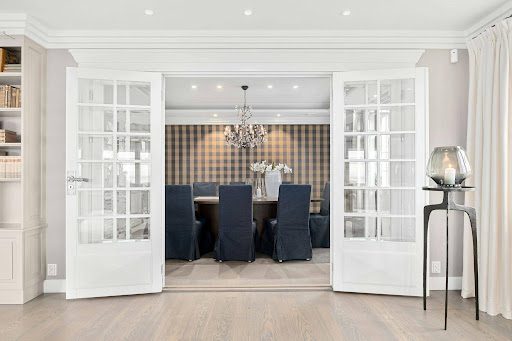
Internal folding door systems are available in both solid panel and glazed configurations, and the choice between them depends on the desired balance between privacy and light transmission. Solid panels create a more complete visual and acoustic division between spaces, which suits applications where genuine separation is needed. Glazed or part-glazed panels allow light to pass between spaces even when the doors are closed, maintaining a visual connection that prevents the divided space from feeling enclosed. Frosted or textured glazing provides a middle ground, admitting diffused light while obscuring the view between spaces.
Floor-to-Ceiling vs Standard Height Systems
Internal folding doors are available in standard door heights of around 2000mm and in floor-to-ceiling configurations that extend to the full room height. Floor-to-ceiling systems have a more dramatic architectural impact and create a more complete separation between spaces, but they require more precise installation to ensure the frame is plumb and the top of the system aligns with the ceiling or a boxed-in head detail. Standard-height systems are simpler to install and more easily accommodated within existing room heights, making them a more practical choice for retrofit installations in existing properties.
Hardware and Track Systems
The track and hinge system on which internal folding doors operate is a critical factor in their long-term performance and ease of use. Top-hung systems support the weight of the door panels from a track mounted above the opening, which eliminates the need for a floor track that can be a trip hazard or an obstacle to cleaning and furniture placement. The quality of the pivot hinges and the smoothness of the top-hung track determine how easily the door operates over its lifetime, and investing in a well-made system from the outset avoids the frustrating issues of stiff, rattling, or misaligned panels that can develop with lower-quality hardware.
Integration With Interior Design
The design of internal folding doors has evolved to accommodate a much wider range of interior styles than earlier systems. Contemporary internal folding door systems are available in smooth primed finishes for painting in any colour, in real wood veneers, and in high-gloss lacquered finishes that suit modern interiors. The frame profiles can be designed to sit flush with the surrounding wall finish or to stand proud as a distinct architectural element. Integrating the door hardware in finishes that match or complement the wider interior metalwork creates a cohesive result that reads as a considered design choice rather than a practical afterthought.