On July 23, front-month WTI rose above $92 per barrel following the attacks on Saudi oil tankers in the Red Sea and the near halt of traffic through the Strait of Hormuz. Amid the renewed hostilities, shipments from the Gulf fell to 2.5 million barrels per day over the last seven days, compared with an average of 6 million over the previous thirty days.
Despite this, it is not the oil prices, which have returned to its June highs, that is causing the greatest concern. Instead, the market is increasingly focused on the continued decline in strategic oil stocks held by key states.
This is reflected in futures prices for the coming months, with the September contract trading $12.01 above December and $18.12 above May 2027. Oil for near-term delivery is therefore much more expensive.
This effect is called backwardation, meaning the premium buyers must pay to obtain the earliest available barrels. At the close on July 22, the three-month Brent spread stood at $9.26 per barrel, its widest since May 22. Backwardation shows how much refiners, traders, and oil users are willing to pay to bring delivery forward. It is a measure of the market’s concern over declining crude inventories.
Unlike a single price, which indicates the cost of a barrel at a given moment, the futures curve shows the prices for future deliveries; higher premiums for near-term contracts reflect market participants’ concerns about securing crude within the required time frame.
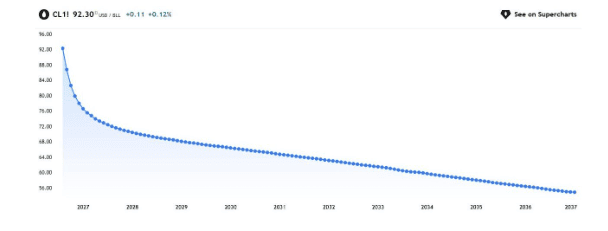
On July 23, September WTI was worth $92.42, October $87.31, and December $80.41. The decline is particularly steep at the beginning: the September–October premium is already $5.11. The slope of the curve then becomes less pronounced, signalling that the market assigns the greatest value to barrels available over the next few weeks.
More than the outright price, this is what distinguishes an immediate supply shock from a uniform long-term increase.
In other words, each futures contract sets today’s price for delivery in a specific month. When the nearby contract costs more than the later-dated contracts, the futures curve is in backwardation. The basic calculation is:
Calendar spread = price of the nearby contract − price of the later-dated contract
In the case of WTI:
- September–December: 92.42 − 80.41 = +$12.01 per barrel
- September–May 2027: 92.42 − 74.30 = +$18.12 per barrel
A positive result means that receiving crude oil earlier has a higher economic value. That advantage is called the convenience yield: physical availability makes it possible to supply a refinery, meet contractual deliveries, or avoid a shutdown, benefits that may be worth more than financing, insurance, and storage costs.
The opposite structure is contango, where later-dated contracts cost more. In that case, storage can become profitable: oil is bought today, stored, and sold in the future at a higher price.
A curve in backwardation is not designed to predict future prices. In the specific case of oil and the crisis in the Middle East, however, it confirms that the production losses caused by the war are not the only factor driving market tightness.
Even if hostilities stopped today and a final agreement were reached, longer travel times, diversions, higher freight and insurance costs, and cargoes blocked in the wrong place could continue to disrupt the market and prolong the recovery, keeping upward pressure on prices even after production normalizes.
However, it remains unclear when the crisis will end. For now, it continues to ripple across global markets — driving up oil prices, fueling broader inflationary pressures, and impacting the trajectory of gold (XAUUSD) and silver (XAGUSD) prices, among others.