Who is the Biggest Designer Brand in the World Right Now?
The World’s Costliest Brands of Clothes: A Ranked Guide for 2026
When it comes to the costliest brand of clothes, the answer depends on whether you measure by brand value, individual item prices, or the sheer audacity of the price tag on a basic white t-shirt.
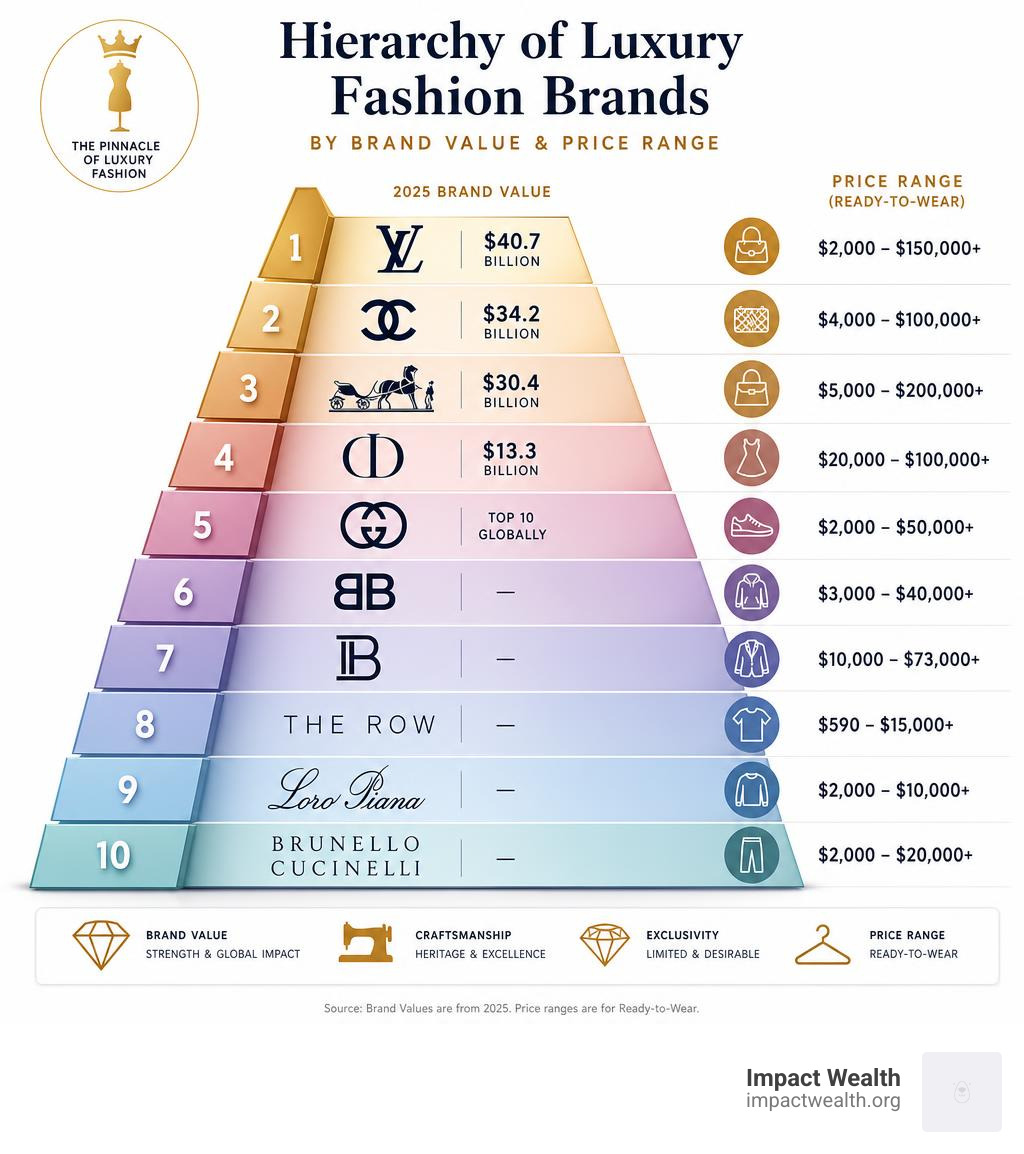
Here is a quick-reference ranking of the most expensive clothing brands in the world right now:
| Rank | Brand | 2025 Brand Value | Price Range (Ready-to-Wear) |
|---|---|---|---|
| 1 | Louis Vuitton | $40.7 billion | $2,000–$150,000+ |
| 2 | Chanel | $34.2 billion | $4,000–$100,000+ |
| 3 | Hermès | $30.4 billion | $5,000–$200,000+ |
| 4 | Dior | $13.3 billion | $20,000–$100,000+ |
| 5 | Gucci | Top 10 globally | $2,000–$50,000+ |
| 6 | Balenciaga | — | $3,000–$40,000+ |
| 7 | Balmain | — | $10,000–$73,000+ |
| 8 | The Row | — | $590–$15,000+ |
| 9 | Loro Piana | — | $2,000–$10,000+ |
| 10 | Brunello Cucinelli | — | $2,000–$20,000+ |
The luxury fashion world is not just about clothes. It is about who you are — or at least who others think you are.
The numbers behind this industry are staggering. Louis Vuitton alone carries a brand value of $40.7 billion as of 2025. The global luxury goods industry generated €253 billion in revenue in the past year. And yet, some of the most talked-about pieces are deceptively simple: a plain cotton t-shirt from The Row costs $590. A deliberately “destroyed” jacket from Balenciaga sold out in 24 hours at $950.
So what actually separates a $30 t-shirt from a $590 one? And which brands sit at the very top of this pyramid?
That is exactly what this guide unpacks.
Decoding the Costliest Brand of Clothes: What Drives Ultra-Luxury Pricing?

The costliest brand of clothes is rarely expensive for one reason. Price is usually built from a stack of tangible and intangible factors: rare materials, highly skilled labor, limited production, heritage, celebrity visibility, and a carefully managed feeling of access.
In simple terms, luxury pricing works like this:
- The product must feel hard to make.
- The brand must feel hard to access.
- The story must feel bigger than the garment.
- The buyer must feel they are joining a world, not just buying fabric.
That is why a lambskin parka, a vicuña coat, a couture gown, or a logo t-shirt can all command extreme prices, even though their physical production costs vary widely.
Some luxury materials really are expensive. Loro Piana is known for rare fibers such as vicuña, one of the most prized natural fibers in the world. Givenchy lists pieces such as a Couture Seam knitted argyle sweater at $2,400, with a blend that includes cotton, polyamide, mohair, and wool. Its leather parka is priced at $9,900 and made in Italy from 100 percent lambskin.
But let us be honest: materials alone do not explain everything.
A $590 t-shirt is not expensive because cotton suddenly became a precious metal. It is expensive because the brand has created a meaning system around restraint, taste, scarcity, and status.
| Cost Driver | What It Includes | How It Affects Retail Price |
|---|---|---|
| Raw materials | Lambskin, cashmere, vicuña, mohair, silk, exotic skins | Can raise base cost significantly |
| Labor | Hand stitching, tailoring, embroidery, couture finishing | Adds time and skill-based cost |
| Design and research | Creative direction, prototypes, runway development | Spread across collections |
| Marketing | Fashion shows, celebrity dressing, campaigns, events | Often a major hidden cost |
| Distribution | Flagship boutiques, private clients, controlled wholesale | Maintains exclusivity |
| Brand equity | Heritage, desirability, resale perception, cultural status | The largest premium in many cases |
For ultra-luxury buyers, the item is only part of the purchase. The rest is identity, access, and confidence. That is why the same client may care deeply about craftsmanship in a Zegna bespoke suit, while also laughing at a Balenciaga “destroyed” jacket and still understanding why it sells.
The Psychology Behind the Costliest Brand of Clothes and Overpriced Basics
Ultra-luxury fashion depends on a fascinating psychological equation: the more irrational a price appears to outsiders, the more powerful it can feel to insiders.
That is the magic, and the mischief, of overpriced basics.
The Row is one of the clearest examples. The brand built its identity around minimalism, restraint, and almost invisible wealth signals. A critical essay, How The Row Convinced Women That $5,000 T-Shirts Are Normal, argues that the brand made extreme simplicity feel like proof of taste. Whether one agrees with the tone or not, the broader point is important: quiet luxury turns plainness into a code.
A $590 white t-shirt says, “I do not need logos.” But it also says, “I know exactly what this is.”
That is social signaling at its most refined.
For ultra-high-net-worth consumers, value is often not measured by utility. It is measured by:
- Recognition among the right people
- Rarity
- Association with a lifestyle
- Confidence in taste
- Ease of access to elite spaces
- The feeling of buying the “best” version of something
This is why we see luxury buyers treat wardrobe staples as strategic pieces. A simple coat, perfect loafer, or pristine white shirt becomes part of a broader visual language. For readers building a high-end closet, our guide to Luxury Wardrobe Essentials explores that idea from a more practical angle.
There is also cognitive dissonance. If someone pays $950 for a distressed jacket, they are likely to defend it as art, satire, quality, or cultural commentary. And sometimes, that is true. Fashion has always played with irony. But sometimes, the honest answer is simpler: the buyer likes being part of the conversation.
Luxury is not always logical. If it were, a spreadsheet would be the season’s hottest accessory.
Production Costs vs. Retail Markups: Is the Price Justified?
The big question: are ultra-luxury prices justified?
The fair answer is: sometimes partly, rarely fully, and almost never by materials alone.
High-end garments often involve better fabric, European manufacturing, more careful finishing, and smaller production runs than mass-market clothing. A bespoke suit by Ermenegildo Zegna can sell for around $22,000 because it involves custom measurement, specialist tailoring, premium cloth, and personal service. A hand-embroidered couture gown from Dior or Chanel can take hundreds of hours.
But many luxury markups also include brand value, marketing, boutique costs, and scarcity management.
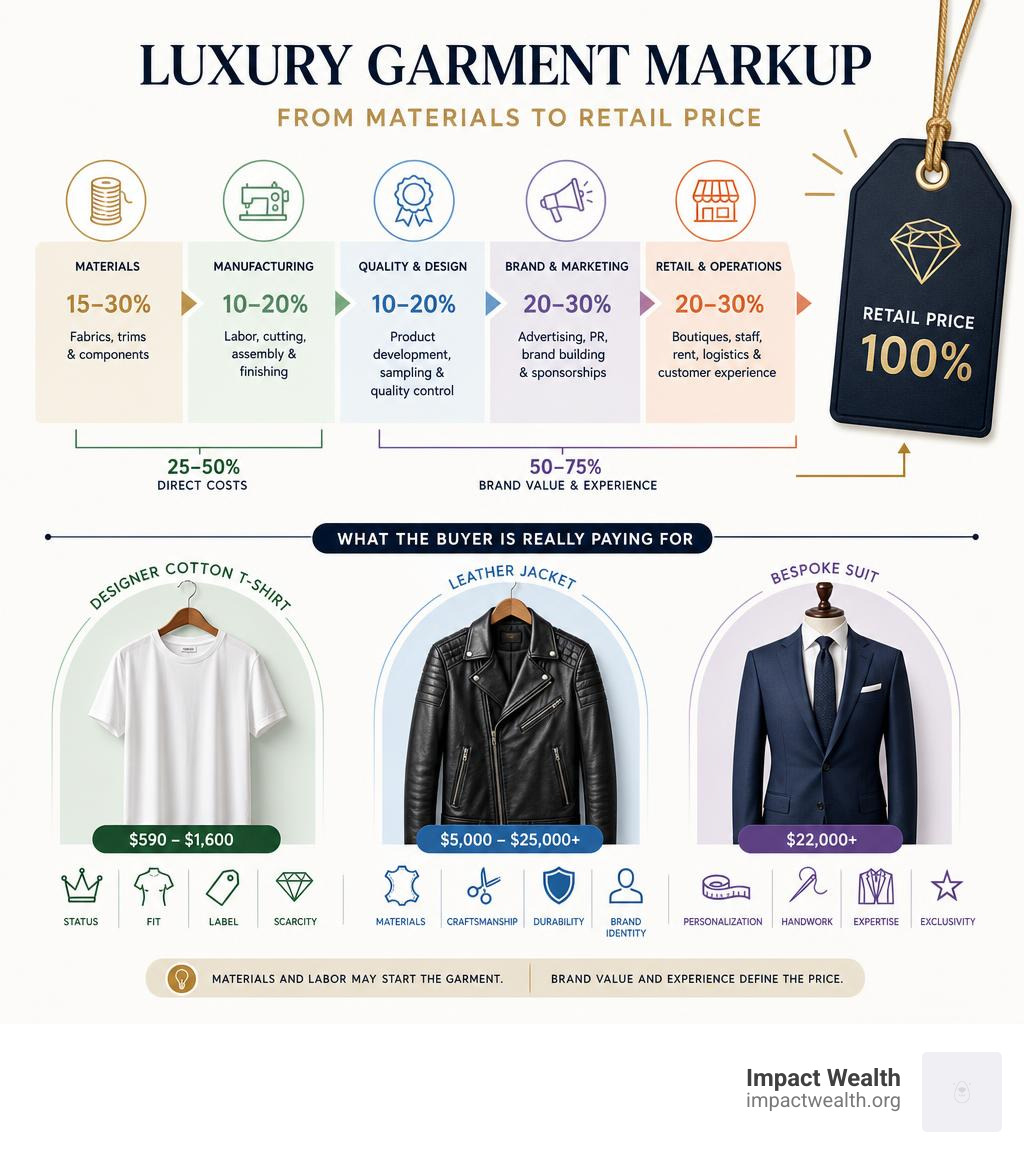
Research on Philipp Plein’s pricing suggests that physical production costs may account for only about 25 to 35 percent of the final retail price. That does not mean the brand is doing something unusual; it means luxury pricing is not a simple cost-plus formula.
A simplified markup example might look like this:
| Garment Type | Estimated Cost Inputs | Retail Price Example | What the Buyer Is Really Paying For |
|---|---|---|---|
| Designer cotton t-shirt | Fabric, cut-sew labor, branding, retail margin | $590 to $1,600 | Status, fit, label, scarcity |
| Leather jacket | Lambskin or nappa leather, skilled labor, hardware | $5,000 to $25,000+ | Materials plus brand identity |
| Bespoke suit | Cloth, fittings, handwork, tailoring expertise | $22,000+ | Personalization and craft |
| Couture gown | Atelier labor, embroidery, rare fabric, fittings | $75,000 to $100,000+ | Art-level construction and exclusivity |
| Exotic handbag | Rare skins, handcraft, allocation control | $50,000 to $200,000+ | Scarcity, resale power, access |
In short, the price is most justified when craft, material, fit, and longevity are clearly present. It is least justified when a basic garment relies mainly on hype. Still, if consumers willingly pay, the market has already voted.
For buyers who want elegance without losing comfort, our coverage of Fashion Trends Focused on Comfort and Style is a helpful counterbalance to pure status dressing. And for those studying how basics can be styled intelligently, see How to Style Basic T-Shirts in Multiple Ways.
Quiet Luxury vs. Loud Luxury: Two Paths to Exclusivity

Luxury fashion in 2026 is split between two powerful strategies: quiet luxury and loud luxury.
Quiet luxury whispers. Loud luxury shouts. Both can be very expensive.
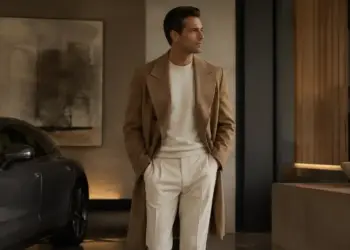
Quiet luxury is The Row, Loro Piana, Brunello Cucinelli, and certain Hermès pieces. The look is soft, neutral, logo-free, and almost deliberately boring to anyone not fluent in fabric and cut. It says, “If you know, you know.”
Loud luxury is Philipp Plein, Balenciaga, Versace, Balmain, and parts of Gucci. It uses logos, spectacle, distortion, crystals, irony, and runway theater. It says, “Everyone should know.”
Both strategies justify high prices differently.
| Luxury Style | Typical Brands | Pricing Logic | Risk |
|---|---|---|---|
| Quiet luxury | The Row, Loro Piana, Brunello Cucinelli, Hermès | Minimalism, rare materials, insider recognition | Can look too plain for the price |
| Loud luxury | Balenciaga, Philipp Plein, Balmain, Versace | Provocation, celebrity visibility, bold identity | Can become overexposed or mocked |
| Heritage luxury | Chanel, Dior, Louis Vuitton, Zegna | History, craft, icons, global prestige | Must modernize without diluting legacy |
| Street-luxury | Palm Angels, Vetements, Balenciaga | Youth culture, irony, limited drops | Trend fatigue |
We see this split clearly in how consumers shop in luxury destinations. In Miami and Bal Harbour, clients may move between understated tailoring and bold statement pieces in the same afternoon. For high-end retail context, see Miami’s Luxury Shopping, Luxury lifestyle and fashion shopping at Bal Harbour Shops, and Aventura Mall: Miami’s Best Luxury Shopping Mall. In Los Angeles, a boutique such as Maxfield LA reflects that same mix of fashion, art, and collectible design.
The future challenge is balance. Quiet luxury can become repetitive. Loud luxury can become exhausting. Sustainability pressures, resale transparency, and younger buyers’ skepticism will push brands to prove that expensive also means meaningful.
For readers tracking ethical material shifts, we also recommend our coverage of Cruelty-Free Leather Alternatives for Fashion and Organic Cotton Clothing Manufacturers.
How the Costliest Brand of Clothes Uses Scarcity and Distribution Control
Scarcity is the engine of luxury.
The costliest brands do not simply sell products. They manage access. That access can take several forms:
- Limited production runs
- No-discount policies
- Boutique-only releases
- Private client appointments
- Allocation systems
- Waitlist-style demand management
- Seasonal drops
- Selective wholesale partnerships
- Controlled resale narratives
Hermès is the master of this. Its most desired bags are not usually available just because a client walks into a boutique and asks. Buyers often build a relationship through other purchases before being offered a Birkin or Kelly. That structure turns access itself into part of the product.
Balenciaga uses a different scarcity model: cultural urgency. Its $950 destroyed jacket sold out quickly because it became a conversation piece. The product was not just outerwear; it was a meme, a provocation, and a signal.
Philipp Plein uses spectacle and excess. Reports around the brand describe celebrity-heavy shows, bold styling, and highly visible social media engagement. Its sales reportedly reached €250 million in 2023, up 85 percent from 2019, showing that maximalism still has a powerful customer base.
Digital scarcity may be next. Limited online drops, authenticated digital twins, and private e-commerce access are likely to become more important, especially for buyers in the United States, Europe, China, the Middle East, and the UK.
The Top Ultra-Luxury Fashion Houses Dominating the Market
The most expensive fashion houses dominate for different reasons. Some win on brand value. Some win on couture. Some win on handbags. Others win by making the internet argue for 48 hours, which in 2026 is basically free advertising with better lighting.
Here are the brands shaping the top end of the market.
Hermès: The Pinnacle of Equestrian Heritage and Accessory Allocation
Hermès began in 1837 with equestrian goods, and that heritage still matters. The brand’s identity is built on leather, handcraft, restraint, and controlled supply.
Its 2025 brand value is listed at $30.4 billion, making it one of the most valuable fashion brands in the world. But Hermès’ true pricing power comes from allocation.
A Birkin 30cm in standard leather may retail around the low-to-mid five figures in 2026, while secondary market prices can climb far higher depending on color, size, condition, and leather. Exotic versions can exceed $50,000, while rare examples have sold for far more.
Why does this work?
Because Hermès sells more than a bag. It sells:
- The relationship with the boutique
- The thrill of being offered something unavailable to others
- A product with strong resale recognition
- A symbol understood across Palm Beach, Miami, Bal Harbour, Los Angeles, Europe, China, the Middle East, and the UK
The Birkin is not always practical. It can be heavy, delicate, and too recognizable for daily use. But as a status credential, it remains one of the strongest objects in luxury fashion.
For styling around accessories, our pieces on 10 Types of Gold Necklaces and How to Style Them and Jewelry Brands pair well with the Hermès approach to discreet wealth.
Louis Vuitton and Chanel: The Titans of Brand Valuation
Louis Vuitton is the biggest designer brand by 2025 brand value in the fashion category, at $40.7 billion. Chanel follows at $34.2 billion. These two houses define global luxury scale.
Louis Vuitton began as a luggage maker in 1854, and travel remains central to its identity. Its monogram is one of the most recognized patterns in the world. Ready-to-wear, handbags, trunks, and limited collaborations all support its pricing power.
Chanel’s authority comes from icons: the tweed jacket, quilted bag, pearls, No. 5 fragrance, and the little black dress. Chanel also has one of the strongest price increase strategies in luxury. Its classic flap bags have become benchmarks for fashion inflation.
In clothing, Chanel haute couture can reach $100,000 or more. Louis Vuitton high-end pieces can move from several thousand dollars into six figures, especially when exotic skins or special runway items are involved. Some luxury rankings have cited Louis Vuitton crocodile outerwear above $150,000.
These brands justify their prices through:
- Heritage
- Global recognition
- Controlled retail environments
- High production standards
- Powerful creative direction
- Celebrity and red-carpet visibility
- Strong accessory ecosystems
For readers refining a long-term closet, Womens Wardrobe Essentials and Timeless Fashion Pieces Every Wardrobe Needs are useful starting points.
Balenciaga and Philipp Plein: Provocative Marketing and Distressed Aesthetics
Balenciaga and Philipp Plein represent the loud, provocative end of luxury.
Balenciaga has repeatedly turned ordinary or “ugly” objects into luxury talking points: worn-looking sneakers, oversized silhouettes, distressed garments, and deliberately awkward proportions. A recent example is the $950 destroyed jacket reported in Balenciaga’s ‘Destroyed’ Jacket, Priced At $950, Sells Out In 24 Hours: ‘I Have A Lot To Clean Floors’. The first batch reportedly sold out within 24 hours, despite social media jokes comparing it to cleaning rags.
That reaction is part of the strategy. Balenciaga knows outrage travels fast.
The buyers tend to fall into two groups:
- Fashion insiders who understand the reference and want the signal
- Irony-driven buyers who enjoy the absurdity and cultural commentary
Philipp Plein takes a different route: maximalism. Crystals, skulls, leather, spectacle, celebrities, and nightclub energy are part of the brand language. Industry analyses point to premium positioning, celebrity marketing, handcrafted details, and a deliberate culture of excess. Reports also note that the average price of a Philipp Plein jacket has risen sharply over the past decade.
This is not quiet wealth. This is “the valet knows exactly which car is yours” wealth.
Other brands in this street-luxury and statement category include Palm Angels, Vetements, Balmain, and Givenchy. Balmain is especially known for highly structured, embellished pieces, with some rare jackets and dresses reaching tens of thousands of dollars.
The Row and Loro Piana: The Masters of Understated Elegance
The Row and Loro Piana sit at the opposite end of the aesthetic spectrum from Philipp Plein.
The Row, founded by Mary-Kate and Ashley Olsen, built its reputation on severe minimalism, exacting cuts, neutral palettes, and near-invisible branding. Its prices can be startling: around $590 for a basic t-shirt, thousands for coats, and several thousand for leather bags.
The Row’s genius is that it made simplicity feel elite. The absence of decoration becomes the decoration.
Loro Piana, by contrast, is rooted more deeply in textile excellence. It is famous for cashmere, baby cashmere, and vicuña. Its coats can exceed $10,000, not because they scream status, but because the material and hand feel are immediately apparent to those who know fabric.
Brunello Cucinelli belongs in this conversation too. The brand built a world around cashmere, soft tailoring, Italian craft, and a philosophy of humanistic capitalism. Sweaters can exceed $2,000, while full looks easily climb much higher.
These brands appeal to buyers who want luxury without obvious logos. In our view, this is one of the most durable directions in ultra-luxury fashion, especially for family office circles, private wealth events, and destination wardrobes across Palm Beach, Miami, Bal Harbour, Los Angeles, Europe, the Middle East, China, and the UK.
Frequently Asked Questions About Ultra-Luxury Fashion
What is the most expensive clothing item ever sold?
It depends on how we define “clothing item.”
Among fashion-related items, Jimmy Choo’s diamond-encrusted Gènavant heels reportedly sold for $4.3 million in Shanghai, making them one of the most expensive footwear items associated with a luxury fashion brand.
For garments, notable examples include the Givenchy little black dress associated with Audrey Hepburn, often cited around $923,187, and couture or custom gowns that can reach six figures. Dior couture gowns may exceed $100,000, Valentino couture pieces can range from $20,000 to $100,000, and Oscar de la Renta custom couture has also been reported above $100,000.
In menswear, a bespoke Ermenegildo Zegna suit can sell for around $22,000, while Kiton and Brioni have produced suits priced much higher depending on fabric and construction.
So the highest records often come from three categories:
- Celebrity or film-linked garments
- Diamond or precious-material accessories
- Bespoke or couture pieces requiring exceptional labor
Why do luxury brands destroy or limit their inventory?
Luxury brands limit inventory to protect desirability. If everyone can buy a product easily, it stops feeling exclusive.
Historically, some brands have destroyed unsold inventory to prevent discounting or grey-market dilution. The industry has faced criticism for this, especially from a sustainability perspective. Today, many houses are under pressure to find better solutions, including recycling, upcycling, controlled outlet strategies, and tighter production planning.
The business logic is clear, even if the optics can be poor:
- Discounting can weaken brand equity.
- Excess supply reduces urgency.
- Scarcity supports full-price selling.
- Controlled distribution prevents overexposure.
- Limited availability increases perceived value.
The risk is that younger luxury buyers are more skeptical. They want exclusivity, but they also expect responsibility. Brands that cannot explain their environmental and ethical choices may face reputational pressure.
Is buying from ultra-luxury brands a good financial investment?
Sometimes, but we should be careful with the word “investment.”
A Hermès Birkin or Kelly in the right size, color, leather, and condition can hold value exceptionally well. Certain Chanel bags and limited Louis Vuitton pieces also perform strongly on the resale market. However, clothing is usually less liquid than handbags or jewelry.
The hidden costs matter:
- Resale platforms often charge significant fees.
- Condition affects value dramatically.
- Trends can change.
- Storage and care are real costs.
- Not every expensive item has strong resale demand.
- Some brands are famous at retail but weaker at resale.
A $25,000 coat may be beautiful, but that does not mean someone will pay $25,000 for it later. Fashion is emotional, seasonal, and size-specific. Bags are easier to resell than tailored clothing because they do not depend on body fit.
Our rule of thumb: buy ultra-luxury clothing because you love it, will wear it, and understand its place in your wardrobe. Treat resale as a bonus, not the core reason.
Conclusion
The answer to “Who is the biggest designer brand in the world right now?” is Louis Vuitton by brand value. But the answer to “What is the costliest brand of clothes?” depends on the lens.
- By brand value, Louis Vuitton leads.
- By controlled scarcity, Hermès is unmatched.
- By couture heritage, Chanel and Dior dominate.
- By provocative pricing, Balenciaga and Philipp Plein know how to create buzz.
- By quiet luxury psychology, The Row and Loro Piana are masters.
- By pure shock value, diamond accessories and celebrity-linked garments sit in a category of their own.
Ultra-luxury fashion is never just about fabric. It is about identity, access, scarcity, craft, and story. Sometimes the price is supported by extraordinary materials and workmanship. Sometimes it is supported by marketing and myth. Often, it is both.
At Impact Wealth, we view luxury fashion as part of a wider lifestyle conversation for ultra-high-net-worth individuals and family offices: how people dress, collect, travel, invest, and express taste across generations.
To continue following where the market is headed, explore our coverage of Luxury Fashion Trends.