As hybrid creative work has settled into a mix of in-person sessions and constant calls, many workplaces have moved toward standardised, ready-to-use meeting-room packages. In AV terms, they’re simply room kits. Crestron’s Flex versions, commonly deployed by integrators such as Creation Networks, have become one of the dominant choices in studios, agency floors and internal creative teams.
Hybrid Permanence, Meet Hybrid Creatives
Crestron has been blunt about the idea that hybrid work is no longer an experiment but “hybrid permanence”. The goal, in their language, is equity between people in the room and those on the call. That intention maps neatly onto creative work, where it’s no longer unusual to have a colourist dialling in from another city, a client on a laptop at home, and half the team physically gathered around a table.
Thomas Geblein, a solution architect working on digital enablement at Rich Products, puts it simply: “The world has become our workplace, and Crestron provides us with technology solutions that are essential to keep moving forward.” For hybrid creatives, that “world” might be a living room with a laptop, a hot desk two days a week, and one reliable room where big conversations actually happen.
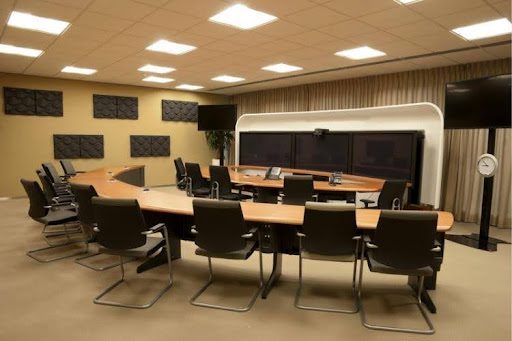
Flex is designed to make that room predictable. Walk in, drop your bag, hit one button, and the platform—Teams or Zoom—springs to life with the same interface you saw yesterday. If you prefer to run everything from your own machine, Flex is also used as the core for BYOD rooms where you plug in a laptop but still get full-room audio and camera coverage, rather than shouting into your MacBook from the far end of a long table.
Hybrid creatives might not care that much about the product names, but they do care about friction. That’s where the “room kit” idea earns its keep: you don’t have to spec five separate devices, you don’t have to guess about compatibility, and you don’t have to teach every new hire a new ritual per room. You standardise.
What the People Who Build and Run These Rooms Keep Noticing
Behind the scenes, AV integrators, higher-ed technologists, and event managers are unusually aligned in how they talk about Crestron.
Carter Saul, an enterprise architect at the integrator FORTÉ, calls Crestron’s DM NVX AV-over-IP platform “a turning point in AV technology.” That’s not Flex itself, but it’s part of the same ecosystem: DM NVX carries video and audio signals through the network, while Crestron Flex manages the conferencing functions inside the room.
On the campus side, Jonathan Brennan, CIO at Hudson Valley Community College, describes Crestron AV Framework as a way to create “a consistent room experience that is economical, simple, and scalable.” His colleague in another institution, AV design manager John David Walker at Georgia Southern University, says the same framework lets his team design a single room type and replicate it across campus far more quickly. Those comments point to the same pattern: standardisation without making rooms feel generic.
RIT’s John Schrenker, who manages learning space and classroom technology, describes AV-over-IP as “extremely flexible” and says it allows his team to adapt spaces as needs evolve. At the leadership level, RIT President David Munson says Crestron technology has supported the development of new learning and lab spaces on campus. When the people running hybrid lecture theatres sound this positive about the infrastructure, it’s not a stretch to see why creative studios and in-house teams are happy to work on the same stack.
Even in the brutally practical world of a poker room and sportsbook, Fletcher Hickey at Talking Stick Resort is blunt: “Without Crestron’s support and guidance throughout this project, we would not be able to accomplish the massive upgrade that we did.”
Why Creation Networks Is the Integrator Most Teams Turn To
Most hybrid teams aren’t buying their room kits directly from a manufacturer. Instead, they turn to integrators who work with these systems every day. Creation Networks is one of the main ones in that role. They carry a broad catalogue of Crestron AV solutions, and it’s often where organisations start when they want to shop Crestron.
Creation Networks describes itself as a commercial AV integrator that “combines top manufacturers with technical expertise” across design, installation, programming, training and support. In practice, you outline how a room is used, and they assemble a mix of Flex hardware and supporting components to suit the space.
Their work centres on modern, hybrid-focused environments: meeting rooms, classrooms, control rooms, government spaces, houses of worship and event venues. Crestron sits at the core of that portfolio alongside Teams, Zoom and digital signage systems, with options that scale from everyday workplaces to TAA-compliant setups in regulated sectors.
The Practical Realities of Adopting the Room Kit
Room kits like Crestron Flex address a simple requirement: reducing technical friction in spaces used for hybrid work. For creative teams, this means a setup that can manage video calls, presentations and shared work sessions without constant troubleshooting. For the teams responsible for maintenance, having a standardised system is easier to support than dealing with different devices in every room. Flex also integrates with broader systems such as AV-over-IP distribution, scheduling panels and digital signage, which makes it easier to manage multiple rooms across an organisation.
Across workplaces, education environments, hospitality venues and event spaces, the reasoning behind adoption is consistent. Practitioners emphasise reliability, straightforward operation and the ability to scale as needs change. Those points explain why Flex kits appear so frequently in creative settings. They minimise the technical overhead for teams who already move between multiple tools and formats throughout the day, and they reduce the number of variables that can interrupt collaborative work.
Conclusion
Hybrid creative work depends on setups that support both in-person collaboration and remote participation without unnecessary complexity. Crestron Flex room kits, often deployed by integrators such as Creation Networks, offer a standardised way to meet those demands. They provide consistent controls, predictable performance and integration with wider AV infrastructure. They can’t resolve every room-design issue, but they do offer a stable foundation that many teams now rely on.