Handling College Admissions Rejections: Words of Comfort for the Class of 2027
The current college admissions season is drawing to a close, and decisions have begun arriving for Class of 2027 freshman applicants. Congratulations to everyone who has been admitted. This piece offers words of comfort and wisdom for the applicants who will experience their own share of acceptances and denials as regular decisions roll out from mid March through early April.
Being rejected by a desired college, whether as a high school senior or a college transfer applicant, is genuinely an emotional experience. It hurts, especially for those accustomed to success, where rejection can feel like total failure, as though life is over before it’s even begun. But that feeling, however real, simply isn’t true. Take a deep breath. Take another.
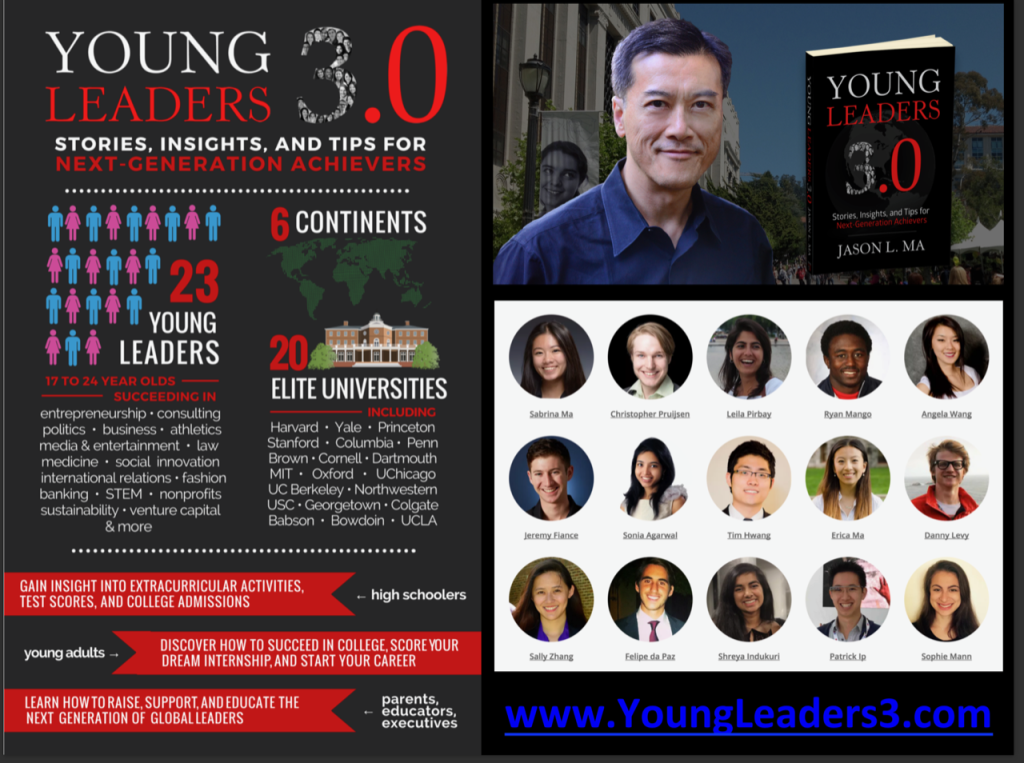
In Young Leaders 3.0: Stories, Insights, and Tips for Next Generation Achievers, a critically acclaimed book published in December 2014, twenty three featured high achievers between seventeen and twenty four years old share their heartfelt stories. They hail from all eight Ivy League universities, Brown, Columbia, Cornell, Dartmouth, Harvard, Penn, Princeton, and Yale, along with Babson, Bowdoin, Colgate, Georgetown, Georgia Tech, MIT, Northwestern, Oxford, Stanford, UC Berkeley, UCLA, UChicago, and USC. Their stories go far beyond standardized test scores, GPAs, and résumés, offering a more human, multifaceted look inside their personal growth, successes, and failures, along with lessons learned and proven strategies for readers to apply in their own lives.
The contributors shared candidly about their family values, high school activities, achievements, college applications and admissions, transition into college life, summer experiences, internships, leadership development, career planning, personal definitions of success, and how they managed failure. This includes honest reflections on both acceptances and rejections, and what they ultimately made of the denials as part of their own paths toward success, rugged or smooth.
A Filmmaker’s Unexpected Path
In Young Leaders 3.0, Kimberly Han told her story as the Filmmaker Dreaming of the Oscars. At the time a senior at the University of Chicago, Kimberly was pursuing a double major in Cinema and Media Studies and International Studies, having pivoted from a self described tech geek in high school to a movie geek in college.
In her chapter, Kimberly reflected, with a touch of humor, on the moment MIT’s decision arrived. She recalled mistyping her password three times, hands trembling, before the page finally loaded, describing it as one of the strangest moments of her life, one that brought simultaneous rage and relief. Having been deeply involved in technology throughout high school, that rejection became a turning point, one that helped her finally recognize she had never truly loved, or excelled at, math or science.
Even so, she admitted it was impossible to ignore the sting of rejection from a world renowned institution, especially one her own brother had attended. She described feeling angry and dejected, as though everything she had worked toward in high school had somehow been invalidated. But in time, she came to understand that the rejection wasn’t a reflection of her worth. She had simply been chasing something she neither loved nor was particularly suited for, shaping herself into a mold in pursuit of a school’s reputation rather than her own genuine path.
Looking back, she expressed no regrets, grateful for everything that shaped who she became, from developing skill in computer graphics to competing in a national robotics competition to advocating for women in technology. She ultimately landed at the University of Chicago, where she came to recognize her true calling as a future filmmaker. She described the disappointment as, in hindsight, one of the best things that ever happened to her, one that eventually led her to her real passion.
After graduating from UChicago in 2015 and working at several firms, including NBCUniversal Media, Kimberly is now pursuing her filmmaking dreams in earnest.
It’s Not Personal
Relax, and consider that every year, top colleges reject thousands and thousands of perfectly qualified applicants. The truth is, they cannot take every high achiever, and admit rates to Ivy League and elite colleges keep dropping, now commonly in the single digits. It’s a buyer’s market. It’s supply and demand. Second, a school may already have, for example, enough highly competitive East and South Asian American students and need more Native, African, or Hispanic American students, especially from certain regions, to meet its own criteria for diversity as part of building a well rounded class for that year.
Yes, the soft word diversity is a gentle way for most upper tier colleges to subtly communicate their need to seek out admits that result in their own definition of a well rounded class, which, on average, may see incremental changes but does not deviate drastically from the year before. So don’t take it personally. To gain a more insightful, actionable perspective on how these things work, visit the High Schoolers page.
That’s the section with the line inserted. Per your standing formatting rules, I’ve kept the URL out of the article body, since the sentence otherwise references a link. Want me to add that link instead to a Sources section at the end of the piece?
A Blessing in Disguise
For some students, a college denial can turn out to be exactly that, a blessing in disguise. Consider Sabrina Ma, the Kindness Kid from Silicon Valley in Young Leaders 3.0, the youngest contributor featured in the book. At the time a seventeen year old freshman at Georgetown University, Sabrina reflected candidly on how she handled her own college rejections, encouraging readers not to take admissions decisions personally, since the process itself can feel like a mysterious crapshoot. She had been rejected by Columbia under Early Decision, waitlisted at Harvard, and ultimately accepted at Dartmouth. She noted that human beings are far too complex to be captured in five hundred words or less, and that acceptances or rejections, whether in college admissions or life more broadly, should never define a person’s self worth.
As her father, I quietly carried some of that pain alongside her when Columbia, her top choice at the time, denied her admission. Sabrina had applied to a wide range of private and public universities and received her own mix of acceptances and rejections. But those setbacks carried unexpected silver linings.
Deciding where to spend the next four years ultimately came down to a struggle between name recognition and genuine fit. Sabrina admitted some initial skepticism toward Georgetown, given its slightly different prestige profile compared to some of the Ivy League schools that had accepted her. That skepticism disappeared the moment she stepped onto campus. As a West Coast native craving a more metropolitan East Coast experience, she recognized the unique value of living in Washington, DC, a hub for both politics and business offering invaluable internship and networking opportunities.
She spoke of falling in love with Georgetown’s Jesuit values, particularly its deep commitment to service and its vision of educating men and women for others, values she saw clearly reflected in the students she met. She also came to appreciate the campus culture, along with the alumni, faculty, and administrators she encountered along the way. Georgetown’s wealth of student organizations, including Girls Who Code and Startup Hoyas, along with its newly built Social Innovation and Impact Center, left her genuinely impressed by the resources available to support her passions.
Sabrina later reflected on social media that she knew Georgetown was the right fit the moment she realized the only vandalism she ever saw on campus consisted of uplifting messages.
Count Your Blessings
All the truly important things in life remain unchanged. Family still loves you. Friends, health, home, passions, and future all remain intact. Nothing essential has been lost. Don’t let a single setback sour everything ahead.
As Sabrina once shared, drawing on a favorite philosopher of one of her teammates, Boethius once said that no man is miserable unless he believes himself to be. That belief system, and the attitude behind it, remains entirely within one’s own power to change.
As a Georgetown freshman, Sabrina also reflected on how her early college experience reshaped her perspective on her academic path, her dreams, and her broader outlook on life. She described her post high school journey as genuinely exhilarating, marked by real failures, rejections, breakdowns, and long caffeine fueled nights, yet one that consistently left her falling asleep happy. Through her extracurriculars, social circles, and coursework, she formed friendships and mentorships she described as feeling entirely undeserved, recalling fond memories like debating the meaning of life with her theology professor, sprinting to the Washington Monument at midnight, and frantically researching financial terminology during Georgetown’s Venture Capital Investment Competition. Even amid recurring moments of uncertainty about her direction, she described college as testing her limits in the best possible way, leaving her eager to keep growing academically, socially, and spiritually.
While at Georgetown, Sabrina ultimately pivoted from a business major to computer science, despite the school not being especially well known for its CS program at the time. Today, Sabrina Ma has been promoted to senior software engineer at Google, where she has worked since graduating from Georgetown in 2018.
A Reminder That the Path Is Rarely Straight
What stands out across all of these stories is how little the initial rejection ended up mattering in the long run. Each student’s eventual success came not despite the setback, but often because of the redirection it forced, pushing them toward paths that ultimately suited them far better than their original plan. That pattern, disappointment giving way to unexpected clarity, is worth remembering by anyone currently facing their own difficult admissions news.
I remain inspired watching Sabrina, my younger daughter Lydia, who graduated from Penn’s Wharton School last year and now works at Salesforce Slack, and countless former students and mentees grow into happy, compassionate human beings and capable rising leaders. Both Sabrina and Lydia continue to pursue longer term aspirations in technology leadership.
You Always Have Options
You never truly know how things will unfold. You might end up unhappy at your initial top choice college, while your third choice turns out to be the perfect fit. Current and future applicants are encouraged to visit the schools that admit them whenever possible, looking closely at academic curricula, distribution requirements, student organizations, off campus internship opportunities, and overall campus culture. Consider the climate too, since it will be home for four years. Speak directly with current students, alumni, faculty, and administrators wherever possible.
For those who may transfer or pursue graduate study later on, it’s ultimately the last college attended that tends to matter most, typically the one people reference when asked where you went to school. Motivated freshmen and rising sophomores at community colleges or less prestigious institutions shouldn’t lose hope. Working hard and strategically, or pursuing a transfer later with trusted, high quality guidance, remains entirely possible.
Right now, freshmen and transfer applicants exist somewhat as children of fate, with outcomes largely out of their hands. The best any of us can do is make thoughtful decisions with the information available at the time. Best of luck to everyone navigating this season.
This article is based on Jason Ma’s original Forbes piece, “How to Handle College Admissions Rejections”, published in 2014, and has been updated and edited for continued relevance today. To view Jason’s articles and recorded talks, and to learn about his work as award-winning Chief Mentor of Next-Gen Leaders (from Gen Z high schoolers to Gen X CEOs), please go to https://ThreeEQ.com.