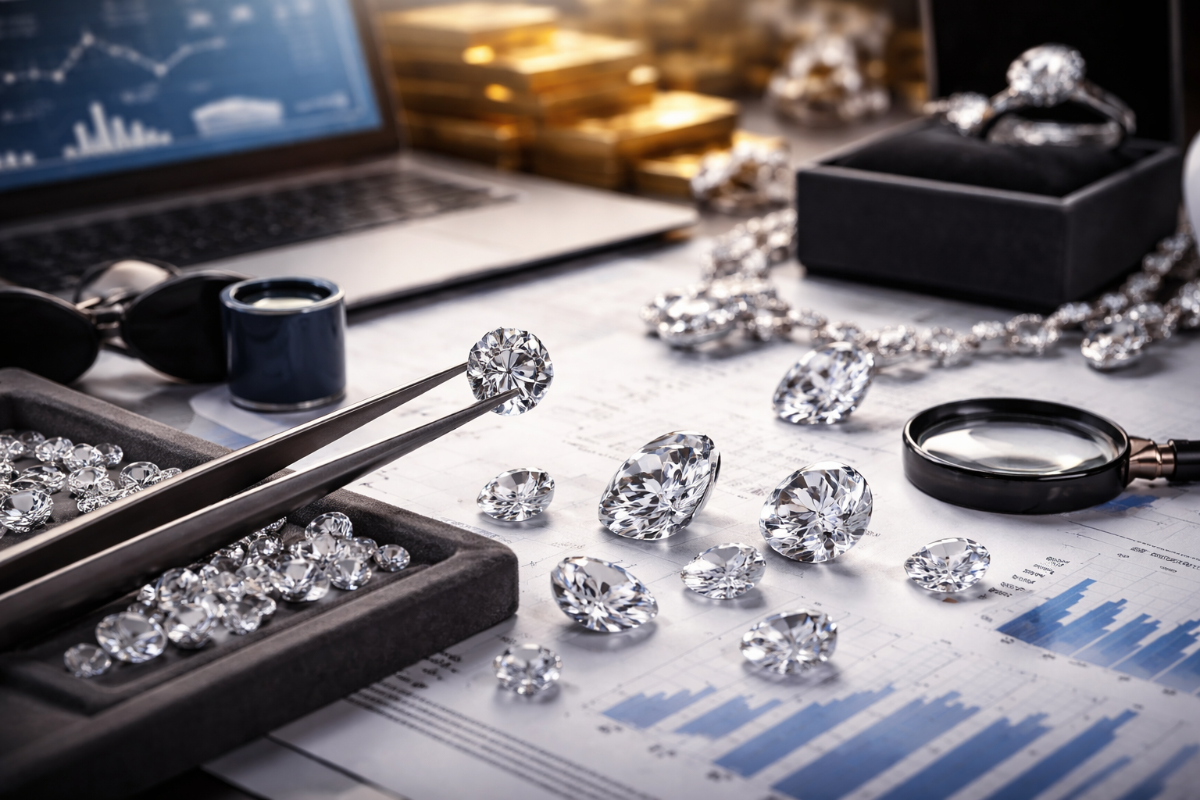
In today’s shifting macroeconomic climate, Global Diamond Price Analysis has become more than a niche concern for jewelers. It now sits squarely within the strategic framework of portfolio managers, commodity analysts, and luxury asset allocators. As inflation hedges, alternative assets, and tangible stores of value gain renewed attention, diamonds occupy a distinctive position bridging rarity, portability, and emotional capital.
For investors navigating commodity cycles and luxury demand inflections, Global Diamond Price Analysis provides essential clarity. Unlike gold or oil, diamonds trade in a fragmented, opaque market where price discovery depends on grading standards, dealer networks, and auction performance. Therefore, understanding structural supply constraints, consumer purchasing behavior, and geopolitical influence becomes critical to managing risk exposure.
Moreover, the scope of Global Diamond Price Analysis extends beyond retail pricing trends. It integrates mining production data, central bank policy shifts, currency volatility, and the divergence between natural and lab-grown stones. For those seeking diversification within alternative assets, the diamond market offers opportunity but only with disciplined analysis and realistic expectations around liquidity and valuation transparency.
Understanding Supply-Demand Dynamics
Unlike standardized commodities, diamonds are heterogeneous. Each stone differs in cut, clarity, carat, and color the “4Cs” making uniform pricing impossible. Consequently, pricing relies on benchmark reports such as the Rapaport Price List and transaction-level negotiations within global trading hubs.
On the supply side, the industry is dominated by a handful of major miners including De Beers, ALROSA, and Rio Tinto. Production has plateaued in recent years as mature mines age and fewer large-scale discoveries emerge. Capital expenditure cycles in mining are long, often spanning a decade before output reaches commercial scale. Therefore, supply responses to demand surges are slow and capital-intensive.
Demand, however, reacts more fluidly. Bridal jewelry remains the backbone of consumption, particularly in the United States. Meanwhile, luxury self-purchasing trends in China and India add cyclical sensitivity. Economic slowdowns or property market stress in Asia, for example, can materially dampen global demand within quarters.
Geopolitics further complicates pricing. Sanctions affecting Russian exports have disrupted trade flows, forcing redistribution through secondary markets. Consequently, pricing spreads between trading centers can widen temporarily, creating arbitrage but also volatility.
Historical Price Cycles and Volatility Patterns
Diamond prices have historically followed broader luxury cycles rather than industrial commodity cycles. After peaking in the early 2010s amid strong Chinese demand, prices softened between 2014 and 2019 due to oversupply and slower emerging-market growth.
The COVID-19 pandemic initially triggered a demand shock. However, stimulus-driven liquidity and constrained mining output created a sharp rebound in 2021–2022. Wholesale polished prices surged, particularly for 1-carat round stones of higher clarity grades.
Nevertheless, volatility in diamonds differs from gold or oil. Price movements tend to be slower and less transparent. Instead of daily spot fluctuations, adjustments occur via dealer negotiations and index revisions. Therefore, short-term volatility appears muted, but periodic corrections can be significant when liquidity tightens.
Rare stones behave differently. Auction houses such as Sotheby’s and Christie’s have recorded record-breaking sales for exceptional colored diamonds, including pink and blue stones. These assets often decouple from mainstream pricing trends and track ultra-high-net-worth demand.
Macroeconomic Variables: Inflation, Currency & Rates
Inflation typically supports tangible assets. During inflationary periods, consumers shift toward physical stores of value. However, diamonds are discretionary purchases; therefore, persistent inflation that erodes disposable income can suppress jewelry demand.
Currency fluctuations play a crucial role. Diamonds are primarily priced in U.S. dollars. A strengthening dollar increases effective costs for buyers in emerging markets, potentially reducing demand. Conversely, a weaker dollar can stimulate cross-border purchasing.
Interest rates influence inventory financing. Diamond traders often rely on credit lines to hold stock. When rates rise, carrying costs increase, leading to inventory liquidation and downward pressure on prices. Consequently, monetary tightening cycles can introduce temporary softness.
Natural vs. Lab-Grown Diamond Pricing Divergence
Natural diamonds, by contrast, derive value from geological scarcity and long formation timelines. This scarcity underpins investment-grade pricing. However, price transparency has improved in lab-grown markets, increasing competitive pressure on entry-level natural stones.
For investors, differentiation is critical. Lab-grown diamonds function more like manufactured luxury goods, subject to technological cost curves. Natural diamonds, particularly rare stones above 3 carats or with exceptional color grading, retain scarcity premiums.
Supply Constraints and Mining Production Trends
Global diamond production has remained relatively flat, hovering around 120–130 million carats annually in recent years. Major mines in Botswana, Russia, and Canada account for the majority of output.
Capital discipline among miners has tightened following past oversupply cycles. Moreover, environmental and regulatory pressures have raised barriers to new projects. Consequently, future supply growth appears limited.
This structural constraint supports long-term pricing, provided demand remains stable. However, secondary market recycling where consumers resell diamonds can offset supply shortages during downturns.
Demand Shifts Across Major Consumer Markets
The United States remains the largest single diamond jewelry market. Bridal demand is steady, although generational shifts toward alternative gemstones and experiences influence purchasing behavior.
China has historically driven luxury growth. However, property market volatility and cautious consumer sentiment have moderated demand. India, conversely, shows expanding middle-class consumption and strong cultural affinity for gold and diamonds.
Regional Market Pricing Comparison
| Region | Demand Trend | Price Direction | Economic Outlook | Growth Potential |
|---|---|---|---|---|
| United States | Stable bridal base | Moderately upward | Resilient consumption | Moderate |
| China | Cyclical recovery | Mixed | Slower growth | Selective |
| India | Expanding middle class | Upward bias | Strong domestic demand | High |
| Middle East | Luxury-driven | Premium pricing | Oil-sensitive | Moderate-High |
| Europe | Mature market | Stable | Modest growth | Low-Moderate |
Therefore, geographic diversification plays a role in wholesale pricing stability.
Auction Performance and Rare Stone Valuation
For example, intense pink diamonds exceeding 5 carats have achieved record per-carat prices at Sotheby’s and Christie’s sales. These stones trade within a thin market of ultra-high-net-worth buyers, making them less correlated with retail trends but more sensitive to global wealth cycles.
Role of Certifications and Grading Standards
Certification underpins pricing credibility. Laboratories such as the Gemological Institute of America (GIA) and the International Gemological Institute (IGI) provide grading reports detailing the 4Cs.
Even minor variations in clarity or color grade can shift price brackets materially. Therefore, investors must understand grading nuances and ensure stones are certified by reputable institutions. Secondary market liquidity often depends on universally recognized certificates.
Price Driver Matrix
| Factor | Short-Term Impact | Long-Term Impact | Volatility Level | Investor Risk Exposure |
|---|---|---|---|---|
| Global GDP Growth | High | High | Medium | Demand sensitivity |
| Inflation | Moderate | Moderate | Medium | Purchasing power erosion |
| Interest Rates | High | Low | High | Inventory financing risk |
| USD Strength | High | Moderate | High | Currency translation risk |
| Mining Supply | Low | High | Low-Medium | Structural scarcity |
| Lab-Grown Production | High | High | High | Pricing compression risk |
| Auction Results | Low | Moderate | Medium | Sentiment-driven swings |
Consequently, portfolio managers should evaluate diamonds within a multi-factor macro framework rather than as a simple inflation hedge.
Market Transparency Challenges
Unlike exchange-traded commodities, diamonds lack a centralized pricing mechanism. Transaction-level opacity complicates mark-to-market valuation. Retail markups further obscure wholesale benchmarks.
Blockchain initiatives aim to enhance traceability, ensuring origin verification and ethical sourcing compliance. Improved transparency may tighten bid-ask spreads over time, potentially reducing friction for institutional investors.
Forward-Looking Insights Beyond 2026
Sustainability considerations are increasingly shaping buyer preferences. Consumers, particularly millennials and Gen Z, scrutinize environmental impact and sourcing ethics. Consequently, traceability tools and ESG disclosures may influence pricing premiums.
Blockchain-backed provenance systems could enhance confidence in natural stone authenticity. Moreover, demographic shifts toward experiential luxury may temper mass-market growth while supporting high-end bespoke segments.
Investment-grade stones large, high-clarity natural diamonds with strong certification—are likely to remain the most defensible segment. Meanwhile, lab-grown stones may continue experiencing deflationary pricing pressure as technology scales.
Therefore, Global Diamond Price Analysis will increasingly intersect with sustainability metrics, digital verification systems, and demographic consumption patterns. Strategic allocation decisions beyond 2026 will depend on distinguishing between commodity-grade inventory and truly scarce assets capable of preserving value across cycles.
Frequently Asked Questions
Are diamonds a good investment?
Diamonds can serve as a portfolio diversifier, particularly rare, high-quality natural stones. However, they lack liquidity and transparent pricing compared to exchange-traded assets.
How volatile are diamond prices?
Volatility tends to be lower on a daily basis but can manifest in cyclical corrections. Macroeconomic downturns, currency shifts, and credit tightening introduce episodic risk.
What is the difference between natural and lab-grown diamond pricing?
Natural diamonds derive value from geological scarcity. Lab-grown stones follow technological cost curves and have experienced sustained price declines due to increased production efficiency.
Are diamonds liquid assets?
Liquidity varies by stone quality. Investment-grade diamonds with recognized certification are more liquid, while commercial-grade stones may require significant discounts for resale.
What is the long-term outlook for diamond prices?
Long-term pricing depends on supply discipline, global wealth growth, and sustainability-driven consumer preferences. Select segments particularly rare colored diamonds—show stronger appreciation potential than mass-market stones.