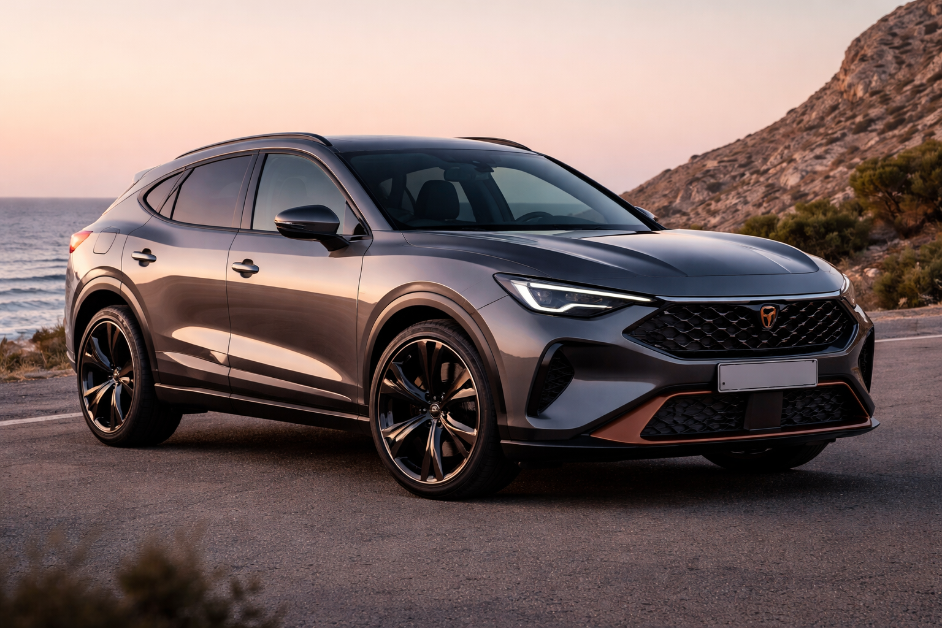
The Cupra Terramar enters the premium compact SUV segment with a clear intent: to challenge mainstream expectations through performance-led engineering and bold design. Positioned as a key model in Cupra’s expanding portfolio, the Terramar reflects the brand’s evolution from a niche performance division into a standalone automotive force within the Volkswagen Group.
Unveiled in 2024, the Terramar is scheduled for a broader market rollout between 2025 and 2026. It represents a strategic move into the high-demand compact SUV category, but with a distinctly sport-oriented identity. Unlike conventional rivals, the Terramar emphasizes driving dynamics, electrified performance, and unconventional styling cues.
Moreover, its development aligns with shifting global demand toward hybridized powertrains and premium compact SUVs. Consequently, the Terramar is not positioned as a volume seller but rather as a targeted offering for drivers seeking individuality, performance, and modern electrification in a single package.
Overview & Brand Positioning
The Terramar is manufactured at the Audi Győr Plant, a production hub known for high-precision engineering within the Volkswagen ecosystem. This location underscores the model’s premium aspirations and technical foundation.
Cupra itself operates as a performance-focused sub-brand, leveraging shared platforms and technologies while differentiating through design, tuning, and branding. Therefore, the Terramar is not simply another compact SUV it is engineered to reflect a more emotional, driver-centric philosophy.
From a timeline perspective:
- Revealed globally in 2024
- Production begins in 2025
- Full market presence expected through 2026
- Positioned as a successor to performance-oriented ICE and hybrid SUVs
However, Cupra deliberately limits mass-market appeal, focusing instead on brand identity and exclusivity.
Platform & Core Specifications
Built on the MQB Evo platform, the Terramar shares its underlying structure with several Volkswagen Group vehicles. This platform enables flexibility in powertrains, safety systems, and drivetrain configurations.
Key structural and mechanical highlights include:
- Approximate length: 4.5 meters
- Seating capacity: 5 passengers
- Transmission: DSG dual-clutch automatic
- Drivetrain: Front-wheel drive (FWD) and all-wheel drive (4Drive)
- Architecture optimized for hybrid integration
Moreover, the MQB Evo platform allows for improved rigidity, better weight distribution, and advanced driver assistance systems. Consequently, it supports both performance driving and everyday usability.
Powertrain & Performance Overview
The Terramar offers a diverse range of powertrains, reflecting the industry’s transition toward electrification while retaining internal combustion performance.
Powertrain Options:
- Turbocharged petrol (TSI) engines
- Mild-hybrid (eTSI) systems
- Plug-in hybrid (PHEV) variants
- High-performance VZ trims
These options provide flexibility for different driving preferences, from efficiency-focused commuting to performance-oriented driving.
Powertrain & Performance Overview
| Powertrain Type | Configuration | Estimated Power Output | Key Features |
|---|---|---|---|
| Petrol (TSI) | Turbocharged ICE | ~150–265 HP | Traditional performance, responsive acceleration |
| Mild Hybrid (eTSI) | 48V system | ~150–200 HP | Improved efficiency, smoother start-stop |
| Plug-in Hybrid (PHEV) | ICE + electric motor | ~200–300+ HP | ~100 km WLTP electric range |
| VZ Performance | High-output variant | 300+ HP | Sport-tuned suspension, AWD |
Furthermore, the plug-in hybrid variants are expected to deliver up to approximately 100 km of electric-only range under WLTP standards. Therefore, the Terramar aligns with stricter emissions regulations while maintaining performance credentials.
Performance vs Practicality
The Terramar is engineered to balance everyday usability with performance characteristics. Unlike traditional performance SUVs that compromise comfort, this model integrates both aspects through platform engineering and drivetrain flexibility.
From a performance standpoint:
- Power output spans from ~150 HP to over 300 HP
- AWD (4Drive) enhances traction and handling
- DSG transmission ensures quick gear shifts
However, practicality remains a core focus:
- Five-seat configuration supports family use
- Hybrid systems improve fuel efficiency
- Electric driving capability reduces urban emissions
Moreover, the plug-in hybrid system allows short-distance commuting without fuel consumption. Consequently, it appeals to urban drivers seeking both sustainability and performance.
Design & Interior
The Terramar adopts a design philosophy that prioritizes visual impact and brand identity. Its exterior styling is characterized by sharp lines, aggressive proportions, and signature copper accents.
Key exterior features include:
- Coupe-like SUV silhouette
- Wide stance with sculpted body panels
- Distinctive LED lighting signatures
- Aerodynamic detailing
Inside, the cabin emphasizes a driver-focused layout:
- Large central infotainment display
- Fully digital instrument cluster
- Performance-oriented steering wheel
- Premium materials with sustainable elements
Additionally, Cupra integrates advanced driver assistance systems (ADAS), enhancing safety and convenience.
Interior highlights:
- Digital cockpit interface
- Touch-based controls
- Connected vehicle technology
- Eco-conscious material usage
Therefore, the interior balances technology, sustainability, and performance aesthetics.
Technology & Build Quality
The MQB Evo platform enables the integration of advanced technologies that enhance both safety and driving experience.
Key technological features:
- Adaptive cruise control
- Lane-keeping assistance
- Autonomous emergency braking
- Connected infotainment ecosystem
Moreover, the Terramar benefits from Volkswagen Group’s engineering standards, ensuring build quality and reliability. Consequently, it competes effectively within the premium compact SUV segment.
Electrification also plays a central role:
- Hybrid systems reduce emissions
- Regenerative braking improves efficiency
- Battery integration optimized for space
Market Positioning
The Terramar enters a competitive segment dominated by established premium models. However, its differentiation lies in design and performance emphasis rather than brand heritage alone.
Comparison vs Competitors
| Model | Power Range | Platform | Positioning |
|---|---|---|---|
| Audi Q3 | ~150–300 HP | MQB | Premium, conservative design |
| BMW X1 | ~150–300 HP | UKL | Performance + practicality |
| Mercedes-Benz GLA | ~160–300 HP | MFA | Luxury-focused |
| Cupra Terramar | ~150–300+ HP | MQB Evo | Sporty, design-led, niche |
Therefore, while competitors emphasize luxury or brand prestige, the Terramar targets a more design-conscious and performance-driven audience.
Moreover, pricing strategy plays a critical role in Cupra’s positioning, as seen in the Cupra Formentor update Cupra Formentor Facelift Starts Under $50K with Updated Pricing highlighting the brand’s balance between premium appeal and competitive entry points.
Why It Stands Out?
The Terramar distinguishes itself through several key attributes:
- Non-mainstream design language
- Strong performance orientation
- Electrified powertrain options
- Distinct brand identity
Moreover, Cupra’s approach avoids mass-market homogenization. Consequently, the Terramar appeals to buyers seeking exclusivity rather than conformity.
Benefits
Key advantages of the Terramar include:
- Sporty driving dynamics
- Multiple powertrain choices
- Advanced hybrid technology
- Unique visual identity
Additionally, its platform ensures reliability and scalability across different variants.
Limitations
Despite its strengths, the Terramar has certain constraints:
- Niche appeal may limit broader adoption
- Premium pricing compared to mainstream SUVs
- Plug-in hybrid range may vary in real-world conditions
However, these factors are consistent with its positioning as a premium, performance-oriented vehicle.
2026 Automotive Trends Alignment
The Terramar aligns with several key industry trends:
- Increasing demand for compact SUVs
- Shift toward electrified powertrains
- Growth of niche performance brands
Moreover, consumers are prioritizing individuality and design differentiation. Therefore, the Terramar’s unique positioning becomes increasingly relevant.
Conclusion
The Cupra Terramar represents a strategic expansion into the premium compact SUV market, combining performance engineering with electrification and bold design. While it may not appeal to mainstream buyers, this exclusivity is intentional.
Consequently, the Terramar stands as a focused product for a specific audience those prioritizing performance, individuality, and modern automotive technology.
FAQs
What is the Cupra Terramar?
The Cupra Terramar is a premium compact SUV focused on performance, design, and electrified powertrains.
Is it hybrid or electric?
It offers petrol, mild-hybrid, and plug-in hybrid options, including electric-only driving capability in PHEV variants.
What is the power output?
Power ranges from approximately 150 HP to over 300 HP in performance variants.
Where is it built?
It is manufactured at the Audi Győr plant in Hungary.
Who should buy it?
It is suited for drivers seeking a sporty, distinctive SUV with modern hybrid technology.