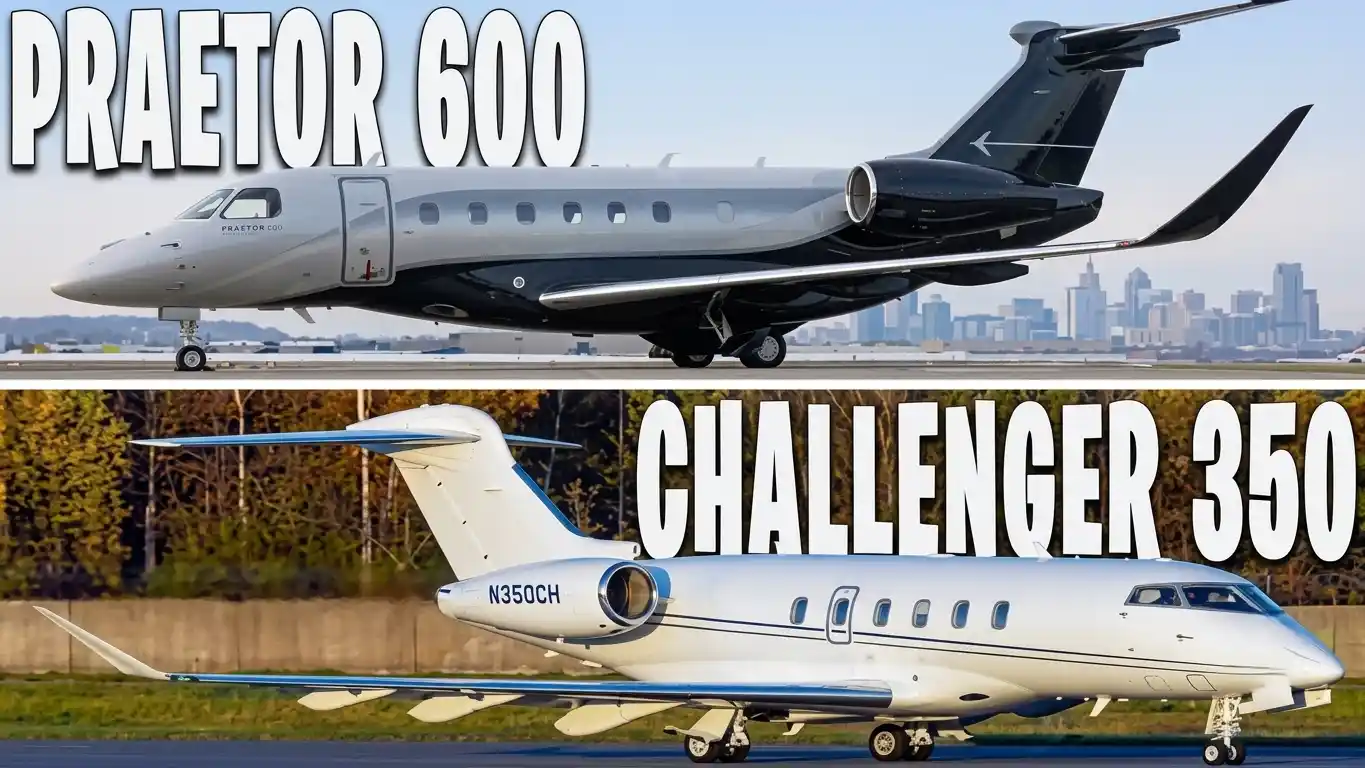
The super-midsize business jet segment has become increasingly competitive as manufacturers respond to changing executive travel priorities. Buyers now evaluate aircraft using a broader set of criteria than range and cruise speed alone. Cabin comfort, operational flexibility, connectivity, sustainability, and long-term ownership costs have become central considerations for corporations, charter operators, and private owners alike.
The Challenger 3500 and Praetor 600 illustrate how different manufacturers are addressing these evolving market demands. Although both aircraft serve similar mission profiles, they reflect different approaches to balancing passenger experience, operating efficiency, airport accessibility, and technology integration. Rather than identifying a single winner, comparing these aircraft provides insight into the broader direction of modern business aviation and the priorities shaping the next generation of executive travel.
Challenger 3500 vs Praetor 600 in the Context of Business Aviation
While both aircraft compete in the super-midsize category, they represent different responses to the same market trends.
Challenger 3500
Bombardier has placed considerable emphasis on cabin environment, passenger comfort, and operational consistency, reflecting growing demand for aircraft that function as productive workspaces during flight. Embraer, meanwhile, has focused on combining long-range capability with advanced flight-control technology and operational flexibility. Together, these approaches demonstrate how manufacturers are adapting to changing customer expectations rather than pursuing a single formula for success.
For buyers, the comparison extends beyond technical specifications. Increasingly, the decision depends on mission requirements, ownership strategy, operating economics, and the overall travel experience.

Bombardier evolved the Challenger 3500 from the highly successful Challenger 350 platform, concentrating on continuous refinement rather than radical redesign. The company’s objective centered on enhancing passenger comfort, reducing pilot workload, modernizing cabin technology, and improving sustainability while preserving the reliability that made the Challenger family a corporate aviation favorite.
Embraer approached the Praetor 600 from another direction. Building upon the Legacy 500 platform, the manufacturer sought to push the boundaries of performance by introducing one of the longest-range aircraft in its class. Advanced fly-by-wire controls, aerodynamic refinements, and improved fuel capacity transformed the aircraft into a serious competitor for operators requiring greater operational reach.
These contrasting philosophies influence nearly every aspect of ownership.
Bombardier positions the Challenger 3500 as a premium executive workspace capable of maximizing passenger wellbeing throughout demanding travel schedules. Every detail—from seating ergonomics to cabin acoustics—supports long working days in the air.
Praetor 600

The Praetor 600, developed from Embraer’s Legacy 500 platform, reflects a different design strategy. The manufacturer expanded range, incorporated advanced fly-by-wire technology, and enhanced operational flexibility to support longer missions and broader airport accessibility.
These contrasting approaches illustrate how manufacturers are responding to similar market demands through different engineering priorities.
Bombardier has emphasized creating a cabin environment that supports executive productivity during frequent business travel, while Embraer has focused on extending operational reach without moving into a larger aircraft category.
Despite these differences, both aircraft reflect wider trends across business aviation. Buyers increasingly expect connected cabins, quieter interiors, improved fuel efficiency, advanced flight decks, and greater operational flexibility. As a result, the comparison extends beyond specifications and provides insight into how the super-midsize business jet market is evolving.
The differences become clearer when examining performance, cabin design, and onboard technology.
Performance, Cabin Comfort, and Technology in Context
Performance remains an important consideration in the super-midsize segment, although it is no longer the sole factor influencing purchasing decisions.
The Praetor 600 offers a longer published range, allowing operators to complete more nonstop international missions. For organizations with frequent long-distance travel requirements, that additional capability can improve scheduling flexibility and reduce intermediate fuel stops.
The Challenger 3500, by comparison, is optimized for the mission profiles commonly flown by many corporate operators. Its performance supports transcontinental travel while placing significant emphasis on passenger comfort, operating efficiency, and overall travel experience.
Cabin design has become another area where manufacturers differentiate themselves. The Challenger 3500 incorporates wellness-focused features such as improved seating ergonomics, enhanced sound insulation, refined lighting, and cabin technologies intended to reduce passenger fatigue.
The Praetor 600 approaches cabin design from a different perspective, combining flexible layouts, modern materials, generous baggage capacity, and advanced environmental control systems to support both executive and leisure travel.
Both aircraft also reflect broader digital trends within business aviation by offering:
- High-speed connectivity
- Flat-floor cabin layouts
- Integrated cabin management systems
- Fully reclining executive seating
- Generous baggage capacity
Flight deck technology continues to evolve across the segment. Both aircraft use Collins Aerospace Pro Line Fusion avionics, while the Praetor 600 also incorporates a digital fly-by-wire flight-control system that enhances handling characteristics and flight stability.
Operational flexibility has likewise become an important purchasing consideration. Both aircraft are capable of operating from a wide range of airports, improving access to regional destinations and reducing overall travel time for corporate passengers.
Performance and Cabin Comparison
| Industry Priority | Challenger 3500 Approach | Praetor 600 Approach |
|---|---|---|
| Mission Profile | Transcontinental business travel | Longer-range international missions |
| Cabin Design | Wellness-focused passenger environment | Flexible executive cabin |
| Flight Technology | Collins Pro Line Fusion avionics | Pro Line Fusion with fly-by-wire |
| Airport Access | Strong regional airport capability | Broad operational flexibility |
| Design Philosophy | Passenger experience and efficiency | Range and mission versatility |
Rather than identifying a superior aircraft, these differences demonstrate how manufacturers interpret changing executive travel priorities in different ways.
Ownership, Charter Operations, and Long-Term Value
Ownership decisions increasingly extend beyond aircraft performance. Corporate flight departments, charter operators, and private owners now evaluate lifecycle costs, maintenance support, operational efficiency, technology upgrades, and resale potential alongside traditional performance metrics.
Bombardier’s global support network and the established Challenger family provide one ownership model centered on operational consistency and long-term fleet planning. Embraer, meanwhile, has continued expanding its worldwide service capabilities while positioning the Praetor 600 as an aircraft suited to operators requiring greater mission flexibility.
The charter market has also influenced aircraft development. Clients increasingly expect reliable connectivity, premium cabin environments, efficient operations, and access to smaller airports. Both aircraft address these expectations, although their strengths may appeal to different operating profiles depending on mission requirements.
As a result, aircraft selection increasingly depends on matching operational needs with long-term ownership strategy rather than comparing specifications alone.
How Buyer Priorities Influence Aircraft Selection?
The Challenger 3500 vs Praetor 600 comparison reflects a broader shift within business aviation. Modern buyers increasingly evaluate aircraft according to how they support productivity, operational efficiency, sustainability, and passenger experience throughout the ownership lifecycle.
Organizations conducting frequent long-range international missions may prioritize additional range and operational flexibility. Others may place greater value on cabin environment, passenger wellbeing, predictable operating economics, and fleet consistency.
Technology also plays a growing role in purchasing decisions, with digital flight-control systems, connected aircraft, and advanced cockpit integration becoming increasingly important across the industry.
Industry Priorities Compared
| Industry Priority | Challenger 3500 | Praetor 600 |
|---|---|---|
| Passenger Wellness | Strong emphasis | Moderate emphasis |
| Operational Reach | Transcontinental capability | Extended international capability |
| Flight Technology | Advanced avionics | Fly-by-wire integration |
| Airport Flexibility | Broad access | Broad access with longer missions |
| Ownership Strategy | Mature support ecosystem | Expanding global support |
Rather than producing a universal winner, the comparison highlights how manufacturers are adapting to different customer priorities within the same market segment.
Why the Challenger 3500 vs Praetor 600 Comparison Matters?
The Challenger 3500 vs Praetor 600 discussion illustrates how the super-midsize business jet market has evolved beyond simple measures of speed or range.
Both aircraft reflect wider industry priorities, including passenger wellbeing, digital connectivity, operational flexibility, and long-term ownership value. Their differences demonstrate that manufacturers are responding to changing executive travel needs through distinct design philosophies rather than pursuing a single formula for success.
For operators, the comparison is therefore less about identifying one aircraft as objectively superior and more about understanding which approach best aligns with specific mission requirements, operational strategy, and future fleet planning.
Conclusion
The Challenger 3500 vs Praetor 600 comparison remains one of the most significant decisions in today’s super-midsize business jet market because both aircraft represent exceptional yet distinct approaches to executive aviation.
The Challenger 3500 stands out through outstanding cabin comfort, refined passenger experience, and a mature ownership proposition backed by Bombardier’s extensive support network. Conversely, the Praetor 600 impresses with class-leading range, advanced fly-by-wire technology, and remarkable operational flexibility.
Rather than producing a universal winner, the Challenger 3500 vs Praetor 600 debate highlights the importance of selecting an aircraft that best matches real-world mission requirements. Buyers who carefully evaluate their travel patterns, passenger priorities, and long-term ownership goals will find that either aircraft can deliver outstanding value within the premium super-midsize category.
Frequently Asked Questions
Which is better: Challenger 3500 or Praetor 600?
Neither is universally better. The right choice depends on whether you prioritize cabin comfort and refinement or longer range and operational flexibility.
What is the biggest difference between the Challenger 3500 and Praetor 600?
The Challenger 3500 emphasizes passenger wellness and cabin experience, while the Praetor 600 focuses on extended range and fly-by-wire technology.
Which aircraft has the longer range?
The Embraer Praetor 600 offers greater maximum range, making it especially attractive for longer international missions.
Which jet offers the better cabin experience?
Many operators consider the Bombardier Challenger 3500 one of the most refined cabins in the super-midsize segment thanks to its wellness-focused design.
Is the Praetor 600 better for transatlantic flights?
Its additional range makes the Praetor 600 a stronger option for many transatlantic and other long-range business missions.
Why do corporations choose the Challenger 3500?
Corporations value its comfortable cabin, proven reliability, efficient operations, and strong manufacturer support.
Which aircraft is better for charter operations?
Both perform well, but charter operators serving longer international routes often favor the Praetor 600, while premium executive charters may prefer the Challenger 3500.
How do operating costs compare?
Both aircraft offer competitive operating economics, although total ownership costs depend on utilization, maintenance programs, and mission profiles.
Which aircraft has more advanced technology?
The Praetor 600’s digital fly-by-wire system provides a notable technological advantage, while both feature advanced Collins Pro Line Fusion avionics.
Who should choose the Challenger 3500 vs Praetor 600?
The Challenger 3500 vs Praetor 600 decision should be based on your typical missions, passenger expectations, ownership strategy, and operational priorities rather than a single specification.