Trading cards boomed during the pandemic, pushing the global sports-card market to roughly $13.1 billion in 2023—more than double its 2019 size. Card Ladder still logged a 30–35 percent slide in ultra-modern prices during 2022 as stimulus money dried up. Even after that shake-out, vaults, indices, and fractional platforms kept fresh capital flowing, cementing cardboard as a genuine alternative asset. That’s why we built these 2024 Power Rankings: we score every major segment on two equal factors—long-term return and real-world liquidity—so you can see exactly where smart money still has an edge. (Source: Strategy MRC)
#1 Vintage baseball cards (pre-1980 blue chips)
Return on investment
Pull almost any ten-year window since the early 1980s and vintage baseball marches up and to the right. A benchmark index of pre-1980 Hall-of-Famer rookies returned roughly 150 percent over the decade ending 2018, against 92 percent for the S&P 500 across the same stretch (Forbes, 2018). Card Ladder’s Vintage Index then added about 270 percent in the five years to 2023, yet gave back only a sliver when modern cards cratered. The category compounds through recessions and lockouts, behaving more like a dividend aristocrat than a meme stock—the reason wealth managers treat it as a core holding rather than a moonshot.
Liquidity and market depth
Ask any auction house which category keeps the lights on and the answer is vintage baseball. Weekly Heritage, PWCC, and Goldin sales clear thousands of pre-1980 lots, and a PSA-graded 1950s Hall-of-Famer changes hands on eBay almost hourly. That flow compresses spreads: price a mid-grade Ernie Banks rookie within about five percent of the last comp and it usually sells in days, not months. Six-figure grails draw wired-up bidders from Hong Kong, London, and São Paulo, so exit doors exist at every price tier.
Volatility and risk
No asset grows in a straight line, but vintage baseball comes close. After the 2021 run, the Card Ladder Vintage Index slipped only about five percent during the 2022 pullback while ultra-modern cards fell roughly a third (Sports Collectors Daily, 2022). The floor is held up by true collectors, not weekend flippers chasing quick multiples. Prices still jump when a Mantle or Wagner sets a fresh auction record, but the amplitude is mild next to newer segments—closer to a blue-chip equity than a momentum trade.
Scarcity that sticks
The supply side is frozen in amber. No one prints another 1952 Topps Mantle, and decades of attrition thinned an already modest run; PSA’s census lists only a few hundred copies of many pre-1960 rookies in investment grade. Grading magnifies that scarcity—a single hop from PSA 8 to PSA 9 often doubles value because the top-grade population falls off a cliff, sometimes to fewer than a hundred examples worldwide. Third-party slabs from reputable firms keep counterfeit risk low and liquidity high.
Outlook and catalysts
Two forces favor the segment. First, the Fanatics effect: as the company floods mainstream channels with modern product, history says many new collectors graduate to chasing the legends—more buyers against fixed supply. Second, alternative-asset platforms keep treating blue-chip cards like fine art, with each fractional IPO and insured-vault launch pulling fresh capital in. The bear case is sticker shock and a macro slump freezing discretionary spending for a quarter or two, but past downturns suggest any softness is temporary.
Playbook: Anchor the sleeve here—buy slabbed pre-1980 Hall-of-Famers in PSA 8 and up, prioritize the top grade where population cliffs create premiums, and hold through cycles rather than trading headlines.
#2 Pokémon 1990s 1st edition cards
Return on investment
The English Pokémon TCG debuted in 1999, and its cornerstone 1st Edition holos have outperformed many venture bets. A PSA-10 Charizard 1st Edition fetched $50,100 in October 2020, surged to $311,800 in March 2021, and still sells near $300,000 in 2026. PokeTop10’s Vintage Index climbed from about 2,800 to 16,000 (a four-fold jump) between 2019 and the 2021 peak, fell forty-five percent in 2022, then recaptured much of that ground. Long-horizon buyers remain three- to five-times ahead over five years.
Liquidity and market depth
High-grade Base-Set holos appear on eBay daily and often change hands within 48 hours under normal conditions, with recent bid-ask spreads of six to eight percent on PSA-9/10 staples. TCGplayer’s marketplace and weekly Heritage or PWCC auctions create parallel exits, and fractional platforms such as Rally offer additional price discovery for six-figure pieces.
Weekly reverse auctions on Vaulted move graded Pokémon slabs and sealed product fast.
Prices start 10 percent below list on Monday and drop by another 10 points each day, hitting 50 percent by Friday if the lot lasts that long.
For investors, consigning to a fixed five-day window like that provides hard-stop liquidity without the month-long lead times of legacy houses.
Volatility and risk
Social media can swing Pokémon prices sharply. Stimulus checks and influencer box breaks pushed 2021 values to option-like highs; by 2022 many flagships had retraced roughly forty to fifty percent. Two factors magnify swings:
- Population velocity. PSA’s 2022 backlog release added double-digit Gem-Mint copies of key cards just as demand cooled, expanding supply.
- Constant new sets. Quarterly releases split collector budgets; every new Charizard competes with vintage counterparts.
Scarcity that sticks
First-edition stamps lock supply for good. PSA shows 124 Gem-Mint Charizard 1st Edition slabs out of roughly 5,300 graded. Comparable populations for Blastoise and Venusaur each sit below 150. That fixed ceiling helps prices recover once excess inventory is absorbed.
Outlook and catalysts
The franchise’s 30th anniversary in 2026 should spark fresh demand, and a rumored Netflix live-action series could widen the funnel quickly. Insured vault lending and card-backed financing are also institutionalizing Pokémon. Expect turbulence, yet the math (global fan base plus capped 1st Edition supply) still favors patient, long-term gains.
Playbook: Focus on true scarcity (1st Edition, shadowless, PSA 9/10), size positions for volatility, and keep cash ready for sentiment-driven dips.
#3 Magic: The Gathering reserved list cards
Return on investment
Wizards of the Coast published the Reserved List in March 1996 and has reaffirmed it several times since. The policy froze supply, and investors have been rewarded for that scarcity.
- Alpha Black Lotus: sold for about $30,000 in 2005, crossed $100,000 in 2019, and reached $511,100 on January 28, 2021 in a PWCC sale (PSA-10, artist-signed).
- Dual lands: MTG Goldfish data shows staples such as Underground Sea and Volcanic Island rising two to three times between 2016 and 2026, even after the 2022 correction.
Across a basket of fifty high-liquidity Reserved List cards, Altan Insights estimates an annual compound growth rate of twelve to fifteen percent from 2013 through 2025, slightly below vintage baseball but ahead of most modern sports cards (Altan Collectibles Briefing, 2026).
Liquidity and market depth
TCGplayer’s February 2026 seller report lists more than 400 Underground Sea copies sold in twenty-eight days, confirming steady retail turnover. PWCC and Heritage clear PSA or BGS-graded Power Nine pieces almost every quarter, with a median time on market under fourteen days for lots priced below $50,000. Bid–ask spreads widen with value: five to seven percent on $500 dual lands and ten to fifteen percent on six-figure Black Lotus copies (PWCC auction data, Q1 2026).
Scarcity locked by policy
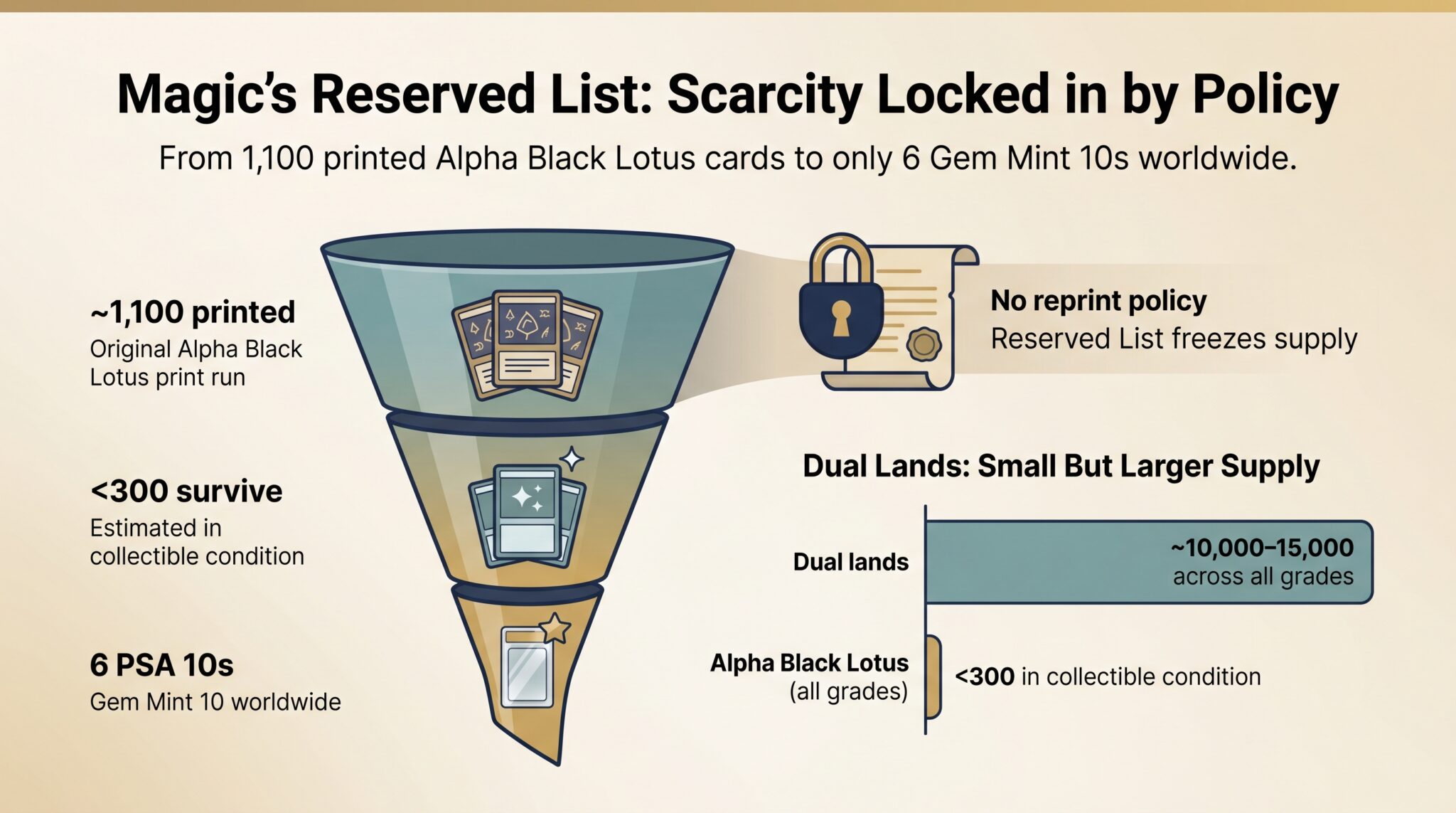
Only about 1,100 Alpha Black Lotus cards were printed, and fewer than 300 are thought to survive in collectible condition. PSA’s census lists just six Gem-Mint 10 examples worldwide. Dual-land populations sit in the 10,000 to 15,000 range across all grades-tiny next to Pokémon or sports pop counts. Because Commander and Vintage formats still require originals, gameplay utility reinforces the price floor.
Active players often use these valuable cards in actual tournament decks instead of locking them away in safes. This physical use means that players need reliable ways to keep cards protected during games. Constant shuffling and handling can quickly wear down the edges of vintage cardboard. High-quality sleeves with a matte finish help prevent this wear and make the cards easy to handle. Protecting the physical condition of these cards is a simple way to preserve their market value over time
Volatility, risk and outlook
During the 2022 hobby downturn, Power Nine indices dipped about fifteen percent, far milder than the decline of more than thirty percent in ultra-modern sports cards. Risks remain: a shrinking paper-Magic player base, improved counterfeit technology, or a policy reversal (unlikely yet devastating). For now, gameplay demand plus the no-reprint clause support a thesis of steady, inflation-beating growth with moderate liquidity—more like a collectible mid-cap than a momentum stock.
#4 Modern sports cards (2010s–2020s rookies & autos)
Return on investment
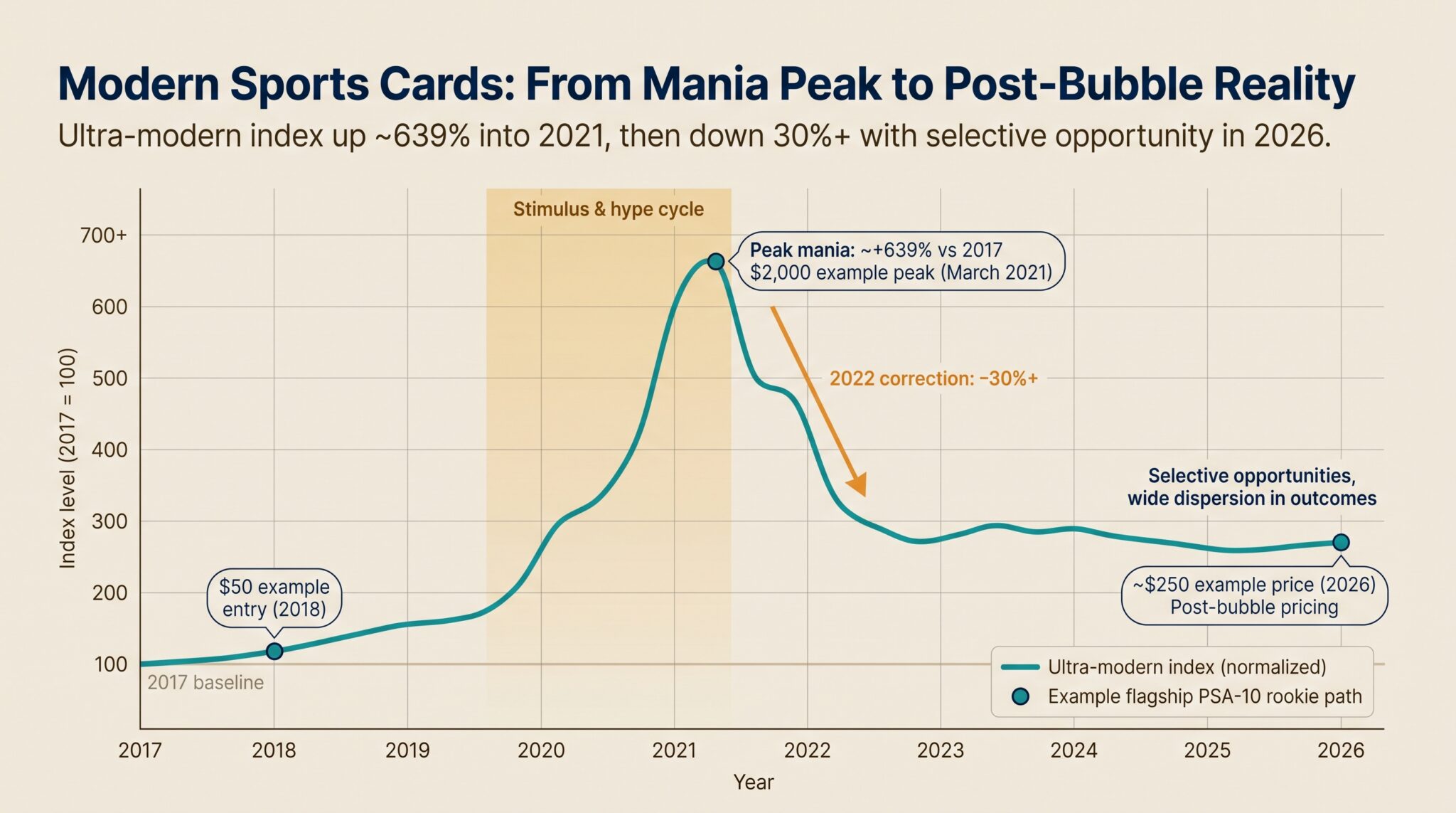
Card Ladder’s Ultra-Modern Index gained about 639 percent from 2017 to the February 2021 peak, then surrendered more than 30 percent in 2022. A PSA-10 Luka Dončić Prizm sold for $50 in 2018, reached $2,000 in March 2021, and trades near $250 in 2026 (PWCC sales history, May 2026). Opportunity exists, yet timing is harsh: Zion Williamson’s flagship PSA-10 fell 60 percent in the second quarter of 2023 after injury setbacks (Card Ladder player index).
Winners still post double-digit five-year compound annual growth rates, but dispersion is wide; the median modern rookie trails the S&P 500 unless you buy before the hype and sell into headlines.
Liquidity and market dynamics
High-profile PSA-10 rookies can change hands ten to twenty times during a single game on eBay vault listings. Median time to cash is fewer than seven days, and bid-ask spreads tighten to about five percent when at least one thousand identical slabs exist (eBay Vault analytics, April 2026). Liquidity also cuts both ways: performance hiccups trigger listing floods and price gaps.
Serial-numbered parallels and on-card autographs trade less often; expect two- to three-week sale windows and spreads of twelve to fifteen percent unless the player is on a tear.
Volatility, supply glut and the Fanatics factor
PSA’s population report lists 20,345 Gem-Mint Zion Williamson Prizm Base cards (#248), a figure higher than the entire PSA population of 1950s Mickey Mantles. Print runs accelerated in 2020 and 2021, and Fanatics, which assumed NBA and NFL licenses in 2026, plans even broader retail distribution. As a result, base and Silver rookies turn into commodities quickly.
Protection lies in engineered scarcity: cards numbered to ninety-nine, true-color parallels, and one-of-ones remain insulated because print supply is fixed.
Playbook: flip liquid base or Silver slabs on momentum, hold only numbered or on-card autographs of proven stars, set exit targets in advance and honor them.
#5 Emerging TCGs (One Piece, Lorcana, Flesh and Blood)
Return on investment
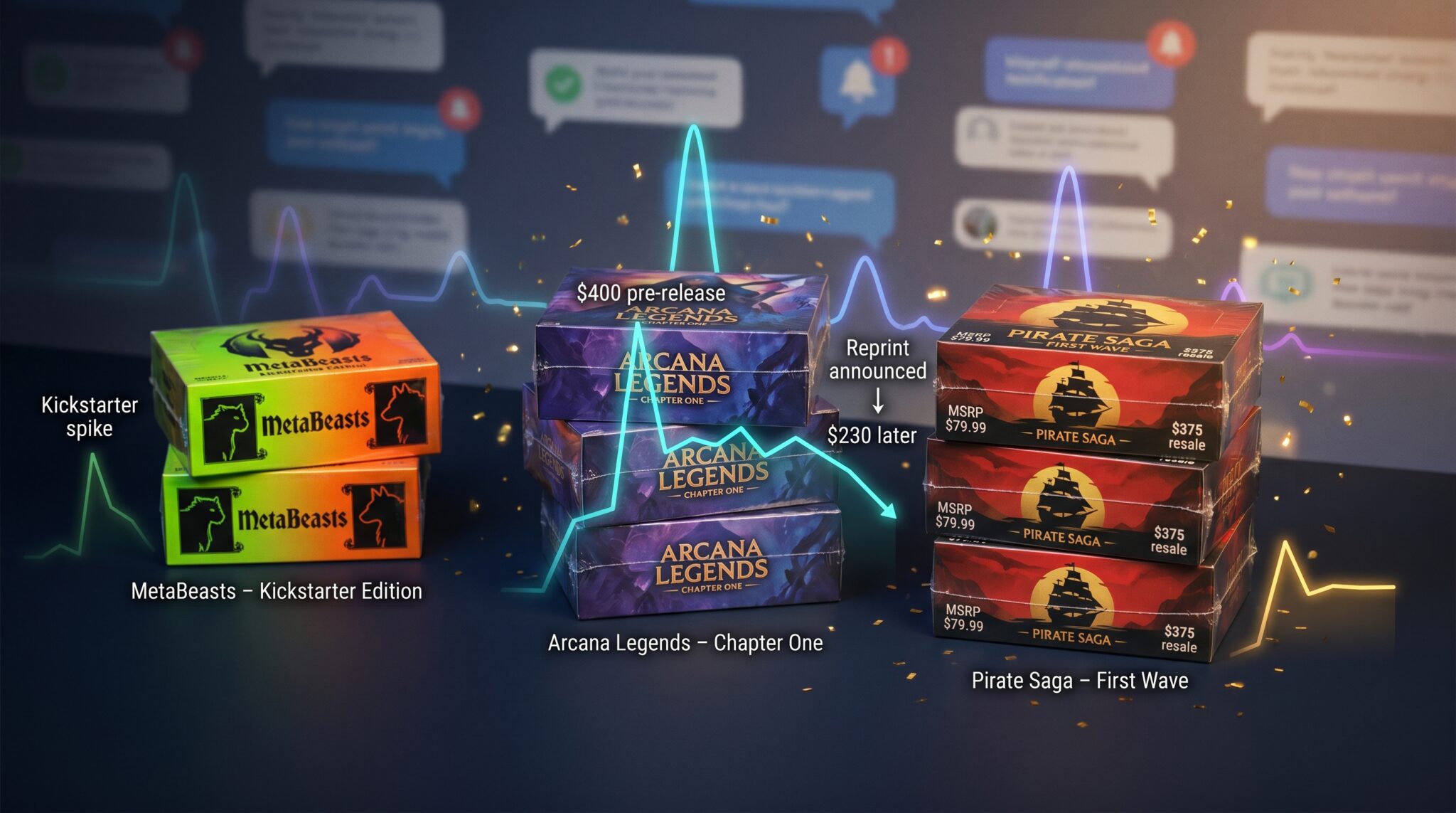
Launch scarcity can feel like a gold-rush. The English One Piece Romance Dawn booster box carried a $79.99 MSRP in November 2022 and resold for $350 to $400 on eBay within two weeks. Disney Lorcana – The First Chapter boxes reached $400 pre-release in August 2023 but slipped below $230 by April 2024. MetaZoo Kickstarter product followed the same arc. With limited history, a five-year compound growth rate is a guess: you might earn five times your money if the intellectual property endures or lose everything if hype fades.
Liquidity and market depth
Hype weeks appear liquid; Discord breakers move sealed cases every hour. Depth, however, is thin. TCGplayer data show Lorcana booster-box transactions falling about sixty-five percent between September 2023 and March 2024. List a high-end Lorcana promo today and you may wait more than three weeks or accept a fifteen to twenty percent discount to the last sale.
Volatility, risk and outlook
Prices move on headlines, not fundamentals. A reprint tweet can cut values by fifty percent overnight. Supply is elastic because publishers can add unlimited waves, holiday boxes, or promo kits. That protects players but hurts investors. Only serialized judge promos or championship foils have fixed caps, and even they rely on an active player base.
The path forward is binary. If One Piece maintains organized play and the anime draws new viewers, early sets could mature like Pokémon Base. If the meta shifts or social buzz cools, sealed boxes turn into cardboard clutter. Treat these positions the same way you treat angel checks: small, thesis-driven, and guided by preset exit plans.
Playbook
- Cap exposure at “fun-money” levels (one percent of portfolio or less).
- Flip sealed product during launch-week frenzy; keep only true serialized promos.
- Track reprint news closely and sell immediately after a confirmed wave.
Frequently asked questions & common objections
Why didn’t you rank Yu-Gi-Oh! or comic books?
Our brief required both deep data and clear institutional demand. Vintage Yu-Gi-Oh! sales volume in 2025 reached about one-third of Pokémon’s level (Heritage Auctions data), and comics follow a different risk profile. We will cover those assets in a separate report.
Sealed boxes or graded singles?
Sealed boxes offer asymmetric upside but require bulky storage and hide uncertain contents. Graded singles provide transparent comps and move faster. Many investors keep a small “time-capsule” stash of sealed product and rely on key graded cards for day-to-day liquidity.
If grading adds value, why not grade everything?
Fees and population velocity matter. PSA’s economy tier costs twenty-five dollars per card (May 2026). A one-hundred-dollar raw card must rise at least twenty-five percent after grading just to break even; most low-end cards will not clear that bar.
Can I gain exposure without storing cardboard?
Yes. Fractional initial public offerings and collateralized lending let you buy shares or borrow against slabs. Secondary-market volume remains thin—Collectable averaged fourteen thousand dollars of daily turnover in the first quarter of 2026—so treat these tools as complements, not replacements, for direct ownership.
How do I time the market?
Match catalysts to segments:
- Modern sports — sell into playoff or award hype.
- Vintage Pokémon — trim positions near key anniversaries, such as the twentieth, twenty-fifth, or thirtieth.
- Emerging TCGs — exit before confirmed reprint waves.
Write down a target price or date when you buy and follow it; emotion is the largest leak in collectible returns.
Conclusion: putting the rankings to work
Vintage baseball remains the core holding, offering steady compounding and high liquidity. Vintage Pokémon adds global growth potential, and Magic’s Reserved List provides slow, reliable appreciation. Modern sports cards supply tactical upside, while new TCGs act as venture-style options.
Portfolio sizing
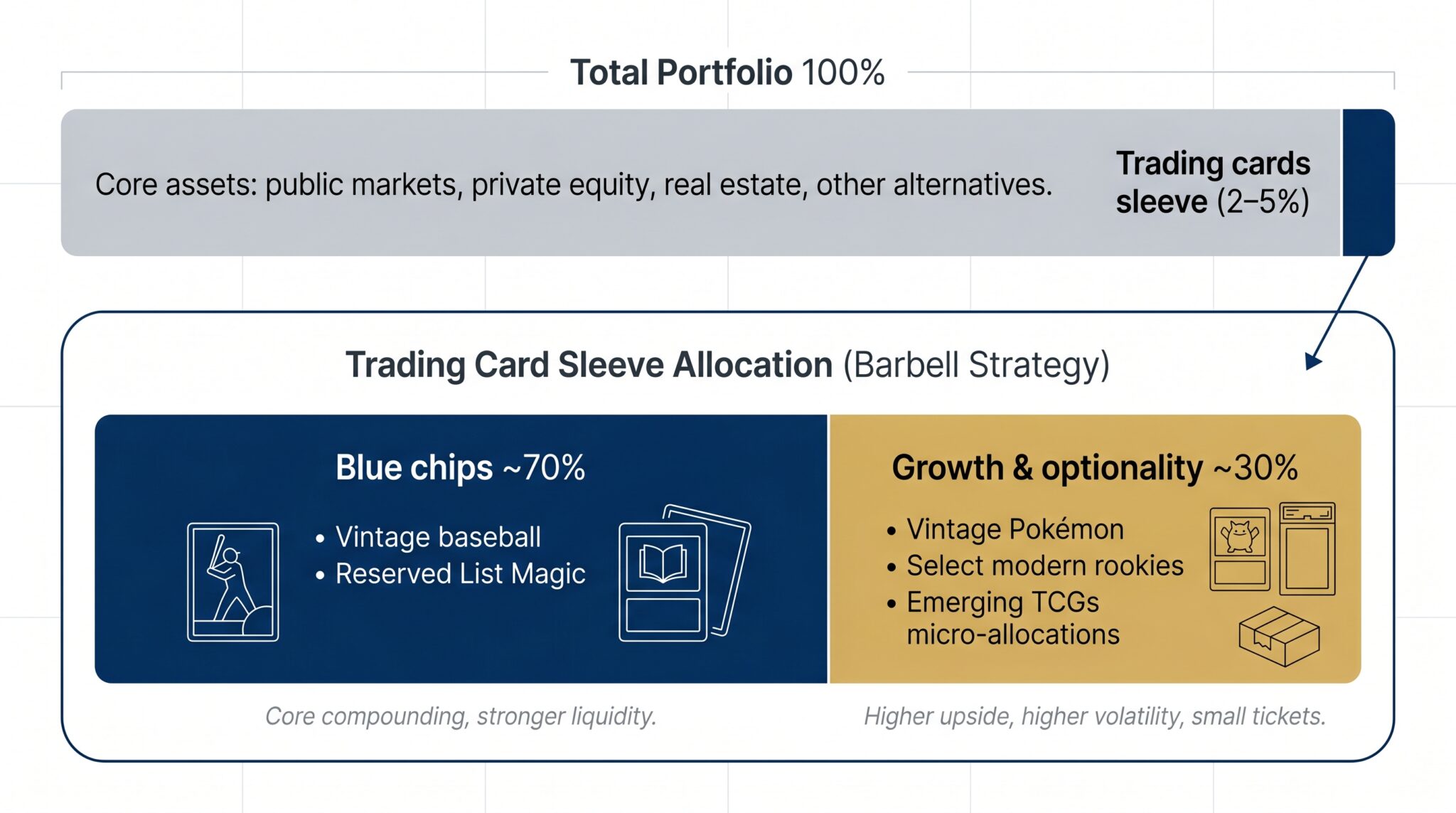
For most accredited investors, cap trading cards at two to five percent of total assets: large enough for uncorrelated alpha, small enough that volatility cannot derail the plan. Inside that sleeve, run a barbell:
- Blue chips (about seventy percent) – vintage baseball, Reserved List Magic
- Growth and optionality (about thirty percent) – vintage Pokémon, select modern rookies, and micro-allocations to emerging TCGs
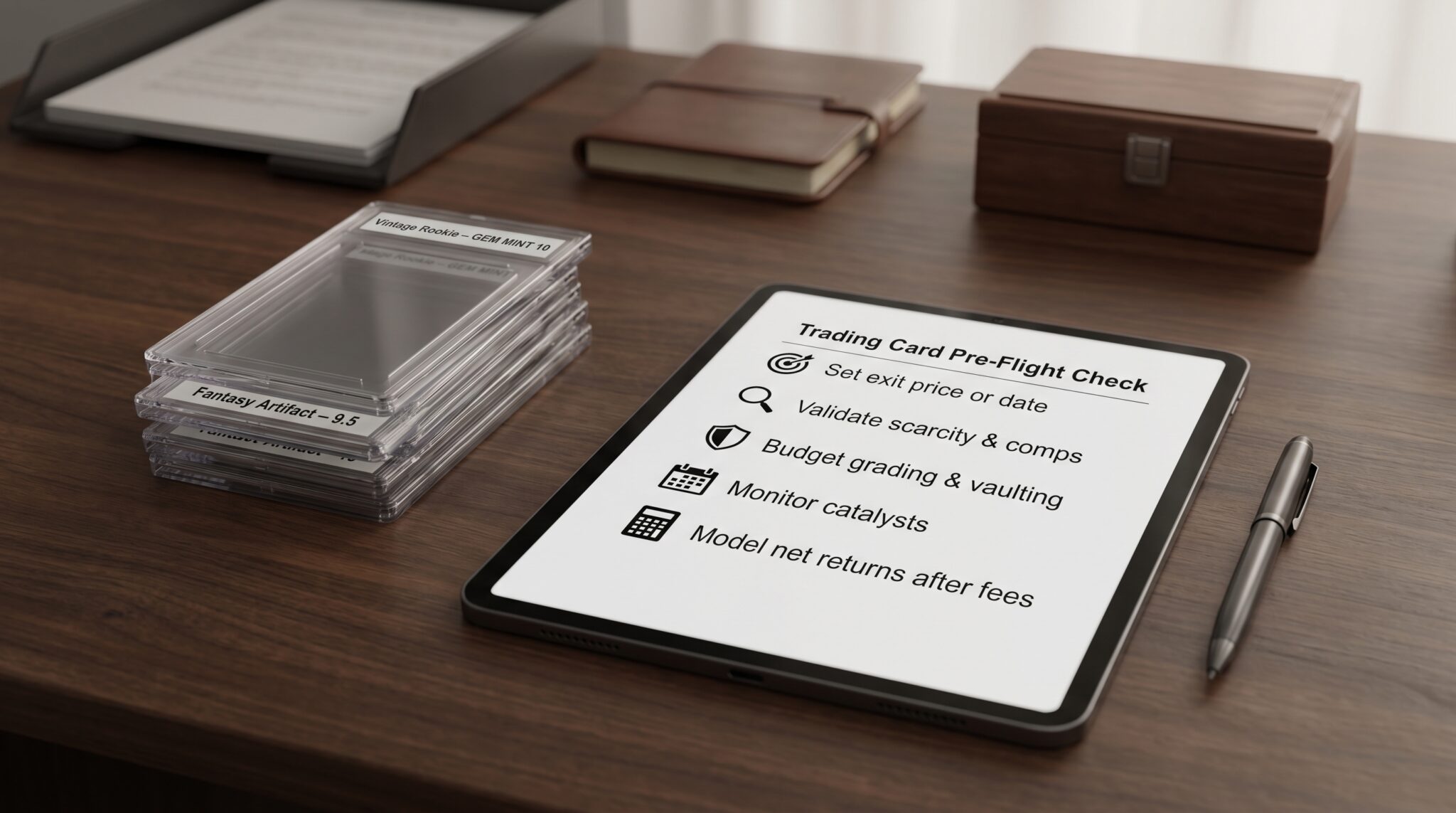
Five-point pre-flight check
- Set your exit. Record a price target or catalyst date.
- Validate scarcity. Confirm PSA or BGS populations and the last three comparable sales.
- Grade and vault. Budget twenty-five to thirty dollars per card for PSA economy and one-half to one percent of value per year for insured storage.
- Monitor catalysts. Awards seasons, anniversary years, and print-run news.
- Model net returns. Subtract auction fees of ten to twenty percent, vault fees, and shipping before quoting headline prices.
Follow this discipline and trading cards can do what few alternative assets manage: deliver real returns while letting you own a slice of pop culture heritage—a win for the spreadsheet and the shelf.