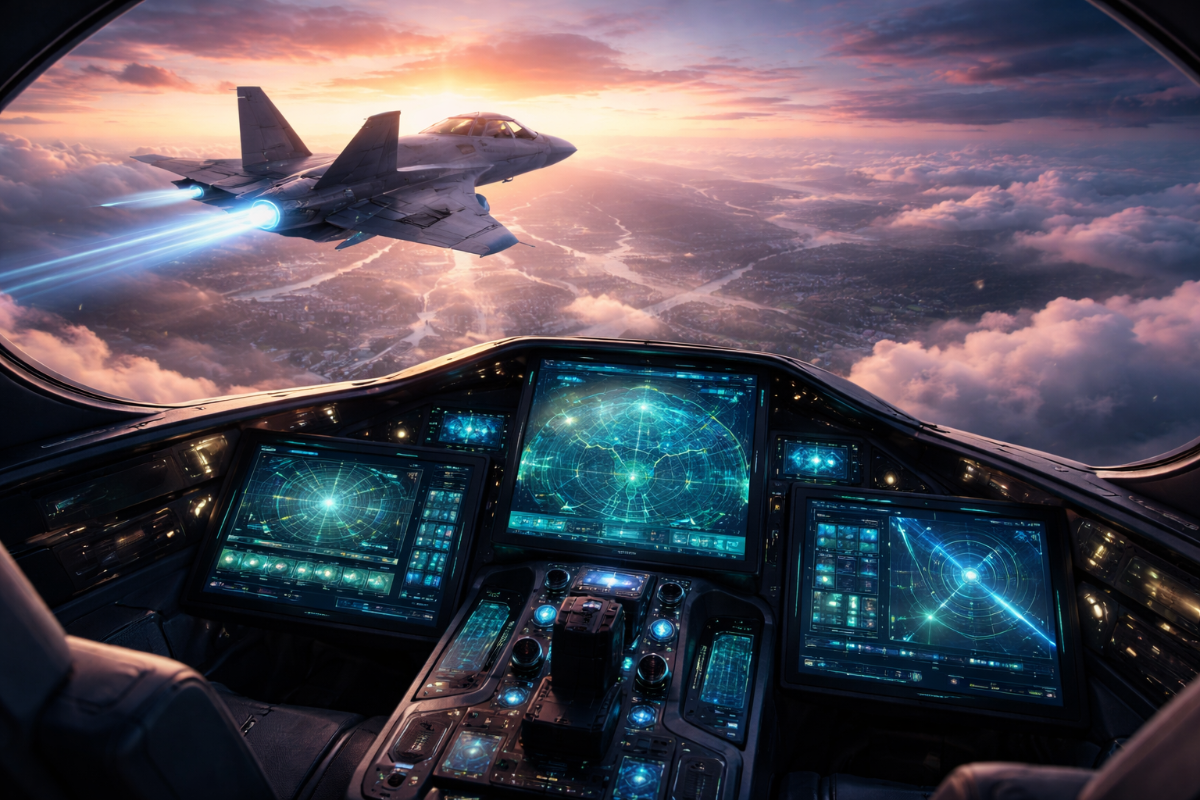
Modern aviation is entering a transformative era. Advances in artificial intelligence are reshaping how aircraft operate, navigate, and make decisions in the sky. At the center of this transformation lies AI Jet Autonomy, a technology that enables aircraft to perform complex flight operations with minimal or no human intervention.
For decades, aviation relied heavily on human expertise, training, and experience. Pilots have been responsible for interpreting instruments, navigating complex airspace, and responding to emergencies. However, recent breakthroughs in machine learning, sensor systems, and computational power are allowing AI-driven flight systems to perform many of these tasks faster and with greater data awareness.
As a result, AI Jet Autonomy is no longer a futuristic concept. It is quickly becoming a critical component of both military and commercial aviation strategies. Moreover, autonomous flight technologies promise improvements in safety, efficiency, and operational cost.
This article explores the rise of AI pilots, how autonomous flight systems work, how they compare to human pilots, and what the future holds for aviation professionals.
The Rise of AI Pilots in Aviation
Artificial intelligence has steadily integrated into aviation systems over the past several decades. Early autopilot systems handled basic functions such as maintaining altitude or heading. However, modern AI-powered systems go far beyond simple automation.
Today’s AI Jet Autonomy systems use advanced algorithms capable of:
-
Real-time decision making
-
Dynamic route optimization
-
Threat detection
-
Autonomous landing and takeoff
-
Predictive aircraft health monitoring
Moreover, defense agencies and aerospace companies are investing heavily in autonomous aviation technologies. Military programs already test AI-controlled fighter jets capable of aerial combat maneuvers.
Commercial aviation is also exploring semi-autonomous aircraft operations. Some manufacturers are developing systems that could allow aircraft to operate with reduced pilot crews or remote supervision.
Consequently, the aviation industry is moving toward a future where human pilots collaborate with intelligent flight systems rather than controlling every aspect of the aircraft.
How Autonomous Flight Systems Work?
To understand AI Jet Autonomy, it is essential to examine the underlying technologies that enable autonomous flight.
Autonomous aircraft rely on a layered architecture combining sensors, data processing systems, and machine learning models.
Core Components of Autonomous Flight
-
Sensor Networks
Aircraft collect massive amounts of environmental and operational data using sensors such as:
-
Radar
-
Lidar
-
Infrared cameras
-
GPS receivers
-
Air data sensors
-
Inertial navigation systems
These sensors continuously monitor weather conditions, terrain, nearby aircraft, and system performance.
-
Sensor Fusion Technology
Sensor fusion combines data from multiple sources to build a unified and accurate representation of the aircraft’s environment.
For example, radar may detect nearby aircraft while infrared sensors identify heat signatures. When combined, the system gains a clearer situational picture.
Moreover, sensor fusion helps eliminate false readings and improves reliability in challenging environments.
-
Machine Learning Algorithms
Machine learning models analyze patterns in flight data and learn from past experiences.
These models enable aircraft to:
-
Predict turbulence
-
Optimize flight paths
-
Detect system anomalies
-
Respond to emergencies
Therefore, the aircraft continuously improves its operational decision-making capabilities.
-
Autonomous Decision Engine
The decision engine acts as the aircraft’s “brain.” It processes sensor inputs and determines the most appropriate action.
For example, if severe weather appears on the planned route, the AI system can calculate alternate paths instantly.
Consequently, the aircraft reacts faster than a human pilot relying on manual data interpretation.
AI vs Human Pilot Performance
One of the most debated topics in aviation is whether AI can outperform human pilots. While human expertise remains essential, AI-driven systems offer several advantages in specific scenarios.
Performance Comparison
| Factor | AI Jet Autonomy | Human Pilots |
|---|---|---|
| Reaction Speed | Milliseconds | Seconds |
| Data Processing | Can analyze thousands of parameters simultaneously | Limited cognitive processing |
| Fatigue | No fatigue | Fatigue affects performance |
| Learning | Continuous algorithm training | Training limited by experience |
| Adaptability | Strong in structured environments | Strong in unpredictable scenarios |
AI systems excel at analyzing large data sets and responding instantly. Moreover, they do not suffer from fatigue or cognitive overload.
However, human pilots still possess strong intuition, creativity, and judgment in unusual situations. Therefore, the most effective aviation model today combines AI support with human oversight.
Safety, Regulation, and Certification Challenges
Despite its advantages, AI Jet Autonomy faces significant regulatory and safety challenges.
Aviation regulators must ensure autonomous systems meet strict safety standards before they can be deployed widely.
Major Certification Challenges
-
Algorithm Transparency
AI decision-making processes can be difficult to interpret. Regulators require clear explanations of how systems reach specific decisions.
-
System Reliability
Autonomous systems must demonstrate extremely high reliability levels. Aviation standards often require failure probabilities lower than one in a billion flight hours.
-
Cybersecurity
AI-controlled aircraft introduce new cybersecurity risks. Therefore, systems must include robust protection against hacking or data manipulation.
-
Human Oversight Requirements
Many regulators currently require human pilots to remain in the cockpit even if autonomous systems handle most operations.
Consequently, certification frameworks must evolve alongside emerging technologies.
Military and Commercial Aviation Use Cases
AI Jet Autonomy is already shaping both military and commercial aviation sectors.
Military Applications
Defense organizations are actively developing AI-controlled combat aircraft.
Key applications include:
-
Autonomous fighter jets
-
Drone swarms
-
Reconnaissance aircraft
-
Autonomous refueling systems
Moreover, AI pilots can perform high-risk missions without endangering human lives.
In air combat scenarios, AI systems can also execute complex maneuvers faster than human pilots.
Commercial Aviation Applications
In commercial aviation, autonomous technology focuses primarily on operational efficiency and safety.
Examples include:
-
Autonomous taxiing on runways
-
AI-assisted landing systems
-
Predictive maintenance systems
-
Flight path optimization
Consequently, airlines may reduce operational costs while improving flight reliability.
However, fully autonomous passenger flights may still take years before widespread adoption.
Role of Machine Learning and Sensor Fusion
Artificial intelligence in autonomous jets relies heavily on advanced data learning models combined with integrated sensor technologies.
Machine Learning in Aviation
Machine learning systems process enormous volumes of aviation data collected from thousands of recorded flights. By studying operational patterns, aircraft behavior, and environmental variables, these algorithms uncover critical insights from large datasets. Consequently, AI systems refine their predictive accuracy and continuously improve flight decision-making using both historical and real-time data.
These models allow aircraft to predict:
-
Weather disturbances
-
Mechanical failures
-
Air traffic congestion
-
Fuel consumption patterns
Moreover, predictive analytics improves flight safety by identifying potential risks before they escalate.
Sensor Fusion Advantages
Sensor fusion enhances situational awareness by combining different sensor inputs into a single operational picture.
This capability allows aircraft to:
-
Detect obstacles faster
-
Navigate complex airspace
-
Operate safely in poor visibility
Therefore, sensor fusion significantly strengthens autonomous flight reliability.
Impact on Airlines and Pilot Careers
The emergence of AI Jet Autonomy is raising questions about the future of pilot careers.
Some aviation experts fear that autonomous aircraft could eventually replace human pilots. However, most industry analysts predict a more collaborative future.
Airline Benefits
Airlines could gain several operational advantages:
-
Reduced fuel consumption
-
Lower operational costs
-
Improved route efficiency
-
Reduced human error
Moreover, AI systems can assist pilots during high workload situations.
Evolution of Pilot Roles
Instead of disappearing, pilot roles may evolve into supervisory positions.
Future pilots may focus on:
-
Monitoring AI systems
-
Managing complex emergencies
-
Coordinating with air traffic control
-
Overseeing autonomous operations
Consequently, pilot training programs may include AI system management and data analysis skills.
Human Pilots vs AI-Assisted Flight Operations
The aviation industry is likely to adopt hybrid flight models combining human expertise with AI automation.
| Flight Operation | Human-Controlled Aircraft | AI Jet Autonomy System |
|---|---|---|
| Navigation | Manual route adjustments | Automated route optimization |
| Weather Avoidance | Pilot interpretation | Real-time predictive rerouting |
| Emergency Response | Experience-based decisions | Algorithmic risk evaluation |
| Fuel Efficiency | Depends on pilot strategy | Continuous optimization |
| Operational Consistency | Variable | Highly consistent |
This hybrid model ensures safety while leveraging AI efficiency.
The Future of AI Jet Autonomy
The development of AI Jet Autonomy represents one of the most significant technological shifts in aviation history.
Over the next decade, several trends are expected:
-
Increased AI-assisted cockpit systems
-
Autonomous cargo aircraft operations
-
Remote pilot monitoring centers
-
Integration with smart air traffic management systems
Moreover, autonomous aircraft may eventually enable new aviation models such as urban air mobility and pilotless cargo transport.
However, regulatory approval, public trust, and safety validation will remain essential milestones.
Therefore, while full autonomy may still be years away, AI-driven aviation technologies will continue reshaping the industry.
Frequently Asked Questions
What is AI Jet Autonomy?
AI Jet Autonomy refers to artificial intelligence systems that allow aircraft to operate with minimal or no human intervention by analyzing data, making decisions, and controlling flight operations.
Can AI completely replace human pilots?
Currently, AI cannot fully replace human pilots. Instead, aviation is moving toward AI-assisted flight where humans supervise autonomous systems.
Is autonomous aviation safe?
Autonomous aviation systems undergo strict safety testing and certification. Moreover, AI can reduce human error, which contributes to many aviation incidents.
When will autonomous passenger flights become common?
Experts estimate that limited autonomous passenger flights could appear within the next two decades, depending on regulatory approval and technological maturity.
What technologies power AI Jet Autonomy?
Key technologies include machine learning, sensor fusion, radar systems, advanced flight computers, and real-time data analytics.