Picture a marketing head at a Malaysian group with 8,000 pages across three country sites. Her SEO playbook worked well when she ran a 40-page site for a smaller company. Now she publishes the same kind of blog posts, fixes the same kind of title tags, and traffic barely moves. Nothing is “wrong” with the tactics. The problem is that the game changed size.
That’s the core issue with enterprise SEO. It isn’t SME SEO with a bigger budget. The constraints, the people involved, the risks and even the way you measure success are different. This article explains where the two diverge and what to do about it.
What Is Enterprise SEO, and How Is It Different From SME SEO?
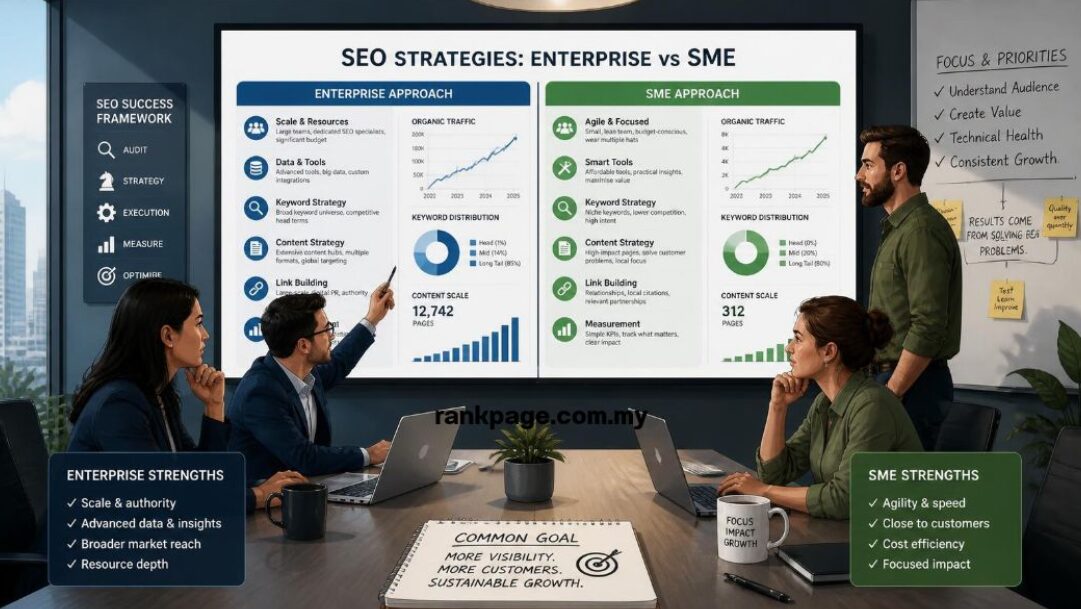
Enterprise SEO is the practice of improving organic search performance for large organisations that run big, complex websites, often across several markets, teams and business units. SME SEO focuses on a smaller site and a narrower set of keywords, usually managed by one or two people.
In practice the gap shows up in five places:
| Factor | SME SEO | Enterprise SEO |
| Site size | Dozens to a few hundred pages | Thousands of pages, often many templates |
| Decision-making | One owner, quick approvals | Several teams, legal review, long approval chains |
| Markets | Usually one country or city | Multiple countries, languages and domains |
| Main risk | Not ranking | Technical errors that affect thousands of URLs at once |
| Success metric | Rankings and enquiries | Revenue, pipeline and share of search across segments |
A small business can win by being fast and focused. A large one wins by being consistent and well-organised, which is a very different skill.
Scale Turns Small Technical Issues Into Big Ones
On a 50-page site, a broken canonical tag is an annoyance. On a 50,000-URL site, the same mistake can quietly stop important pages from being indexed for months.
Large sites tend to run into problems smaller ones never see:
- Crawl and index control: Search engines don’t crawl everything equally. Filter pages, internal search results, tracking parameters and old campaign URLs can soak up attention that should go to revenue pages.
- Template-level errors: One faulty template can affect an entire product or service category overnight.
- JavaScript rendering: Heavy front-end frameworks can hide content from crawlers if rendering isn’t handled carefully.
- Site speed and Core Web Vitals: Fixing performance on one page is easy. Fixing it across dozens of templates needs developer time and a clear priority list.
This is why enterprise work leans so heavily on site architecture. Before you write another article, you need to know which pages deserve to be found, how they link together, and which ones should be kept out of the index.
SEO at Enterprise Level Is Also an Organisational Problem
Here’s something SME owners rarely have to think about: who needs to sign off on a page title?
In a large company, a single content update might involve the SEO lead, a copywriter, a brand manager, a compliance officer and a developer who has a six-week backlog. Industries like banking, insurance and healthcare add regulatory review on top. If SEO isn’t built into that workflow, good recommendations die in a queue.
What works in practice:
- Agree on ownership: Decide who owns SEO decisions for each part of the site, so two departments don’t publish competing pages.
- Write guidelines, not one-off fixes: Templates, naming rules and content checklists let large content teams stay consistent without asking the SEO team every time.
- Get SEO tasks into the developer roadmap early: Technical fixes need to be scoped, ticketed and prioritised like any other product work.
- Build compliance into the process: Review steps should happen before publishing, not after.
If your team doesn’t have the capacity to build this in-house, working with providers of enterprise SEO services can help, especially when the real challenge is coordinating site architecture, technical fixes and content across several teams rather than producing more content.
Multi-Market and Multilingual SEO Gets Complicated Fast
Malaysia makes this especially interesting. Searchers move between English, Bahasa Malaysia and Chinese, sometimes within the same session. A company that also sells into Singapore or elsewhere in the region has to decide how all those versions fit together.
Common mistakes include:
- Translating pages word for word without adapting terms people actually search for.
- Skipping or misusing hreflang tags, so the wrong country or language version shows up in results.
- Letting several country sites compete against each other for the same query.
- Treating all markets identically, even when search demand and competitors differ.
A good rule of thumb: localise, don’t just translate. The phrase a Kuala Lumpur customer types may not match the phrase a customer in another country uses, even in the same language.
Keyword Strategy: From Lists to Ecosystems
An SME might target 20 to 50 keywords and map each to a page. That’s manageable on a spreadsheet.
Enterprises have thousands of keywords spread across product lines, departments and regions. The risk isn’t just missing keywords. It’s keyword cannibalisation, where several of your own pages target similar terms and end up weakening each other.
A better approach is to treat keywords as a structured system:
- Group keywords by topic and search intent, not just by volume.
- Assign one primary page to each intent.
- Check regularly for overlap between teams, categories and country sites.
- Link related pages deliberately so authority flows to the pages that matter most.
The goal is clarity. Every important search intent should have one obvious page that answers it.
Measurement: Rankings Aren’t Enough
SME reporting often stops at rankings, traffic and leads. That’s fine for a small business with a simple funnel.
Enterprise leadership usually wants a different answer: what is organic search contributing to revenue or pipeline, and where should we invest next? To answer that, reporting needs to be segmented by market, business unit and page type, and connected to conversion data. When SEO is tracked in silos, nobody can say which efforts are paying off.
A sensible enterprise dashboard separates brand from non-brand searches, shows performance by region, and links organic visits to business outcomes where tracking allows it.
Common Enterprise SEO Mistakes
- Copying an SME playbook: More blog posts won’t fix an indexation problem.
- Fixing symptoms instead of templates: Patching individual pages while the underlying template keeps producing errors.
- Ignoring internal politics: A perfect audit means little if no one owns the fixes.
- Launching migrations without SEO input: Redesigns and platform changes are where large sites often lose organic traffic.
- Expecting instant results: Large sites move through approvals and releases slowly, so progress usually takes months, not weeks.
How to Choose Support for Enterprise SEO
When you’re comparing any SEO agency Malaysia has to offer, look past the pitch and ask practical questions:
- Have they handled sites with thousands of pages, and can they explain how they manage crawl and index control?
- How do they work with your developers, legal team and content teams?
- Can they handle multilingual and multi-market structures?
- How will they report on revenue impact, not just rankings?
- Do they tailor the plan to how your organisation works, or hand over a generic template?
Good answers will be specific. Vague promises about “boosting rankings” are a warning sign for a project of this size.
FAQs
Is enterprise SEO just SME SEO on a larger scale?
No. The fundamentals are the same, but enterprise SEO adds technical complexity, many stakeholders, multi-market structures and revenue-focused reporting. Scale changes which problems matter most, and how quickly mistakes spread.
When does a business need enterprise SEO?
Usually when a website has thousands of pages, runs across multiple countries or languages, or involves many teams and approval layers. If SEO decisions regularly get blocked or contradict each other, it’s a sign you’ve outgrown SME-style SEO.
How long does enterprise SEO take to show results?
It depends on competition, site condition and how fast changes get implemented. Many large sites need several months before improvements show clearly, since technical fixes and approvals take time.
What is keyword cannibalisation?
It happens when several pages on the same site target similar search terms, so they compete with each other instead of the competition. Large sites with many teams publishing content are especially prone to it.
Do Malaysian companies need multilingual SEO?
If your customers search in English, Bahasa Malaysia or Chinese, yes. Each language version should reflect how people really search, and hreflang tags should signal which version belongs to which audience.
What should enterprise SEO reporting include?
Organic traffic and rankings, split by market and page type, plus crawl and index health, conversions and revenue impact where possible. Reporting should help leadership decide where to invest, not just show vanity numbers.
Final Thoughts: Treat Enterprise SEO as Its Own Discipline
SME SEO rewards speed and focus. Enterprise SEO rewards structure, coordination and patience. The sooner a large organisation accepts that difference, the sooner it stops spending effort on tactics that no longer fit its size.
If you’re not sure whether your site’s structure, teams or markets are holding back your organic growth, a good first step is an audit that looks at indexation, architecture and ownership together. From there, you’ll know what to fix first.