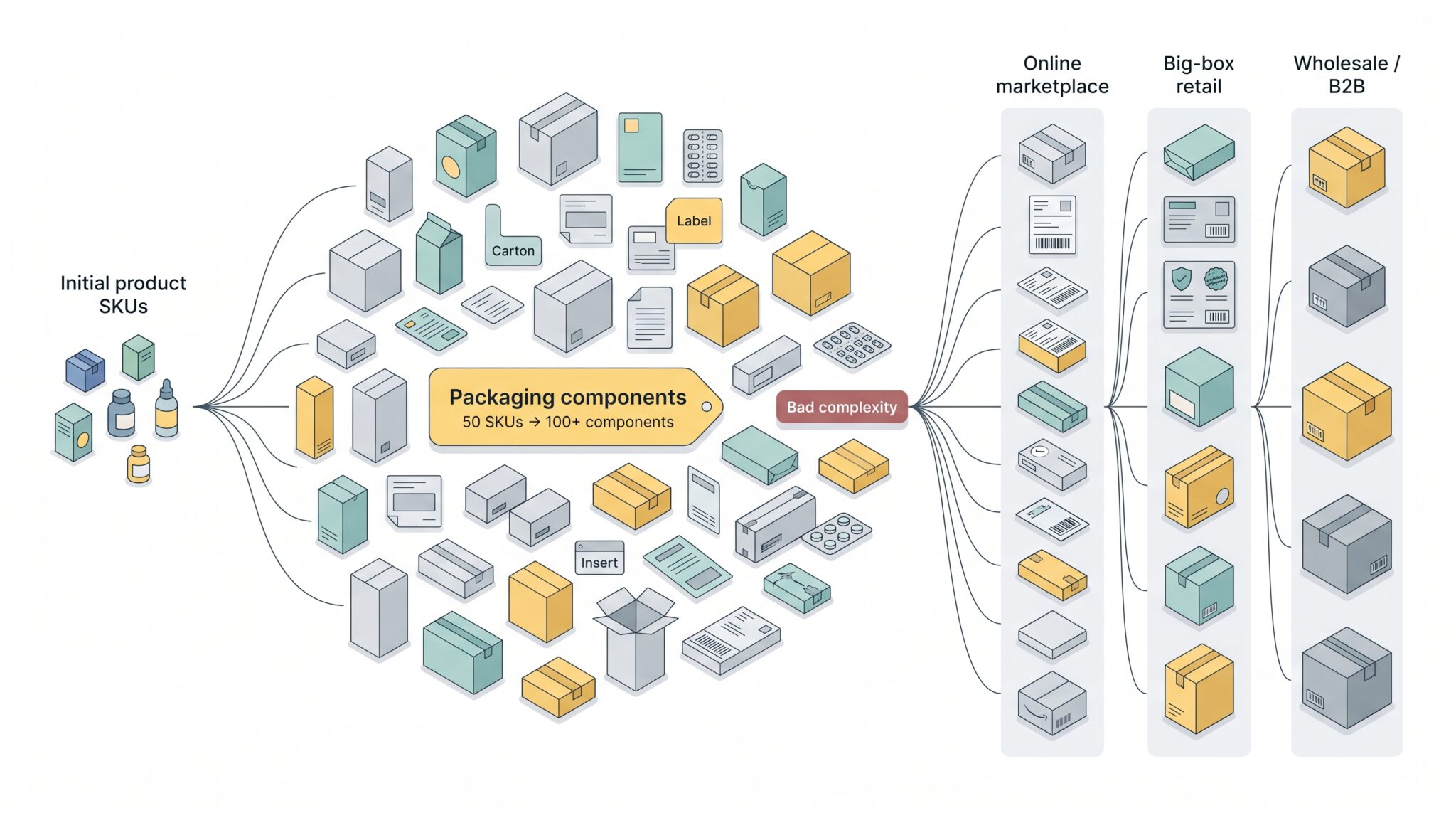
Growing from a handful of items to a portfolio of dozens can turn packaging from an after-thought into a margin killer. This guide shows how disciplined specifications, governance, and cost modeling tame complexity once your catalog crosses the 50-SKU mark.
1. Why packaging complexity explodes at 50 SKUs
Add one new flavor and you swap more than a label—you tack on a carton, a shipper, and a fresh set of plate charges. Spread that across Amazon, Walmart, and wholesale variants, and the math gets ugly: 50 sellable SKUs can spawn 100-plus packaging components, each with its own artwork file, supplier code, and quality test.
McKinsey calls this hidden surcharge on low-volume variants “bad complexity.” According to McKinsey, one global food manufacturer’s North American business grew its SKU count by 66 percent over three years while sales per SKU dropped 40 percent. Tooling sits idle, press changeovers steal uptime, and slow-moving cartons clog pallet racks. Meanwhile, teams chase the “final-final” PDF while the warehouse ships the wrong box.
Cross the ~50-SKU line and you hit a fork:
- Govern—keep one authoritative spec sheet per sellable configuration and link shared components so a single change ripples safely across the portfolio.
- Wing it—juggle duplicate files, emergency reprints, and shrinking margin.
Choose the first path now and good complexity—new channels, regulatory access, true incremental volume—will pay for itself. Choose the second and the tax of bad complexity keeps compounding long after the launch buzz fades.
2. Pick your packaging operating model early
Your operating model (the way people, data, and suppliers move a package from idea to shelf) decides whether the 51st SKU clicks into place or sparks a fire drill.
Most teams start with one shared Excel file. It feels cheap and flexible until variation creeps in: a board-grade tweak in column G clashes with a barcode update in column H, and the press operator calls at midnight. Real-world audits show 1–5 percent of all formula cells contain errors, according to research published on arXiv. In packaging, one wrong plate number can scrap an entire print run.
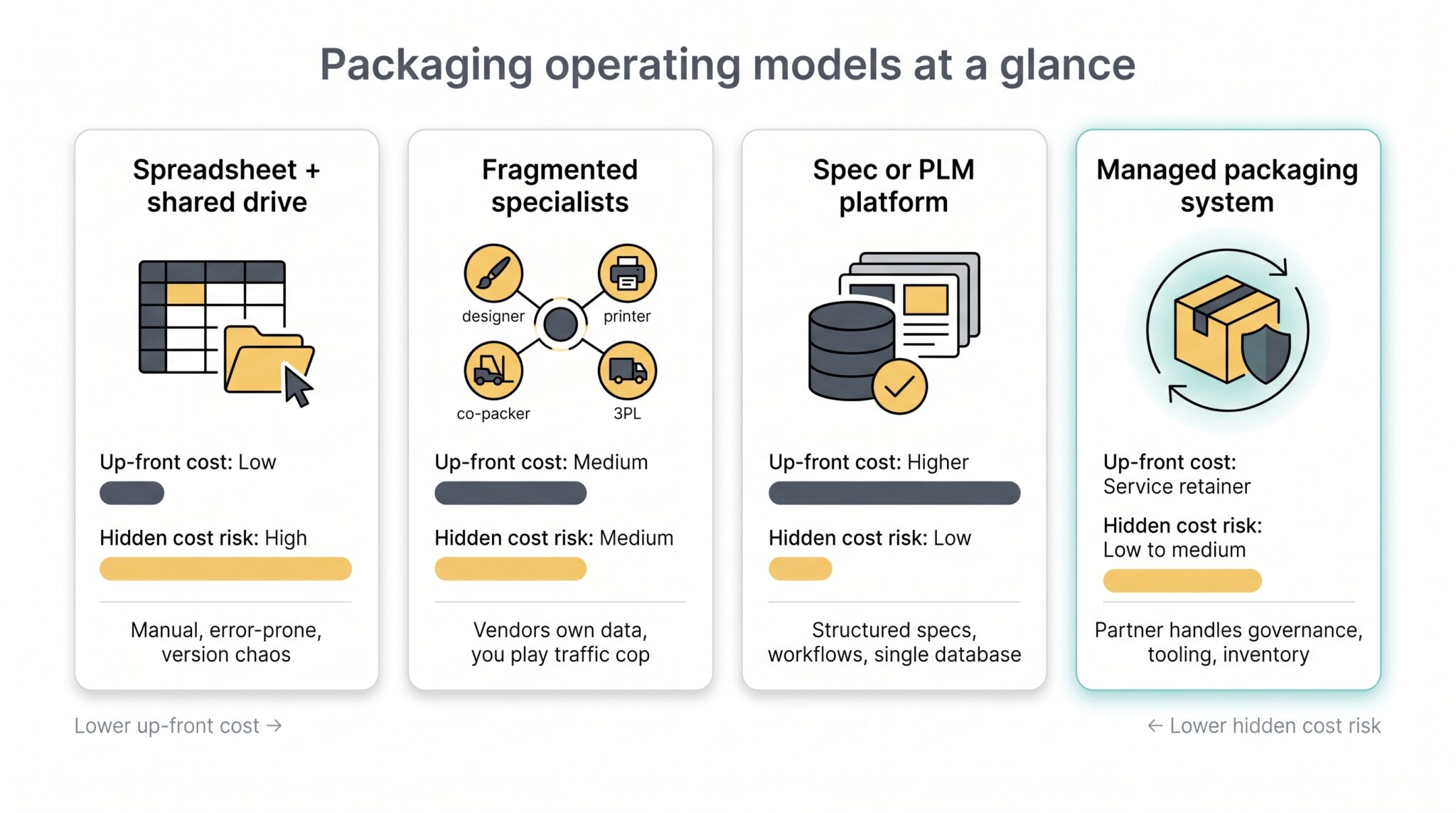
Choose a structured model before volume spikes. This guide compares four lanes you can drive in:
- Spreadsheet + shared drive – lowest software cost, highest manual risk
- Fragmented specialists – every vendor owns a slice; you play traffic cop
- Specification or PLM platform – one database for data, artwork, and approvals
- Managed packaging system – a partner owns governance and supply while you focus on launches. Zenpack’s managed packaging system consolidates dielines, Pantone targets, and factory specs into a master specification library; client T3 Micro says the switch cut its packaging costs by 20 percent.
Lock the right lane now. Decide before seasonal packs, Amazon tests, or bilingual labels pile up, and you’ll spend less on reprints than on the software license you thought you were saving.
Zenpack’s packaging-system page
Four models at a glance
| Model | Typical adoption | Up-front cost | Hidden cost risk | Best when… |
| 1. Spreadsheet + shared drive | Still used by 67.4 percent of supply-chain managers as a management tool, according to Zippia | License-free | High: version errors, manual approvals, midnight press calls | Fewer than 20 SKUs, few launches |
| 2. Fragmented specialists | Designer, printer, co-packer, 3PL all separate | Moderate | Medium: you become the traffic cop | You want vendor flexibility but have strong in-house project management |
| 3. Spec or PLM platform | Growing segment of the USD 242.8 million spec-management market, reports Future Market Insights | Subscription + data clean-up | Low: relational BOMs flag ripple effects | 20–500 SKUs with frequent changes |
| 4. Managed packaging system | Emerging option, often bundled with sourcing | Service retainer | Low to medium (scope dependent) | You’d rather outsource data governance, tooling, and inventory — see Zenpack’s managed packaging system for an example |
Pick a lane before complexity snowballs. Switching later means migrating every artwork file, BOM, and approval history while launches keep rolling; it’s a remodel nobody wants during peak season.
3. Build your packaging architecture before finalizing SKU-level specs
A solid architecture keeps you from redesigning every new SKU in a vacuum. Follow three disciplined steps.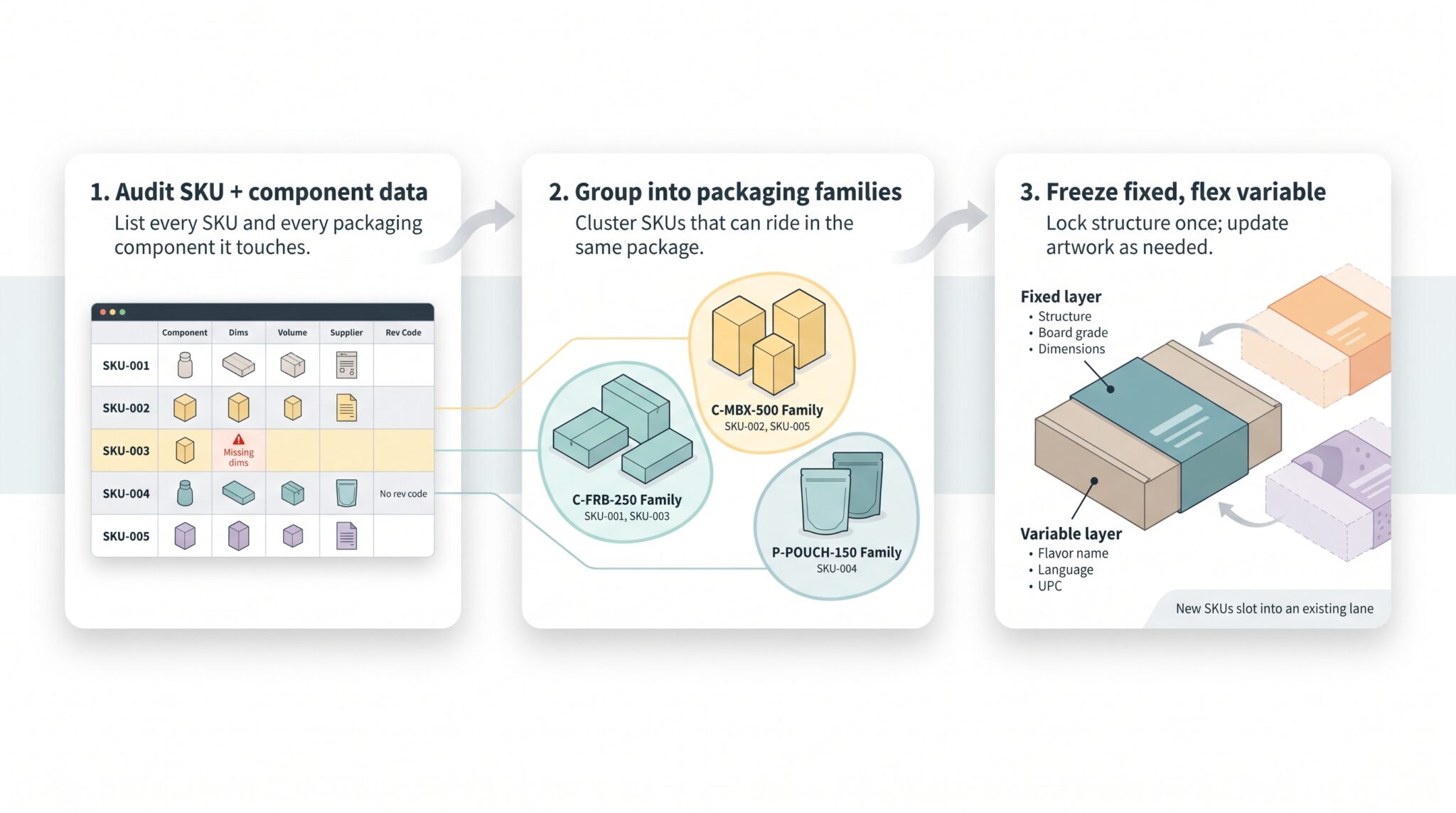
3.1 Start with a packaging portfolio audit
Begin with a line-item list of every active or planned SKU and every component it touches — carton, insert, film, sleeve, label, master case. In packaging-cost reviews for CPG brands, component reduction is a major driver of savings. SC Johnson reduced Windex packaging size by 70 percent by redesigning the trigger spray fitment, notes Packworld.
Capture hard facts for each component:
- Footprint (L × W × H) and weight
- Annual and peak volumes
- Destination markets and channels
- Current supplier and tooling ownership
- Recorded damage or pick errors
Flag fuzzy numbers and circle back. One wrong dimension can invalidate an ISTA drop test.
As the sheet fills, waste patterns jump out: one dieline printed six ways, two fragrances sharing a bottle yet riding in different master cases, or a seasonal flavour storing 12 months of corrugated inventory just to meet an MOQ. Those visuals turn skeptics into standardisation champions.
The audit also surfaces compliance gaps: artwork files with no revision code, bilingual labels shipped to a single-language market, or haz-mat flags missing from Amazon listings. Finding these on a screen is cheaper than having Walmart discover them at its inbound dock.
Do this rigorously and every architecture decision that follows rests on real data, not tribal memory.
3.2 Group products into packaging families
Group SKUs that can ride in the same physical package with zero compromise. Start with physics: if two products share length × width × height and a similar weight range, they usually tolerate one carton footprint. Then layer in fragility and barrier needs — glass jars and foil pouches may match on size but diverge on drop-test and moisture requirements.
Channel and copy come next. A pouch that ships flat DTC can share a master case with its siblings, but the club-store version riding a pallet display belongs elsewhere. If only the EU SKU needs 14-point French safety text, park it in its own family.
Label each family with a short code — “C-FRB-250” for corrugated, fragile, up to 250 g — and print that code on every spec and PO so converters and 3PLs know the rules at a glance.
The payoff is real. Hershey cut its outer-carton count from 900 to 72 after family grouping, reducing corrugated use by 32 percent and speeding shelf set-up time by 62 percent, according to Packworld. One family template plus SKU-specific artwork swaps plates, not cutting dies, and those savings repeat every run.
3.3 Separate fixed and variable layers
Lock the backbone, flex the face. Treat board grade, critical dimensions, closure, and drop-test rating as fixed. One approval covers every SKU that rides those rails. Then keep flavour names, colours, languages, UPCs, and promo badges in an artwork layer you can swap without touching tooling.
Real-world numbers back this up. Brands that move seasonal graphics to sleeves or labels cut waste; for example, digital printing for short-run packaging lets brands order to demand, eliminating the risk of obsolete inventory, reports ePac Flexibles. Printers gang-run sleeves across SKUs, easing MOQs while marketing still gets a fresh look.
A quick test:
- Yes: keep it variable.
- No: freeze it in the fixed spec.
The result is a corrugated mailer that stays unchanged for 18 months while a low-cost sleeve rotates quarterly — marketing cheers, ops pools inventory, finance stops writing off cartons.
Get these three steps right and every new SKU slots into an existing lane — no last-minute dieline panic, no surprise MOQs, and no mystery “final_v7” files.
4. What belongs on one packaging spec sheet per SKU
A complete spec has ten building blocks. Capturing each block in a single system cuts lead time and trims operating costs; one PLM rollout lowered expenses by about 20 percent and sped launches by the same margin, according to PTC.
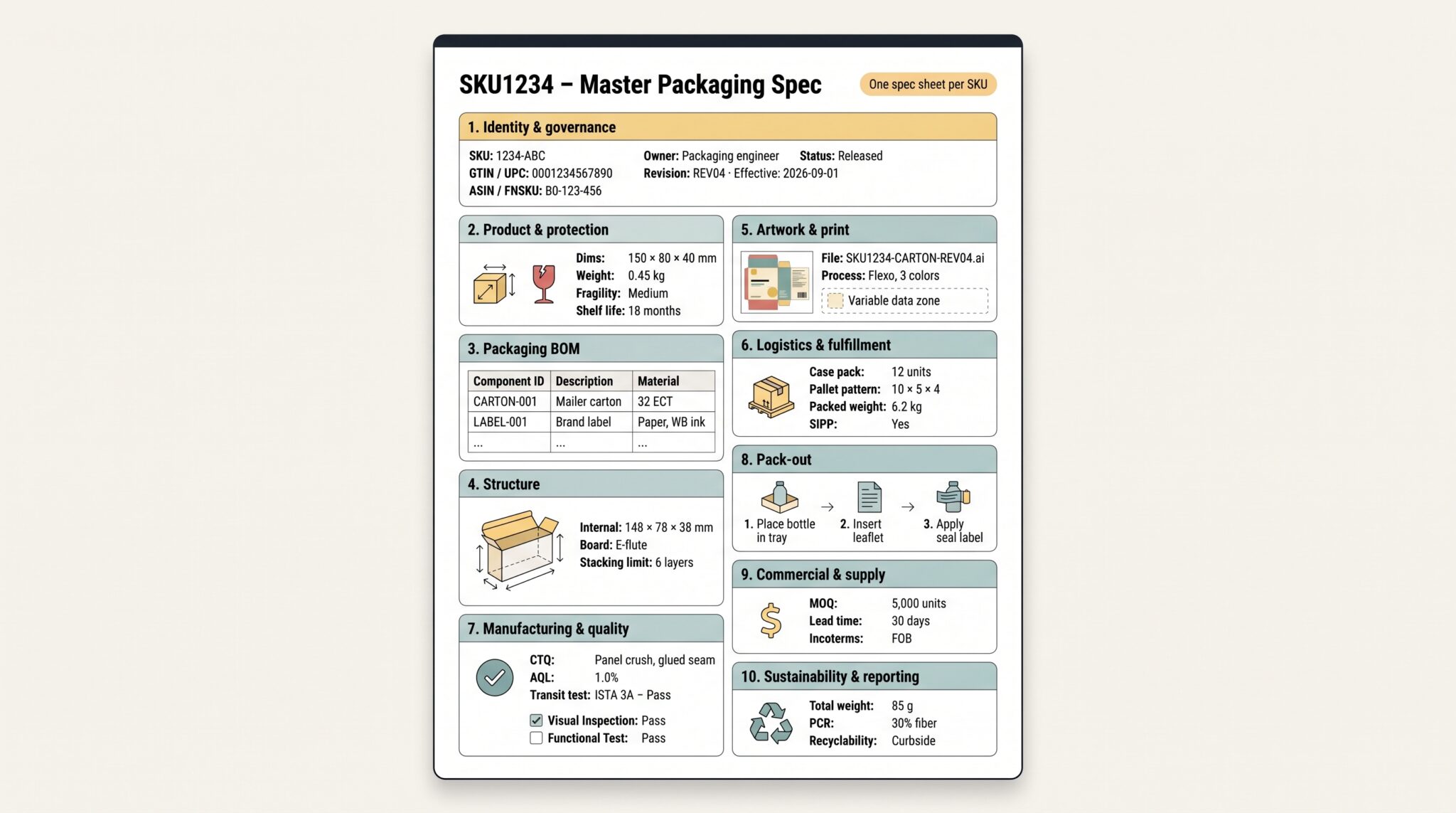
| Block | Key fields | Why it matters |
| 1. Identity & governance | SKU, GTIN/UPC, ASIN/FNSKU, owner, status, rev #, effective date | Anchors every ERP and WMS record; one owner stops the “final_v7” saga |
| 2. Product & protection | Dimensions, weight, fragility score, special sensitivities, shelf life | Drives board grade, barrier, and drop-test targets |
| 3. Packaging BOM | Component ID, description, material or grade, weight, approved alternates | Links cost, sustainability grams, and change ripple effects |
| 4. Structure | Internal and external dims, tolerances, flute or board, closure, stacking limit | Sets tooling and freight cube |
| 5. Artwork & print | Artwork file plus rev, print process, color specs, variable-data zones | Prevents color disputes and barcode mis-reads |
| 6. Logistics & fulfillment | Packed dims or weight, case pack, pallet pattern, SIPP flag | Feeds rate shopping and 3PL cartonization |
| 7. Manufacturing & quality | CTQ dims, AQL plan, transit tests, defect library | Moves QC from “looks good” to pass or fail |
| 8. Pack-out | Step-by-step assembly, orientation, weight check, substitution rules | Stops mis-picks and returns |
| 9. Commercial & supply | MOQ, price breaks, lead times, Incoterms, safety-stock rule | Gives finance and planning real-time cost drivers |
| 10. Sustainability & reporting | Gram weight by material, PCR %, recyclability certs, EPR owner | Automates Canada, EU, and state filings |
Start with a minimum viable spec (blocks 1–4 and 8) if you manage fewer than 20 SKUs. Add the rest as channels, regulations, and audit risk grow.
Download the editable checklist to copy these fields into Excel or your PLM (link).
Record the data once and that PDF turns into a living contract your designers, suppliers, and auditors can all trust.
5. Governance: keep 50 specs from becoming 50 conflicting files
Good files have owners, versions, and guardrails. Bad files pile up when ownership is fuzzy. Use five governance levers:
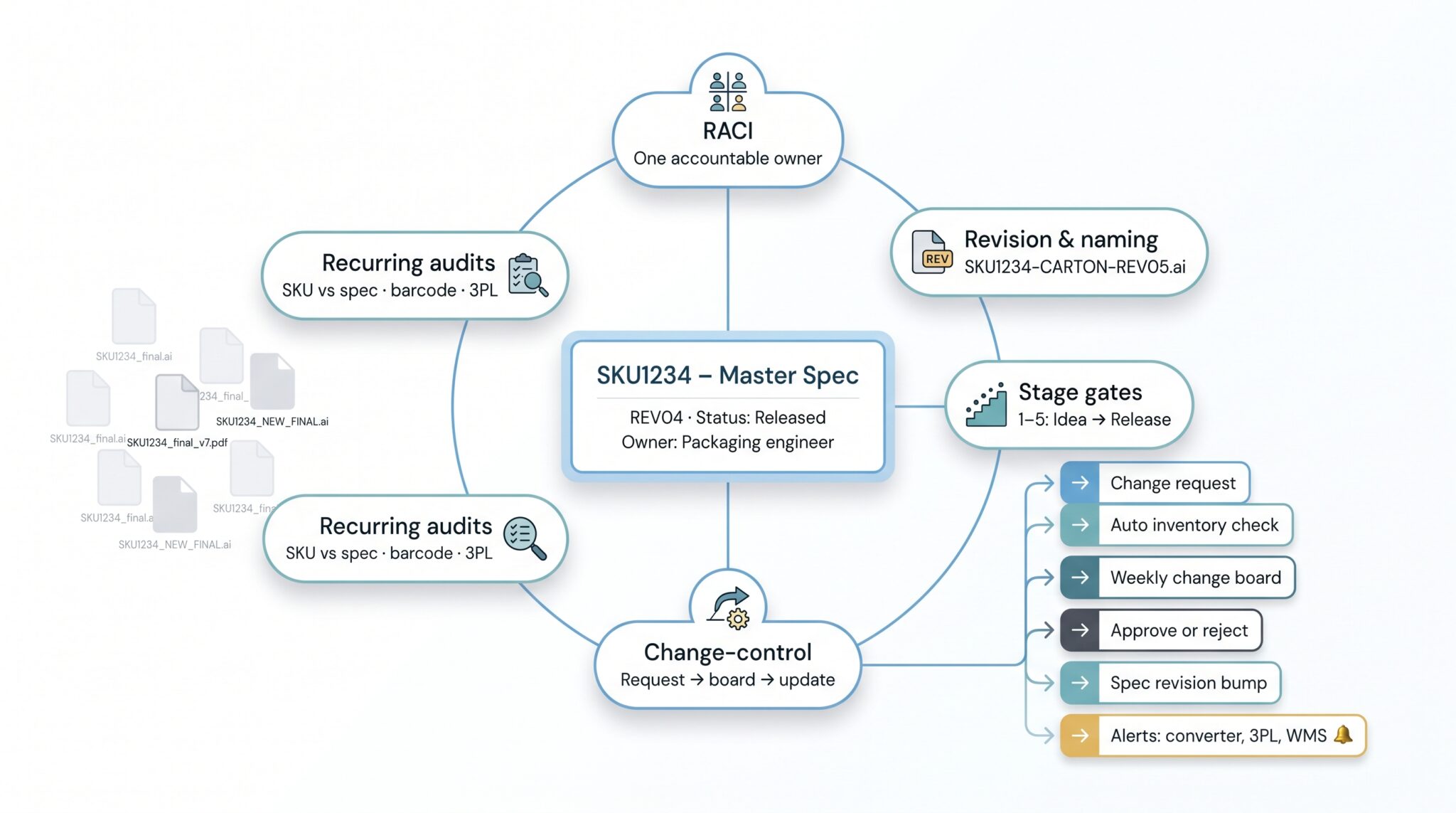
| Lever | What to document | Why it matters |
| RACI | Responsible (doer) · Accountable (single sign-off) · Consulted · Informed | Clear ownership shortens approval loops. Brands that add PLM workflows often cut handoff delays by about 30 percent, according to Siemens. |
| Revision & naming | SKU1234-CARTON-REV04.ai — no dates or initials | Prevents “final_final” chaos. Inline AI print inspection can push accuracy above 99 percent, Ifactory AI reports. |
| Stage gates | 1-Business case → 2-Structure → 3-Artwork/Reg → 4-Samples → 5-Release | Catches bad assumptions early; every late change costs around 10× more than an early one, according to Gartner. |
| Change-control workflow | Online form → weekly board → approved spec bump → auto-alerts | Live inventory check stops mid-cycle tweaks that would scrap stock. |
| Recurring audits | SKU vs spec (quarterly) · Barcode scan (semi-annual) · Supplier spec (annual) · 3PL pack-out (peak season) | Retailer chargebacks often eat 1–5 percent of gross invoice value when compliance slips, notes 3PL Center. |
5.1 RACI in one line
Place one name only in the Accountable box; shared accountability equals none.
5.2 Revision logic
Increment whole integers only after approval. “REV05” follows “REV04” — skip letters like “b” or tags such as “final.”
5.3 Stage-gate checklist
- Business value confirmed
- Structure frozen
- Copy and artwork approved
- Samples and SIPP tests passed
- Spec released; prior rev archived
5.4 Change-control flow (30-second view)
Requester → auto inventory pull → weekly board → approve or reject → spec update → downstream alerts to converter, 3PL, and rate shopper.
5.5 Audit rhythm
Put audits on the calendar. Miss one and the next recall may cost six figures instead of an afternoon fix.
Governance can feel bureaucratic until it saves the first $50 000 reprint; then it feels cheap.
6. Compare packaging strategies using total cost, not unit price
6.1 Build a total-cost model
| Cost bucket | Typical share of landed cost | Spec field |
| Direct material | 40–60 % | Packaging BOM |
| Tooling and setup | 5–15 % | Artwork history |
| Freight and duty | 8–20 % | Logistics block |
| Storage and carrying | 18–25 %¹ | Inventory policy |
| Application labor | 5–10 % | Pack-out steps |
| Damage or returns | 1–5 % | Quality block |
| Obsolete stock | 2–8 % | Change-control log |
¹ Range from McKinsey supply-chain benchmarks
6.2 Four strategies, side by side
| Strategy | Best for | Unit-cost rank | Obsolescence risk | Notes |
| Fully printed package | Hero SKUs | ★ | High | Lowest per unit, biggest write-off if art changes |
| Shared structure + unique print | Mid-volume | ★★ | Medium | One die, many plates |
| Common pack + label or sleeve | Long tail and seasonal | ★★★ | Low | Higher labor, lower tooling |
| Digital short-run or hybrid | Tests and regulated copy | ★★★★ | Very low | Higher unit cost, zero plates until velocity proves out |
6.3 Segment by velocity and risk
- Hero (steady ≥ 100 k units/yr): invest in stronger board and dual sourcing
- Mid-volume (25–100 k): share tooling, keep unique print
- Long tail (< 25 k): pooled base pack plus digital label
- Seasonal or promo: sleeves or digital print; plan the exit date
- Regulated or high risk: quick-change label field and extra QA budget
6.4 Model each SKU
Track volume per artwork, order frequency, forecast error, safe shelf life, and discontinuation odds. Plug the numbers into a mini P&L. Two SKUs in one carton can post opposite margins if run lengths diverge.
6.5 Cost per successful delivered order
Material
+ Pick/pack
+ Dimensional freight
+ (Damage rate × refund cost)
+ (Return rate × handling cost)
= True cost
Stress-test the model with plus-15 % fuel and plus-12 % resin. The cheapest board today can become tomorrow’s pricey outlier after a surcharge.
When every bucket rolls into dollars per delivered order, teams stop chasing five-cent board savings and start guarding real margin.
7. Plan separate packaging configurations for DTC, Amazon, Walmart, and retail
7.1 One-page channel matrix
| Field | DTC parcel | Amazon FBA | Walmart DC | Brick-and-mortar |
| Ship-ready? | Yes | Only if SIPP-certified | Master case only | Shelf-ready |
| Key labels | Carrier, returns | FNSKU, SIPP stamp | UCC-128 on short side | GTIN on unit and case |
| Drop test | ISTA 3A | ISTA 6A SIPP | ISTA 1A | Retailer-specific |
| Pallet rules | Standard 1.2 m (48 in) | 1.8 m (71 in) max | 1.2 m, four-way | Varies by buyer |
| Chargeback | Damage or late | Missing barcode = inbound defect fees and delays¹ | Missed label = SQEP fees per case or pallet² | Shelf damage fees |
¹ Amazon FBA inbound defect policies, 2026.
² Walmart Supplier Quality Excellence Program (SQEP) guidelines.
7.2 Map identifiers once
Internal SKU ─┬─ GTIN / UPC
├─ ASIN → FNSKU (Amazon)
└─ Walmart Item #
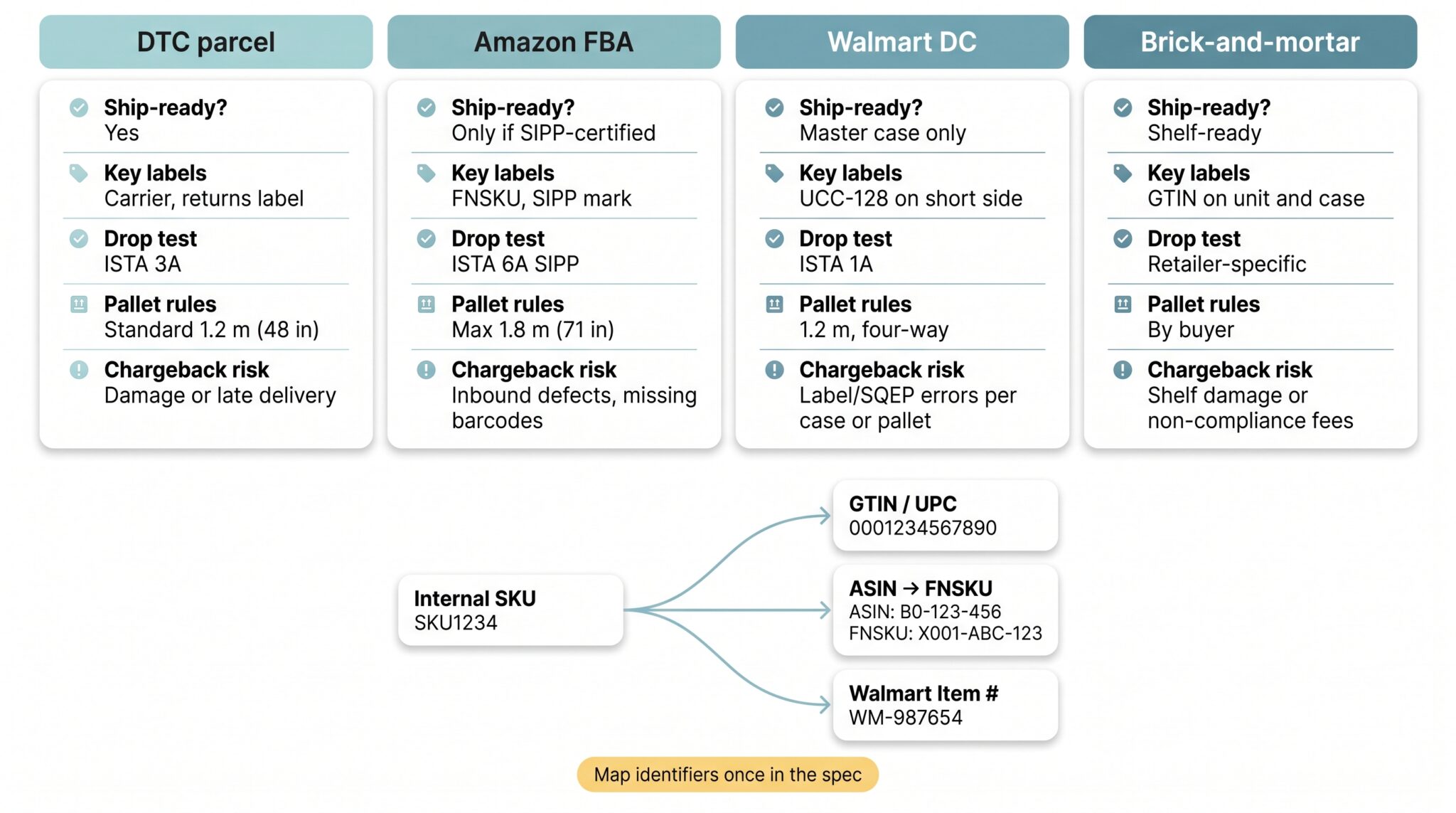
Store every ID in the channel block so the WMS prints the right barcode automatically.
7.3 Amazon-only fields
- SIPP family ID, test date, lab link
- Product-family grouping for fees
- Rigid or flexible category code
- Tamper-evident seal diagram
- Next Seller Central verification date
7.4 Walmart and retail extras
- Master-case board grade; add double-wall if weight > 50 lb
- Case-label X/Y offsets (mm) for automated scanners
- Perforation spec for shelf-ready trays
- Approved pallet pattern (1.2 m tall, four-way)
- Neutral-packaging flag for MCF orders
7.5 Bundles, kits, multipacks
- Assign a new sellable SKU and spec that references child components.
- Document assembly steps with photos.
- Apply a bundle barcode plus “Not for individual sale” copy.
- Define return rules (rework or scrap).
- Record final dimensional weight to avoid surprise parcel tiers.
Building these channel blocks into each configuration keeps compliance scorecards green and lets the 3PL ship the right box every time.
8. Build regulatory and sustainability changes into the specification system
8.1 Component-level material ledger
| Field | Example value | Why it matters |
| Weight (g) | 12.4 | Canada’s Federal Plastics Registry will require mass data by component starting September 29 2025 |
| Material breakdown | 1.6 g PCR fiber, 0.4 g water-based ink | EU PPWR Article 10 calls for “minimum necessary” weight proof |
| Market of sale | Ontario, CA; California, US | One carton can trigger two reporting regimes |
| Evidence file and expiry | Supplier PCR certificate (expires Mar 2027) | Auto reminders prevent lapsed claims |
8.2 Pair every environmental claim with proof
| On-pack claim | Evidence on file | Review date |
| “30 % PCR” | Converter statement plus ASTM D7209 lab test | 2027-05-31 |
| “Home-compostable in 180 days” | EN 13432 report | 2026-11-15 |
If a certificate lapses, the claim turns yellow in the database. No surprise reprint.
8.3 Jurisdiction matrix inside the spec platform
Build one grid: markets across the top, requirement categories down the side. Color-code cells (green = compliant, amber = pending, red = gap) and link each red cell to its clause owner. When you add a new market row, updates ripple only to affected SKUs. No portfolio-wide fire drill.
8.4 Design for painless updates
- Controlled copy zones – reg text sits in an expandable white panel
- Modular labels or sleeves – update claims in days, not weeks
- Planned change windows – batch regulatory and seasonal art twice a year; converters gang plates while warehouses drain old stock
- Common dieline family – swap substrates to meet new EPR targets without new tooling
Redesigning packaging to remove unnecessary parts cuts waste fast. Fisher-Price, for example, right-sized a box, removed 18 components, and trimmed cube by 88 percent, Packworld notes.
8.5 Keep legal review explicit
Disclaimer: This specification offers operational guidance. The brand is still responsible for legal advice on regulatory interpretation.
Flag “Legal review required” when a change adds a health claim, alters identity, or touches restricted substances. One line now can save weeks of blame-shifting later.
9. Protect the portfolio against material, supplier, and freight disruption
9.1 Approve alternates before the crisis
| Field to capture | Example | Standard / evidence |
| Form-fit-function limits | Flute strength ±10 % | TAPPI T 823 compression test |
| Color delta | ≤ 1.0 ΔE | ISO 12647-2 |
| Film gauge | ±5 µm | ASTM D 882 |
| Validation file | ISTA 6A pass report, Oct 2026 | Linked PDF |
| Trigger authority | Lead-time > 8 weeks | Auto-email to packaging engineer |
When a lead-time breach hits the spec threshold, the engineer flips to the prequalified alternate. No emergency change board, no production stop.
9.2 Choose single vs dual source on purpose
| SKU tier | Volume | Recommended stance | Typical premium | Rationale |
| Hero (≥ 100 k units/yr) | High | Dual source | +3–5 % unit cost | One disruption can cost more than the premium. McKinsey notes that supply-chain shocks have wiped out more than 40 percent of a year’s profits over a decade. |
| Workhorse (25–100 k) | Medium | Single plant, dual substrate | +0–2 % | Cheaper than duplicating tooling; a substrate swap keeps the line running. |
| Long tail or seasonal (< 25 k) | Low | Single source | 0 % | The cost to qualify a backup exceeds revenue at risk. |
Log each choice in the spec with a review date (for example, an annual hero-SKU risk audit). Finance sees the premium, supply chain sees the plan, and risk management models real exposure instead of guessing.
Approved alternates plus purposeful sourcing mean a typhoon on the resin coast sends a prewritten email, not a six-figure stock-out.
Conclusion
Packaging complexity accelerates after about 50 SKUs, but a disciplined spec system, strong governance, and channel-specific configurations keep new variants profitable. Lock the architecture early, pick the right operating model, and treat the spec sheet as the single source of truth to turn growth into gain instead of chaos.