Executive-search fees keep climbing. The top 50 firms in the Americas pulled in $6.69 billion in 2025, an 11 percent year-over-year jump (Hunt Scanlon). At the same time AI has swallowed the funding market, taking roughly 86 cents of every U.S. venture dollar in the first half of 2026, which shrinks the pool of seasoned operators you can hire and raises what they cost. In this guide, we rank the nine best executive recruiters for startup C-suites and show how one contract clause can erase the “replacement guarantee” you thought you had – before you wire a five-figure retainer.
How we ranked the nine firms
We scored every contender with a three-step gate and eight weighted factors so founders can see, in plain numbers, why each firm made the list.
Step 1 – Eligibility gate
A firm had to prove (1) clear startup focus, (2) documented C-suite placements, and (3) an active practice that reaches CEO-minus-one roles. Miss even one, and the firm was out.
Step 2 – Eight weighted factors (100-point scale)
- Startup specialization – 25 points
- Public proof of executive results – 15 points
- Functional breadth or exceptional depth – 15 points
- Passive-candidate reach and geography – 10 points
- Partner involvement and process speed – 10 points
- Fee transparency (base, milestones, expenses) – 10 points
- Guarantee clarity and client protection – 10 points
- DEI, data, and technology differentiation – 5 points
Step 3 – Practical tiebreaker
If two firms landed on the same score, we asked which one fixes a more common pain for U.S. startups right now. That simple question kept the ranking useful.
The result is a ranked lineup of the top executive recruiters for C-level startup roles based on evidence, not sponsorships. Next, a quick comparison table.
Quick comparison table
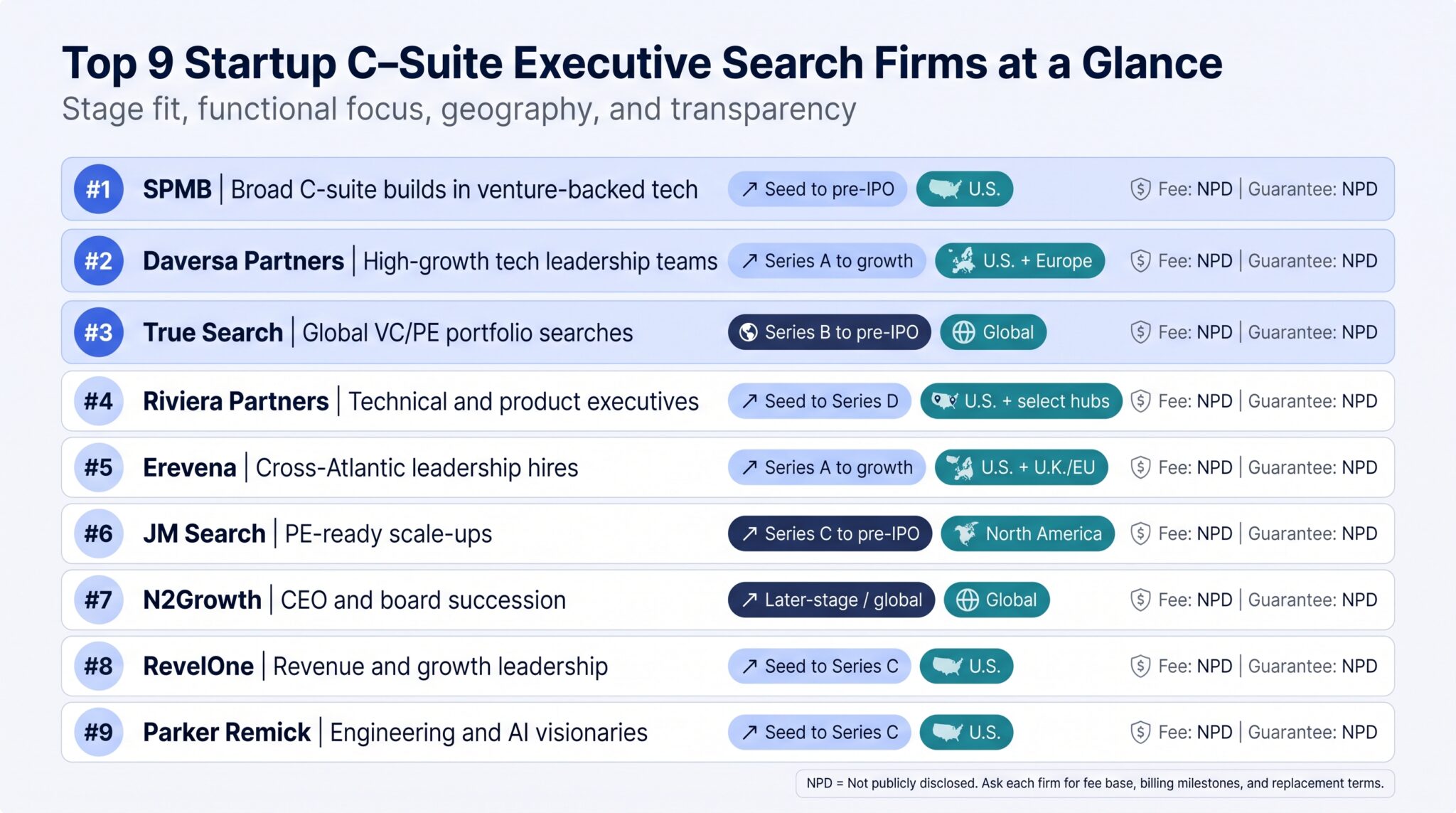
Here is the gist in 90 seconds: the grid below compares the top executive recruiters for startup C-level roles by stage fit, functional depth, and fee or guarantee transparency.
| Rank | Firm | Best for | Typical stage | Core functions | Geography | Fee visibility | Guarantee visibility |
| 1 | SPMB | Broad C-suite builds in venture-backed tech | Seed to pre-IPO | CEO, product, engineering, GTM, finance | U.S. | NPD | NPD |
| 2 | Daversa Partners | High-growth tech leadership teams | Series A to growth | Full C-suite | U.S. + Europe | NPD | NPD |
| 3 | True Search | Global VC/PE portfolio searches | Series B to pre-IPO | Full C-suite | Global | NPD | NPD |
| 4 | Riviera Partners | Technical and product executives | Seed to Series D | CTO, CPO, VP Eng, data, design | U.S. + select hubs | NPD | NPD |
| 5 | Erevena | European and Nordic leadership hires for U.S.-facing scale-ups | Series A to growth | Tech, fintech, digital | U.K./EU + Gulf | NPD | NPD |
| 6 | JM Search | PE-ready scale-ups | Series C to pre-IPO | CEO, CFO, CHRO, CPO | North America | NPD | NPD |
| 7 | N2Growth | CEO and board succession | Later-stage or global mandates | CEO, board, transformation | Global | NPD | NPD |
| 8 | RevelOne | Revenue and growth leadership | Seed to Series C | CMO, CRO, VP Sales | U.S. | NPD | NPD |
| 9 | Parker Remick | Engineering and AI visionaries | Seed to Series C | CTO, CPO, AI leaders | U.S. | NPD | NPD |
Key: NPD means not publicly disclosed. Ask each firm for its fee base, billing milestones, and replacement language before you commit.
Next, learn why a “replacement guarantee” can vanish the moment your org chart shifts.
The slippery truth about “replacement guarantees”
That comforting “six-month guarantee” in your engagement letter can vanish once real-world chaos hits. Legal templates from NPAworldwide and marketplace terms like Dover’s list pages of carve-outs that let a search firm keep the retainer.
Founders run into five common loopholes:
- Late or partial payment: even a three-day slip can void coverage.
- “Material” changes to title, location, or compensation: vague wording the firm defines after the fact.
- Layoffs, M&A deals, or restructures: any corporate shake-up shifts risk back to you.
- Tight notice windows: some contracts demand written notice within five business days.
- Hiring another recruiter: calling a second firm before the original partner finishes a redo cancels the guarantee.
Quick answer: the guarantee disappears if you pay late, change the role, restructure, miss the notice window, or bring in another search firm.
The profiles that follow flag these blind spots so you can mark them up before any cash leaves your account.
1. SPMB
SPMB has completed thousands of executive search assignments since 1978, recruiting C-level executives and board members for everything from venture-backed startups to publicly traded technology companies. A typical retained search closes in 60 to 120 days, a pace that meets board deadlines while leaving room for deep referencing and passive-candidate outreach.

Why founders like it: partners stay hands-on after the pitch, and SPMB’s internal market taxonomy often produces a calibrated shortlist before your hiring committee finalizes interview questions. Its founder’s guide argues that who are the top executive recruiters for C-level roles share three essentials – functional specialization, a growth-stage track record, and partner-led execution – benchmarks that map closely to our own scoring model.
What to watch: the commercial terms sit behind NDAs. Ask for (1) fee base, billing milestones, and reimbursables; (2) the exact replacement-guarantee window; and (3) a written definition of “material change” that might void coverage.
If you need an operator who can scale today’s product roadmap and draft tomorrow’s S-1, SPMB ranks among the top executive recruiters for C-level startup roles, but only once the paperwork is clear.
2. Daversa Partners
Founded in 1993, Daversa Partners sits at the centre of venture and growth-stage tech, hunting operators who have already scaled a company through the stage you are entering rather than ones who have read about it. Paul Daversa still runs the firm, and the pitch is access: the partners live inside the venture network and reach people who are not looking.
Speed is the selling point clients talk about. If a Series B board needs a CFO before the term sheet closes, Daversa is built for that clock. Ask them to commit to a first-slate date in writing, because the firm publishes no timeline commitments of its own.
Paperwork is the weak spot. Fee base, billing milestones, and guarantee clauses stay private. Ask for the same rigour they apply to talent: the exact percentage on each comp element, payment triggers, and a written definition of what voids a replacement.
Investors often place Daversa in the top executive recruiters for C-level startup roles; speed and network earn the praise once your terms are locked in writing.
3. True Search
Founded in March 2012, True Search has expanded to 20 offices and roughly 800 team members across North America, EMEA, and APAC, backed by an investment partnership with Integrum. The firm layers data, AI, and sector expertise onto a classic retained-search model.
True operates as a platform, not a single practice. Dedicated teams cover CEO succession, finance, product, people, and climate tech, while an in-house research unit tracks emerging talent clusters so your long list already aligns with tomorrow’s Series C valuations.
Cross-border consistency is the main selling point. A U.S. fintech hiring a London-based CRO or a German AI scale-up looking for a Bay Area CTO taps the same global database and the same standardized assessment stack, so slates from three continents can be compared side by side. True does not publish client satisfaction scores, so ask for two references at your stage rather than taking a rating on trust.
Caveat: outcomes still hinge on the partner who leads the search. Confirm ownership of weekly updates, and lock fee percentage, billing triggers, and guarantee language before the first invoice lands. True keeps those terms private, like most top executive recruiters for C-level startup roles.
If your cap table spans continents or you need an executive who can handle multiple regulatory regimes, True brings a deep team and disciplined process that close the gap once the paperwork is clear.
4. Riviera Partners
Riviera Partners runs technical leadership searches only: product management, software engineering, IT, AI/ML and data, security, and design. Founded in 2001, it now runs more than 120 team members and has placed talent in over 25 countries, and it ranks 16th on Hunt Scanlon’s 2026 Americas Top 50, by far the highest placing of any firm that does technology exclusively.
Focus is the whole proposition. Riviera describes itself as the largest tech-focused executive search firm and runs its searches through SutroX, its own machine-learning matching layer. That volume gives founders current compensation data and close-rate benchmarks most boutiques lack. It does not publish shortlist timelines or placement success rates, so pin both in the engagement letter rather than the pitch.
Trade-offs remain. If you also need a CFO or CHRO this quarter, you will pair Riviera with a broader firm. Like many top executive recruiters for C-level startup roles, Riviera keeps fee percentages and guarantee clauses private. Before signing, confirm whether shifting from a pure CTO brief to a combined CPTO counts as a “material change” that voids a replacement.
Used in its sweet spot, Riviera acts as a precision tool for landing engineering and product leaders who set the roadmap rather than just keep servers running.
5. Erevena
Headquartered in London since the early 2000s, Erevena runs from six offices across Europe and the Gulf: London, Paris, Stockholm, Copenhagen, Oslo and Dubai. That Nordic and continental density is the point. A U.S. startup standing up an engineering hub in Stockholm or Oslo, or a European scale-up hiring ahead of a U.S. revenue push, gets one firm, one fee model, and a network that actually lives in those markets rather than flying in.
Sector sweet spots include software, fintech, and digital marketplaces. Recent searches span Chief Product Officers for B2B-SaaS scale-ups and CEOs for fintech challengers entering the United States, according to the firm’s public case studies. Founders value Erevena’s skill at translating culture fit; for example, why Dutch pay philosophy may clash with a Slack-first California startup.
Data gaps remain. Erevena does not publish fee percentages, completion rates, or replacement-guarantee clauses. Before you sign, confirm:
- Which legal entity issues the contract and which country’s employment law governs a redo.
- Whether moving the hire’s home base from London to New York voids a “material change” clause.
- Billing milestones tied to deliverables; some Erevena projects invoice only on agreed search-delivery stages.
With those terms in writing, Erevena becomes a single point of accountability for European and Gulf leadership hunts and earns a place among the top executive recruiters for startup C-level roles when the talent sits outside the United States.
6. JM Search
Ranked 11th on Hunt Scanlon’s 2026 Top 50 Recruiters list and named a Fastest-Growing Private Company by Inc. 5000 for three consecutive years, JM Search is a solid choice when a growth-stage startup adopts private-equity discipline. The firm’s process centers on value-creation plans and operating metrics, not résumés, making it ideal when your Series C story shifts from ARR to EBITDA.
Broad functional coverage is the draw. Need a CFO who can tame covenant reporting, a CHRO fluent in option repricing, and a CRO with eight-figure SaaS wins? JM’s practice leaders staff the bench, and the pitch-meeting partner runs the weekly call, so you avoid the usual vanishing act.
Typical clients sit Series C and later, often with a growth-equity or buy-out term sheet in hand. Earlier-stage founders may find the KPI frameworks heavy, but if investors already use operating partners, the structure fits.
Commercial terms sit behind NDAs. Before signing, clarify:
- Cancellation fees if financing falls through
- Whether a post-close strategic pivot voids the guarantee
- Billing triggers tied to deliverables, not calendar dates
Lock those items, and JM Search stands out among the top executive recruiters for startup C-level roles, ready to help a scrappy scale-up mature into a disciplined, PE-ready company.
7. N2Growth
N2Growth began as a leadership-advisory boutique and still treats executive recruiting as one link in a broader “leadership supply chain.” The scope shows in the numbers: the firm has held a top-20 spot on Forbes’ America’s Best Executive Recruiting Firms list for ten consecutive years.
Why founders care: you gain big-company CEO transition tools such as psychometric assessments, 100-day onboarding plans, and board-evaluation workshops, without hiring three consultants. AI-assisted market mapping, diversity dashboards, and investor-friendly progress portals also shorten cycles and raise transparency.
Watchouts: breadth can outweigh startup focus. N2Growth’s client roster spans industrial, consumer, and government sectors, so ask for venture-backed references at your funding stage. Guarantee language varies by region because the firm operates through global affiliates; confirm which office owns liability and whether advisory hours count against the replacement clock.
Choose N2Growth when the mandate goes beyond “fill a seat.” If you need to realign strategy, board composition, and C-suite talent in one plan, few top executive recruiters for startup C-level roles offer the same range of tools once the paperwork is clear.
8. RevelOne
Founded by former marketing and growth leaders in 2015, RevelOne focuses solely on go-to-market roles such as CMO, CRO, VP Growth, and related posts. Because the partners have owned pipeline numbers themselves, early conversations start with board-level KPIs, not boilerplate job descriptions.
Process in brief: the team isolates the three KPIs that will define success, then sources candidates who have already moved those needles under similar burn constraints, which skips the “explain our funnel” orientation call. Ask for the first-slate date and slate size in writing; RevelOne publishes neither.
Depth is both strength and limit. If you also need a CFO or VP Engineering, you will still shop elsewhere. Yet when CAC efficiency, PLG monetization, or product-led growth loops keep you awake, few top executive recruiters for startup C-level roles run a tighter search.
Commercial terms vary. Confirm whether revenue-target shifts void the guarantee, and clarify that any embedded advisory hours do not erode replacement coverage before you wire the retainer.
9. Parker Remick
Founded in 1998, Parker Remick has completed more than 1,000 C-level and VP searches in engineering, product, and AI. Over 80 percent of current mandates involve AI or machine-learning leadership, and the firm placed its first AI leadership hire at Google in 2006, years before “transformers” became everyday talk.
The boutique stands out for disciplined execution. Partners lead the intake, hand-code target lists, and test finalists on architecture trade-offs, zero-to-one product strategy, and scale reliability. The boutique publishes its own numbers, which is rare at this size: a 24-day average to identify the placement, 8.8 out of 10 average client satisfaction over the last twelve months, and 90 percent of placements retained beyond one year. One client describes the experience as “refreshing to work with a firm that reflected the urgency and importance of this role.”
Breadth is limited; you will not find a roster of CFO or people-ops candidates here. That focus brings faster calibration and fewer mismatched introductions when you need a CTO who can ship code, recruit elite engineers, and manage a heated AI salary market.
Commercial terms stay under NDA. Before wiring a retainer, specify whether a pivot from pure software to integrated hardware, or a funding-driven AI roadmap shift, voids the guarantee. With clear terms, Parker Remick earns its place among the top executive recruiters for C-level startup roles in deep tech.
Honorable mentions by use case
Need a focused option outside our top nine? Match the firm to the mandate:
- The Up Group – London-based digital specialist. Use when a U.K. scale-up needs its first U.S. CEO, or a Bay Area SaaS player wants a GM for EMEA.
- Cowen Partners – Markets sub-six-week C-suite searches; handy when speed outranks breadth.
- Hunt Club – Referral-network model; ideal if warm intros beat cold outbound for senior product or design hires.
- Hirewell – Embedded executive recruiters who plug into your ATS and Slack, great for venture studios or multi-hire bursts.
- The Good Search – Research-heavy boutique for “needle in a haystack” tech roles.
- Westwood & Wilshire – Biotech and health-tech C-suites, with deep VC ties in Boston and San Diego.
- Ember Search – Finance-first boutique focusing on startup CFO and VP Finance roles.
- Rados Recruiting – European biotech leadership for Series A–C therapeutics firms eyeing U.S. expansion.
- SHREK majors (Spencer Stuart, Heidrick, Russell Reynolds, Egon Zehnder, Korn Ferry) – Call when global brand recognition, board succession, or public-company readiness outweigh pure startup DNA.
These firms missed our scoring gate, usually on transparency or stage fit, yet they still outperform generalists in their niches. Choose the right match and save runway, search time, and board patience.
What voids the replacement guarantee
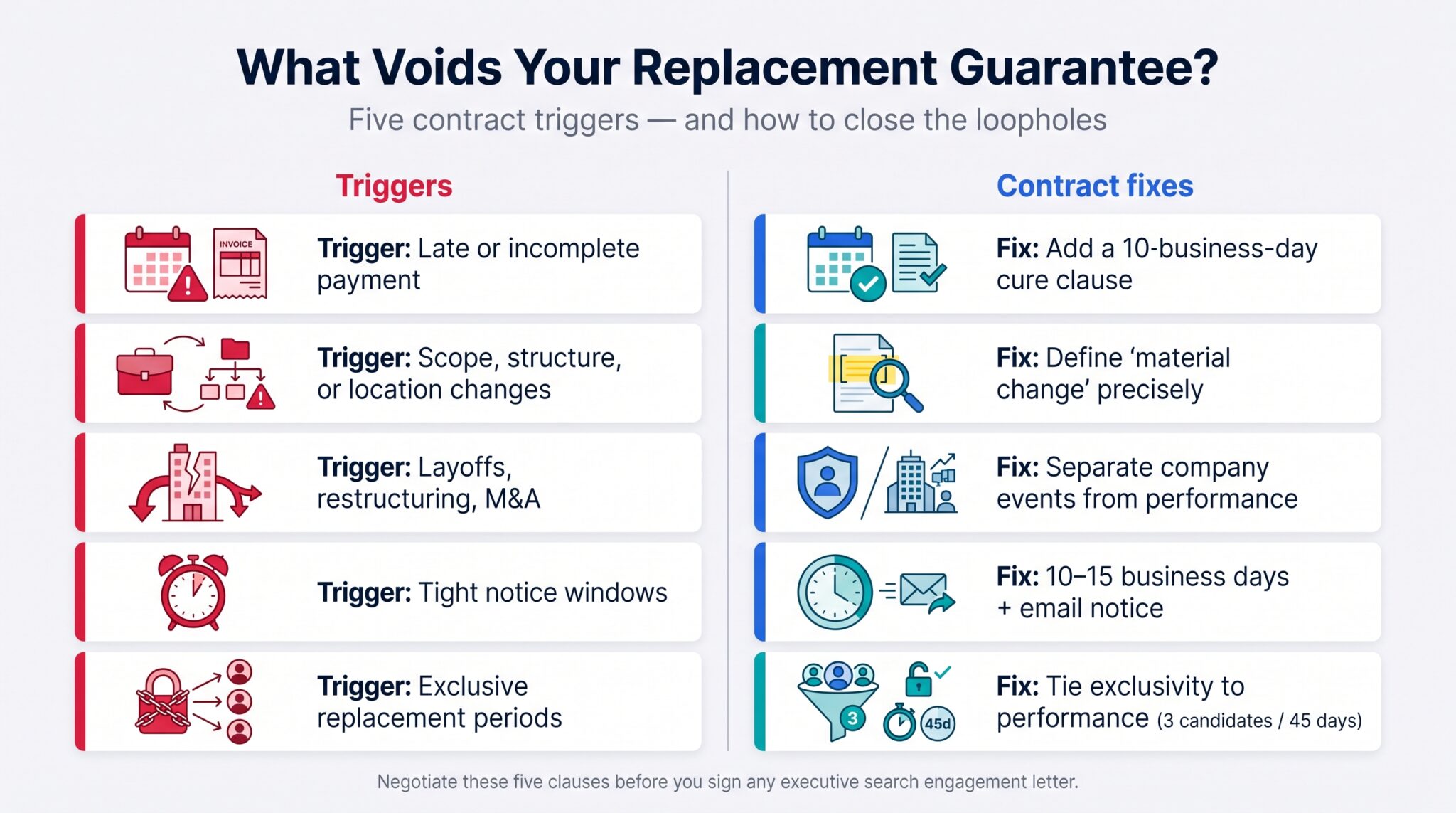
On paper a six-month guarantee looks solid. In the fine print, though, most retained-search contracts list carve-outs that cancel coverage. Dover’s standard terms, for example, exclude “layoffs, restructuring, mergers, acquisitions, or similar organizational changes,” and condition the guarantee on having “paid the original Success Fee in full and on time.” Close these gaps before you sign.
1. Late or incomplete payment
Miss an invoice deadline, even by a week, and coverage disappears. Add a cure clause: “Client has ten business days after written notice to cure any late payment before guarantee coverage is forfeited.”
2. Scope, structure, or location changes
Define “material change.” Example: “A material change means a reduction of more than 25 percent in budgeted team size, or a permanent relocation across time zones.” Everything else stays covered.
3. Layoffs, restructuring, mergers, and acquisitions
Separate company-wide events from the hire’s performance. If the role still exists, the guarantee should stand. As a fallback, negotiate a transferable retainer credit valid for 12 months.
4. Tight notice windows
Five-day notice is unrealistic in a crisis. Push for 10–15 business days and accept email notification, not certified mail.
5. Exclusive replacement periods
Tie exclusivity to performance: “Exclusivity expires if the firm fails to present three qualified candidates within 45 calendar days of notification.” Clarify that internal referrals do not breach the clause.
Seal these five holes and the guarantee shifts from marketing copy to real downside protection for your next C-suite hire.
Retained, contingency, or hybrid?
Founders weighing top executive recruiters for startup C-level roles usually face three billing models, and the right choice depends on urgency, confidentiality, and risk tolerance.
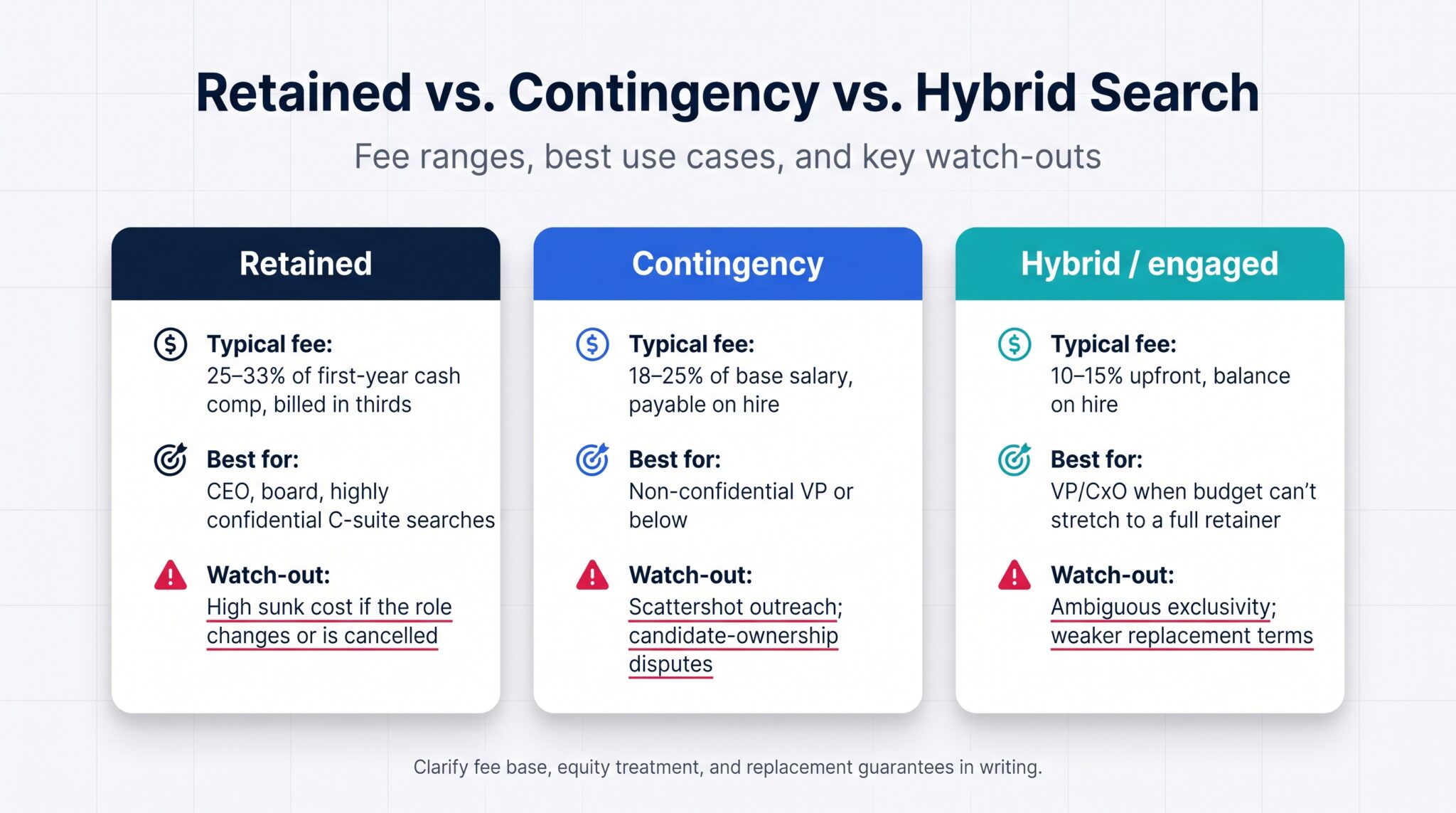
| Model | Typical fee | Best for | Watch-out |
| Retained | 25–33 percent of first-year cash comp, billed in thirds | CEO, board, highly confidential C-suite searches | High sunk cost if the role changes or is cancelled |
| Contingency | 18–25 percent of base salary, payable on hire | Non-confidential VP or below | Scattershot outreach; candidate-ownership disputes |
| Hybrid / engaged | 10–15 percent upfront, balance on hire | VP/CxO when budget cannot stretch to a full retainer | Ambiguous exclusivity; weaker replacement terms |
(Typical market ranges. No industry body publishes an audited fee survey, so treat these as negotiating context, not benchmarks.)
Key nuances founders overlook:
- Some retained firms peg fees to total compensation (salary, bonus, and equity); clarify the base.
- Hybrid agreements sometimes convert to monthly retainers after 90 days, so negotiate a cap.
- Contingency contracts may exclude equity from fee calculations but charge extra for sign-on bonuses.
- Replacement guarantees are strongest in retained deals; hybrids vary, and contingency offers usually none.
No model is automatically better. The safeguard is a written agreement that spells out scope, milestones, fee triggers, and guarantee language. If a recruiter avoids those basics, walk away, no matter the sticker price.
Fees and search time: what you can actually compare
Many blogs claim that executive recruiters charge 33 percent. In practice the band runs wider, roughly 25 to 33 percent of first-year cash compensation, and the sticker rate is only the start. Founders should benchmark four variables – fee base, billing milestones, reimbursables, and timeline commitments – when choosing among top executive recruiters for startup C-level roles.
- Fee base. Some firms charge on first-year cash compensation (salary plus target bonus); others include equity at grant-date value or sign-on incentives. A 25-percent fee on cash can cost less than 22 percent on total comp. Ask for a calculation using your draft offer.
- Billing cadence. Traditional thirds (kickoff, shortlist, hire) still dominate, but hybrids may invoice 50 percent up front or switch to monthly retainers. Tie each invoice to a deliverable, such as a market map, first slate, or signed offer, so cash moves with progress.
- Reimbursables. Travel, background checks, psychometrics, even LinkedIn Recruiter seats can add $5,000–$10,000. Cap expenses and require pre-approval above a set threshold.
- Timeline commitments. Public claims range from 6 to 120 days. Negotiate a calibrated-shortlist deadline (often day 21 or 30) and pause the replacement-guarantee clock if the firm misses it. Slippage should cost them, not you.
If a recruiter avoids any of these specifics, treat it as a red flag; clear terms today protect your runway tomorrow.
Market trends reshaping startup executive search
Four macro shifts now shape every C-suite hire. Use them to sanity-check any pitch from the top executive recruiters for startup C-level roles.
1. AI everywhere, talent scarce
AI took roughly 86 percent of U.S. venture deal value in the first half of 2026, yet seasoned AI leaders remain hard to find. Firms with deep technical networks such as Riviera and Parker Remick charge premium retainers because their shortlists surface candidates you have not already contacted on LinkedIn.
2. Smaller teams, higher stakes
Carta reports the slowest January hiring since 2018, a fourth consecutive annual decline. With leaner head counts, every exec must span strategy and execution. Operator-led recruiters such as RevelOne and Daversa thrive here, while generalists struggle.
3. Pay-transparency laws go national
New Jersey’s statute joined Colorado, California, and New York in 2025, forcing salary ranges into job posts. Recruiters now advise founders on compliant ranges and clarify whether their fee is based on salary only or total cash. If a partner dodges the question, they are behind the curve.
4. Board churn hits record highs
Spencer Stuart counted 168 CEO transitions in the S&P 1500 during 2025, the most in 15 years. Late-stage investors now bake succession and leadership-development plans into every term sheet. Firms that offer onboarding and board advisory, such as True and N2Growth, stand out because founders buy risk mitigation, not résumés.
Together, these trends reward specialists who blend niche networks, regulatory fluency, and advisory depth – the qualities to seek in your next search partner.
Twelve questions to ask before you retain a search firm
These questions cut through pitch-deck gloss and show whether your partner stays hands-on when turbulence hits.
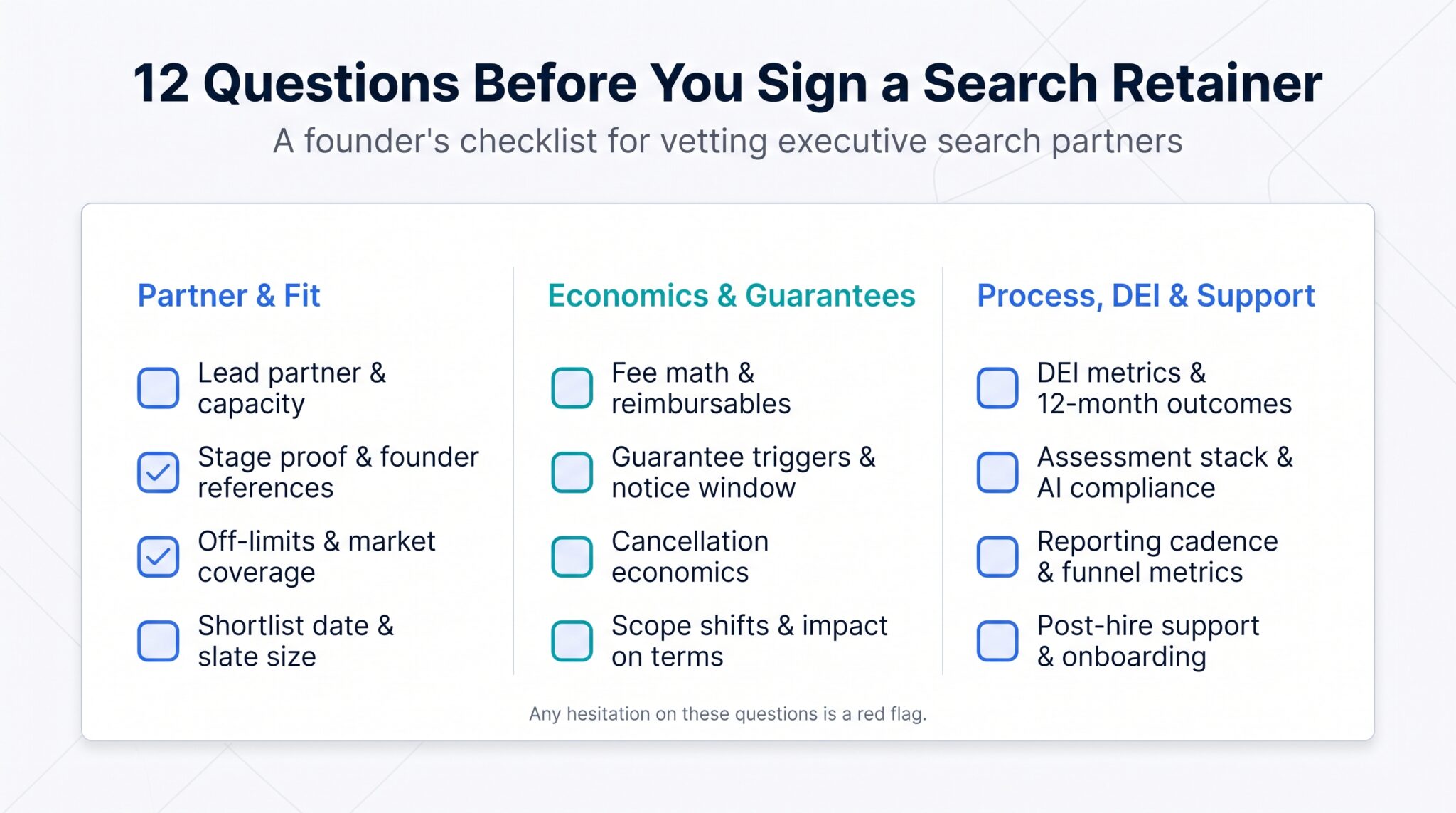
- Lead partner. Who runs the search after contract signature, and how many other mandates do they carry?
- Stage proof. How many comparable-stage searches closed in the past 24 months, and may I speak with two founder references?
- Off-limits. Which companies are blocked, and what percentage of the market does that remove?
- Shortlist date. When will I receive the first calibrated slate, and how many candidates will it include?
- Fee math. Is the fee based on cash only or total comp, and which expenses need pre-approval?
- Guarantee triggers. What events void replacement coverage, and what is my notice window?
- Cancellation economics. If we pull the plug, what portion of the retainer converts to credit or refund?
- Scope shifts. How does a title, location, or scope change affect fees and guarantees?
- DEI metrics. Do you track slate composition, hires, or 12-month retention, and will you share the data?
- Assessment stack. Which psychometrics or AI filters do you use, and may we review compliance documents?
- Reporting cadence. Will you send weekly funnel metrics (outreach, responses, interviews, and offers)?
- Post-hire support. What onboarding or coaching is included in the fee?
Any firm that hesitates on these points is asking you to pay for its learning curve. Press for specifics, and protect your runway.
Conclusion and next steps
A great executive recruiter does more than surface résumés; the right partner calibrates stage fit, tests culture, and shields you from a seven-figure mis-hire. Even the best search can fail if the engagement letter is loose or the partner disappears after kickoff. Follow these steps to turn insight into action:
- Shortlist three firms that match your stage, sector, and role.
- Send the same scorecard and RFP to each; objective inputs enable objective comparisons.
- Interview the working partner, not just the pitch team; capacity and chemistry outrank glossy decks.
- Speak with two founder references at your funding stage; past behaviour predicts future execution.
- Review the full engagement letter – fee base, billing milestones, notice windows, and guarantee carve-outs.
- Ask counsel to vet off-limits, data use, AI compliance, and cancellation terms; a two-hour legal bill beats a voided warranty.
Work through this list and the replacement guarantee you negotiate on paper will stand in practice, freeing you to build product, win customers, and raise the next round.