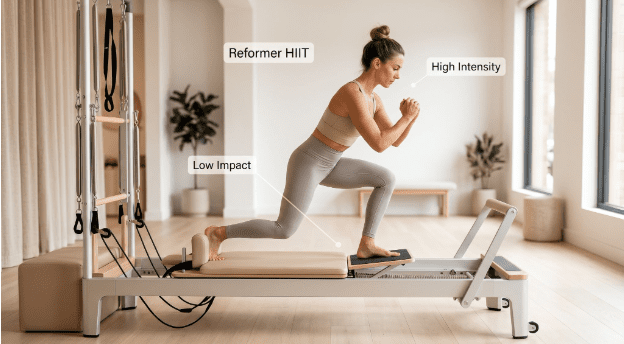
Reformer HIIT is interval training performed on a spring-loaded reformer carriage instead of a treadmill, bike, or open floor. You work in short, hard bursts against adjustable spring resistance, then recover, then repeat, so your heart rate climbs the way it does in any high-intensity session, but your feet never leave the carriage. If the term sounds familiar but the format does not, you are not alone, and it is worth understanding the mechanics before you book. It is the same idea that studios lay out in a FORM50 first-timer guide: high effort, controlled movement, and no pounding.
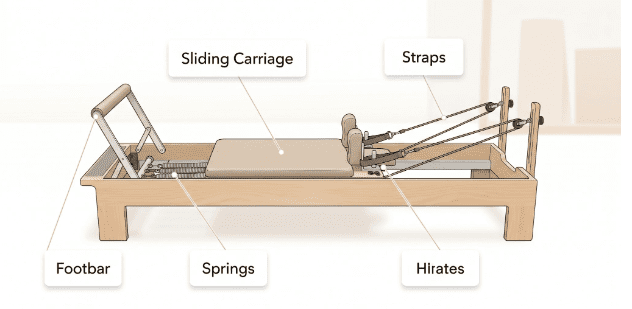
The “HIIT” part is unchanged from what you already know. High-intensity interval training alternates near-maximal effort with brief recovery, which is what drives the cardiovascular and metabolic demand. The “reformer” part is what changes the experience. A reformer is a sliding platform connected to a set of springs; you push and pull the carriage through each rep, and the springs load your muscles continuously rather than only at the bottom of a movement. Traditional HIIT often relies on impact and momentum, such as jump squats, sprints, or burpees, to spike intensity. Reformer HIIT generates that same intensity through resistance and tempo instead.
That distinction matters most for people who want results without the wear. Because the carriage carries your body weight and the springs absorb load, there is no ground-reaction force traveling up through your knees, hips, and spine. You can train hard several times a week without the joint cost that often forces people off high-impact programs. Studios built entirely around this format, like FORM50 Miami in Wynwood, structure the full 50 minutes around constant tension and interval work so the intensity stays high while the impact stays at zero.
How reformer HIIT differs from traditional HIIT
The goal is the same, but the levers are different. Traditional HIIT usually reaches high intensity through speed and impact. Reformer HIIT reaches it through spring resistance, time under tension, and tightly controlled transitions.
| Traditional HIIT | Reformer HIIT | |
| Intensity driver | Speed, impact, momentum | Spring resistance, tempo, time under tension |
| Joint impact | Moderate to high (jumping, running) | Zero (no running, no jumping) |
| Muscle loading | Mostly during the active rep | Continuous, including the return phase |
| Skill demand | Lower; familiar movements | Higher; controlled carriage work |
| Best for | People who tolerate impact well | People who want intensity without joint load |
Neither is “better” in the abstract. If you love sprint intervals and your joints handle them, traditional HIIT is effective. If impact is the thing that keeps derailing your consistency, the reformer removes that variable without lowering the effort.
Constant tension and time under tension
The most underrated feature of reformer training is what happens on the way back. With free weights or body weight, the lowering phase is often passive; gravity does part of the work. On a reformer, the springs pull the carriage toward its starting point, so you have to resist on the return as well as drive on the push. That doubles the working portion of each rep and increases time under tension, which is one of the main stimuli for building and maintaining lean muscle.
More time under tension at a controlled tempo also keeps your heart rate elevated, because the muscle is rarely fully unloaded. You get a strength stimulus and a conditioning stimulus from the same set, which is why a well-built reformer HIIT class can feel harder than its calm pace suggests.
The low-impact advantage is not a downgrade
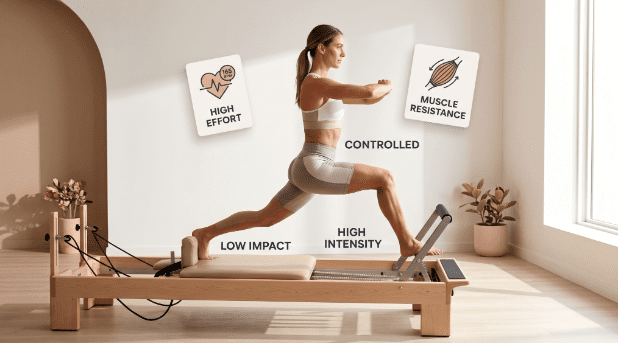
There is a common assumption that “low impact” means “low intensity.” It does not. Impact refers to the force of your body striking a surface. Intensity refers to how hard your muscles and cardiovascular system are working. You can remove the first and keep the second, which is exactly what spring resistance training is designed to do.
For specific groups, this is the difference between training and not training at all. People with knee or hip issues, anyone managing a previous stress fracture, those returning after a long break, and people who simply do not recover well from constant jumping can all push to a genuine high-effort zone on a reformer. The format meets the intensity goal without asking the joints to absorb repeated impact.
What the “afterburn” actually means
You have probably seen high-intensity workouts marketed around an afterburn effect. The science behind it is real, and it has a name: excess post-exercise oxygen consumption, or EPOC. After a hard session, your body keeps using extra oxygen, and therefore extra energy, to return to its resting state. Research shows EPOC rises with intensity, so short, higher-effort intervals tend to produce more of it than long, steady, moderate work, and resistance-based intervals add to the effect by taxing the anaerobic system during work and the aerobic system during recovery (NASM; EPOC comparison study, 2021).
A fair way to think about it: the afterburn is a modest, real bonus on top of the calories you burn during class, not a magic multiplier. Reformer HIIT, by pairing resistance with intervals, is well positioned to take advantage of it. Just keep expectations grounded; the bigger wins are the training stimulus itself and the consistency that low impact makes possible.
Who reformer HIIT is for
It suits a wide range of people, but a few profiles benefit most:
- Anyone told to avoid high-impact exercise who still wants real intensity.
- Lifters and runners who want a hard cross-training day that does not add joint stress.
- Beginners who want structure and coaching rather than guessing on a gym floor.
- Busy people who want strength and conditioning in one efficient session.
The main learning curve is the carriage itself. The springs, foot positions, and tempo take a class or two to feel natural, which is why most studios run an introductory format before you move into the signature class.
The bottom line
Reformer HIIT keeps the part of high-intensity training that works, the hard intervals, and swaps the part that breaks people down, the impact, for continuous spring resistance. The result is a demanding, low-impact workout that builds strength and conditioning at the same time. If you have heard the term and wondered whether it lives up to it, the honest answer is that the intensity is real and the joint cost is not. FORM50 built its entire 50-minute class around that trade, which is a useful reference point for anyone curious about how the format runs in practice.