Walk a commissioning meeting on any large commercial project in 2026 and the bottleneck is almost never the licensed electrician on the floor. It is the panel itself. Procurement teams that used to wait four to six weeks for a 1,200-amp panelboard are now budgeting twenty weeks or more for the same gear. Schedules slip. Tenants miss move-in dates. Production lines stay dark.
The shift has changed how seasoned facilities managers think about circuit breaker panel installation. It is no longer just an electrical task. It is a procurement, code-compliance, and supply-chain problem that has to be solved in parallel, often months before a single conductor is pulled.
Why Commercial Panel Installation Is a Procurement Problem Before It’s an Electrical One
Field contractors will tell you they can install a 2,000-amp switchboard in a few days once the gear is on site and the utility coordination is done. The slowest part of the job is the one that happens before anyone shows up in a hard hat.
Lead times have stretched from weeks to months
Industrial service upgrades are rarely a single install. They are projects with load calculations, permits, utility coordination, factory acceptance testing, and commissioning. Equipment procurement on commercial panel projects typically runs 4 to 12 weeks, with the total project commonly extending to 8 to 16 weeks once permits and utility cut-overs are factored in. For switchgear above 2,000 amps, OEM lead times in 2025 and 2026 have routinely pushed beyond 20 weeks for new-build gear.
The hidden cost of “I’ll wait for the OEM”
Waiting on a factory queue feels like the safe call. It rarely is. Facilities running on temporary power, generator rentals, or shed-load arrangements burn through budget every week the gear is delayed. Data center operators absorb SLA penalties. Industrial tenants miss production windows that do not come back around for a quarter. The arithmetic almost always favors paying a small premium for a stocked or rush-built panel that ships in days, not months.
The Code Layer: NEC 2023 Updates That Catch Out Rushed Installs
Rush jobs do not get a pass on the National Electrical Code. The 2023 NEC tightened several requirements that consistently trip up commercial panel installations when the install team is racing a deadline.
Working clearance is non-negotiable
The 2023 NEC requires a clear working space in front of energized panels of at least 30 inches wide, 36 inches deep, and 6.5 feet high. On retrofit projects, this is where rushed installs most often fail inspection. A panel that fits the wall does not always fit the working envelope, and adding shelving, storage, or HVAC ducting too close to the panel face will fail a re-inspection.
Arc-flash labeling and AIC matching
Every commercial panel must carry an arc-flash hazard label and a service fault-current label that reflects the actual available short-circuit current at that point in the system. The AIC rating of the installed breakers has to match or exceed that available fault current. Mismatched AIC ratings, common when a replacement panel is sourced quickly without re-checking upstream gear, are a serious safety defect and an inspection failure waiting to happen.
Circuit directory accuracy
The circuit directory inside the panel cover has to identify each circuit’s actual load with enough specificity that a maintenance electrician can isolate the right breaker in an emergency. “Lights” is not a circuit description. “East corridor lighting, rooms 201 to 215” is. Inspectors increasingly cite vague directories on commercial gear, particularly in healthcare and education facilities.
Spec Decisions That Have to Happen Before the Panel Ships
The procurement conversation usually starts with one number, the amp rating, but a real spec has at least half a dozen decisions baked into it. Getting any of them wrong means the panel either does not fit the application or does not pass inspection.
Amperage rating: 600A to 4,000A is the commercial range
Commercial distribution covers a broad band. A 600-amp three-phase service might feed a mid-size retail unit, a small medical office, or a multi-tenant warehouse. Smaller mixed-use builds still use single-phase service at lower amperage ratings, but most commercial work today lands in three-phase territory. Schneider Electric’s commercial portfolio extends panelboards, switchboards, and switchgear up to 4,000 amps, which frames the upper end of distribution gear as standard utility-grade infrastructure rather than something exotic. Eaton’s commercial materials cover configurations like 400-amp subfeed breakers landed on 600-amp panels, which is a routine commercial distribution tier, not a niche request. The main breaker rating on the incoming service has to be coordinated with both the upstream utility transformer and the downstream feeder protection, otherwise the entire selective coordination scheme falls apart on the first fault event.
Voltage and phase configuration
Residential thinking does not transfer. Commercial buildings commonly run 208Y/120V three-phase for general distribution, 480Y/277V three-phase for HVAC, large motors, and high-bay lighting, and increasingly 600V for heavy industrial loads. The panel’s bus bracing, breaker selection, and line-side connections all change with voltage class. A panel ordered for the wrong voltage is scrap.
NEMA enclosure rating for indoor vs outdoor
Indoor mechanical rooms typically take NEMA 1 enclosures. Wet locations, washdown areas, and exterior installations move to NEMA 3R or NEMA 4. Corrosive industrial environments push to NEMA 4X. Specifying an indoor enclosure for an outdoor pad is one of the most expensive procurement mistakes a project can make, because the panel cannot simply be relocated.
The Brand Question: Why Square D, Siemens, Eaton, GE, and ABB Still Dominate Spec Sheets
Commercial electrical drawings almost always specify a brand by name. The reason is rarely loyalty. It is interchangeability with existing gear, breaker availability, and the institutional knowledge of the maintenance team.
A facility with twenty years of Square D panelboards on its electrical drawings is going to specify Square D for the next install, because every spare breaker in the maintenance closet fits a Square D bus stab. Siemens and Eaton dominate the same way in facilities that grew up on those product lines. GE and ABB are heavily specified in industrial and utility-adjacent applications where switchgear lineups are already in place. Brand match is a long-term operational decision, not a procurement preference.
The practical consequence for procurement: when an emergency replacement is needed, sourcing a brand-matched panel is non-negotiable. A different brand will not simply “drop in,” because breaker compatibility, bus stab geometry, and even the bolt patterns on the gutter sections are brand-specific.
Installation Pitfalls That Show Up in Inspections
Once the gear lands on site, the failure modes are remarkably predictable. The same three issues account for a disproportionate share of inspection failures and post-energization defects.
Torque-to-spec lug failures
Both Eaton and Schneider Electric installation materials are explicit about the importance of torqueing breaker terminals and feeder lugs to the manufacturer-specified value, neither over nor under. Under-torqued connections develop loose joints, heat up, and eventually arc or fail. Over-torqued connections crush conductor strands and create the same heat-related failure mode. Most commercial inspectors now check torque marks on terminations during initial energization.
AIC mismatch with upstream gear
This one keeps showing up in field reports. A breaker is replaced like-for-like in a panel, but the new breaker carries a lower AIC rating than the available fault current calls for. The panel passes a casual look but fails a real engineering review. AIC has to be verified against the upstream service equipment, not assumed from the existing panel directory. The same logic applies to thermal overload protection on motor feeders and to short circuit interrupting capacity at every level of the distribution tree. A breaker that can clear a 22 kAIC short circuit fault is not the same component as one rated for 65 kAIC, even when the case looks identical.
Field testing before energization
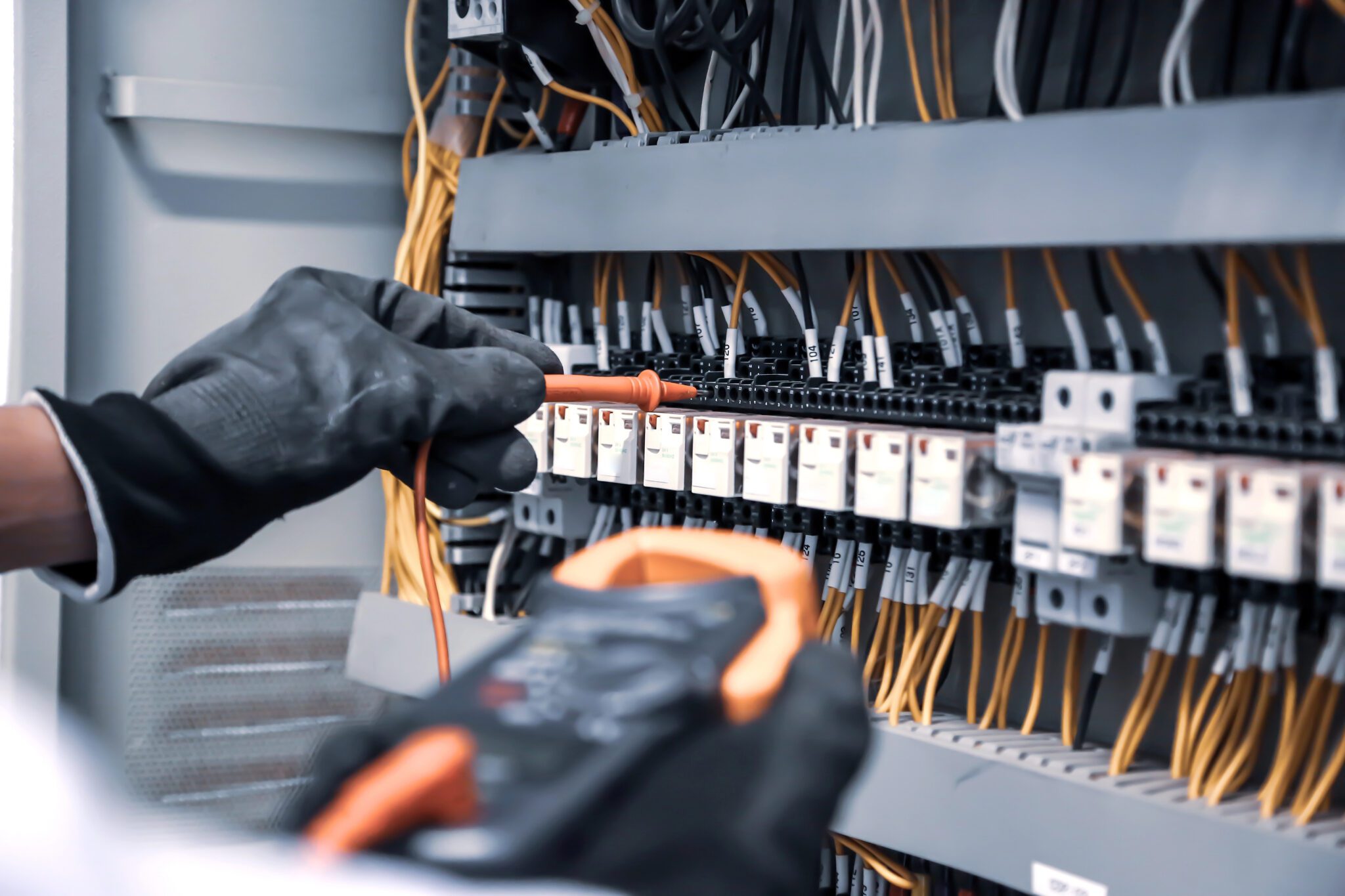
Before any commercial panel is energized for the first time, the installation team should be running insulation resistance checks, phase rotation verification, and continuity tests at every termination. A calibrated multimeter and a clamp meter belong in every panel installation kit. Feeder conductor wire gauge should be cross-checked against the breaker ampacity and the conductor table in NEC Chapter 9, not just trusted from the original drawings. Conductor sizing errors caught at this stage are inexpensive to correct; the same errors caught after energization usually involve cutting and re-pulling cable.
Bus bar damage during transport
Switchboards in the 2,000-amp and 3,000-amp range are heavy, awkward to maneuver, and easy to damage in transit if they are not crated and rigged properly. Hairline cracks in bus insulation are almost impossible to spot before energization. Reputable suppliers inspect and torque-check bus connections before shipment and provide the rigging documentation contractors need to land the gear without internal damage.
When Rush Builds Make Sense (and When They Don’t)
Not every project should be a rush build. Greenfield construction with a known schedule should plan around standard OEM lead times. Rush builds earn their premium on a narrower set of scenarios: failed gear in an operating facility, tenant fit-outs racing a lease commencement date, data center capacity expansions tied to a tenant move-in, and post-storm or post-fault replacements where the existing service equipment is unsafe to re-energize.
For those scenarios, the stocked-inventory model has become a meaningful piece of US commercial electrical infrastructure. Verified Breakers circuit breaker panels are one example of this approach: warehouses in Colorado, Texas, and California stocking commercial gear from Square D, Siemens, Eaton, GE, and ABB, with quote response under two hours and panel and switchboard builds turning around in 24 to 48 hours when OEM channels are quoting 20 weeks. The supplier carries BBB Accreditation and ships nationwide, with named buyers including Powerpro Electrical Services, WinSupply, Butler Supply, and the U.S. Navy. That kind of stocked-build capacity exists precisely to handle the procurement scenarios where waiting on a factory queue is not an option.
The decision rule most experienced project managers use is straightforward: if every week of delay is costing more than the rush premium, source from stock. If the schedule has genuine slack, ride the OEM lead time. The math almost always points one direction or the other.
The Total Project Timeline Most Teams Miss
A common procurement error is treating panel delivery as the critical path and assuming the rest of the install is a few days of field work. The reality on a commercial service upgrade looks more like this:
Engineering and load calculations take one to three weeks. Permit submission and approval is another two to four weeks, depending on the jurisdiction. Utility coordination, including any required service drop or transformer changes, can take four to eight weeks on its own and is often the longest single line item. Equipment procurement, the line everyone watches, runs 4 to 12 weeks for standard panels and longer for switchgear. On-site rough-in, panel landing, and termination is typically one to two weeks. Inspection and utility energization adds another one to three weeks.
Add it up and an 8-to-16 week total project window is common for commercial service upgrades. Compressing the equipment line from twenty weeks to two days does not collapse the project to a fortnight, but it does take the panel off the critical path, which lets the rest of the schedule finish in parallel instead of stacking behind a single late delivery.
Practical Pre-Install Checklist for Procurement Teams
Before any commercial panel order is placed, the procurement team should be able to answer the following in writing:
Service size and configuration: Confirmed amp rating, voltage class, phase configuration, and bus bracing requirement. Verified against the load calculation and the upstream service equipment.
Brand and breaker compatibility: Confirmed brand match with the existing facility standard, breaker series compatibility with spare stock, and clear stocking arrangements for replacement breakers.
AIC and fault-current data: Documented available fault current at the panel location and verified breaker AIC rating that meets or exceeds it. Arc-flash incident energy calculated and labeled.
Enclosure rating: NEMA rating selected for the actual installation environment, including any wet, corrosive, or outdoor exposure.
Physical fit: Confirmed working clearance per 2023 NEC, gutter and cable entry plan, and rigging path from receiving dock to install location.
Schedule alignment: Confirmed procurement lead time against the project critical path, with an explicit decision on stock-build versus OEM order based on cost-of-delay analysis.
Compliance documentation: Manufacturer cut sheets, factory test reports, torque values, and warranty terms received in writing before delivery.
Skipping any of these is how a routine circuit breaker panel installation turns into a months-long delay, an inspection failure, or worse, a post-energization fault. Treating the procurement decision with the same rigor as the field work is what separates projects that finish on schedule from those that quietly fall behind quarter after quarter.
The commercial electrical world has not gone back to four-week OEM lead times, and there is no realistic signal it will in 2026. The teams that adapt fastest are the ones treating panel installation as a supply-chain problem first and an electrical problem second.
Photo by depositphotos