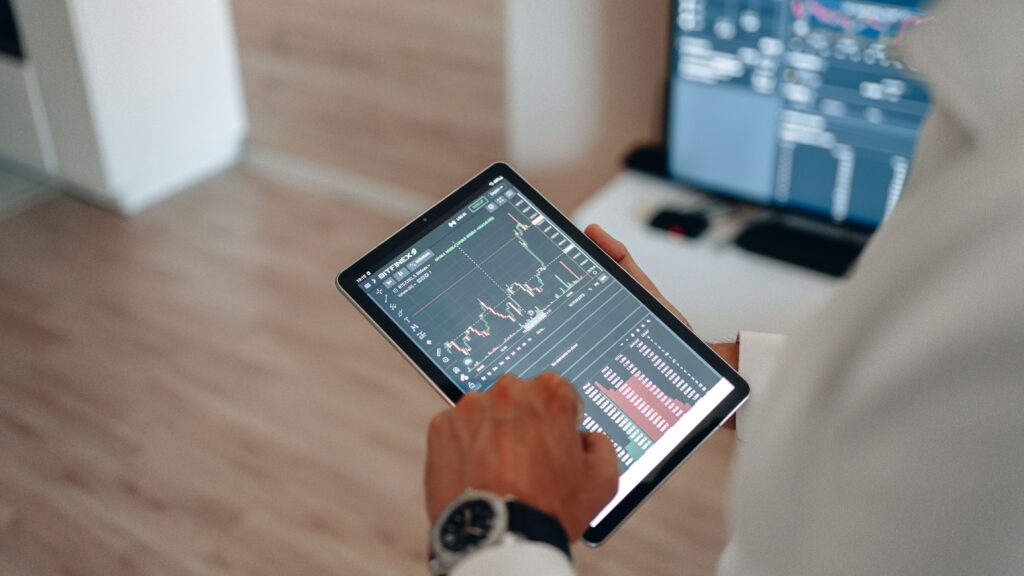
Prediction markets have been around for decades in academic circles, but something has shifted. Billions of dollars are now flowing through platforms built on the idea that crowds, when given a financial stake in being right, produce more accurate forecasts than most analysts.
For investors trying to read economic signals ahead of major decisions, that’s worth paying attention to.
The Basic Mechanics
A prediction market works by letting participants buy and sell contracts tied to the outcome of a specific event. If a contract pays out $1 if the Fed holds rates steady, and the market prices it at $0.97, the crowd is effectively pricing a 97% probability of no change.
That number updates in real time as new information arrives. It reflects the collective judgment of everyone who has put money behind their view – not a poll, not an analyst note, but skin in the game.
Two platforms dominate the space right now. Kalshi is CFTC-regulated and operates within the US financial system. Polymarket is a decentralized platform that draws significant international volume. Together, they processed over $5.3 billion in notional weekly volume as of mid-March 2026, with more than 440,000 active markets open across both platforms.
What the Data Is Signaling Today
The Fed decision market is the clearest example of how useful this data can be for investors. With the March 2026 FOMC meeting concluding today, Polymarket’s contract on a rate change attracted over $142 million in rolling volume – and has priced the probability of any change at effectively zero. The crowd isn’t hedging. It’s settled.
That kind of high-conviction pricing on a liquid market is worth more than most economist surveys, because participants have financial exposure to being wrong.
Beyond rates, the data tells a broader story. Polymarket’s market on what Bitcoin price will hit in March is drawing $17.9 million in rolling volume, with 87% odds on $75,000. Open interest on the 2028 presidential election already exceeds $30 million. These aren’t idle bets – they reflect where informed money sees the future.
For readers who want a real-time view across categories, DeFi Rate’s prediction market tracker aggregates live volume, open interest, and contract pricing from both Kalshi and Polymarket in one place, making it straightforward to scan what the market is pricing across economic, political, and financial events.
Kalshi vs. Polymarket: Two Different Signals
It’s worth understanding how each platform attracts different types of participants.
Kalshi’s CFTC-regulated status means it draws US-based retail and professional participants who are comfortable operating within the traditional financial system. Its active market count sits above 400,000, and the platform posted a record $2.9 billion in weekly notional volume the week of March 9-15 – driven heavily by NCAA March Madness activity.
Polymarket is decentralized and crypto-native, drawing a global participant base. Its rolling 30-day volume of $9.6 billion is nearly 27% higher than the prior period, and it holds $463 million in open interest. The platform tends to attract more politically and macro-focused activity, with markets on geopolitical events, currency moves, and AI model rankings sitting alongside sports and entertainment.
The two platforms often agree. When they diverge, the divergence itself can be informative.
How Investors Are Using This Data
The most practical use case is as a cross-check on consensus. Before an earnings release or a central bank decision, checking what the prediction market is pricing can reveal whether options markets and analyst estimates are in sync with real-money crowd sentiment.
Some family offices and quantitative traders monitor these platforms for arbitrage signals – moments when Kalshi and Polymarket price the same outcome differently. That spread is usually small and closes fast, but it exists.
Others use the data more passively, as a temperature gauge on political or macro risk. The probability of a China-Taiwan confrontation by March 31 sits at 1% on Polymarket. The odds of the Iranian regime falling before year-end are around 38%. Those numbers don’t drive portfolio decisions alone, but they quantify risk in a way that a news headline doesn’t.
A useful reference point for anyone building a framework around this is the CFTC’s public guidance on event contracts, which sets out how regulated prediction markets operate and what consumer protections apply.
The Limits Worth Knowing
Prediction markets aren’t infallible. They’re most accurate when a large number of informed participants are trading, and least reliable in thin or obscure markets.
Liquidity matters. A contract with $10,000 in volume carries far less weight than one with $140 million. And markets can move on sentiment as much as on new information – a single large position can shift pricing before the crowd corrects it.
They also can’t predict what they can’t see. A black swan event won’t show up in a prediction market before it happens.
The University of Chicago’s research on information markets outlines both the theoretical basis for why these markets work and the documented cases where they’ve failed – useful reading for anyone thinking seriously about incorporating this data into investment analysis.
The Takeaway for Investors
Prediction markets are not a replacement for fundamental analysis. They’re a live, crowd-sourced probability layer that sits on top of it.
At $5 billion-plus in weekly volume and nearly half a billion in open interest, the data these platforms generate is no longer a curiosity. It’s a signal that serious allocators are watching.
For any investor who wants to understand what the market – not just the analysts – actually believes about the Fed, elections, or macro conditions, these platforms are worth adding to the research stack.