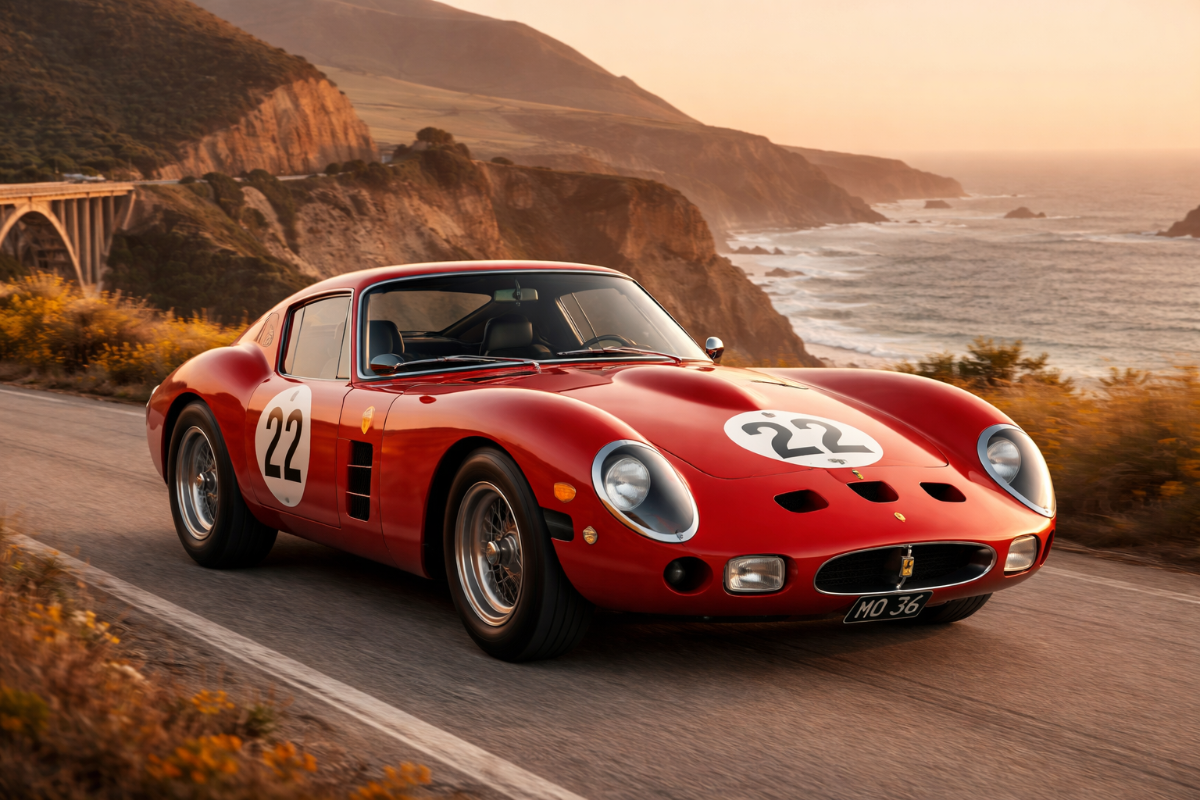
The 1962 Ferrari 250 GTO is more than just a sports car it stands as an enduring symbol of automotive excellence and a benchmark in the history of high-performance vehicles. From its inception, Ferrari aimed to create a car that would merge precision engineering with elegant design, resulting in a vehicle that excelled both on the racetrack and as a collector’s masterpiece. Moreover, its engineering brilliance is visible in every detail, from the lightweight tubular steel chassis to the powerful 3.0-liter V12 engine, which delivered exceptional speed and handling for its era.
Beyond raw performance, the 250 GTO’s aerodynamic design and sculpted bodywork, crafted by Ferrari’s legendary designers, set new standards for both beauty and functionality. On the racing circuit, the 1962 Ferrari 250 GTO quickly proved its superiority, securing victories in prestigious competitions and building a reputation for reliability and agility that few rivals could match. Furthermore, with only 36 units ever produced, its rarity and historical significance have made it one of the most coveted classic cars in the world. Consequently, for collectors and enthusiasts alike, the 1962 Ferrari 250 GTO represents not only Ferrari’s innovation but also a lasting legacy of passion, craftsmanship, and automotive artistry.
Development and Design of the 1962 Ferrari 250 GTO
Origins of the 250 GTO
Ferrari introduced the 250 GTO in the early 1960s in response to new FIA GT regulations. The company intended to produce a car that combined aerodynamic efficiency, lightweight construction, and Ferrari’s signature V12 power. Therefore, the “GTO” designation, which stands for Gran Turismo Omologato, indicated that the car met strict GT racing homologation standards.
From the very beginning, the 250 GTO aimed to blend speed, elegance, and functionality. As a result, it quickly became a benchmark for competitors and set the stage for Ferrari’s future GT models.
Engineering Excellence
The 1962 Ferrari 250 GTO featured a 3.0-liter V12 engine producing approximately 300 horsepower. Coupled with a 5-speed manual gearbox, the car could reach top speeds of 174 mph (280 km/h). Additionally, its tubular steel chassis and aluminum body panels provided a perfect balance of strength and weight, ensuring superior handling both on the track and on long road circuits.
Moreover, Ferrari engineers fine-tuned the suspension system to deliver precise road control and agile cornering. Consequently, the 250 GTO excelled on twisty tracks and long straights alike, giving drivers an unparalleled combination of speed and stability.
Timeless Design
The 250 GTO’s body design, initially created by Giotto Bizzarrini and later refined by Mauro Forghieri and Sergio Scaglietti, remains instantly recognizable. Its long hood, sweeping fenders, and distinctive front grille not only enhance aerodynamics but also contribute to an aesthetic that is timeless.
-
Lightweight aluminum body for optimal performance
-
Aerodynamic front and rear profiles to reduce drag
-
Iconic round tail lights and elegant curves
Therefore, the 1962 Ferrari 250 GTO was not just a racing machine but also a work of art, seamlessly blending performance with style.
Racing History and Performance Achievements
Dominance on the Track
From its debut, the Ferrari 250 GTO quickly established dominance in competitive racing. It participated in major events, including the Tour de France Automobile, the 24 Hours of Le Mans, and the Targa Florio, consistently outperforming rivals.
-
1962 Tour de France Automobile: 1st overall
-
1963 Nürburgring 1000 km: 1st in class
-
Multiple wins in FIA GT Championships
Furthermore, its victories were not merely a matter of power; the 250 GTO’s agility, reliability, and precise engineering allowed it to excel in endurance races where consistency often mattered more than speed.
Performance Metrics
The car’s 3.0-liter V12 engine produced smooth yet formidable acceleration, while the lightweight chassis enabled sharp handling. Moreover, its aerodynamic design reduced drag and improved stability at high speeds, giving it a competitive edge.
| Feature | 1962 Ferrari 250 GTO | Ferrari 275 GTB | Ferrari 330 P4 |
|---|---|---|---|
| Engine | 3.0L V12 | 3.3L V12 | 4.0L V12 |
| Horsepower | 300 hp | 280 hp | 450 hp |
| Top Speed | 174 mph | 166 mph | 196 mph |
| 0-60 mph | 5.4 sec | 6.0 sec | 4.2 sec |
| Weight | 880 kg | 950 kg | 800 kg |
Consequently, the 1962 Ferrari 250 GTO set new standards in both speed and endurance, earning a reputation as one of the most formidable GT cars of its time.
The 1962 Ferrari 250 GTO as a Collector’s Icon
Unmatched Rarity
Only 36 units of the 1962 Ferrari 250 GTO were ever built, making it extremely rare. Each car was hand-assembled, contributing to slight variations between units. This rarity has fueled its desirability among collectors and automotive museums.
Record-Breaking Value
The 250 GTO is considered the most valuable Ferrari ever. Auction sales have reached astronomical figures, reflecting its historical and cultural significance.
| Year | Sale Price (USD) | Event |
|---|---|---|
| 2000 | $4.5 million | Pebble Beach |
| 2014 | $38 million | Private Sale |
| 2018 | $48.4 million | RM Sotheby’s |
| 2022 | $70 million | Private Transaction |
Moreover, its investment potential is unmatched, often outperforming other classic cars in terms of appreciation.
Cultural Legacy
Beyond its technical and monetary value, the 1962 Ferrari 250 GTO has left an indelible mark on car culture.
-
Appears in classic car exhibitions globally
-
Featured in automotive films and documentaries
-
Symbol of status and sophistication in collector communities
Therefore, the 250 GTO is more than a vehicle—it is a legend that represents Ferrari’s pursuit of excellence.
Comparisons with Other Ferrari Classics
| Model | Production Years | Units Made | Current Value (USD) | Racing Success |
|---|---|---|---|---|
| 1962 Ferrari 250 GTO | 1962–1964 | 36 | $70 million | High |
| 1964 Ferrari 275 GTB/4 | 1964–1966 | 330 | $3 million | Medium |
| 1967 Ferrari 330 P4 | 1967 | 4 | $15–20 million | High |
From this comparison, it is evident that the 1962 Ferrari 250 GTO stands out for its combination of rarity, performance, and cultural influence.
Why the 1962 Ferrari 250 GTO Remains Iconic?
-
Design Excellence: Its curves, aerodynamic profile, and classic Ferrari styling remain timeless.
-
Racing Legacy: Proven track record against formidable competitors.
-
Investment Potential: Record-breaking auction prices highlight its financial value.
-
Cultural Impact: Celebrated in car shows, films, and collector circles.
-
Rarity: Limited production ensures scarcity and exclusivity.
Consequently, it continues to inspire modern Ferrari designs and captivates automotive enthusiasts globally.
Frequently Asked Questions
What makes the 1962 Ferrari 250 GTO so valuable?
Its rarity, racing history, and timeless design make it a top collector’s item with record-breaking auction prices.
How many 1962 Ferrari 250 GTOs were built?
Only 36 units were produced, making it extremely rare and highly sought after.
What is the top speed of the 1962 Ferrari 250 GTO?
The car could reach approximately 174 mph (280 km/h).
Who designed the 1962 Ferrari 250 GTO?
Giotto Bizzarrini initially designed it, with refinements by Mauro Forghieri and Sergio Scaglietti.
How does the 250 GTO compare to other classic Ferraris?
While other models excel in various aspects, the 250 GTO uniquely combines rarity, design, and racing performance, making it the most iconic.