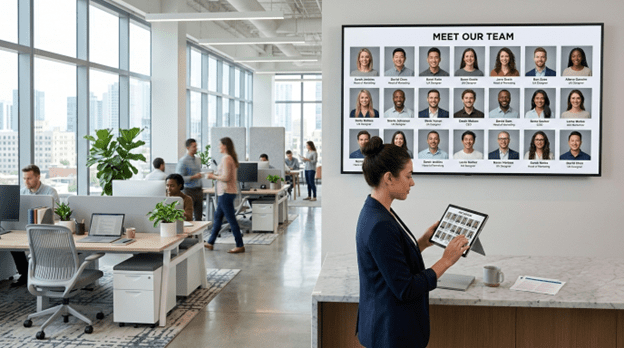
Picture a 3,000-person company. Offices in six cities. Hiring 400 people this year. And a brand standard that requires every employee to have a consistent, professional headshot on their internal directory, LinkedIn profile, and company website.
Now picture coordinating that with traditional photography.
Someone is doing that math right now, and they don’t like the answer.
The Scale Problem Nobody Budgeted For
Corporate headshots were never designed to scale. The traditional model, a photographer, a studio, a half-day of scheduling per location, was built for executive teams of 10 or 15. It worked fine when companies were smaller, turnover was lower, and “consistent visual branding” wasn’t a line item anyone measured.
That world is gone.
Today, distributed teams are the norm. Remote hiring means employees in dozens of cities who will never set foot in a headquarters studio. Meanwhile, the pressure to maintain visual brand consistency has increased, not decreased. Investors, clients, and recruits look at company websites and LinkedIn pages with far more scrutiny than they did a decade ago. A patchwork of inconsistent headshots, some formal, some casual, some taken on someone’s phone in bad lighting, communicates something the brand team didn’t intend.
It communicates that nobody’s paying attention.
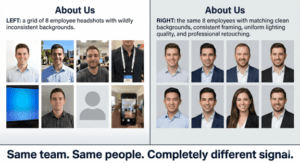
Here’s what most people miss: the cost of visual brand inconsistency isn’t just aesthetic. It affects how enterprise clients assess operational maturity, how recruits evaluate culture, and how a leadership team projects credibility during high-stakes moments like fundraising, acquisitions, or media coverage.
What AI Actually Changed (It’s Not What You Think)
The conversation around AI headshots usually focuses on cost. That’s understandable. The price difference is significant: traditional corporate photography runs $150 to $500 per person once you factor in photographer fees, travel, studio time, and editing. AI-based solutions bring that closer to $20 to $50 per person, sometimes less at volume.
But cost is the second reason enterprise teams are making the switch.
The first reason is speed.
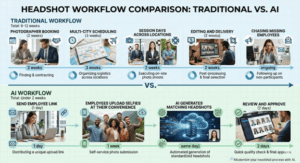
A traditional headshot program for a 500-person company takes months to execute. You coordinate schedules across locations, book photographers in multiple cities, manage rescheduling for people who miss their slots, wait for editing turnaround, then chase down the employees who still haven’t submitted anything three weeks after the shoot.
HR teams will tell you this project quietly consumes 40 to 60 hours of someone’s time before it’s done.
AI changes the flow entirely. Employees upload 10 to 20 reference photos from their phones. Headshots are returned within hours, in consistent lighting, backgrounds, and framing across the entire organization. No coordination overhead. No scheduling dependencies. No photographer no-shows.
Some organizations have moved to running these programs on a rolling basis, onboarding new hires with a professional headshot on their first day rather than waiting for the next company-wide photo initiative. Tools built for corporate programs at this scale have made that kind of always-on visual branding operationally feasible for the first time.
The Quality Objection (And Why It’s Mostly Outdated)
This is where it gets interesting.
Two years ago, the quality objection to AI headshots was legitimate. Early outputs had telltale signs: slightly off skin textures, background anomalies, hands that looked wrong. A trained eye could spot them immediately.
That gap has closed faster than most people expected.
The models powering today’s AI headshot tools have been trained on millions of professional photographs. The output, when you’re working from decent reference photos, is now consistently indistinguishable from studio work in standard professional contexts: website bios, LinkedIn profiles, internal directories, press kits. Blind comparisons run informally by HR teams at tech companies consistently show that employees, clients, and even photographers themselves struggle to identify which photos came from a studio and which came from AI.

The real question is not whether AI headshots are good enough. They are, for the vast majority of use cases. The real question is what specific scenarios still require traditional photography.
The answer is narrower than most people assume. High-profile executive portraits for major publications, keynote speaker photography, brand campaigns that require significant creative direction: these still benefit from a human photographer. Everything else is a candidate for AI.
Understanding how different AI headshot platforms compare is a useful exercise before committing to a vendor for an enterprise rollout, since output quality, turnaround time, and volume pricing vary meaningfully across the category.
The Organizational Shift Happening Right Now
Here’s the thing nobody mentions when discussing AI’s role in corporate photography: the companies moving fastest aren’t doing it to cut costs. They’re doing it because they’ve reframed what a corporate headshot program is supposed to accomplish.
Old framing: a headshot is a one-time administrative task, something HR handles during onboarding, then forgets about.
New framing: a consistent, current, professional visual identity is a brand asset that requires ongoing maintenance, just like a website or a LinkedIn company page.
Under the old framing, a two-year-old headshot is acceptable because the cost of updating it is too high to justify for every employee every year. Under the new framing, an outdated headshot is a liability: it signals that the company’s public-facing information is stale, which raises questions about what else might be.
AI makes the new framing economically viable. When the cost and operational overhead of refreshing headshots drops by 80%, the calculus changes. Annual or even semi-annual updates become reasonable. New hires get sorted on day one instead of appearing in the directory with a placeholder avatar for their first six months.

The practical steps for a company evaluating this shift are straightforward. Start with a pilot cohort, typically a department or regional office, 30 to 50 people. Establish the background color, framing, and lighting standard you want to maintain across the organization. Run the cohort through an AI headshot program and compare output consistency against your last traditional photography session. Measure the time HR spent coordinating each. The results tend to be self-evident.
For executives specifically, the consideration is slightly different: executive-level headshots carry more weight in high-visibility contexts and are worth evaluating separately from the general employee program. A C-suite photo that appears in board decks and media coverage has different requirements than a headshot in an internal directory.
The Companies That Wait Will Pay for It Twice
The organizations moving early on AI corporate photography aren’t doing so blindly. They’ve done the math on the total cost of traditional programs at their current size, and they’ve seen what visual brand consistency actually does for perception in competitive talent markets.
The organizations waiting tend to be doing so out of inertia rather than a considered objection. “We’ve always used a photographer” is a process reason, not a strategic one.
The irony is that the longer a company waits, the more their existing headshot library ages, which means the eventual reckoning requires even more volume to address. The companies that refresh early get ahead of the problem. The ones that wait handle it at a moment of maximum inconvenience, usually when a rebrand or acquisition forces the issue.
AI didn’t make professional visual identity optional. It made the excuse for neglecting it much harder to defend.