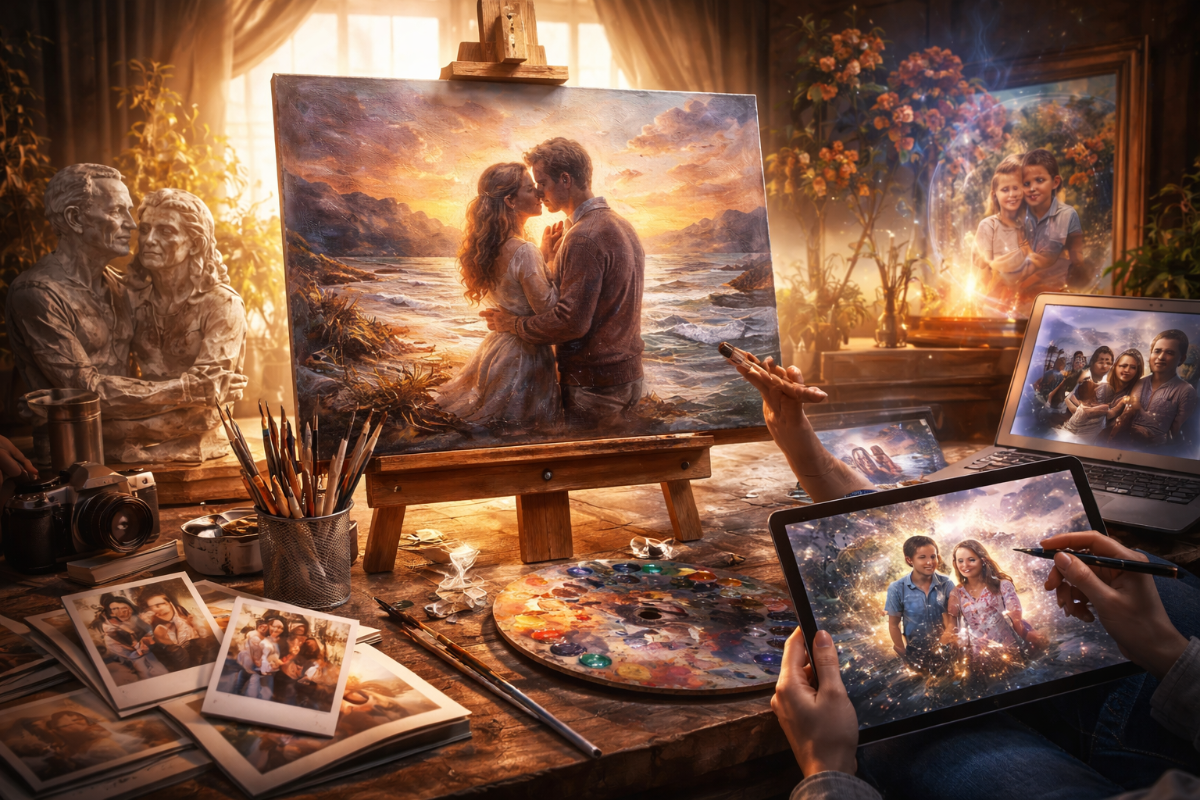
There is something profoundly human about holding onto a moment a wedding glance, a childhood home, a handwritten note, a final embrace. Art has always been our most enduring vessel for preserving these fragments of time. Today, Transforming Memories into Masterpieces is more than a poetic phrase; it represents a deeply intentional process of turning personal history into lasting works of art.
From oil paintings that outlive generations to digital portraits minted on blockchain, the desire to preserve memory is universal. However, the way we express and safeguard those memories continues to evolve. As emotion meets craftsmanship and technology, art becomes both a personal sanctuary and a legacy strategy.
This exploration examines how memories shape creative expression, the psychology behind nostalgia, the mediums used to preserve meaning, and why personalized art is emerging as both a luxury statement and a long-term investment.
The Emotional Power of Art and Human Connection
Art is, at its core, an act of connection.
Before language formalized communication, early humans painted their stories on cave walls. Those images were not decorative; they were declarations of existence. Similarly, every portrait, sculpture, or photograph created today carries emotional intent.
When we speak of Transforming Memories into Masterpieces, we are describing the elevation of lived experience into something tangible. Art allows us to:
-
Anchor fleeting moments
-
Honor relationships
-
Process grief and joy
-
Share identity across generations
Moreover, art externalizes emotion. A memory locked in the mind is intimate but fragile. Once translated into a physical or digital medium, it gains permanence and shared meaning.
Consequently, collectors and families increasingly commission works that reflect personal milestones anniversaries, births, family heritage because art captures not just how something looked, but how it felt.
How Memories Influence Creative Expression?
No masterpiece exists without memory.
Artists draw from personal experience, cultural narratives, and emotional imprints. Memory shapes color choices, composition, symbolism, and tone. A childhood home may inspire warm earth tones; a memory of loss may result in negative space or subdued palettes.
Neurologically, memory and creativity are deeply intertwined. The brain’s hippocampus, responsible for memory consolidation, interacts closely with imagination networks. Therefore, when artists create, they are often reassembling fragments of memory into new visual narratives.
For commissioned artwork, this relationship becomes even more intimate. The patron’s memories merge with the artist’s interpretation. The final piece becomes a collaborative act of meaning-making not just documentation, but interpretation.
Thus, Transforming Memories into Masterpieces requires both emotional intelligence and technical mastery.
Mediums for Preserving Memories
Throughout history, different mediums have served as vessels for remembrance. Each carries distinct qualities of permanence, texture, and symbolism.
1. Painting
Oil, acrylic, and watercolor remain timeless methods of memorialization. A painted portrait offers texture and depth that photography sometimes cannot replicate. Brushstrokes communicate presence and intention.
Paintings are often chosen for:
-
Family heirlooms
-
Estate collections
-
Formal commemorations
-
Heritage storytelling
Moreover, paintings age gracefully, often gaining character over decades.
2. Photography
Photography captures reality with immediacy. It freezes time without reinterpretation. However, modern photographic art often blends editing, composition, and lighting to create emotionally resonant images.
Black-and-white photography, for example, intensifies nostalgia by stripping away distraction and emphasizing emotion.
3. Digital Art
Digital art offers versatility and accessibility. Artists can blend photographs, illustrations, and 3D elements to reconstruct memories in imaginative ways.
Consequently, digital art is increasingly used for:
-
Family storybooks
-
Animated memory reels
-
Virtual galleries
-
Personalized wall displays
Moreover, digital preservation ensures redundancy memories can be stored, duplicated, and protected across platforms.
4. Sculpture
Sculpture introduces dimension. A three-dimensional form invites physical interaction. Memorial statues, custom figurines, and carved keepsakes provide tactile continuity.
Unlike flat mediums, sculpture occupies space — reminding us daily of what matters.
Traditional Art vs Digital Art Preservation
Below is a structured comparison of preservation methods:
| Feature | Traditional Art | Digital Art |
|---|---|---|
| Tangibility | Physical presence | Virtual or screen-based |
| Longevity | Can last centuries with care | Depends on digital storage systems |
| Emotional Perception | Often seen as timeless and prestigious | Viewed as modern and adaptable |
| Replication | Limited, often one-of-a-kind | Easily duplicated |
| Investment Value | Historically stable appreciation | Emerging, sometimes volatile |
| Storage Needs | Climate control, physical space | Cloud storage, blockchain, drives |
However, this is not a competition. Instead, many collectors combine both approaches. Therefore, Transforming Memories into Masterpieces often involves hybrid strategies a physical painting complemented by digital archiving.
The Psychology Behind Nostalgia and Storytelling
Nostalgia was once considered a medical condition. Today, psychologists recognize it as a stabilizing emotional force.
When individuals engage with nostalgic art:
-
Stress decreases
-
Sense of identity strengthens
-
Social connectedness increases
-
Emotional resilience improves
Moreover, storytelling activates empathy. A piece of art anchored in memory invites viewers into a shared narrative.
Consequently, personalized artwork becomes a bridge between generations. A grandchild viewing a commissioned portrait of grandparents does not merely see faces they inherit story, legacy, and belonging.
Thus, Transforming Memories into Masterpieces is psychologically restorative.
Personalized Art as a Luxury and Legacy Investment
Luxury is evolving. Increasingly, it is defined not by excess, but by exclusivity and meaning.
Personalized artwork meets both criteria:
-
One-of-a-kind creation
-
Emotional authenticity
-
Historical continuity
-
Asset diversification
High-net-worth collectors often view custom art as both sentimental treasure and financial asset. Moreover, bespoke pieces carry provenance a documented origin tied to family narrative.
Therefore, commissioning art is no longer merely aesthetic; it is strategic.
Art collections frequently form part of estate planning. Consequently, legacy-focused families are investing in curated memory-based collections that represent identity and heritage.
Technology’s Role in Modern Memory Preservation
Technology has redefined how we approach Transforming Memories into Masterpieces.
AI-Assisted Art
Artificial intelligence tools can:
-
Restore old photographs
-
Colorize black-and-white images
-
Generate stylized portraits
-
Recreate lost or damaged visuals
AI enhances rather than replaces human creativity. It allows deeper reconstruction of fragmented memories.
Digital Archives
Cloud storage, encrypted drives, and structured digital libraries ensure organized preservation. Families can now maintain multi-generational archives accessible worldwide.
Moreover, digital tagging enables narrative layering — photos linked with written stories, audio recordings, and historical documentation.
NFTs and Blockchain Authentication
Non-fungible tokens (NFTs) offer proof of ownership and authenticity for digital works. Blockchain-based certification ensures permanence and traceability.
However, this space remains evolving. Therefore, collectors must evaluate longevity and platform credibility before investing.
Commissioning Custom Artwork: Process and Considerations
Commissioning art is both creative and contractual. Understanding the process ensures alignment and satisfaction.
Commissioned Art Process Overview
| Stage | Description | Key Considerations |
|---|---|---|
| Consultation | Initial discussion of concept and vision | Emotional clarity, reference materials |
| Proposal | Artist presents sketches or ideas | Revisions, timeline |
| Agreement | Contract outlining scope and pricing | Ownership rights, usage permissions |
| Creation | Artwork production phase | Progress updates |
| Delivery | Final piece presented | Framing, installation, authentication |
Moreover, patrons should consider:
-
Artistic style compatibility
-
Material durability
-
Insurance and valuation
-
Display environment
Consequently, clear communication enhances outcomes.
Turning Personal Milestones into Timeless Pieces
Life’s milestones naturally invite preservation:
-
Weddings
-
Births
-
Anniversaries
-
Career achievements
-
Family reunions
-
Memorial tributes
However, the most powerful works often focus on subtle moments — a shared laugh, a quiet afternoon, a handwritten recipe.
Therefore, Transforming Memories into Masterpieces is not about grandeur; it is about intentionality.
The art becomes timeless because the memory is timeless.
Conclusion
Art is not merely decoration. It is continuity.
In a world moving at relentless speed, the desire to pause, preserve, and honor moments grows stronger. Transforming Memories into Masterpieces reflects our need to root ourselves in story and connection.
Through painting, photography, sculpture, digital innovation, and commissioned craftsmanship, memories transcend fragility. They become visible, touchable, and inheritable.
Moreover, as technology expands preservation possibilities, art becomes both more accessible and more personalized. Consequently, the masterpieces of tomorrow will not only hang in galleries they will live in homes, archives, and digital vaults as curated expressions of identity.
Ultimately, to transform a memory into a masterpiece is to say: This mattered. This endures.
Frequently Asked Questions
1. Why is personalized art considered a legacy investment?
Because it combines emotional significance with potential financial appreciation, while preserving family identity.
2. Is digital art as valuable as traditional art?
Value depends on demand, authenticity, and cultural relevance. Digital art authenticated via blockchain can hold strong market value.
3. How long does a commissioned artwork take?
Depending on complexity, timelines range from weeks to several months.
4. What materials last the longest?
Oil on canvas, bronze sculpture, and archival photographic prints are among the most durable.
5. Can AI fully replace human artists?
No. AI assists technically, however emotional interpretation and nuance remain human strengths.