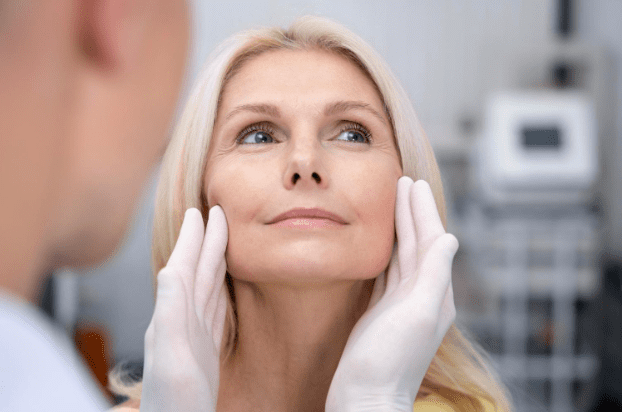
Face lifts are super popular now, and the deep plane lift is often talked about as a great way to look younger. Still, behind the glory, there are quite a few reasons why patients should be aware of these before making a decision. This discusses the cons of deep plane facelift, gives an overview of the operation, and points out a contemporary substitute—the Optimum Mobility Facelift—that provides results that are not only safer but also more natural.
Deep Plane Facelift Explained – How It Works
If you are thinking about facelift surgery, it is definitely important to have a deep plane facelift explained overview. Deep plane facelift is far from a simple skin tightening procedure; it works on the layers under the superficial musculoaponeurotic system (SMAS). To bring back the facial structure surgeons take the muscle, ligaments, and fat for lifting, repositioning, and filling.
Key points about the procedure:
- Works to lift the area between the eyes, the cheeks, and jawline
- Moves underlining layers of the tissues to give back the natural youthful shapes
- Intended for permanent-like, usually, the effects can last for ten years or more
- Highly complex, it demands a highly advanced understanding of facial anatomy
Although it is efficient in some situations, the risks associated with the depth and intensity of the operation make it not possible to be used for every patient.
Top Disadvantages of Deep Plane Facelift
The disadvantages of deep plane facelift are important to consider before making a decision. These include:
- High Surgical Complexity
- Requires advanced training and experience of the surgeon
- Since the operation is near the facial nerves, there is a chance of nerve issues, which may be temporary or permanent
- Long Recovery Time
- Extensive dissection is the cause of more swelling, bruising, and pain
- Recovery can take over a few weeks, which means that the time for social or professional activities will be delayed
- Inconsistent Results
- The results mostly depend on the skill of the surgeon
- Some patients may experience over-tightening or an unnatural appearance
- Greater Trauma to Tissues
- The deep dissection increases the chances of prolonged numbness, scarring, and minor asymmetries, besides it can be a source of complications
- Not Ideal for Subtle Rejuvenation
- Often excessive for patients seeking moderate improvements or faster recovery
- Probably not needed for people with minor aging issues
As a result of these constraints, a great number of surgeons and patients have come to question if a deep plane facelift is the right decision when there are safer options available.
Why Patients Are Turning to the Optimum Mobility Facelift
The Optimum Mobility Facelift is a contemporary facelift method that essentially solves a lot of problems of the deep plane technique. The procedure moves the tissues naturally and in a controlled manner while it also minims the surgical trauma.
Benefits of the Optimum Mobility Facelift include:
- Less invasive approach: Significantly decreases deep tissue disruption
- Lower risk to nerves: Preserves natural facial expression
- Faster recovery: Less swelling and bruising
- Natural results: Avoids the overly tight or “pulled” appearance
- Predictable outcomes: Surgeons are able to consistently and balanced rejuvenate the face
This technique gives patients the opportunity to make their dream of a safer, more patient-friendly facelift without seeing any compromise in the results come true.
To Wrap-up
Although the deep plane facelift is able to show a very significant change of the face in some situations, it is very important to know the disadvantages of deep plane facelift. Due to high complexity, longer recovery time, and results that are not always consistent, it is less favoured by patients. The Optimum Mobility Facelift is a safer, more up-to-date alternative that offers natural, predictable results with less risk and recovery time. Do not hesitate to learn more about deep plane facelift methods and have a talk with an experienced surgeon about your goals before making a decision.