Boca Raton isn’t just sunny—it concentrates wealth. About 9 percent of Palm Beach County households qualify as millionaires, the highest share in Florida. With that kind of money in motion, choosing the right advisor can shape everything from your retirement date to your tax bill.
This guide spotlights four fiduciary firms that dominate the local scene. You’ll learn what they charge, who they serve, and where each one shines. We’ll also show why many investors keep a Self-Directed Brokerage Account for extra flexibility before handing the reins to a pro.
Ready? Let’s find the advisor who fits both your life and your balance sheet.
Boca Raton’s wealth market at a glance
Walk down Mizner Boulevard and you’ll spot luxury cars, private-bank billboards, and more CPA plaques than coffee shops. Money isn’t just present; it’s concentrated.
The typical Boca household earns about $98,000 a year, according to the 2023 American Community Survey; that’s well above the statewide median. Entire neighborhoods exceed $250,000 in average income. Palm Beach County holds the highest share of millionaire households in Florida at roughly nine percent. Affluence is the norm, not the exception.
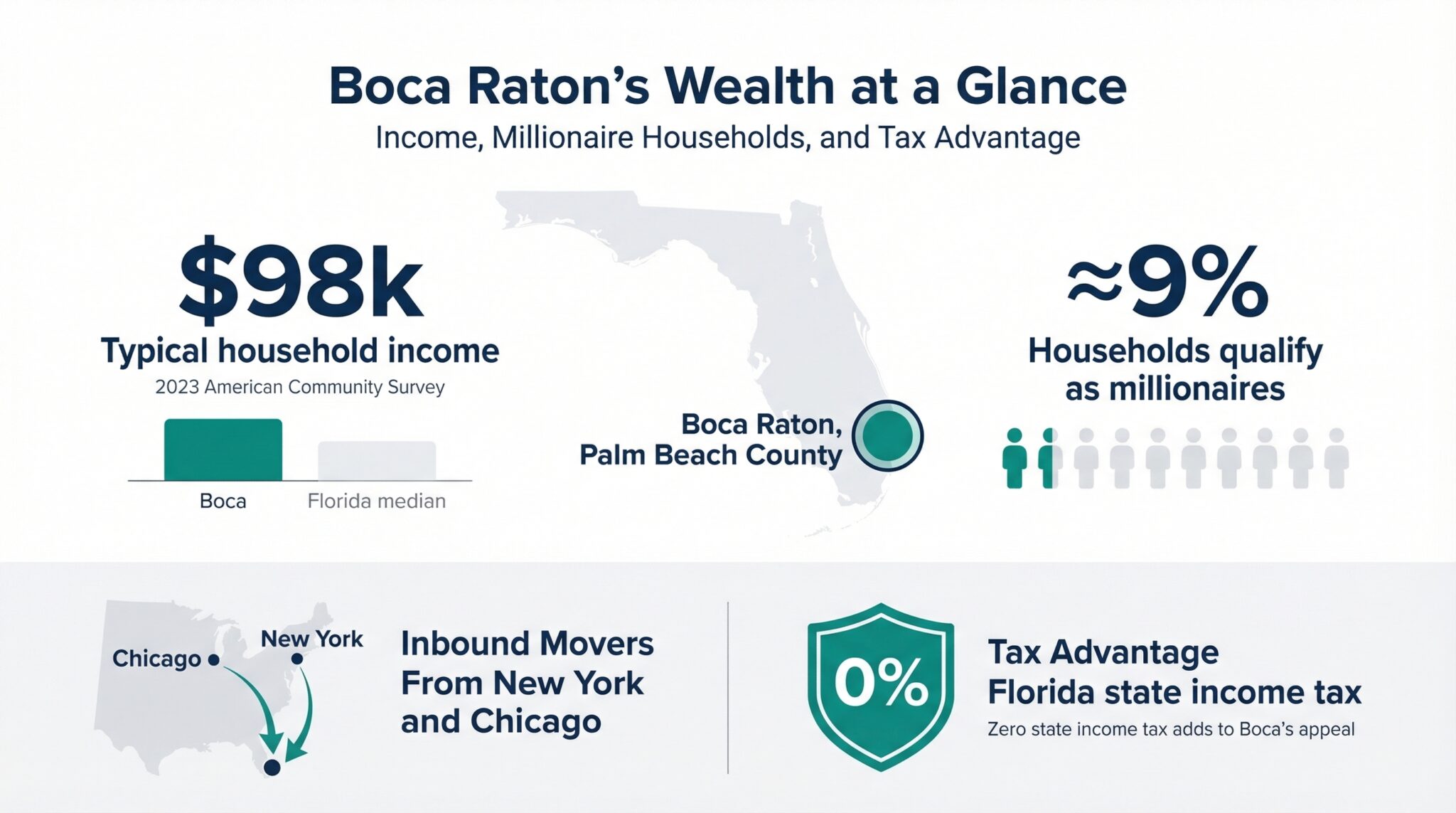
New arrivals from New York and Chicago keep pushing numbers higher. Florida’s zero state income tax adds appeal, and sunny winters seal the deal. Each migration wave brings rollover IRAs, business-sale windfalls, and estate questions that call for professional help.
That demand fuels a crowded advisory market. As of January 2026, a SmartAsset search lists more than a dozen SEC-registered RIAs inside Boca, plus local branches of Morgan Stanley and Merrill. Service approaches vary: some advisors also sell insurance, while others refuse commissions. Account minimums run from “come as you are” to “bring at least $2 million.”
We narrowed that field to four fiduciary firms that illustrate the spectrum. Each has a clean record, yet they differ in size, fee philosophy, and ideal client. Think of the list as a quick way to spot where you fit before you book a discovery call.
Signature Financial Solutions best for comprehensive planning
Signature Financial Solutions operates from an unassuming office park just off Palmetto Park Road. Founded in 1993, it has grown from a solo practice into a midsize advisory group that serves families across wealth tiers.
What sets SFS apart is range. The team pairs Certified Financial Planners with licensed insurance professionals, so you can tackle investments, retirement modeling, and risk protection in a single meeting. There is no hard account minimum. Whether you arrive with $50,000 or $5 million, the first question is the same: “What does financial freedom look like for you?”
Fees stay simple: most portfolios are billed at about 1 percent of assets under management each year, collected quarterly. If you only need a one-time plan, such as help evaluating a business sale or a pension buyout, the firm quotes a flat fee in advance. Advisors may earn insurance commissions, but every dollar is disclosed and the fiduciary duty still applies.
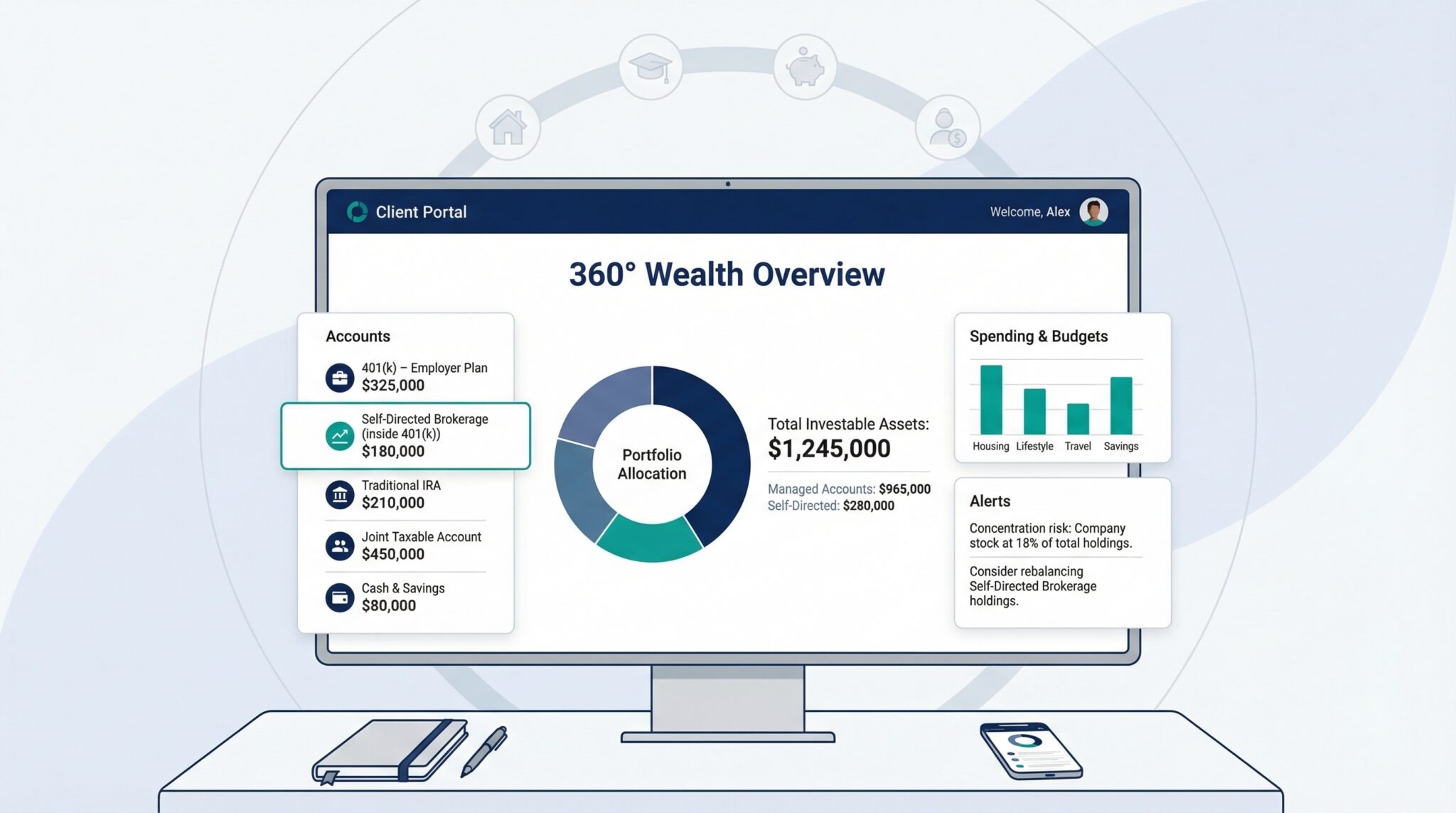
Service feels high-touch without formality. Clients log into a 360-degree portal that rolls investments, budgets, and even a self directed brokerage account tucked inside a workplace 401(k) into one view. Seeing those off-platform holdings alongside core portfolios helps SFS flag concentration risk and spot fresh rebalancing opportunities.
Quarterly check-ins keep goals on track, and evening webinars explain topics like Roth conversions or college funding with no sales pitch.
Choose SFS if you want a partner that can scale with your balance sheet. The firm is accessible to beginners yet deep enough to handle complex estates as your net worth grows. In a city full of “minimum $2 million” signs, that flexibility stands out.
Baron Silver Stevens best boutique for high-net-worth families
Walk into Baron Silver Stevens and you notice two things: mahogany conference tables and partners who greet clients by first name. The firm has advised Boca families since 2000 and now stewards more than $1 billion for about 140 relationships. The typical client brings roughly $5 million, so conversations shift quickly from “Which index fund?” to “How can we pass wealth to our grandchildren tax-efficiently?”
Opening an account requires $500,000, a bar that screens for households with complexity. In return, each family works with a dedicated CFP who coordinates investments, retirement income modeling, and legacy planning. An Accredited Estate Planner keeps trusts and portfolios aligned with outside attorneys.
Fees follow the familiar one-percent schedule and taper on larger balances. Advisors may place insurance or annuity contracts for a commission when suitable, but every dollar is disclosed and fiduciary duty still applies. Most clients bundle planning with portfolio management, so surprise retainers do not appear later.
Baron blends old-school service with modern tools. The Vision2020 platform pulls in real-time performance and risk metrics, then delivers reports even a non-finance spouse can read. Quarterly strategy meetings often include adult children, paving the way for smooth wealth transitions.
Choose Baron Silver Stevens if you want a small-firm handshake backed by deep resources. The team excels when your balance sheet holds business equity, charitable trusts, or multiple properties, and you prefer one seasoned group to keep the parts coordinated.
Noesis Capital Management pure fee-only fiduciary
If you want an advisor who earns nothing beyond the check you write, Noesis sets the Boca standard. Founded in 1995, the firm now manages about $700 million across roughly 100 relationships, according to its January 2026 Form ADV. Everyone on the investment committee holds a CFA or CFP, and the partners still build portfolios in-house rather than outsourcing to model marketplaces.
Noesis prefers clients with at least $1 million, though it may accept half that for determined savers. Pricing is transparent: the firm charges about 1 percent on the first million, then a lower percentage as balances rise. There are no commissions, referral fees, or performance incentives. Your annual fee covers asset allocation, retirement projections, and every planning meeting, so surprise invoices never appear.
The investment approach is global and research-driven. Portfolios favor quality growth companies in the United States, Europe, and emerging Asia, paired with laddered bonds for stability. When markets wobble, you hear directly from the managers who make day-to-day decisions, not a call-center script reader.
Planning depth matches the investment focus. Advisors often solve cross-border tax puzzles for dual citizens, coordinate with CPAs on Roth conversions, and run estate simulations that show how currency moves can affect generational gifts. Because each advisor serves fewer than 20 households, response times feel almost immediate.
Pick Noesis when you want conflict-free advice backed by rigorous research and you meet the asset bar. You will not encounter insurance sales or concierge bill pay; you will gain a fiduciary ally whose incentives align perfectly with your portfolio’s long-term health.
Fiduciary Family Office multi-family-office solution

Fiduciary Family Office is the newcomer, yet it already oversees nearly $700 million for just 45 households, according to its January 2026 Form ADV. The founders arrived with decades of private-bank training and one promise: every client receives the resources of a single-family office without the staffing burden.
Entry starts at $2 million, but the dollar bar tells only part of the story. FFO is built for families juggling LLCs, trusts, vacation homes, and a steady flow of wire instructions. The firm charges between 0.50 percent and 1.50 percent of assets, with a $20,000 yearly minimum. Most clients clear that floor, so the effective rate stays competitive once you consider everything the team handles: portfolio design, bill pay, cash-flow tracking, and even household-staff payroll.
Investment management follows a multi-manager approach. FFO builds public-market cores, then adds vetted private equity, real estate, or hedge fund sleeves. Quarterly reports fold every asset—even a family limited partnership in Wyoming—into one net-worth view.
Beyond money, FFO acts as your financial chief operating officer. Advisors schedule estate-attorney meetings, review insurance contracts, and host education sessions so heirs learn to steward wealth rather than squander it. Each advisor caps the roster at 15 families, preserving white-glove responsiveness.
Choose Fiduciary Family Office when your finances resemble a small enterprise. The fee sounds large in dollars, yet it saves ultra-wealthy families countless hours and costly errors by keeping every moving part under one roof.
How the four firms stack up
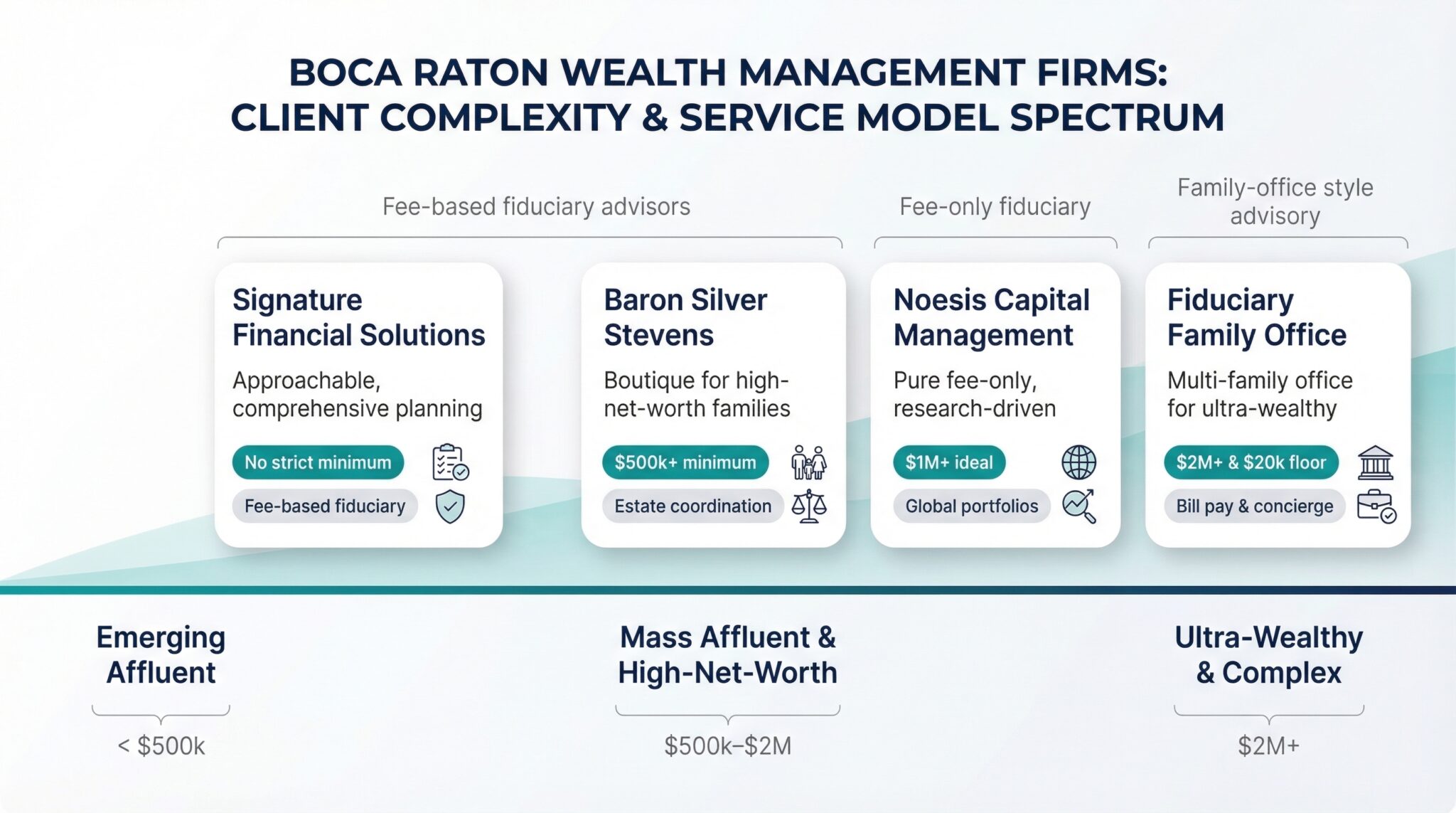
Below are two comparison grids to help you spot the firm that fits your balance sheet and service needs.
Fees and minimums
The first table lists entry thresholds and ongoing costs for each adviser, based on public Form ADVs and January 2026 website disclosures.
| Firm | Fee model | Typical asset-based fee | Account minimum | Notable quirks |
| Signature Financial Solutions | Fee based (fiduciary) | About 1 percent, tiered | None | Flat-fee planning available; advisors can place insurance |
| Baron Silver Stevens | Fee based (hybrid) | Roughly 1 percent, negotiable | $500,000 (SmartAsset) | Commissions possible on insurance or annuities |
| Noesis Capital Management | Fee only | ~1 percent on first $1 million, then lower | $1 million (may accept $500k) | Zero commissions; planning bundled |
| Fiduciary Family Office | Fee based (family office) | 0.50–1.50 percent | $2 million, $20k annual floor (TrueAdvisor) | Offers fixed retainer for complex families |
Services and standout features
The second table highlights each firm’s investment style, planning depth, and value adds.
| Firm | Investment style | Planning depth | Extra value |
| Signature Financial Solutions | Custom portfolios of ETFs, funds, individual securities | Full-spectrum planning plus in-house insurance review | 360-degree portal and education webinars |
| Baron Silver Stevens | Model portfolios via Vision2020 with tactical tilts | Comprehensive planning, estate coordination | Family-office-lite perks for top clients |
| Noesis Capital Management | In-house global stock and bond selection | Integrated planning with cross-border expertise | CFA-led research, small client roster |
| Fiduciary Family Office | Multi-manager, public and private markets | Deep planning plus bill pay and cash-flow control | Concierge help from payroll to heir education |
Conclusion
The result: Signature is the approachable generalist, Baron caters to established families, Noesis suits those who insist on conflict-free precision, and Fiduciary Family Office becomes the command center for ultra-wealthy households.
FAQs
What fees should I expect to pay for wealth management in Boca Raton?
Most investors pay about 1 percent of assets under management. A 2024 Kiplinger survey reports an average adviser fee of 1.02 percent on a $1 million portfolio, with the rate declining as balances rise. Product costs such as mutual-fund expense ratios and outside legal work sit on top, but a good adviser discloses each layer.
Outliers exist. Fiduciary Family Office sets a $20,000 floor, equal to 1 percent on the first $2 million, then slides lower. Signature Financial Solutions may charge a flat planning fee of a few hundred dollars for a one-time plan when assets are smaller.
Before you sign, request the firm’s Form ADV and a simple example: “If you manage $1 million for me for one year, what will I pay all in?” Make the adviser show the math.
How do I know an adviser is truly trustworthy?
Start with registrations. Look up the firm’s Form ADV on the SEC’s Investment Adviser Public Disclosure site and check Part 1 for disciplinary history. Zero disclosures is the goal.
Next, run individual advisers through FINRA BrokerCheck. Patterns of customer disputes or financial troubles are red flags. One isolated issue years ago is less concerning than repeated problems.
Credentials add another filter. Designations such as CFP, CFA, or CPWA come with ethics codes and ongoing education. Ignore unfamiliar strings of letters; many reflect a weekend seminar, not expertise.
Finally, trust your gut in the discovery meeting. A real fiduciary answers pointed questions about compensation, investment philosophy, and succession planning without evasive language.
Do I really need a wealth manager or can I handle it myself?
If your finances are simple—a W-2 job, a 401(k), and a Roth IRA—DIY investing with low-cost index funds can work. Automate contributions and rebalance periodically, and you may save thousands in fees.
Complexity changes the calculus. Stock options, a pending business sale, or cross-border tax rules can turn small mistakes into five-figure costs. Seasoned advisers earn their fee by spotting hidden land mines such as alternative minimum tax surprises or a trust clause that breaks Florida’s homestead protection.
Behavior matters too. Many investors vow to “stay the course,” then sell at the bottom when headlines shout market crash. An adviser acts as an emotional circuit breaker, keeping strategy on track when fear spikes.
Should I pick a national firm or stay local?
National brands such as Morgan Stanley or UBS offer one-stop shops for lending, cash management, and sometimes investment banking. If you value that menu and brand recognition, a big platform delivers.
Local independents win on relationship depth. Your adviser is often an owner rather than an employee rotating in from another branch. Decisions happen across the desk, not across the country, and fees can be leaner because there are no shareholder targets.
Choose the model that fits your priorities. National scale helps if you need a jumbo mortgage alongside portfolio advice. Local focus shines when you value face-to-face trust and tailored flexibility.