The H-1B visa is one of the most in-demand U.S. work visas for skilled foreign professionals who want to work legally in the United States. It allows U.S. employers to hire qualified international workers for specialty occupations that require technical expertise, higher education, or specialized skills. Common H-1B visa jobs include roles in IT, engineering, healthcare, finance, construction management, and scientific research.
With important updates in 2025–2026, including a weighted H-1B lottery system, higher filing fees, and stricter compliance rules, both applicants and employers must clearly understand how the H-1B process works. From eligibility requirements and salary thresholds to employer responsibilities and visa duration, each step plays a critical role in approval success.
This complete guide explains what the H-1B visa is, who qualifies, how the lottery system works, minimum salary requirements, and how the H-1B visa can lead to a U.S. Green Card. Whether you are a foreign professional planning to work in the U.S. or an employer sponsoring global talent, this article provides accurate, up-to-date insights based on official USCIS guidelines, helping you make informed decisions with confidence.
1. What Does an H-1B Visa Mean?
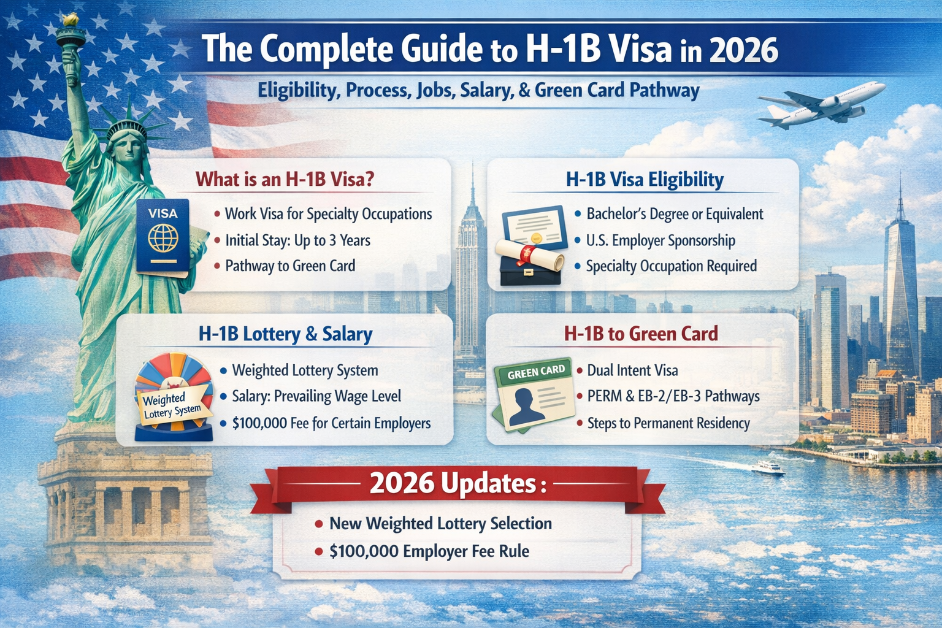
The H-1B visa is a nonimmigrant visa that allows U.S. companies to employ foreign workers in specialty occupations. These are roles that require theoretical and practical application of highly specialized knowledge, such as IT, engineering, medicine, finance, and research. It is valid for three years initially, extendable up to six years, and can be a pathway to permanent residency (Green Card).
The visa program is designed to complement the U.S. workforce, ensuring that foreign professionals fill positions that require skills not readily available in the domestic labor market. The recent DHS and USCIS updates emphasize hiring higher-skilled, higher-paid workers, using a weighted lottery system instead of the previous random lottery.
2. Who Is Eligible for an H-1B Visa?
Eligibility is divided between the employee and the employer:
Employee requirements:
- Must hold a bachelor’s degree or higher (or equivalent experience) in a field related to the specialty occupation.
- Work experience can sometimes substitute for formal education if it demonstrates specialized knowledge.
- Only roles that qualify as specialty occupations are eligible.
Employer requirements:
- Must be a U.S. company or organization capable of sponsoring a foreign worker.
- Must file a Labor Condition Application (LCA) with the Department of Labor to ensure compliance with wage requirements.
3. What Is the Disadvantage of an H-1B Visa?
While the H-1B visa opens doors for working in the U.S., there are notable challenges:
- Dependence on employer: You can only work for the sponsoring employer.
- Limited duration: Usually 3 years, extendable to 6; after this, you must secure a Green Card or leave the U.S.
- Lottery uncertainty: With high demand, approval is not guaranteed, though weighted selection favors higher-paid skilled workers now.
- Salary constraints: Employers must pay prevailing wage; underpayment can lead to rejection.
- Job flexibility restrictions: Any change in employment requires a transfer petition.
4. Who Has to Pay $100,000 for an H-1B Visa?
Recent updates require certain employers, especially in outsourced IT and low-wage sectors, to pay an additional $100,000 per H-1B visa as a condition for eligibility. This is meant to prevent abuse of the program by companies hiring low-cost foreign labor to replace American workers. Higher-paying employers with genuine high-skilled positions benefit from weighted selection.
5. What Jobs Qualify for an H-1B Visa?
Eligible positions are specialty occupations requiring specialized knowledge and at least a bachelor’s degree:
- Software engineers, IT analysts, data scientists
- Architects, civil engineers, mechanical engineers
- Physicians, pharmacists, medical researchers
- Financial analysts, accountants, economists
- University professors and researchers
Jobs must demonstrate that complex problem-solving and advanced education are essential. USCIS evaluates both job duties and qualifications.
6. Who Gets Most H-1B Visas?
Most H-1B visas are awarded to workers in:
- IT and software sectors
- Engineering and research fields
- Professionals from India, China, Canada, and the Philippines
- Advanced-degree holders from U.S. universities (20,000 cap)
7. Is an H-1B Visa Difficult?
Yes, obtaining an H-1B visa can be challenging due to strong competition and strict regulatory requirements. Each year, the U.S. government issues a limited number of visas (65,000 under the regular cap and an additional 20,000 for U.S. master’s degree holders), while applications far exceed this quota. As a result, most applicants must go through a lottery system.
The newer weighted lottery gives better chances to higher-skilled and higher-paid roles, while lower-wage positions face tougher competition. Additionally, employers must submit accurate documentation and meet compliance rules, making professional legal preparation essential. The process can be competitive:
- Limited visas (65,000 + 20,000 for master’s)
- High demand often requires careful documentation and legal compliance
- Weighted lottery increases chances for higher-skilled, higher-paid applicants, but lower-wage applicants face more competition
8. What Is the Salary of H-1B?
Salary requirements vary by role, location, and experience:
- Employers must pay the prevailing wage in that region
- Weighted lottery favors higher-paid positions
- Average H-1B salaries in tech roles range from $80,000 to $130,000 annually
9. Where Do Most H-1B Workers Come From?
The majority of H-1B visa holders come from countries with strong education systems in science, technology, engineering, and mathematics (STEM).
India is by far the largest source of H-1B workers, accounting for approximately 70% of all approved H-1B visas. This is mainly due to India’s strong talent pool in information technology, software development, engineering, and STEM-related professions.
China is the second-largest contributor, supplying professionals in advanced engineering, research, and scientific roles. Other notable source countries include the Philippines, particularly in healthcare and IT services, and Canada, known for skilled professionals in engineering and technology sectors.
Pakistan is an emerging contributor to the H-1B program, with increasing numbers of professionals in IT, software engineering, finance, and technical fields. In addition, many applicants currently working in the Gulf region including Saudi Arabia, the UAE, Qatar, Oman, and Bahrain apply for H-1B visas through U.S. employers, bringing valuable international project experience.
Overall, the H-1B visa attracts skilled professionals from countries with strong education systems and global workforce exposure.
10. Does an H-1B Visa Lead to a Green Card?
Yes, the H-1B visa is a dual-intent visa, which means holders are allowed to work in the United States while simultaneously pursuing permanent residency (a Green Card). Many H-1B professionals transition to a Green Card through employment-based categories, most commonly EB-2 (for advanced degree holders or exceptional ability) and EB-3 (for skilled workers and professionals).
In most cases, the process requires a PERM labor certification, where the employer proves that no qualified U.S. worker is available for the role. The full process is governed by official USCIS employment-based immigration rules.
- EB-2 and EB-3 categories are common
- PERM labor certification is often required
11. Is H-1B Truly a Lottery?
Previously, the H-1B visa selection process was based on a random lottery, giving all eligible registrations an equal chance regardless of job level or salary. However, starting from FY 2027, USCIS introduced a weighted lottery system that prioritizes higher-skilled and higher-paid positions.
While the process is no longer purely random, it still allows opportunities for lower-paid roles, though with increased competition. The updated system aims to reduce misuse of the program and better align H-1B approvals with U.S. labor market needs, as outlined by official USCIS guidelines.
- Previously: Random lottery
- From FY 2027: Weighted lottery prioritizing higher-skilled, higher-paid workers
- Still allows opportunities for lower-paid positions but reduces abuse
12. How Many Years on H-1B Before Green Card?
You can start the Green Card process immediately after your H-1B approval, making it possible to secure permanent residency while on a temporary work visa. EB-2 and EB-3 Green Card processing times vary significantly depending on your country of origin, ranging from 1 to 6 years. Importantly, your H-1B visa can be extended beyond the standard six-year limit if your Green Card petition is pending, allowing you to legally continue working in the U.S. while waiting for permanent residency approval. Planning ahead ensures a smooth transition from H-1B to Green Card.
- Can start Green Card process immediately after H-1B approval
- EB-2 and EB-3 processing times vary: 1–6 years depending on country of origin
- H-1B visa can be extended beyond 6 years if Green Card petition is pending
13. What Happens After 6 Years of H-1B?
After completing six years on an H-1B visa, you must take action to maintain legal status in the U.S. Options include leaving the country, transferring to a different visa category, or extending your H-1B if your Green Card petition is in process. Without proper action, you risk violating U.S. immigration law, which can impact future visa eligibility.
Those pursuing permanent residency often extend their H-1B beyond six years while their employment-based Green Card application is pending, ensuring continuous employment authorization.
- Must either:
- Leave the U.S.
- Transfer to another visa type
- Extend H-1B if Green Card petition is pending
14. How Long Can I Stay in the U.S. With an H-1B Visa?
The H-1B visa is initially granted for three years and can be extended up to six years in total. If your employment ends, you have a 60-day grace period to find a new job or change your visa status without leaving the U.S. Extensions beyond six years are possible if you have a pending Green Card petition.
Properly managing your H-1B status allows you to maintain legal residency and work authorization while planning your path to permanent residency in the United States.
- Initial duration: 3 years
- Extension: Up to 6 years
- Grace period after job loss: 60 days
15. Can I Skip H-1B and Get a Green Card?
Yes, it is possible to bypass the H-1B visa entirely and directly apply for a U.S. Green Card. Employment-based options include EB-1, EB-2, and EB-3 categories, depending on your qualifications and job requirements. Family-based sponsorship and investment-based visas, such as the EB-5 program, are additional pathways to permanent residency. This approach can save time and avoid H-1B limitations, allowing qualified professionals and investors to secure legal permanent residence in the U.S. without first holding a temporary work visa.
Yes, via:
- EB-1, EB-2, EB-3 categories
15.1 EB-1 (Employment-Based First Preference)The EB-1 category is for individuals with extraordinary abilities, outstanding achievements, or leadership roles in their field. This includes:
- EB-1A: Individuals with extraordinary ability in sciences, arts, education, business, or athletics (no job offer required).
- EB-1B: Outstanding professors and researchers with international recognition.
- EB-1C: Multinational executives or managers transferred to the U.S.
EB-1 typically has the shortest processing time among employment-based Green Cards, making it ideal for highly qualified professionals.
15.2 EB-2 (Employment-Based Second Preference)EB-2 is for professionals with advanced degrees or individuals with exceptional ability in sciences, arts, or business.
- Requires a U.S. job offer and labor certification in most cases.
- National Interest Waiver (NIW) allows applicants to bypass the job offer if their work benefits the U.S. significantly.
EB-2 is suitable for highly skilled professionals and usually has moderate processing times, though it can be longer for countries with high demand like India and China.
15.3 EB-3 (Employment-Based Third Preference)EB-3 is for skilled workers, professionals, and other workers:
- Skilled workers: Minimum 2 years of training or experience.
- Professionals: Bachelor’s degree holders.
- Other workers: Unskilled labor requiring less than 2 years of experience.
EB-3 generally has longer waiting times, especially for applicants from India, China, or the Philippines. It is the most common pathway for entry-level or mid-level professionals.
Summary:
- EB-1: Extraordinary ability, professors/researchers, or multinational managers – fastest route.
- EB-2: Advanced degrees or exceptional ability – moderate wait, NIW possible.
- EB-3: Skilled, professional, or unskilled workers – longer wait times.
- Family-based sponsorship
- Investment-based visas (EB-5)
16. How Many Times Can You Get an H-1B Visa?
The H-1B visa is initially valid for three years and can be extended to a total of six years. After completing the maximum period, applicants can reapply for a new H-1B visa after spending at least one year outside the United States.
There are no limits on how many times you can hold H-1B status, as long as each application meets U.S. immigration requirements. Strategic planning can ensure continuity of work authorization and compliance with U.S. visa regulations.
- Initial 3 years, extendable to 6
- Can reapply after spending 1 year outside the U.S.
17. What Happens If You Lose Your Job on H-1B?
If you lose your job while on an H-1B visa, you have a 60-day grace period to either secure a new employer willing to sponsor your H-1B or change to a different visa status. Failure to act within this period results in a visa violation, which can affect your ability to return to the U.S. in the future.
Timely action is critical to maintain legal status, and many workers use this grace period to explore new employment or transition to permanent residency options.
- 60-day grace period to find a new employer or change visa status
- Failure to act results in visa violation and potential future ineligibility
Conclusion
The H-1B visa is a highly competitive, skill-focused program that opens the door to working in the U.S. While it comes with challenges such as cap limits, lottery uncertainty, and employer dependency, it also provides a pathway to permanent residency.
Recent 2025–2026 updates, including the weighted lottery and $100,000 fee, ensure that the program prioritizes highly skilled and well-compensated workers while protecting American jobs. For applicants, understanding eligibility, job requirements, salary, and legal obligations is critical to success.