The Art of Protecting High Value Assets in a Volatile Market
When Every Asset Counts: The Case for High Value Asset Management
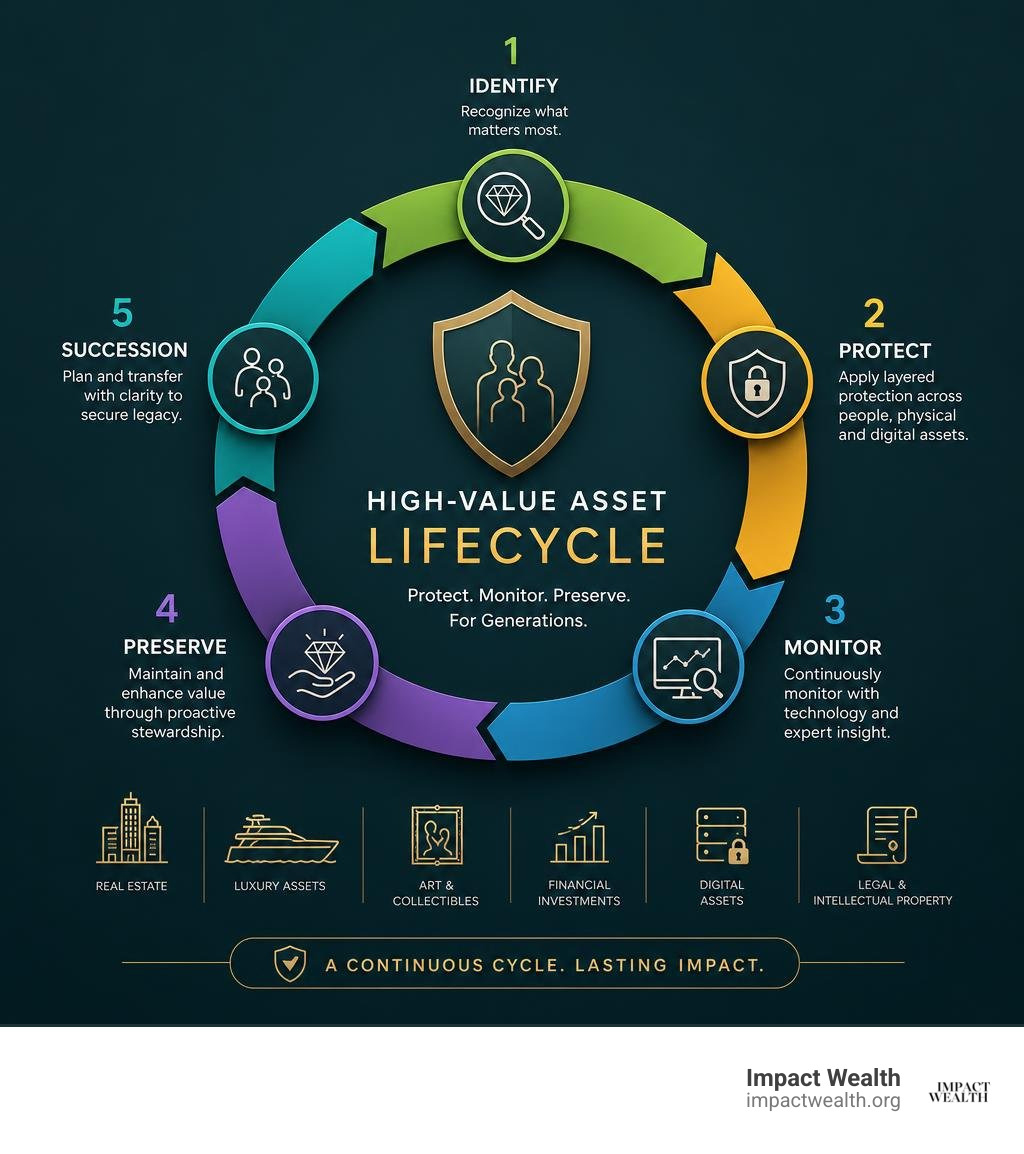
High value asset management is the disciplined practice of identifying, protecting, monitoring, and strategically preserving the assets that matter most — whether that means a critical data system, a superyacht, or a family’s art collection spanning generations.
If you’re looking for a quick overview, here’s what it covers:
- Identify your most critical assets — both physical and digital
- Classify them by the impact their loss would cause
- Protect them with layered security, insurance, and legal structures
- Monitor them continuously using technology and specialist advisers
- Preserve their value through proactive maintenance and succession planning
For ultra-high-net-worth families and family offices, the stakes are uniquely high. Assets are rarely simple. A single portfolio might include private equity holdings, a fleet of classic cars, offshore real estate, and sensitive financial data — each carrying its own category of risk.
The cost of getting this wrong is not abstract. A single ransomware attack on a mid-sized city government cost Baltimore at least $18.2 million. Unplanned asset downtime across industries runs to a median of $125,000 per hour. And those are organizations with dedicated IT departments.
For private wealth structures, the exposure can be even more concentrated — and the recovery far harder.
The challenge is that most people think about asset protection only after something goes wrong. By then, the options narrow dramatically.
This guide walks through how to build a proactive, comprehensive approach before a crisis forces your hand.
The Core Pillars of High-Value Asset Protection
Managing high-value assets requires moving beyond passive custody. In July 2026, navigating global markets means recognizing that risks are interconnected. A security vulnerability in a family office’s communication network can compromise physical security at a private estate in Palm Beach or Bal Harbour. Conversely, poor physical key management can lead to a breach of cold-storage cryptocurrency wallets.
True protection relies on rigorous asset classification. We must categorize assets not just by their acquisition price, but by their replacement difficulty, operational criticality, and potential liability. This classification forms the foundation of The Power of Proactive Planning, shifting our focus from reactive insurance claims to active risk mitigation.
A well-structured program balances three operational vectors:
- Risk Exposure Reduction: Limiting the attack surface of digital databases and the physical vulnerability of tangible collections.
- Portfolio Diversification: Spreading physical holdings across secure jurisdictions like the United States, Europe, and the Middle East to minimize localized regulatory and geopolitical shockwaves.
- Governance Frameworks: Establishing clear operational rules for who can access, move, or modify an asset.
Defining High-Value Assets (HVAs) in 2026
Historically, a high-value asset was defined strictly in financial terms—an estate, a business, or a portfolio of liquid equities. Today, the definition has evolved. Federal authorities, including the Cybersecurity and Infrastructure Security Agency (CISA) and the National Institute of Standards and Technology (NIST), define a High-Value Asset (HVA) as any information system, information resource, or critical program so vital that its loss, corruption, or unauthorized access would cause catastrophic operational, financial, or reputational damage.
For family offices and private enterprises, this means we must treat proprietary investment algorithms, private transaction ledgers, and sensitive family communications with the same institutional reverence that CISA reserves for Tier 1 federal systems. In the luxury space, an HVA also includes “passion assets”—museum-grade fine art, vintage sports cars, superyachts, and bespoke jewelry—where value is driven by rarity, provenance, and historical significance.
Physical vs. Digital High Value Asset Management
While both physical and digital asset management aim to preserve capital and operational continuity, their execution couldn’t be more different:
| Attribute | Physical Asset Management | Digital Asset Management |
|---|---|---|
| Primary Threat | Environmental decay, theft, physical damage, wear | Ransomware, data exfiltration, identity theft, unauthorized access |
| Tracking Mechanism | GPS transponders, IoT environmental sensors, physical audits | Automated inventory discovery, Zero Trust network access (ZTNA) |
| Maintenance | Climate control, mechanical servicing, physical restoration | Continuous patching, software license optimization, penetration testing |
| Key Metric | Depreciation rate, physical preservation state, provenance | Data integrity, system uptime, access control compliance |
In the digital realm, the threat of ransomware is particularly acute. Ransomware operators specifically target backup systems and critical databases to maximize their leverage. When a system is compromised, the damage extends beyond immediate recovery costs to permanent loss of public confidence and systemic operational failure. To understand this lifecycle in detail, consult our Complete Guide to High-Value Asset Management, which bridges the gap between physical custody and digital security.
The Strategic Lifecycle: Identifying, Prioritizing, and Assessing Risks
Many organizations and family offices only discover where their true high-value assets lie after a security incident. A seemingly mundane system—such as an automated HVAC controller or a legacy scheduling database—can cascade into a major vulnerability if it is linked to secure networks.
To prevent this, we must identify our Mission Essential Functions (MEFs)—the absolute core activities that keep our operations running. For a family office, this might be executing daily trades, maintaining private communication channels, or protecting the physical security of a residence.
Once these functions are defined, we map every supporting physical and digital asset directly to them. This process was heavily shaped by lessons from the public sector, notably the massive 2015 U.S. Office of Personnel Management (OPM) data breach, which exposed millions of sensitive background check records and catalyzed the creation of the Federal HVA Program.
By applying a structured 90-day framework, even small-to-mid-sized organizations can successfully catalog their assets, run gap analyses against established frameworks, and implement remediation plans. This structured approach is why we emphasize that Why Strong Governance Is the Foundation of Business Success is not just a corporate slogan, but a practical shield against systemic risk.
Federal HVA Frameworks for Private Organizations
Private entities can learn a great deal from federal cybersecurity practices. CISA’s High Value Asset Program Management Office categorizes systems into Tier 1 (critical national impact) and Non-Tier 1 (significant agency impact). These designations require independent, third-party assessments at least once every three years.
For private family offices and high-net-worth enterprises, adopting a similar tiered approach is highly effective:
- Tier 1 (Critical): Core financial transaction databases, private encryption keys, estate security systems, and proprietary investment algorithms. These require continuous monitoring and annual penetration testing.
- Tier 2 (Significant): Private yacht and aviation schedules, corporate contract repositories, and historical tax archives. These require quarterly audits and strict role-based access control.
- Tier 3 (Standard): General operational files, public-facing website infrastructure, and non-sensitive vendor agreements.
Additionally, implementing Validated Architecture Design Reviews (VADR) for any systems utilizing smart automation or operational technology (OT) ensures that physical security systems—such as biometric vaults or smart-home networks—cannot be digitally bypassed.
Overcoming Implementation Challenges and Shadow IT
The primary obstacle to effective asset management is human error and the rise of “Shadow IT”—unauthorized software or hardware used by family members or employees without the knowledge of the security team. Without real-time visibility, enterprise teams drive an average of 10% to 20% excess hardware spend and leave up to 30% to 50% of software licenses completely unused.
Worse, these unmonitored systems create massive security vulnerabilities. When assets are tracked manually on disjointed spreadsheets, version control breaks down, and critical maintenance events or software patches are missed. Transitioning to a centralized, cloud-based registry with automated discovery tools is the only way to eliminate these blind spots.
Safeguarding Physical Treasures: Best Practices for Passion Assets

Physical high-value assets—often referred to as passion assets—require highly specialized care that balances aesthetic enjoyment with meticulous wealth preservation. Whether managing a rare collection of post-war European sports cars in Los Angeles, a superyacht moored in Miami, or museum-caliber artwork in London, passion assets are dynamic investments that demand active stewardship.
As we outline in our guide on how to Maximize Returns with Passion Assets, neglecting the physical preservation of these items can lead to rapid, irreversible depreciation.
Tailored Preservation and Authentication Strategies
Every asset class requires a tailored preservation strategy that addresses its unique vulnerabilities:
- Fine Art: Canvas and organic pigments are highly sensitive to environmental fluctuations. Art must be kept in climate-controlled environments with minimal light exposure, ideally maintained at 50% relative humidity and 70°F (21°C). Real-time IoT sensors should be used to provide instant alerts if these parameters drift.
- Classic Cars: Vintage automobiles require specialized mechanical servicing, custom protective covers, and routine fluid analysis. Storing them in humidity-regulated environments prevents rust, while GPS trackers monitor their physical locations during transit.
- Superyachts and Aviation: Luxury marine vessels require specialized protective coatings to prevent saltwater corrosion, along with strict adherence to international maritime safety standards. Private aircraft demand rigorous maintenance, repair, and overhaul (MRO) scheduling to remain flight-ready.
For comprehensive management of these complex physical assets, we often coordinate with specialized providers like Rhone High Value Asset Services, who oversee the entire asset lifecycle from design and commissioning to multi-generational succession.
Navigating Legal, Tax, and Insurance Complexities
Owning high-value assets across multiple jurisdictions—such as the United States, Europe, China, and the Middle East—introduces complex legal and tax considerations. For example, moving a high-value art collection from London to Miami can trigger significant customs duties and import taxes if not structured correctly.
Similarly, real estate deadlocks or changes in local tax laws can heavily impact the net value of luxury properties, a topic we explore in our analysis of Economic Cycles and Their Impact on Ultra High-End Properties.
To protect these assets from legal disputes and excessive taxation, we rely on robust legal structures, including family trusts, family limited partnerships (FLPs), and private offshore holding companies. These vehicles ensure that ownership is clearly defined, facilitating seamless generational wealth transfer and protecting the assets from personal liabilities.
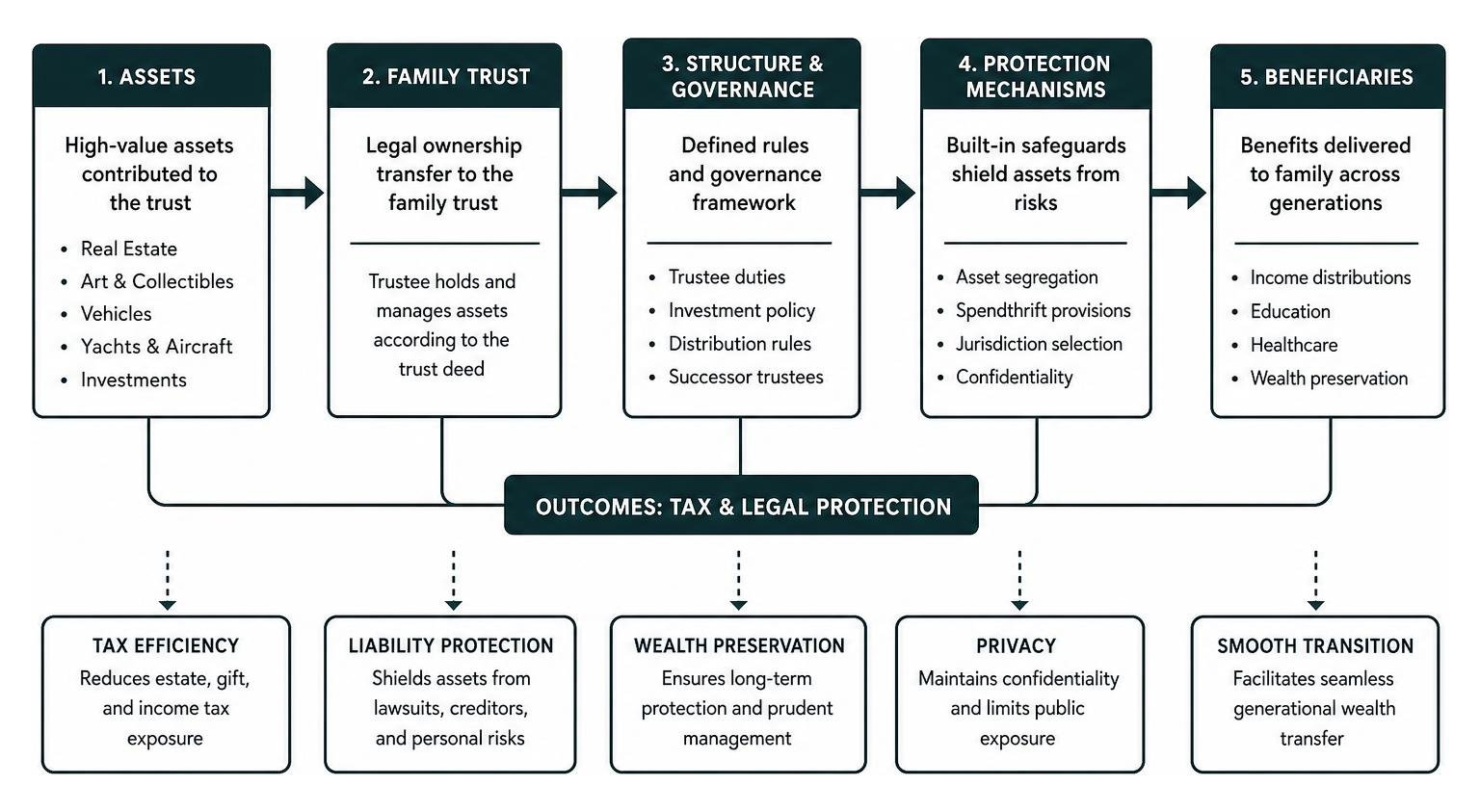
Furthermore, securing specialized “agreed value” insurance policies—rather than standard market value coverage—is essential. An agreed value policy guarantees that in the event of a total loss, the insurer will pay the pre-determined, appraised value of the asset, protecting the owner from market depreciation.
Leveraging Technology and AI in High Value Asset Management
In 2026, the manual tracking of high-value assets is obsolete. Modern family offices and wealth managers utilize advanced enterprise asset management (EAM) software to automate tracking and preservation. Platforms like Enterprise Asset Management Software leverage artificial intelligence to analyze usage patterns and environmental data, transforming asset management from a reactive chore into a predictive strategy.
Autonomous AI and IoT in High Value Asset Management
By deploying autonomous AI agents alongside Internet of Things (IoT) sensors, we can monitor physical assets in real-time. For instance, an AI agent using platforms like Kivo.ai – AI Agent for Smart Asset Management can automatically analyze real-time data from a yacht’s engine sensors, predict mechanical failures before they occur, and schedule maintenance with local technicians in Monaco or Miami.
Similarly, AI-driven metadata extraction can instantly catalog new acquisitions by scanning invoices, certificates of authenticity, and historical provenance documents, reducing manual data entry by up to 60%.
For corporate holdings, utilizing tools like Strev helps eliminate “ghost assets” and optimizes software license spend, ensuring that capital is not wasted on underutilized digital resources.
Additionally, using solutions like SDLC Asset Management allows finance teams to automate complex depreciation schedules (such as straight-line or declining-balance), keeping asset book values perfectly aligned with real-world valuations.
Real-Time Monitoring and Predictive Maintenance
Real-time monitoring is our most effective tool against unplanned downtime and physical theft. By utilizing GPS transponders and localized telemetry, we maintain constant visibility over mobile assets, such as private jets, vintage cars, and valuable shipping containers.
If a vintage sports car is moved without authorization, or if the temperature in an art vault rises by even two degrees, automated systems send instant alerts to security teams, allowing for immediate intervention. This continuous, proactive oversight is the modern standard for preserving both physical and digital wealth.
For localized property management, collaborating with regional experts—such as Luxury Property Care in Bal Harbour or First Service Residential in Hallandale Beach—ensures that physical estates are monitored by boots-on-the-ground professionals who understand the regional climate and security challenges.
Frequently Asked Questions about High-Value Assets
What is the difference between physical and digital high-value assets?
Physical high-value assets are tangible, scarce items—such as fine art, classic cars, superyachts, and real estate—whose value is driven by physical condition, rarity, and market demand. Their primary threats are physical theft, environmental decay, and natural disasters.
Digital high-value assets are intangible, information-based resources—such as proprietary databases, private financial records, intellectual property, and encryption keys—whose value lies in their confidentiality, integrity, and availability. Their primary threats are cyberattacks, ransomware, and unauthorized data access.
How does the 90-day framework simplify asset prioritization?
The 90-day framework breaks down a complex asset management project into manageable phases:
- Days 1–30 (Planning & Mapping): Identify and define your Mission Essential Functions (MEFs) and map every supporting physical and digital asset.
- Days 31–60 (Assessment): Run self-assessments against established security frameworks (such as NIST or CISA) to identify vulnerabilities and compliance gaps.
- Days 61–90 (Remediation): Develop and execute a Remediation Action Plan, prioritizing high-impact vulnerabilities and setting up automated monitoring systems.
This structured timeline prevents teams from becoming overwhelmed and ensures that resources are directed toward protecting the most critical 10% of assets that keep the doors open.
Why is real-time monitoring essential for luxury passion assets?
Luxury passion assets are highly sensitive to their environments. A sudden spike in humidity can ruin a multi-million-dollar canvas, while minor water intrusion can cause catastrophic electrical failures on a superyacht. Real-time monitoring uses IoT sensors to track temperature, humidity, location, and physical vibration. If any of these metrics cross a safe threshold, the system sends an instant alert, enabling proactive maintenance before costly, permanent damage occurs.
Conclusion
In an era defined by rapid technological shifts and global market volatility, protecting what matters most requires a sophisticated, forward-thinking approach. High-value asset management is no longer just about buying insurance and locking physical vaults; it is about building a continuous, integrated system of physical custody, digital security, and robust legal governance.
By partnering with elite advisory networks—such as the wealth strategists at Wisehaupt, Bray in Palm Beach, the private bankers at J.P. Morgan Wealth Management in Miami, or the industrial real estate experts at Cohen Asset—ultra-high-net-worth families can ensure their portfolios are structured to withstand both economic cycles and unexpected disruptions.
True wealth stewardship is about protecting your achievements today while building a resilient foundation for the next generation. Explore our curated insights and connect with leading family office specialists at the Impact Wealth Family Office Hub to elevate your asset protection strategy.