Updated August 2026
Rediscovering Roger Brown: Chicago’s Overlooked Visionary
Twenty years ago, I was the first in house curator for the Microsoft Corporation, tasked with curating and professionalizing their art collection. Previously, a volunteer group of employees with little art expertise had managed the 4,500 works based solely on personal preference.
My mission there was to identify undervalued artists who were not yet in the spotlight, but whose body of work had already earned them a strong reputation. The acquisitions were also international in scope. My list included Daniel Buren, Joan Mitchell, Julian Opie, Peter Schuyff, and Robert Bechtle. One of my early acquisitions, a Roger Brown piece bought for $5,000 at a Sotheby’s auction in Los Angeles, exemplified the investment potential of these choices, as its value now reaches $300,000.
A native of Alabama, Roger Brown was educated at the School of the Art Institute of Chicago. His move to Chicago led him to become one of the New Imagists, a kind of offshoot of Pop art and Chicago style, very personal, emotional, and politically aware, at a time when the social and economic structure of this country was being assaulted, examined, and debated. Riots and demonstrations were the order of the day, and they made their way onto the canvases of Roger Brown and his peers, including artists such as Jim Nutt, Ed Paschke, Gladys Nilsson, Christina Ramberg, and Karl Wirsum.
Brown’s painting style is a unique amalgam of modernity set side by side with folk art. His subject matter can be rural, clouds, fields, weather patterns, or urban, pedestrians and apartments, figuratively documenting the days and nights of the people of this rather young republic. I was immediately drawn to his work because of the simplicity and elegance of his astute social commentary. Like with a good stand up comic, you get the joke quickly, and it lasts.
A Dealer Who Championed the Overlooked
In Chicago and in New York, Brown was promoted by dealer Phyllis Kind, a brilliant blonde from the Bronx who represented his work alongside that of Outsider artists. She was described in The New York Times as a combative, visionary art dealer who championed a group of young artists first called the Hairy Who, and later known as the Chicago Imagists, as well as major Outsider artists in her own right. As the Imagists rejected the ideas behind minimalism and conceptualism of the 1960s, they turned instead to a figurative style, creating art that was sometimes violent and often satirical, as described on the Smithsonian’s website. Kind helped expand the broader narrative of twentieth century art, adding Alison Saar, Robert Colescott, William N. Copley, Gillian Jagger, and Mark Greenwold to the roster of her ground floor Greene Street gallery, which opened in the 1980s and closed in 2009.
In 1984, two decades into his career, Brown worked with Styria Press to publish a facsimile edition of his own sketchbook, fifty works in total, revealing not only the various themes he explored but also his evolving technique for building a picture. Rendered entirely in black and white, the sketchbook still manages to explore texture, density, and environment. To establish location or theme, he often used repetition to set the stage, or suggested shifts in scale, whether addressing a landscape, a cityscape, or a single figure. Within its pages, one finds the full extremes of his vision and the many variants of his imagination, from a rocket ship titled Cathedral to the figure of a man casting a spell on a tree.
A Case for Overdue Recognition
If the Whitney Museum’s 2022 exhibition, Edward Hopper’s New York, told us about the skyline and life within the city, people in a Chinese restaurant, a diner, the interior of a theater, and eventually the New England coast, it is certainly time for a Brown exhibition that brings into focus the architecture of Chicago and its surrounding countryside: rural farm fields, tract homes in the suburbs, and the great weather patterns that crisscross the Midwest.
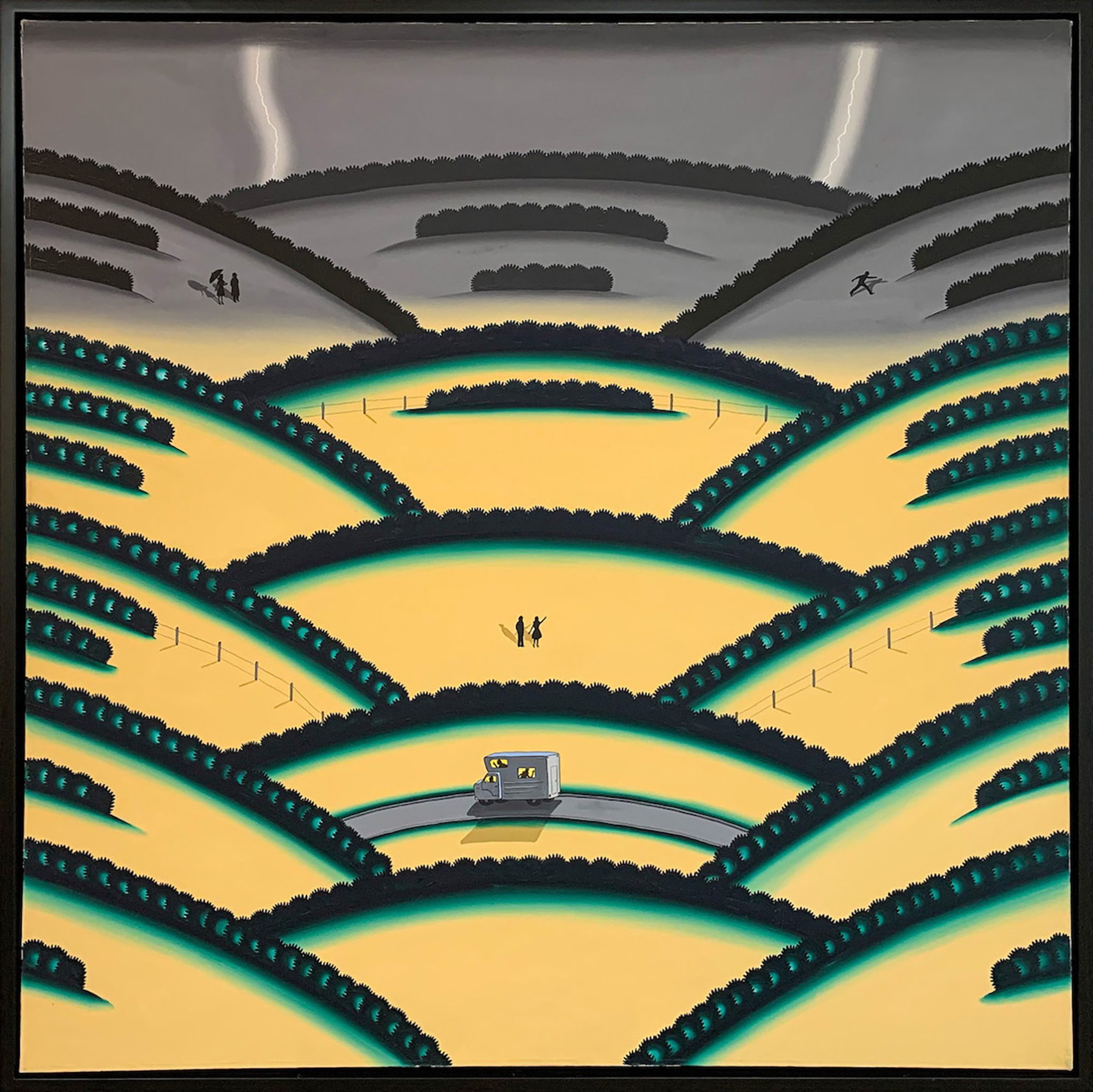
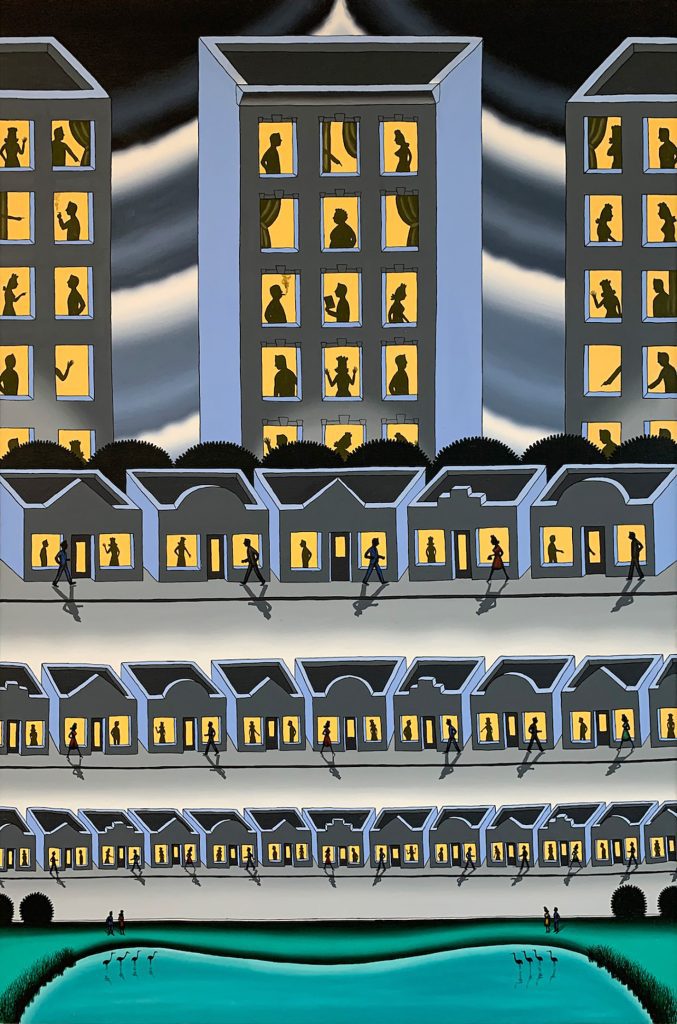
Both artists represent America, but where Hopper worked in a naturalist style drawn from the Ashcan School, Brown was an innovator, improvising color and form more in the spirit of Stuart Davis. Two prime examples of Brown’s work are pictures presented by the Aaron Galleries: Renaissance in Reverse from the 1980s and Looks Like Rain from the 1970s.
The first is a multi layered urban scene in which figures in silhouette populate buildings, inhabiting a kind of play staged within the most modern of structures, the skyscraper. Contemporaries of Brown, including the late Wayne Thiebaud and Robert Moskowitz, addressed similar themes, Thiebaud focused on San Francisco, Moskowitz on Manhattan, with all three men seemingly captivated by the architecture surrounding them. What a remarkable exhibition that combination might make: Brown, Moskowitz, and Thiebaud together.
In the second painting, distant lightning appears in the sky as a train approaches. The foreground unfolds as a map of yellow fields, symmetrical and repetitive, with two protagonists at the center awaiting the coming storm. What is most remarkable about Brown as a painter is that, while his subject matter is thoroughly modern, his style looks back to the pre-Renaissance, to paintings in which the world is rendered as flattened space in deeply rich color, much like the work of the Sienese school in fourteenth century Italy. He borrows from that somewhat naive style and reinvents it in contemporary terms. Ironically, Brown’s works echo the contemplative quality of those early religious pictures, portraying humanity humbled by nature and by its own scheming. Perhaps the most attractive aspect of his work is its strong humanism, tempered by remarkable technical skill.
A Roger Brown retrospective feels long overdue, and perhaps the ideal setting would be the Metropolitan Museum of Art in New York. Having already presented Alice Neel and her world of friends, relatives, and associates, it seems fitting that the museum’s next survey might focus on a place and its surroundings, and what better place than Chicago, introduced through the pictures of Roger Brown?